
Let’s Ask Arty uses existing Artificial Intelligence (AI) technology to query LLMs about politics in these troubled times.
Query 1: What is gerrymandering?
Gerrymandering is the practice of manipulating the boundaries of electoral districts to favor a particular political party, group, or incumbent. It’s a way of shaping the political landscape—literally—by drawing district lines in a way that influences election outcomes.
Query 2: How does gerrymandering work?
There are two main tactics used in gerrymandering:
- Cracking: Splitting up a group of voters (usually of the opposing party) across multiple districts so they don’t form a majority in any of them.
- Packing: Concentrating a group of voters into one district to reduce their influence in other districts.
Query 3: Why is gerrymandering (which seems like cheating) allowed?
Great question—and you’re absolutely right to call it out as feeling like “cheating.”
So why is gerrymandering allowed?
Constitutional Loophole
- The U.S. Constitution requires redistricting every 10 years after the census to reflect population changes, but it doesn’t specify how districts must be drawn.
- That power is left to the states, and in most cases, state legislatures control the process—which means the party in power can draw maps to its advantage
Supreme Court Decisions
- In Rucho v. Common Cause (2019), the Supreme Court ruled that partisan gerrymandering is a “political question” and not something federal courts can regulate. This gave states a green light to continue the practice without federal oversight.
- Earlier rulings had chipped away at protections in the Voting Rights Act, making it harder to challenge racial gerrymandering as well.
Query 4: Why does gerrymandering persist even though the public views it as an unfair practice?
Gerrymandering persists due to:
- Entrenched Interests: Politicians benefit from drawing safe districts, so there’s little incentive to change the system.
- Lack of Transparency: Redistricting often happens behind closed doors, with minimal public input.
- Single-Party Control: When one party controls both the legislature and the governor’s office, they can gerrymander with few checks.
Query 5: Have there been efforts to reform gerrymandering at the state and federal level?
Some states have adopted independent redistricting commissions to reduce bias, but these reforms are uneven across the country. Congress has tried to pass national legislation to ban gerrymandering, but those efforts have stalled due to partisan gridlock.
Query 6: Which political party gerrymanders more aggressively?
Although both major political parties in the U.S. have used gerrymandering to gain electoral advantage, recent data suggests that Republicans have been more aggressive and systematic in their use of the tactic, especially in key battleground states.
Query 7: Is it true that when put to a congressional vote to end gerrymandering, the vast majority of Democrats voted Yes, and all Republicans voted No?
Yes, in recent congressional efforts to ban gerrymandering—particularly through the Freedom to Vote Act and the earlier For the People Act—Democrats overwhelmingly voted in favor, while Republicans uniformly opposed the measures.
This stark divide reflects broader tensions over voting rights, election integrity, and partisan control of the redistricting process.
Query 8: In 2025, Did President Trump request that Governor Abbot of Texas to gerrymander districts in Texas?
Yes, according to multiple reports, former President Donald Trump has actively encouraged Texas Governor Greg Abbott and Republican lawmakers to redraw congressional districts in Texas to favor the Republican Party.
What Trump Requested
- Trump reportedly asked Abbott to call a special legislative session to redraw Texas’s congressional map in a way that could flip up to five seats from Democrats to Republicans.
- In a CNBC interview on August 5, 2025, Trump stated, “We are entitled to five more seats” in Texas, signaling his belief that redistricting should be used to secure partisan advantage.
Query 8a: What has been the political fallout of President Trump’s request to redraw districting maps in Texas?
Political fallout from Trump’s request includes the following:
- Governor Abbott added redistricting to the special session agenda, citing a controversial memo from the U.S. Department of Justice that questioned the legality of certain districts based on racial composition.
- Democratic lawmakers fled the state to prevent a quorum and block the vote, triggering a constitutional standoff and threats of arrest from Abbott.
- The redistricting plan is widely seen as part of a broader strategy to entrench Republican control ahead of the 2026 midterms and potentially influence future presidential elections.
Critics argue this effort undermines democratic norms and disproportionately targets districts with large Black and Latino populations.
The term “Trumpmandering” has emerged to describe this aggressive form of partisan redistricting.
My Input
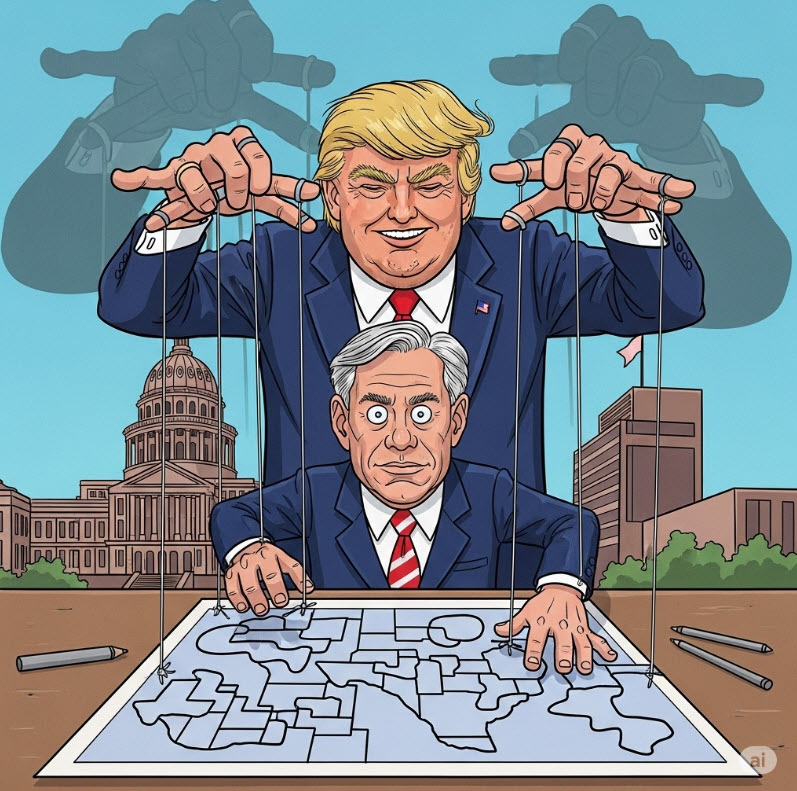
Gerrymandering is a form of cheating and should be illegal, regardless of which party practices it.
Suppose a political party can’t win an election based on the policies it champions and implements. In that case, they shouldn’t be allowed to rig the outcome in their favor with the stroke of a redistricting pen – that’s ludicrous and unethical.
Recent polling in Texas shows that most Texans oppose gerrymandering. Texans aren’t stupid. They understand Governor Abbot’s motivation. They see the unquestioning loyalty, knee-bending, and ring kissing as a blatantly partisan power-grab that serves Trump and Governor Abbot but does nothing for the citizens of Texas.
The backlash in Texas to a corrupt process where politicians pick their voters instead of the other way around has been swift and decisive, particularly among Democrats and independents.
The sentiments nationally are similar, with voters across party lines supporting independent redistricting commissions and opposing partisan manipulation of district maps. For example, a recent poll in Ohio showed 57% of voters supported a neutral redistricting commission when asked in unbiased language—even though the measure was ultimately defeated due to misleading ballot wording.
If Texas succeeds in its efforts to gerrymander districts, it will be another nail in the coffin of American democracy.
If you haven’t had a chance yet, please check out my book, My Paper, My Words: Rantings from a Progressive Boomer and Peeved Parent, from Amazon. And if you feel moved to write a review of the book, on Amazon, or anywhere else, I’d be honored.
My Paper, My Words is a collection of essays, stories, and poems reflect the challenges of a middle-class husband and father trying to navigate a rapidly changing political, religious, and technological landscape of post-911 America.

 bendingtheneedle