A few days ago, I had dinner with an acquaintance from China. He is an engaging and inquisitive young man, interested in America and American culture.
From our conversation, I learned that to the Chinese citizens, America is still that shining city on the hill. Well-off Chinese parents send their children to American prep schools, colleges, and universities because they believe doing so gives their children an advantage they can’t get in China.
I learned that in China, breaking free of the class you are born into is nearly impossible and that even white-collar professionals struggle to buy homes and save money, often relying on parents for support.
We discussed the many differences between our two countries before sitting down to dinner. Even though our countries couldn’t be more different, we connected on a human level. We loved our families and wanted a better world for them.
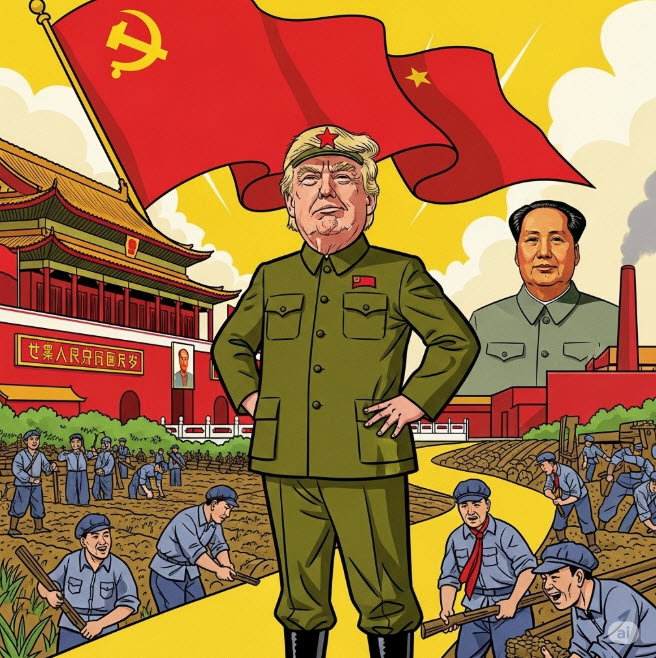
After dinner, I broached the subject of our President, asking my acquaintance how people in China view President Trump. He smiled politely and chuckled. “We refer to him as Comrade Trump – a member of the Chinese Communist Party.”
“We think he is insane, but ultimately helpful to China.”
Orange is the new Red
The unpredictability of Trump’s aggressive tariff policies, shifting trade strategies, and draconian immigration tactics presents an opportunity for China.
Here’s how China is taking advantage of President Trump’s ham-fisted and chaotic approach to global trade and why some Chinese refer to him as “Comrade Trump.”
Perception Shift
- A global analysis reveals that while the U.S. has experienced a decline in favorability due to Trump’s tariffs and immigration policies, China’s image has improved in many countries.
- China now enjoys a net favorability rating of +8.8, compared to the U.S.’s -1.5, marking a significant gain in soft power.
Trade Diversification and Realignment
- China has responded to U.S. tariffs by intensifying trade with other partners, including the EU, ASEAN nations, and Belt and Road countries.
- Trump’s tit-for-tat tariff war prompted China to reduce its reliance on U.S. imports and strengthen its domestic supply chains.
Boost to Domestic Industries
- U.S. tariffs on Chinese goods have led to price hikes in the U.S., making Chinese alternatives more attractive in other markets.
- China has used the opportunity to promote its own tech, energy, and manufacturing sectors, especially in regions where U.S. influence has waned.
Diplomatic Leverage
- The Trump administration’s erratic trade policies have alienated traditional allies, giving China room to present itself as a more stable and predictable partner.
- China has capitalized on this by deepening ties with countries affected by U.S. tariffs, including those in Africa, Latin America, and Southeast Asia.
Economic Resilience and Adaptation
- Despite high tariffs (some reaching 145% on Chinese goods), China has adapted by shifting exports, investing in domestic innovation, and retaliating strategically.
- The disruption has accelerated China’s push for self-reliance in key sectors like semiconductors, green energy, and AI.
Despite what he says, Donald Trump is not making America great or putting America first. Instead, his inability to read the “global” room, his misunderstanding of how tariffs work, combined with a noxious personality, inflated self-image, insatiable greed, and an unquenchable desire to be the center of attention, is causing irreparable harm to America while creating unprecedented opportunity for China.
Well done, Comrade Trump!
 bendingtheneedle