“I’ve washed this towel twice and still can’t remove the puke stain.”
His wife Mary stands at the top of the stairs, gently shaking the unfurled towel at her husband, who sits with his back to her, hunched over his “work-from-home desk,” even though he’s been out of work for 10 months.
The vet called it megaesophagus, a condition in which the esophagus is unable to move food into the stomach efficiently, causing their aging dog to vomit frequently. His wife displayed the artistic consequence of their dog’s medical condition for her husband to see.
Planting his bare feet on the protective matt under his office chair, he spins towards his wife, her pretty, puzzled face resting atop the puke-stained towel.
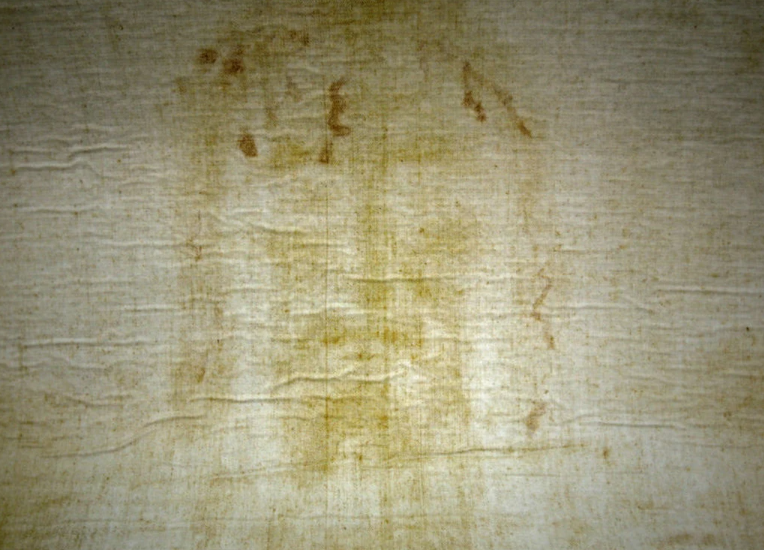
He studies the stain. “Let’s change Pepsi’s name to Pollock and sell her work online.” Then, in the next breath, he squints and quips, “Hold on a second… what the hell . . . I think I see Jesus’s face in that puke stain!”
“Ha-ha, very funny”, still, she turns the towel 180 degrees, tilts her head slightly, and studies the stain.
“Our lord savior, perpetually pictured in Pepsi’s puke! — or Pollock’s puke if we decide to move ahead with the name change,” her alliterative husband continues with a self-satisfying grin.
“This could be the financial windfall we’ve been waiting for!”
“It’s a laundry version of the miracle at Lourdes… the Tide Pod that Spied God!” He slips effortlessly into one of his riffs, wagging his finger enthusiastically above his head.
“I’ll call the Vatican and local paper; you work on logistics for backyard tours.”
She chuckles, turns on her heel, and heads down the stairs.
He’s unfazed by her absence.
Once he starts ranting, it’s got to run its course, “like diarrhea,” she would often say.
“We’ll need to erect a clothesline for the bath towel shroud of Jesus!”
“Maybe by the vegetable garden in the back, in front of the doubting toms and holy basil,” he shouts while spinning back to his work desk.
Halfway down the staircase, she responds sarcastically over her shoulder, “I’ll get on that right way,” tossing the rolled-up towel into the clothes hamper at the bottom of the stairs.
The morning sun finds its way through crowds of whispering pines and stoic oaks before crashing onto the skylight, splashing the inhabitants below in ghostly shadows of needles and oakleaf.
Peering over his coffee cup, he clears his throat – brushing aside the silence.
“We don’t fuck in the shower anymore.”
He takes a sip.
She raises an eyebrow, but not her eyes, working her butter knife methodically, like a skilled artisan, covering every nook and cranny of a slightly burnt English muffin.
A second passes.
“Fuck in the shower?” she scoffs incredulously, “Hell, I’d settle for a dry hump in the driveway.”
“Hmm. Interesting.” He takes another sip and studies his wife across the table. “Still pretty without makeup,” he thinks to himself.
Lifting her head, she takes a bite and shoots him a toothless smile, which he returns instantly (with a wink) before heading to the sink with his coffee cup.
“So,” he says, “What’s the plan today?”
She floats across the kitchen floor, meeting him at the sink, “I’m thinking of going to Mom’s to help in the yard.”
“After that, I’m free as a bird.”
“Maybe we can shower then?”
Standing directly behind him, she places her hand lightly on his lower back and slides her plate onto the kitchen counter before walking away.
He marvels at how she’s kept her figure. With his hand on his belly, he begins to second-guess his shower comment.
It’s their anniversary.
“By the way,” she says over her shoulder. “We’ve only done that like twice – maybe 3 times – in 30 years of marriage.”
He detects a hint of disappointment, and that famous quote from Cool Hand Luke, “What we’ve got here is failure to communicate,” plays on a loop in his head.
He wonders momentarily how many shower opportunities he’s missed out on.
The space between them has grown exponentially since the kids left, and lately, he wonders if it’s even navigable.
The kids were a bridge.
Now, the person he fell in love with is this spotty, blurry-edged figure on a distant shore, and he’s pretty sure that’s how he appears to her as well — spotty and distant, lost in his coffee, fantasizing about fucking in the shower.
In a strained and slightly desperate tone he pushes his words towards her “Strange how time clouds our perception of reality,” as if words can fix what feels irrevocably broken.
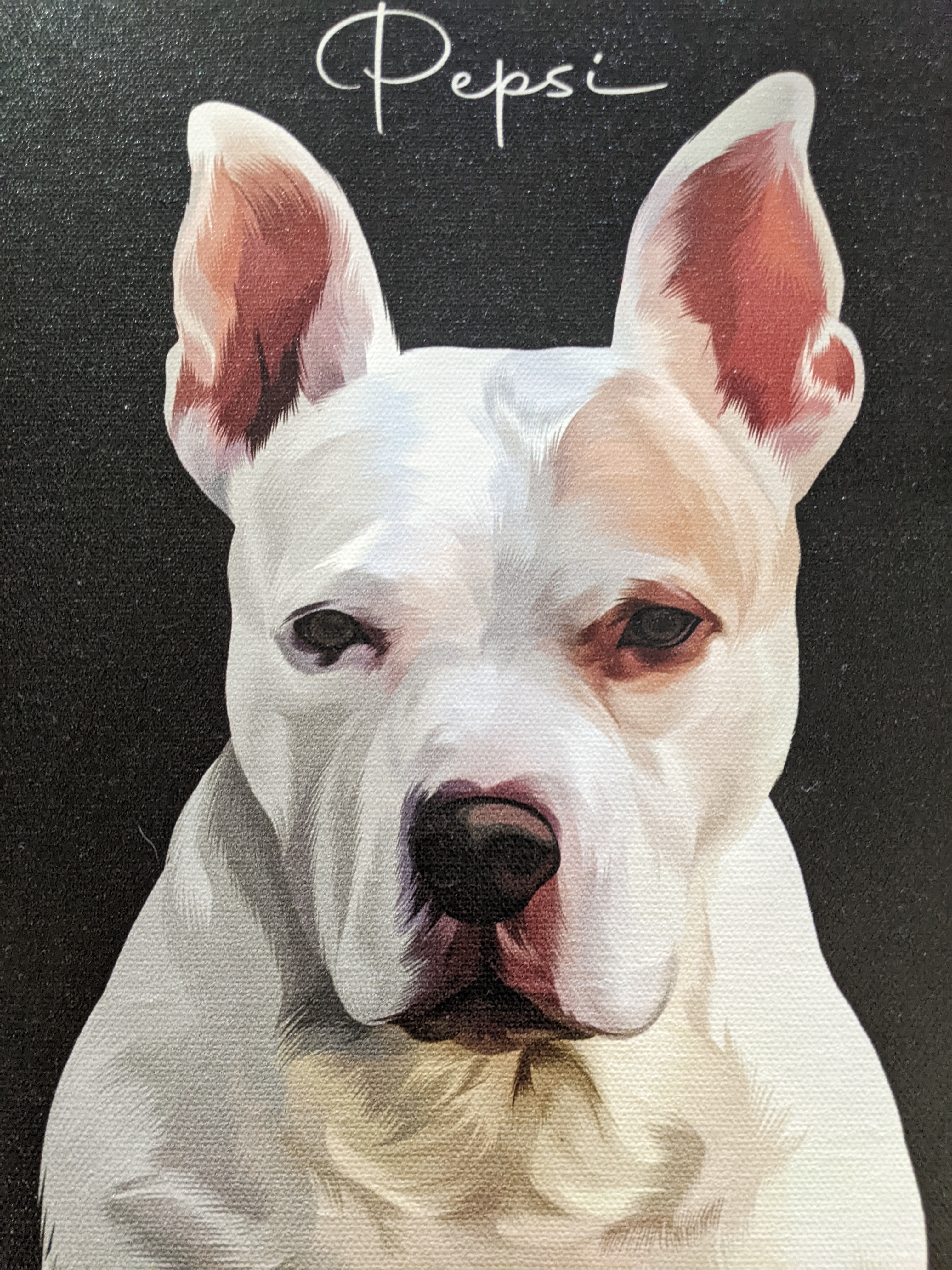
After more than eleven years of love and devotion, we had to put our beloved Pepsi down on Sunday.
Over the next several weeks, I’ll miss the routine I had with Pepsi for the last eleven years – all the daily interactions – from when I woke to when I went to bed.
Our pets affect us in ways that the people in our lives do not. Our relationship with them isn’t complicated by ego, insecurities, or pettiness. There are no traps, tripwires, or pretentiousness because our pets love us unconditionally. More significantly, they allow us to love with no contingencies—something we’re incapable of doing with people—no matter the relationship.
So, when our pets die, that pure and unblemished love and devotion disappears from our lives. The grief is so profound that it wrecks us for a time.
How We Came to Know and Love Pepsi
In 2013, months after losing our lab, Walter, to Cancer, I found myself searching for shelter dogs. As I remember, it was just a whim; I had no intentions of adopting.
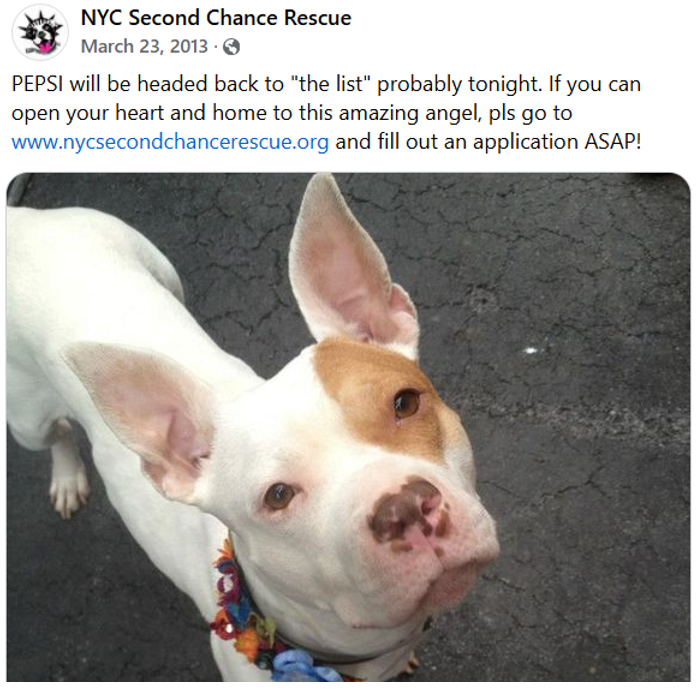
I have no recollection of what I typed for my Google search – but I ended up on this Facebook post:
The post included a link to this video, showing Pepsi and a shelter volunteer:
Unfortunately, as often is the case with Pitbull and Pitbull mixes, a NYC animal shelter put this sweet girl on their kill list.
As I watched the video of Pepsi, I felt an immediate obligation to contact Second Chance Rescue to get her off “the list.” So, I corresponded with them through their Facebook page, which initiated a sequence of events (filling out an application, putting down a deposit, and having a consultant visit our home to ensure it was a suitable environment) and ended with the ASPCA transporting Pepsi from Brooklyn, NY, to the Mystic Aquarium parking lot in Mystic CT, where she went from a dog on a video to a cherished member of our family.
Second Chance Rescue of NYC rescues and rehabilitates critically injured and neglected dogs and cats and those at high risk of euthanasia.
Pepsi was our first experience with the pitbull breed. The consultant from Second Chance Rescue told us that Pepsi should be the only dog in the household. We quickly learned of her distrust of other dogs, but of people, her affection was undeniable. She developed a strong bond with our family almost instantly, especially with my wife, Meg.
Pepsi’s mood spanned the spectrum from stoic and intimidating to warm and loving.
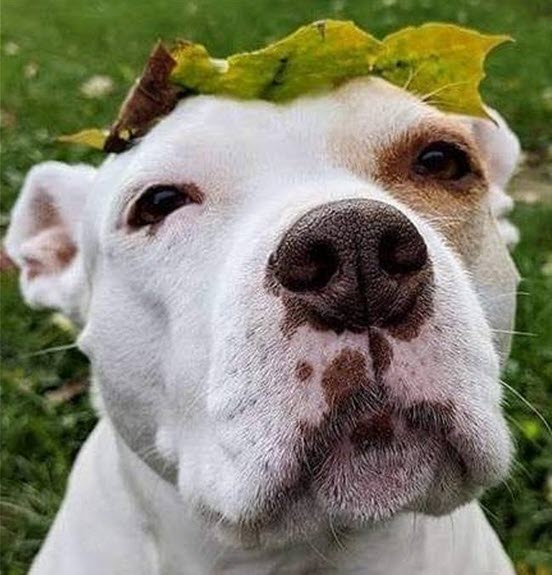
Her smiling eyes could melt the coldest of hearts.
She was loving, observant, doting, and intelligent. She was also deaf and, thus, the quietest dog we’ve ever owned.
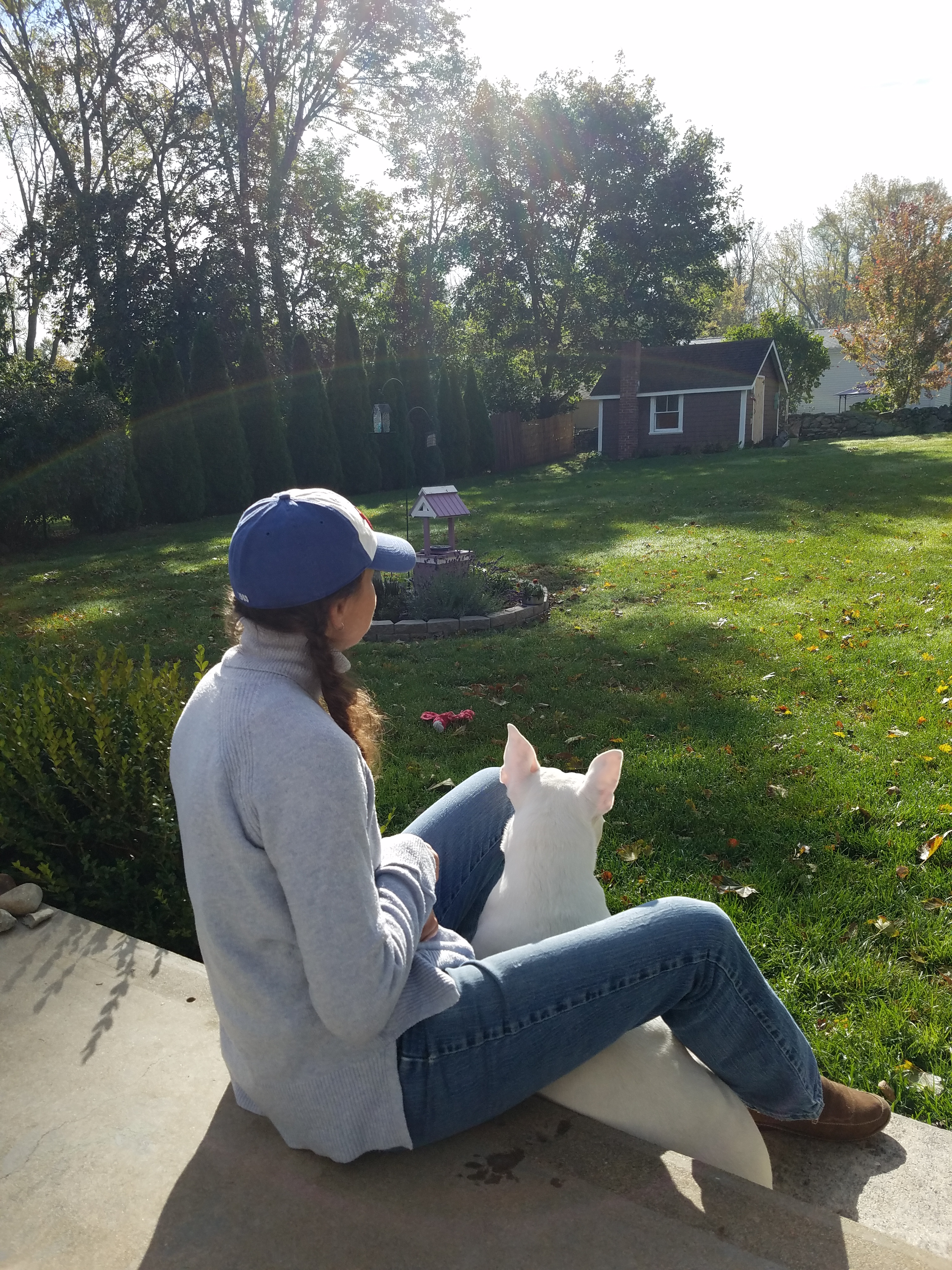
I work from home, so Pepsi was my constant companion for more than 11 years. She loved resting on the recliner next to my work desk, stretching out on our bed, sleeping and sunbathing on the patio, going for walks, lounging in the yard, and crunching on carrots.
She chased squirrels and bunny rabbits and killed a groundhog behind the shed one summer.
If Meg was outside, Pepsi wanted to be outside. She would dutifully follow Meg to her gardens and lie down in the shade while Meg weeded, planted, or watered. When Meg was done, she would follow her back into the house. Every time Meg went to the bathroom, Pepsi would follow her. If Meg locked the door, you could hear Pepsi knock her head into it from the living room. If Meg happened to leave the latch off, well, she had a visitor.
We will miss Pepsi deeply – we’ll miss seeing her navigate the swivel chair as she walks from the kitchen to the living room in search of hugs – we’ll miss the gentle snoring and weight of her in the bed – we’ll miss the sound of rhythmic hopping as she descends the staircase from the upstairs bedroom to the kitchen, ending with the slight sliding and clicking of her nails when she reaches the kitchen – we’ll miss watching her morning routine, slowly walking the perimeter of the yard, we’ll miss the thump of her tail on the bed or the recliner – we’ll miss how she helped connect us as a family – I think that’s the most magical thing a family dog does – they connect us because we all love them in the same way.
Dogs bring out our humanity and kindness in ways people don’t.
Even before putting Pepsi down, I said that she’d be my last dog. This time around, the slow decline was more challenging to deal with emotionally and physically. In her final months, Meg and I carried Pepsi from room to room, putting off the inevitable as long as we saw a spark of life or tiny moments of enjoyment—until the day they no longer came.
Maybe my feelings will change over time, and my longing for a dog’s love will outweigh the sadness I know I’ll feel when we part. For now, I’ll simply cherish what I had with this wonderful dog.
I’m so grateful for Pepsi’s love and companionship to our family, and I will never forget her.
When someone is true to themselves, it doesn’t automatically mean they’re a good person. You can be authentic and an asshole – just look at Donald Trump.
There’s a strange phenomenon in the MAGA world where authenticity trumps character, where how Trump talksis more important than what he’s saying.
That’s why we see Trump supporters laugh and applaud at all the crass crap spewing from that moron’s mouth – to them, it’s like sitting next to their racist buddy at their favorite bar. It speaks to how shallow and lazy a large portion of the American electorate has become – that a simplistic view of Trump’s authenticity resonates more than his utter lack of substance and character.
I can hear the twang of a Trump supporter now: “That Arnold Palmer schlong story was hilarious; that guy has my vote.”
Since the 2024 VP debate, we’ve all watched JD Vance sidestep whether Trump lost the 2020 election. Most recently, Vance was asked five separate times in the same interview but refused a yes or no answer.
Anyone with an iota of intelligence understands that JD Vance knows Trump lost but was instructed never to say it. Trump won’t allow any of his people to utter the word “loser” when talking about him—he’s too fragile. So, like the good soldier, JD refused to answer, sidestepping more than Al Jolson and Fred Astaire in a game of dodgeball.
Yesterday, Vance got a message from his boss that sidestepping wasn’t cutting it and to fall in line with the election denial. So, when asked AGAIN if Trump lost the 2020 election, he said “No,” which we all know is complete bullshit.
How do we know it’s complete bullshit? Because it’s been almost 4 years since the votes for the 2020 election were tabulated, litigated, and re-tabulated, yielding the same result – an overwhelming victory in the popular vote and electoral college by Joe Biden, with no evidence of vote rigging or cheating, in what the lead Trump election official called the fairest election in a generation and in which Trump’s attorney general called Trump’s assertions of a stolen election “total bullshit.”
Zero evidence that Trump won.
If I were a reporter, I’d follow up with JD Vance and ask why he has refused to answer the question for the last several weeks. Why didn’t he say “No” the first time he was asked? Now that JD Vance has officially joined the Election Deniers club, I would press him to explain precisely why he thinks Trump won. What evidence does he have to come to his conclusion?
It was almost comical watching JD Vance refusing to answer the question about Trump’s 2020 loss because we all understood (to an extent) the Vance Dance – He didn’t want to piss off his boss by being honest, so, sidestep shuffle-shuffle, sidestep, no answer.”
Embracing the lie is anything but comical because it shows us that JD Vance cannot be trusted with the most basic of things: facts, math, counting, and recounting.
If he denies something so clear and definitive, how can he be trusted to be truthful to the American people?
Everyone knows Donald Trump can’t be trusted—that if he loses AGAIN, he’ll refuse to accept the result. Some of us might have had an inkling of hope for Vance—that when faced with basic math that proved he and Trump came out on the short end of the election, he would man up and say, “We lost.” That hope is now gone with his one-word answer, “No,” and it’s the biggest reason to vote against this ticket.
Vance’s election denial is the latest example of the public humiliation by association that anyone close to Trump goes through. The cowardice of simply going along to get along will stick to Vance long after the stench of Trump fades.
It’s challenging to poll the minds of Republican voters in 2024.
Some are undoubtedly embarrassed their party re-nominated an incompetent, narcissistic, and megalomaniacal liar who they deeply regret voting for in 2016 and AGAIN in 2020 and will no way in hell vote for again in 2024.
Others wobble on a farcical fence of feeling that says they must vote Republican because they are Republican, even though their candidate has long abandoned Republican principles in favor of authoritarianism.
There are large sacks of numb-nuts incapable of independent and critical thought who still believe the 2020 election was stolen and will undoubtedly vote for the orange jack-wagon again.
And then all those barely closeted racists who won’t openly say they’re voting for Trump for fear of being publicly shamed, but deep down in their black hearts, have every intention of doing so.
Tough to quantify that fuck-tangled mess, even with the best polling in place.
Trump and Trumpism get their sustenance at the intersection of blind ambition and intellectual vapidity, as demonstrated most recently by the former President’s racist remarks about immigrants eating the pets of people who live in Springfield, Ohio.
More telling than the remark itself was Trump’s justification for making it on the debate stage in front of 67 million viewers:
“I saw a guy say it on TV.”
Nothing exemplifies the festering rot of politics in America more than that statement by former president Trump, which dovetails beautifully into the Murdochian decline of American news media and its host of shit shovelers like Sean Hannity, Tucker Carlson, and Laura Ingram.
Donald Trump is the embodiment of Nazi Joeseph Goebbels’s “Big Lie” messaging strategy:
If you repeat a lie or falsehood loudly and frequently enough with conviction, your audience will come to believe it, even when the facts do not support it.
America is a failing nation
Crime rates are through the roof
Inflation is the worst it’s been in the history of our country
Democrats stole the 2020 election
Haitian immigrants are eating the pets of the people who live in Springfield, Ohio
All of these statements are blatant lies that Donald Trump continues to promote and lean into.
The President’s willingness to repeat and share what he hears (regardless of validity) is strategic. When coupled with our natural inclination to glom onto stories that support preconceptions and voters’ zeal to dismiss evidence and facts they don’t like, the President’s words have a rippling and corrosive effect on social cohesion in our country.
So, when President Trump heard the unsubstantiated rumor on TV about Haitian immigrants eating cats and dogs, that was all the evidence he needed – A responsible candidate for President of the United States would have done their due diligence on the veracity of the rumor because sharing false stories about Haitians eating their neighbor’s pets puts the Haitian community in danger.
Donald Trump is not a responsible candidate.
President Trump shared the lie about Haitians eating cats and dogs because promoting hate of immigrants serves his interests and ambition, the same way refusing to condemn insurrectionists who stormed the capital and violently attacked police officers serves his interests and ambitions.
It’s why we can’t allow this sociopath near the white house again.
After the presidential debate last night between former President Trump and Vice President Kamala Harris, the choice of who should be the next President of the United States couldn’t be clearer.
Unfortunately, nearly 40 percent of Americans will continue to disregard Trump’s incompetence, petulance, and insatiable desire for power and vote for him this November.
In the 1940’s, the greatest generation stormed the beaches of Normandy to stop fascism from spreading across Europe. This November, Gen Z Americans need to storm the polls in massive numbers to stop the spread of fascism here at home.
Gen Z voters are not facing machine gun fire, land minds, or snipers. Still, they are up against concerted voter suppression efforts, deep cynicism and apathy, and an information landscape of lies from far-right, anti-democratic, pro-Russian sources.
Voting this November to stop fascism here at home is far less dangerous and requires none of the bravery that young Americans faced on June 6th, 1944, on the beaches of Normandy – but it is no less critical in terms of what is at stake.
Kamala Harris did her job last night. She demonstrated a calm, cool, and collected understanding of the issues and exposed Donald Trump for the political and personal fraud that he is.
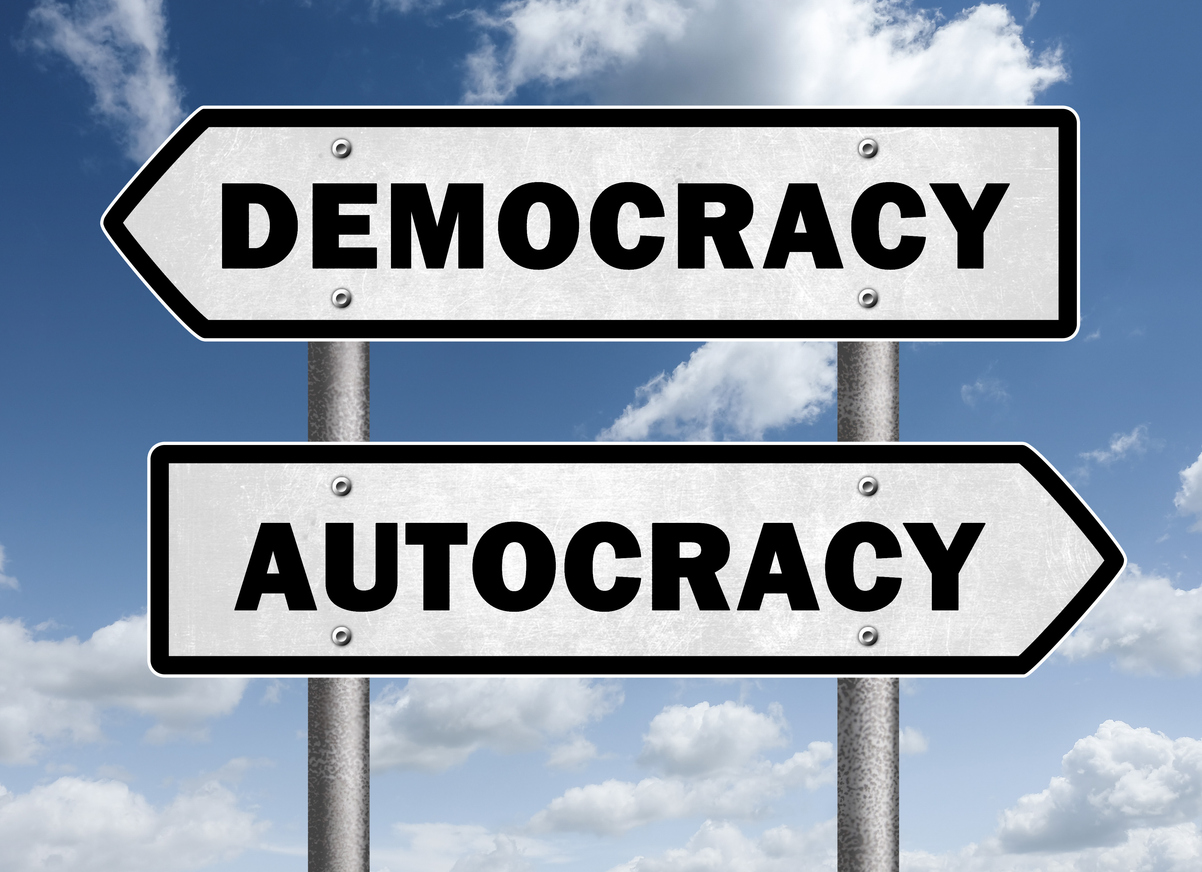
Now it’s up to the voters – it’s on us and (in large part the youth of America) to do their part on Election Day to keep Donald Trump from ending democracy and killing the great American experiment.




 bendingtheneedle