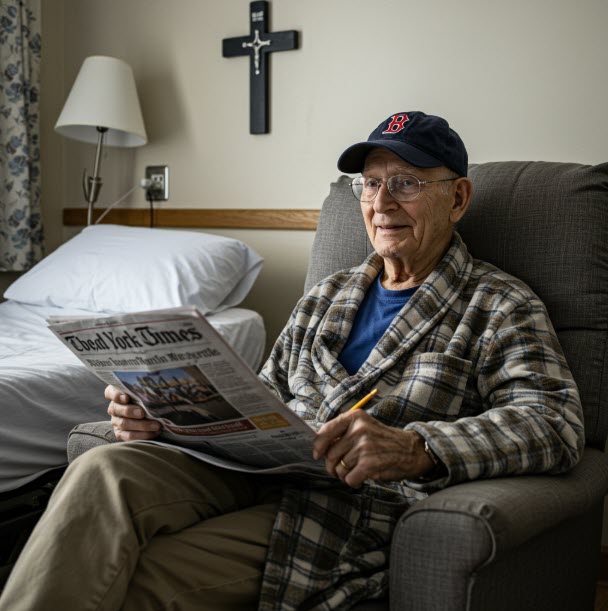
I make my way through a dimly lit hall of walkers, wheelchairs, and medical carts to find him where I always find him – in a threadbare recliner, lightly coated with dried skin cells and broken hair follicles – hunched over the New York Times crossword in his flannel robe, pee-stained underwear, and perfectly fitted Red Sox cap – his lips moving silently to the clues:
“1 Across – Act of saving or being saved – 1 down – Environmentally friendly material.”
Dad never used to move his lips – they were always tightly creased, well-mannered, and coolly detached from the finely humming machine in his head as he attacked the puzzle on all fronts.
To Dad, the Times crossword was a trusted friend, a worthy opponent, and an intellectual fencing partner who, for years, prepared him mentally for the start of his day. It felt grossly unfair that Dad was aging so inelegantly while his opponent remained unscathed by time.
I stand invisible at the entrance of his room, just staring, not wanting to disrupt his endeavor.
When he finally looks up, he shoots me a broad smile and tips his cap in my direction before returning to the puzzle.
I enter the room, clear my throat, and get to the point of my visit.
“Dad, do you have a will?”
Without lifting his eyes or halting the motion of his pencil, he responds, “You can have it all. Just burn me down to a fine ash, then bury me in the desert. There – that’s my will. Cross it off your list.”
I sigh heavily.
With his head still bowed, he holds up his mechanical pencil and points it sharply in my direction before continuing.
“But not too deep. A few inches below the topsoil will do just fine. I want the rain to be able to get to me — muddy me up a bit.”
He lifts his head. A thin dusting of skin cells and hair follicles fall – it’s wintertime in Flannel Ville. He gives me a wink and a smile before returning to the puzzle.
“What about the family plot where Mom is?”
“What about it?”
He goes on, “In the words of the best Beatle by far, Let. It. Be. When she was alive, your mother nagged me about hogging the bed and disturbing her sleep. Trust me, she’d be fine with my desert plan.”
He returns to the puzzle, mumbling under his breath.
“6 across – Breaking down organic matter” – 2 Down – To accept without protest”
“Is any of this written down, Dad?”
He slams the folded Times on his lap, and an unwelcome whiff of urine fills my nostrils.
“Why do I need to write it down? I just told you with actual words from my mouth – Put me in the goddamn desert, a few inches deep – Easy-Peasy. You want to bring nurse Jackie in as a witness?”
There’s no Nurse Jackie, but Dad loved that show so much that he referred to all his nurses as Nurse Jackie—even the males.
“Sorry, Dad.”
He softens immediately and smiles.
“It’s OK. No worries from the weary.”
“The Times is kicking my ass today.” He tosses the newspaper onto his bed – a school of dad-DNA swims in a stream of sunlight above the bedding.
“How are things at home? How are Emma and the boys?”
“They’re good – I’ve been wanting to get the boys in for a visit – -they’ve been busy with basketball and homework.”
“Don’t worry about visits. Honestly, I don’t want them to see me like this.”
A silence settles in the room. I can hear the paint peeling and a clock ticking.
“Can you do me a favor?”
“Sure, Dad, whatever you need.”
He points to the wall behind his bed.
“Get rid of that goddamn cross. It’s from the poor soul who was here before me.”
I lift the lacquered black Christless cross from its nail. The unfaded paint beneath it leaves a crucifix shroud of Turin.
In a deadpan voice, Dad stares at the wall and quotes Luke 24:6-7, “He is not there; he has risen,” and smiles sarcastically.
“Thanks, son.”
I stand Pope-like in the middle of his room, holding the crucifix, “What should I do with this?”
“Burn and bury it in the desert – he chuckles and starts to cough – a mosh pit of Dad-dust bounces enthusiastically on his shuddering shoulders. I can almost hear Cobain screaming.
Suddenly, there’s a discharge of electricity around Dad’s recliner. I look up to an intense blueish-white light pushing through the crevices on his forehead—a halo of electrified dandruff swirls above his head. A look of relief falls upon him. He winks and says warmly, “I’m just saving you the effort. Goodbye, son.”
There’s a loud pop—like a fluorescent light bulb dropped from a great height—as Dad bursts into flames like a human Hindenburg. Thin flakes of ash float in the air. Their fiery orange edges burn bright for a few seconds before self-extinguishing into dissipating wisps of smoke and settling all around me.
I drop the crucifix in stunned silence.
A nurse (followed by an elderly gentleman with a Dustbuster) enters the room. The nurse tilts her head towards her left shoulder and speaks into a small black microphone, “Mr. Smith in 103 has transitioned.” She nods sharply to the gentleman, who retrieves the crucifix and vacuums up every remnant of my father. He even vacuums Dad from my shoulders and shoes. When he finishes, the nurse checks her watch and makes a notation on her clipboard.
She hands me a piece of paper. “Your father left us these coordinates. We’re sorry for your loss. Please collect your father’s remains at the nurse’s station.” She and the orderly exit the room along the same path they entered.
I unfold the paper. Scrawled in my dad’s handwriting are the coordinates 40°40′N 117°40′W.
After a few minutes, I head to the Nurse’s Station. Dad’s been packaged neatly in a small cardboard box with the Crestwood Nursing Home logo. Someone thoughtfully taped the crucifix onto it. I pull it off and toss it in the trash on my way out the door.
I place Dad in the glove compartment and drive west to the desert.
If you haven’t had a chance yet, please check out my first book, My Paper, My Words: Rantings from a Progressive Boomer and Peeved Parent, from Amazon. And if you feel moved to write a review of the book on Amazon or elsewhere, I’d be honored.
My Paper, My Words is a collection of essays, stories, and poems that reflect the challenges of a middle-class husband and father trying to navigate a rapidly changing political, religious, and technological landscape of post-9/11 America.


 bendingtheneedle