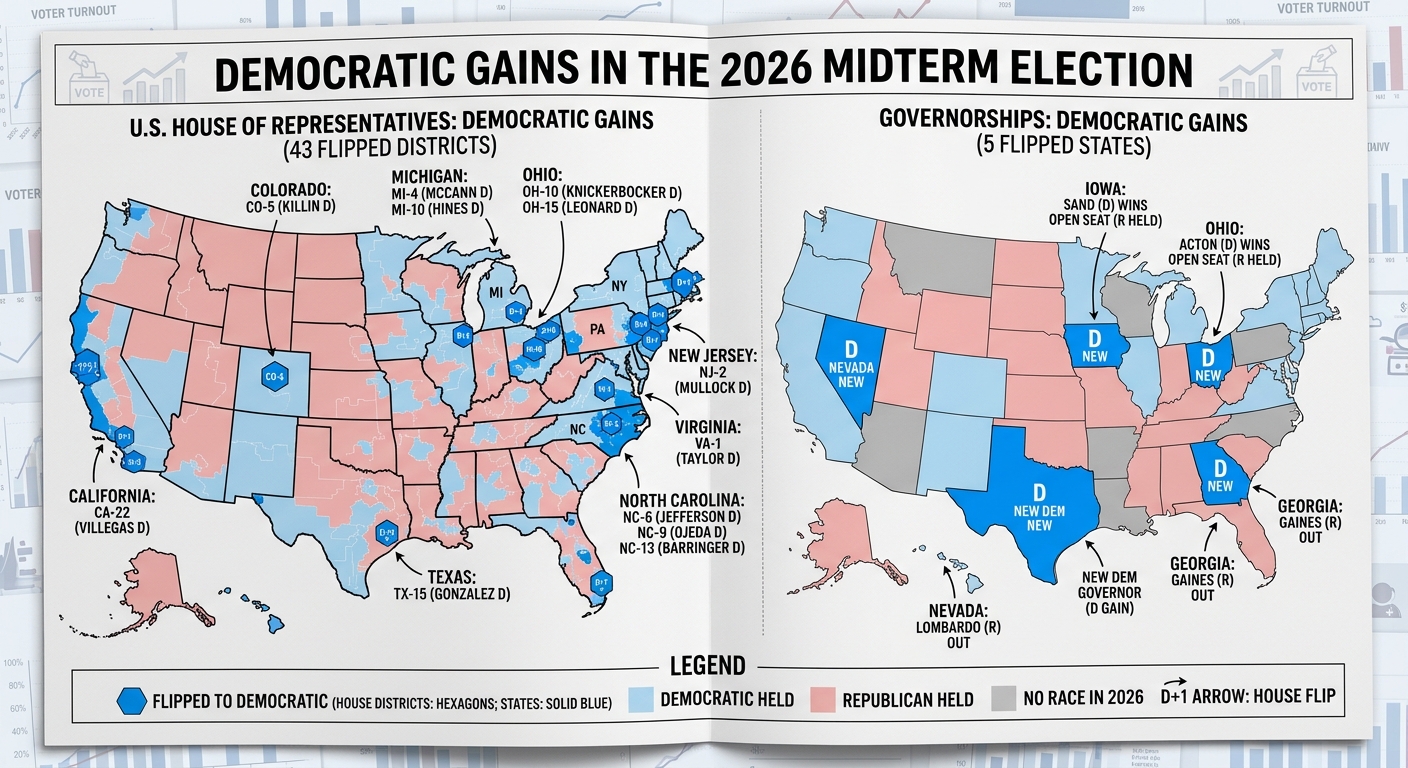
After the ass-whopping Democrats put on Republicans in the 2026 midterms, right-wing media and conservative pundits were quick to point out the normalcy of midterm flips.
Fox News and similar outlets kept drilling home the point that historically, the party in power almost always loses seats in the midterm election. And you know what? They’re correct.
If we compare flipped congressional seats from the 2026 midterms to other recent midterm elections, the numbers are comparable.
Using net congressional gains:
| Election | House gain | Senate gain | Total congressional gain |
|---|---|---|---|
| 1994 Republican wave | +54 | +8 | +62 |
| 2006 Democratic wave | +31 | +6 | +37 |
| 2010 Tea Party wave | +63 | +6 | +69 |
| 2026 Democratic wave | +43 | +7 | +50 |
So, by total congressional seats gained, the ranking is:
- 2010 Republican Tea Party wave: +69
- 1994 Republican Revolution: +62
- 2026 Democratic wave: +50
- 2006 Democratic wave: +37
So, are Democrats and the mainstream media exaggerating the magnitude of the 2026 Blue Wave?
No, they are not – and here’s why.
The 2026 Blue Wave suggests that Democrats not only won swing districts but also captured seats in areas that, as recently as 2024, were as red as rubies and had been comfortably captured by President Trump.
In fact, NBC News reports that Democrats won districts Trump had carried by double digits and pushed into traditionally Republican territory, not merely battleground seats.
Here’s why the 2026 Blue Wave is different:
1. Deep Blue Penetration
The Democrats made incursions into historically red territories to flip seats that were considered unflippable.
Examples included congressional pickups in places like Indiana’s 5th District, which Trump reportedly carried by nearly 17 points, and losses by senior Republican figures in traditionally Republican territory.
That differs from many recent midterm waves, where gains were concentrated in purple suburbs.
2. Senate Flips in Strong Republican States
Historically, Senate waves often occur because one party defends many vulnerable seats. In 2026, Democrats flipped Senate seats in red states including Texas, Kansas, Iowa, Ohio, South Carolina, and North Carolina. Several of these states were not viewed as typical Senate pickup opportunities for Democrats. A Democratic Senate win in Kansas, for example, would be extraordinary by modern standards.
3. Simultaneous House, Senate, and Governor Gains
Many waves produce gains in one chamber but not necessarily broad success everywhere.
The 2026 wins by Democrats were broad, flipping the House, Senate, and racking up governorship victories in Texas, Ohio, and Georgia – creating a broader geographic sweep than a typical midterm correction.
4. Success Despite Modern Polarization
Perhaps the most historically significant characteristic of the 2026 blue wave is that it succeeded in an era of extreme partisan sorting.
Political scientists have often argued that modern elections leave relatively few persuadable districts. Since the 1990s, waves have increasingly been constrained because Republicans dominate rural America while Democrats dominate urban centers.
The early analyses of 2026 suggest Democrats broke through those barriers and won districts that had become structurally Republican. NBC’s analysis specifically noted victories in districts that Trump won by ten points or more.
5. The Redistricting Flop
Another unusual aspect is that mid-decade redistricting undertaken to protect Republican majorities may not have prevented, and in some places may have amplified, Democratic gains.
Reporting notes that Democrats won in districts reshaped through aggressive Republican redistricting efforts.
The Historical Parallel
If there is a close historical comparison, it may be less like 2018 and more like 1930, 1974, or 2006, when voters delivered a broad national repudiation of the party in power.
The difference is that 2026 appears to have reached further into territory that had seemed politically locked down by Republicans.
Earlier waves often swept competitive seats; this one appears to have flipped a meaningful number of districts and statewide offices that many analysts considered safely Republican only two years earlier.
The defining characteristic of the 2026 blue wave is not just its size, but its geography. Democrats reportedly didn’t merely win swing seats. They won seats and statewide races in places that had recently been considered firmly Republican, making it a broader and potentially more historically significant realignment than a standard midterm backlash.
If you haven’t had a chance yet, please check out my book, My Paper, My Words: Rantings from a Progressive Boomer and Peeved Parent, from Amazon. And if you feel moved to write a review of the book, on Amazon, or anywhere else, I’d be honored.
My Paper, My Words is a collection of essays, stories, and poems that reflect the challenges of a middle-class husband and father trying to navigate a rapidly changing political, religious, and technological landscape of post-911 America.
Also, check out my AI music project, Sapient Rain, a human–AI musical collaboration. Sapient Rain’s music blends political fire, surreal storytelling, and nostalgic autobiography, delivered through lyrics that read more like literary vignettes than conventional songcraft.
You can listen to Sapient Rain songs on Spotify, YouTube Music, and Apple Music.

