One might think that Donald Trump always supports the accused rather than the victims of sexual misconduct. For example:
- Roy Moore (2017)
Moore, the Republican Senate candidate in Alabama, was accused by multiple women of sexual misconduct, including allegations involving teenagers. Trump endorsed Moore, accepted his denials, and campaigned for him, saying, “He totally denies it. … You have to listen to him, also.” - Brett Kavanaugh (2018)
After Christine Blasey Ford accused Kavanaugh of sexual assault, Trump repeatedly defended his Supreme Court nominee, praised his character, and publicly questioned aspects of Ford’s account. - Rob Porter (2018)
After photographs and allegations emerged that Porter had physically abused his ex-wives, Trump expressed sympathy for Porter, praised him, and emphasized concerns about due process rather than condemning the alleged conduct. - Bill O’Reilly (2017)
Following reports that several women had received settlements related to sexual harassment allegations, Trump defended O’Reilly, saying, “I don’t think Bill did anything wrong” and describing him as “a good person.” - Roger Ailes (2016)
After multiple women accused the former Fox News chairman of sexual harassment, Trump said he felt bad for Ailes and described him as “a very good person.”
Believe it or not, there are instances where Trump has called for investigations or consequences against individuals accused of sexual misconduct – but in almost all cases, those individuals were either political opponents or of no consequence to Donald Trump. That’s important to know when trying to understand what drives Donald Trump’s thoughts and motivates his decision-making.
With Trump, Morality is a Non-Factor
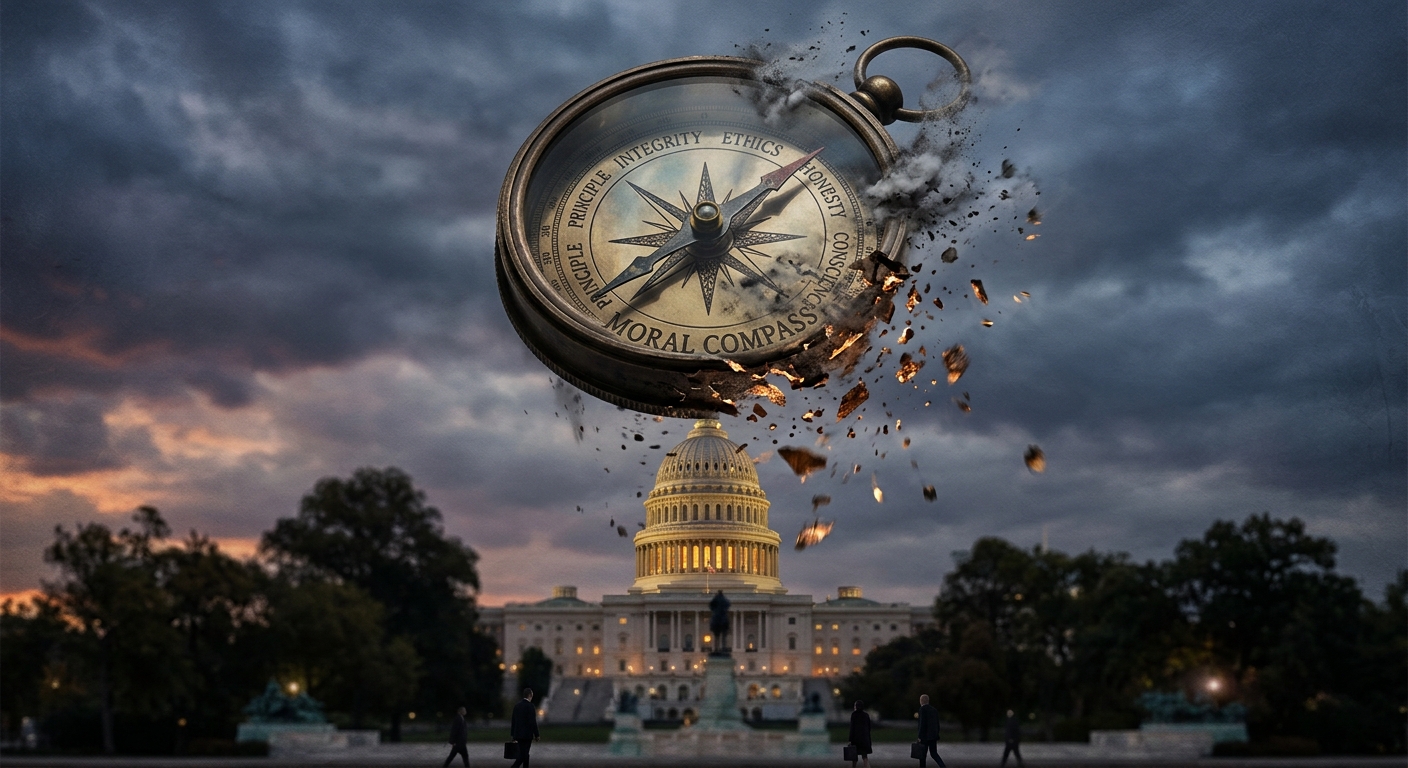
Most people hold a core set of beliefs, values, or principles that guide us when distinguishing right from wrong. These values serve as our moral compass as we live our lives.
What we see with Donald Trump over and over again is that he has no moral compass. Whether a thing is right or wrong or true or false doesn’t matter – what matters is how the thing affects him.
When Donald Trump was asked about the Vivek Ramaswamy ad, he didn’t focus on the ad’s veracity or morality; he focused on how it might help Ramaswamy. In fact, when a reporter pressed Trump about the backstory of Amy Acton’s mother skipping town with the man who raped her daughter, all Trump said was that he didn’t know about that – he dismissed that little tidbit entirely.
Why is that?
Because when you understand the backstory and the facts about Amy Acton’s mother and stepfather, the ugly truth is revealed – and Donald Trump is not interested in something as disruptive as truth. Trump’s actions and statements are purely and solely transactional. Values like morality, integrity, and truth don’t factor in.
What happens to the most powerful nation (and the world) when its leader has no moral compass and makes decisions solely based on how they affect him personally, grow his bank account, shield him from accountability, and solidify his authority?
We’re seeing consequences play out in America and around the globe.
Trump’s climate policies ignore science because implementing a climate policy based on science would disrupt the flow of money and influence from the fossil fuel industry to Donald Trump. The long-term consequences will be more devastating fires, floods, heat waves, and hurricanes.
Trump’s position on the war in Ukraine is based solely on Trump’s worldview and his strange bromance with Vladimir Putin. Trump ignores the fact that Russia’s aggression against Ukraine was objectively illegal and immoral and sides with Russia because siding with Russia keeps him aligned with a country that helped put him in power. The consequence is tens of thousands of dead Ukrainians.
Even the seemingly little things are devastating to America’s psyche. For example, Trump’s narrative around the reflecting pool debacle. Trump knew all along that vandals were not to blame for the algae bloom and peeling paint. But instead of acknowledging the truth (that the no-bid company he gave the job to botched the pool-lining process), he created his own narrative, even going so far as to falsely accuse and arrest a man who had nothing to do with the pool’s liner disintegrating before our very eyes. The leader of the free world targeted an American citizen rather than acknowledge the truth, because that truth made him look incompetent.
Trump bases all his decisions on one condition: what’s in it for him. We see it in the Vivek Ramaswamy ad, in his handling of the war in Ukraine, and in every decision before, after, and between. Trump’s decisions have nothing to do with what is objectively right or wrong and everything to do with self-preservation.
Our forefathers put a mechanism in place to deal with dangerous tyrants like Donald Trump, who put themselves above the people they are supposed to serve. Unfortunately, the forefathers never imagined the level of cowardice that inhabits Congress today. The only hope is that Americans choose leaders who have and will use their moral compass.
We will see if that holds on November 3rd.
If you haven’t had a chance yet, please check out my book, My Paper, My Words: Rantings from a Progressive Boomer and Peeved Parent, from Amazon. And if you feel moved to write a review of the book, on Amazon, or anywhere else, I’d be honored.
My Paper, My Words is a collection of essays, stories, and poems that reflect the challenges of a middle-class husband and father trying to navigate a rapidly changing political, religious, and technological landscape of post-911 America.

