
Let’s Ask Arty uses existing Artificial Intelligence (AI) technology to query LLMs about politics in these troubled times.
Query 1: Arty, please fact check recent comments Donald Trump made from the oval office about windmills as a source of energy.
Donald Trump has made several recent comments criticizing wind turbines as a source of energy, but many of his claims are either misleading or factually incorrect.
In press conferences and meetings—including one with European Commission President Ursula von der Leyen—Trump referred to wind turbines as:
- “Ugly monsters” that ruin landscapes
- A “con job” that harms whales and birds
- The “most expensive and inefficient energy” source
- Prone to “rust and rot in eight years,” with blades that “can’t be buried”
He also claimed he would not allow any new windmills to be built in the U.S. and signed an executive order halting federal wind energy permits.
Let’s break down the accuracy of President Trump’s claims about wind turbines:
| Claim | Reality |
|---|---|
| Wind turbines are the most expensive energy source | ❌ False. Wind is one of the cheapest forms of electricity today, especially onshore. Offshore turbines cost more to build but still compete economically with fossil fuels. |
| Wind turbines rust and rot in 8 years | ❌ Misleading. Most turbines are designed to last 20–25 years, and many components are recyclable. |
| Turbine blades can’t be buried | ✅ Partially true. Blades are made of fiberglass, which is non-biodegradable, but they’re often repurposed (e.g., as highway noise barriers). |
| Wind turbines kill whales | ❌ No evidence. The NOAA and U.S. Department of Energy have found no scientific link between turbine noise and whale deaths. |
| Wind turbines kill birds | ✅ True, but context matters. Turbines do kill birds, but far fewer than buildings, cats, or fossil fuel plants. |
Trump’s opposition to wind energy appears rooted in personal grievances—especially regarding turbines near his golf course in Scotland. While wind power isn’t perfect, it’s a proven, cost-effective, and increasingly vital part of the global energy mix.
My Input
Every time Donald Trump opens his mouth (on any subject), the result is a firehose of falsehoods. And because Trump lies with impunity, fact-checking him has become a Sisyphean task if ever there was one.
President Trump’s lies about wind turbines are a component of his bigger lie that climate change is “a hoax.”
News Alert: Climate change is not a hoax.
Over 97% of climate scientists agree that Earth’s climate is warming and that human activity is the leading cause.
The hot air that Trump produces every time he opens his pie hole is arguably enough to melt a glacier.
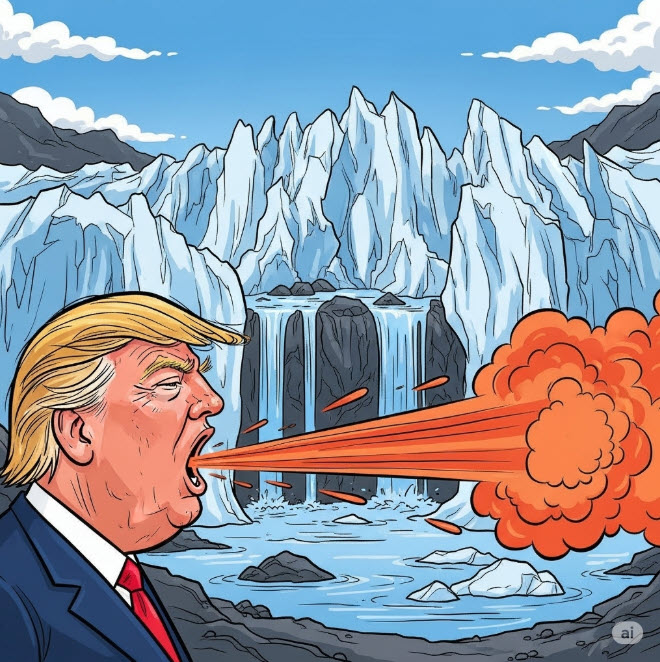
At this point, human inactivity is just as significant a factor in the climate crisis. Rather than be proactive in the fight against climate change, we’ve chosen to sit on our hands.
The evidence of a changing climate is clear:
- Global temperatures have risen by about 2°F (1°C) since the late 19th century.
- Ice sheets in Greenland and Antarctica are shrinking rapidly.
- Sea levels are rising, and extreme weather events are becoming more frequen
And though we haven’t passed a universal “point of no return” for climate change, we are getting dangerously close to triggering multiple tipping points, as Arty informs us below.
What Is the “Point of No Return” in Climate Science?
- It’s not a single moment or threshold. Instead, scientists talk about climate tipping points—critical thresholds where ecosystems or Earth systems (like ice sheets or ocean currents) begin to change irreversibly.
- Once crossed, these changes can accelerate global warming and become self-reinforcing, making it harder or impossible to reverse.
Scientific Evidence of Approaching or Crossing Tipping Points
Here’s what recent research and global observations show:
- Global Temperatures: In 2024, Earth’s average temperature hit 1.52°C above pre-industrial levels, breaching the Paris Agreement’s 1.5°C target.
- Melting Ice Caps: Antarctic and Arctic sea ice have hit record lows for multiple years. Scientists warn we may see an ice-free Arctic summer by the late 2020s, which would drastically alter climate feedback loops.
- Ocean Heat: Oceans are absorbing 90% of the excess heat. In 2025, marine heatwaves led to widespread coral bleaching in the Great Barrier Reef and Caribbean reefs.
- Wildfires & Extreme Weather:Mega-fires and extreme weather events are becoming increasingly frequent and severe. These release more CO₂, creating a vicious cycle.
- Carbon Emissions: Global emissions hit an all-time high in 2025, making it harder to stay below critical warming thresholds
What Scientists Say About “No Return”
- Some experts argue that we’ve already crossed local tipping points, such as irreversible warming in parts of the ocean.
- Others emphasize that while some damage is locked in, we still have time to prevent cascading global tipping events—but only if we act fast.
- A 2024 study found that overshooting the 1.5°C target significantly increases the risk of destabilizing major Earth systems, such as ice sheets and ocean currents.
Putting aside Fat Donny’s lies about Wind Turbines, here are some ways we can harness the wind to fight climate change (with some help from Arty):
- Wind energy is one of the most effective tools we have to combat climate change:
- Massive Impact: Wind and solar combined could deliver over one-third of the emissions reductions needed by 2030 to stay on track for the 1.5°C goal.
- Zero Emissions: Wind turbines generate electricity without releasing greenhouse gases.
- Scalable & Affordable: Wind is now among the cheapest sources of electricity globally, often cheaper than fossil fuels.
- Rapid Deployment: Wind farms can be built quickly and scaled to meet growing energy demands.
The climate change threat to humanity is existential and urgent.
Wind energy is a difference maker. It is a powerful, proven, and implementable solution, and it is clean, cost-effective, and scalable.
 bendingtheneedle