The other day, I watched former President Trump praise his relationship with North Korean dictator Kim Jong-Ill in a televised interview.
I listened to the former disgraced and seditious-prick-of-a-president say how well he got along with dictators and autocrats and how he admired their strong leadership.
None of this surprised me.
Trump is an easily manipulated, egotistical fool. Leaders like Kim Jong-Ill and Vlad Putin simply blew a little smoke up the orange one’s undies to court favor with Trump.
What disheartened me most about the interview was the applause from my fellow Americans in the audience.
When did getting along with murderous dictators become a praiseworthy trait in an American president?
Had President Obama or candidate Clinton said anything remotely like this, they would have been crucified by the very same people who were applauding. As Forest Gump would say, Trump supporters and hypocrisy go together like peas and carrots.
Republicans and Democrats have always differed on policy. But when it came to condemning brutal dictators and autocrats, we stood together.
That used to be common ground.
Why is this no longer the case?
What changed?
Well, for one, we had four years of being led by a self-absorbed, morally corrupt, and intellectually vapid president. Trump rose to power by tapping into many Americans’ grievances and fears around race and then, with purposeful malevolence, sold them a solution based on a warped definition of Americanism.
Trump understood that a divided country was his only path to power. So, from the onset of his candidacy, all the way through his presidency, he divided this country.
Five years later, we see the result in a fact-resistant confederacy of MAGA-hat-wearing morons and the cowering politicians who fear them.
Trump and his supporters are the blood in the boner of an alt-right movement in America — and you can’t reason with a boner.
America has more than her fair share of fascists and white nationalists.
Some of them even serve in congress.
The vast majority, if not all, vote republican.
Donald Trump is a White Nationalist. That’s why White Nationalists supported his presidency.
When someone says they supported Trump’s policies but not his white nationalist and authoritarian views, its no less ludicrous than a German citizen in 1939 saying they support Hitler’s economic policies, not his views on the Jewish population.
In throwing your support behind a president, you have to look at the totality of the man – not just policy bits and pieces that you can align with and rationalize to yourself and your friends.
As we saw with President Trump, it’s the totality of the man (all of his views and values) that set the tone and attitude of his administration. Under Trump, the party’s platform was built on divisiveness, hate, mistrust, and anger, and that’s exactly what was reflected in most of Trump’s policies and actions.
It’s important to keep in mind that the anger, hate, and mistrust of government and institutions that Trump used to divide America and strengthen his position politically, are alive and well today. Those feelings and attitudes didn’t magically disappear when Trump was trounced in the 2020 election.
Many Americans who supported Trump are simply waiting for him, or the next Trump-wannabee to come along and validate those feelings, while cultivating and promoting policies that weaken our democracy and march us down the path to authoritarianism.
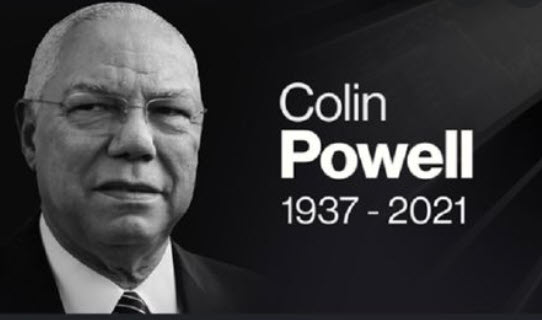
Colin Powel was a lifelong republican, military man, and honorable public servant who understood the danger of authoritarianism. When he saw fellow republicans refuse to stand against a dangerously authoritarian president, he called them out for their cowardice and left the party.
We need more republicans of stature to do what Colin Powell did – speak up and shine a light on the dangerous and dark influences taking hold of their party. And more importantly, we need strong and outspoken leaders in the GOP to provide a roadmap for getting the party back on track to decency, integrity, and basic American ideals. Without a roadmap, we’re going to see the GOP continue it’s downward spiral towards authoritarianism.
The four years of the Trump administration laid the groundwork for dismantling democracy in America. Colin Powel understood that and voiced his disdain for Trump and the political cowards who failed to stand up to him.
If democracy is to survive in America, we’ll need more voices like Colin Powel’s.
You might have some real friends on Facebook. But Facebook isn’t one of them.
Facebook and Instagram use artificial intelligence and algorithms to learn our views on race, identity, religion, and politics. They don’t ask us directly about our views or interact with us in a meaningful way. Instead, they collect data from what we share, like, comment on, and engage with on their platform.
They analyze the data and come up with a profile of me and you (conservative, male, Republican, pro-life or liberal, female, Democrat, pro-choice). Based on that profile, they determine what content to send us. The content they send us reinforces our views, solidifies our attitudes, and affirms our opinions.
Facebook knows which content pulls us in and which content we breeze over.
Facebook knows what we like, who we like, and with whom we like to share.
What’s the danger in that?
What’s the danger of analyzing and understanding our behavior and then delivering content based on that understanding?
Isn’t that a good thing?
No, it is not.
And here’s why.
We share more about ourselves with data scientists at Facebook than with our priests in the confessional.
But the priest (in theory) wants to counsel and help us. Facebook wants to use us.
To Facebook, we are a commodity. And when you’re a commodity on a technology platform with a data-driven business model, you’re prone to exploitation and manipulation by powerful and self-serving individuals and institutions.
Facebook and Instagram are conduits for misinformation and lies. We saw this in real-time with the Big Lie about a stolen election.
We felt it with the fire hose of misinformation about COVID-19 and the COVID-19 vaccine.
The people who consumed and bought into those lies are lost—perhaps forever. Tragically, they’re part of a growing community of people who believe in misinformation. As humans, we long for a sense of community—more so, it seems, than truth.
Mark Zuckerberg and the other executives who launched Facebook did not have bad intentions. They had a business model and the technology to make that business model successful.
What they should have accounted for was the consequence of their success.
Categorized and codified by cold-calculated algorithms, Facebook incentivizes our human desire to be with people who share our views while fueling our dislike of those who don’t.
Because of Facebook, our society is more divided, less trustful, and has more built-up animus than ever before.
We see the unintended consequences of technology and human nature smashing into one another.
That’s why I broke up with Facebook.
For me, the detriments far outweigh the benefits – it’s scary because sometimes I think the best and only way to fight misinformation is to counter it with truth.
If lies and misinformation can spread fast on FB, why not use that platform to spread the truth?
Many of us buy into that argument.
So, we get caught up in this endless battle with others. We live for hours at a time in an environment of constant combat and argument—we look for mistruths, engage the enemy, and fight the fight.
Post-to-Post combat.
Blood pressures rise.
Friendships get wrecked.
Family members are disowned.
Nothing gets solved. We just become agitated at those who don’t share our views.
We willfully retreat to our camps, losing empathy, trust, and any sense of what holds us together as a country and a society.
We lose our ability to compromise and discuss coherently and intelligently with whom we disagree.
Facebook is toxic, destructive, and a danger to society.
The anger and frustration sweeping across America after the Supreme Court overturned Roe exemplifies minority rule politics.
A crooked, twice-impeached president who lost the popular vote appointed 3 justices, which was enough to overturn a decision that most Americans agreed with.
Since the federally protected right to an abortion was stripped away, right-to-lifers and pro-choice advocates have been battling over women’s reproductive rights in states nationwide.
What we’re seeing in states like Kansas, Ohio, and Wisconsin is majority rule politics — where abortion rights are being codified because that’s what the majority of citizens in those states want.
The fight over abortion will intensify and undoubtedly impact the 2024 elections. Abortion is a hot-button issue because it’s inextricably tied to religion and freedom, two things Americans care deeply about.
Right-to-lifers believe life is sacred and God-given. They believe life begins at conception, and a zygote has the same inalienable rights as a fully developed human. And because a zygote is defenseless, right-to-lifers see themselves as self-appointed and divinely anointed protectors of the unborn.
It’s a crusade for these people.
With placards and posters splattered with images of aborted fetuses, they march at pro-life rallies, scream at, harass, and intimidate women at abortion clinics, and vote only for pro-life candidates (regardless of the candidate’s character or qualifications – see Donald J Trump).
Conversely, pro-choice advocates feel as strongly about women’s autonomy over their bodies. Pro-choicers believe any decision around pregnancy is solely up to the woman – her body, her choice. They believe life begins outside the womb after the baby is born and that being forced to carry a pregnancy to term, based on someone else’s philosophical or religious views, is an unacceptable assault on autonomy and human dignity.
Pro-choicers march at rallies, support organizations that provide reproductive health services to women, and vote only for pro-choice candidates.
From a plumbing and religious perspective (male/atheist), I don’t feel invested enough to opine on either side of the issue.
But maybe a lower emotional investment makes me more objective?
I’m not one for telling others what to do or how to think, especially about personal reproductive rights. Ultimately, we make our own decisions.
Well, hopefully, we do.
As I mentioned, I don’t believe in God, heaven, or the notion of a soul – I see no evidence of these things. I believe we are born of biology, just like every other animal. I believe our lives are shaped primarily by what happens (the good and the bad) after entering the world.
That said, none of us can deny that we all begin in the same manner, moving from a fertilized egg to an embryo, from an embryo to a fetus, and finally, from a fetus to a baby. Disrupting that process through abortion prevents a natural biological transformation. Without that disruption (if all goes well), the result is a baby – soul or no soul).
There can be many reasons for disrupting that biological process. And those reasons can run the gamut from the profoundly emotional to the detached and dismissive.
I imagine how a woman feels about her pregnancy depends on the circumstances surrounding it and that those circumstances can vary greatly. Maybe it’s a pregnancy from a casual and consensual fling, a meticulously planned pregnancy with a life partner, or a pregnancy resulting from violent rape. Maybe it’s a planned pregnancy that becomes unviable.
Each circumstance is going to evoke different emotions and thought patterns.
In addition to the circumstances surrounding the pregnancy, the individual woman’s situation is unique. Is she emotionally stable and physically healthy? Does she have a solid social and familial support system? Is she financially independent? Can she and her partner (if she has one) emotionally, physically, and financially support another human being?
Right-to-lifers say the circumstance of the pregnancy and the woman’s situation is not what matters most. Regarding pregnancy, the focus is not on how or why the woman became pregnant or whether she can support a child. Instead, right-to-lifers put all their focus and support on the unborn child.
Regardless of how the seed was planted, in the eyes of a pro-lifer, the woman transforms from an autonomous human being to a vessel – as soon as fertilization occurs.
Imagine having no say. No voice. This is the most important and challenging thing for men to wrap their heads around.
Imagine being told by the state that regardless of the circumstance of your pregnancy or your physical, emotional, and financial status, you have no say in your pregnancy after reaching the six-week marker.
After six weeks, you will do what you’re told.
You will have that baby whether you want to or not.
Whether you can care for it or not.
Whether you were raped or whether you and your partner were a little careless with your birth control.
It. Does. Not. Matter.
You have no say.
Imagine how that makes a person feel.
Stripped.
One group believes that from conception, the woman’s role is that of a vessel. The other believes all the goings-on in a woman’s body (including fertilizing that egg) is the woman’s business and nobody else’s.
Neither side will budge from their firmly held beliefs, and legislation won’t change minds. All legislation does in the case of abortion is make access easier or more difficult. It never changes minds.
The legislation in Texas clearly makes getting an abortion more difficult.
But let’s be honest, a wealthy woman in TX who wants to terminate her pregnancy will not be deterred by legislation. As has always been, women with means will find a way. They’ll get on a plane to go “visit” their cousin. But, like so many other laws, the law in TX will have a far more significant impact on those without means.
The real fight is not about abortion but female autonomy and freedom of choice.
I think what we’re seeing in states where reproductive rights are being put on the ballot is that freedom trumps religiosity. I think voters are saying it’s okay for individuals to follow their religious beliefs, but imposing those beliefs on others is not. In other words, if you don’t believe in abortion, don’t have one.
And finally, if we were serious about reducing the number of abortions in America, we’d be looking at national standards for sex education in public schools, with frank discussions about sex, responsibility, and consequence.
Donald Trump saw masses of hateful and uneducated Americans as an untapped resource. He pandered to them from the very beginning of his campaign, all the way through his presidency. He adroitly tweaked their xenophobic fears and white nationalistic attitudes and transformed them into votes.
He effectively made them the foundation of today’s Republican party.
In the past, Republicans would have blanched at welcoming these types of people under their tent. But once invited, they’ve spread like invasive vegetation, choking out moderate republican and authentic conservative voices.
Today, a uniquely unqualified brood of jackals and jackasses like Marjorie Taylor Greene, Lauren Boebert, Matt Gaetz, “Gym” Jordan, and Devin Nunes has turned the GOP from a party of ideas to a demeaning cult of personality, with zero ideas.
We see them scrambling to prevent the release of phone records that will likely show collaboration with the President in his attempt to subvert the 2020 Presidential election.
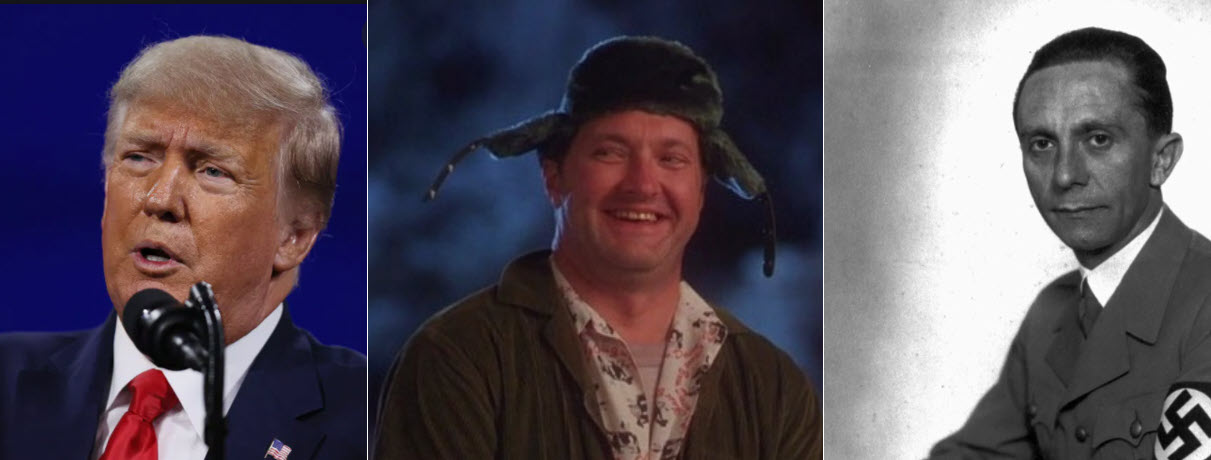
When Donald Trump became President, the old guard Republicans lost control of their party. The GOP is now controlled by a bunch of cousin Eddies’ (from Vacation), except this version of Eddy doesn’t have an ounce of decency or kindness. In fact, he’s more like an Eddy / Josef Goebbels hybrid, and he’s parked that God-awful RV smack dab in the middle of the Republican party.
Instead of taking out the trash, Donald Trump opened the front door and dragged the garbage into the GOP. And now, decent/moderate Republicans find themselves between a rock and a hard place, where If they turn their back on the Cousin Eddy Goebbels of the GOP, they’re likely going to be out of a job.
So, they sit and watch the transformative ruin of their party.
Democrats should work with Republicans to help them get back control of their party for the country’s good. They should reach out to moderates and cut some deals in exchange for expelling the growing number of Eddy Goebbels from the party – it might be the only way we save our country.
We have a free medicine at our disposal that limits the deadly effects of a virus for those who contract it while also reducing our ability to spread it.
We have mountains of data proving the medicine is safe and effective.
We also know how vaccinations work – that to protect the population at large, we need to meet a threshold of more than 80 percent.
In the past, we simply relied on people’s altruism to do the right thing.
In the past, we trusted that the scientific and medical community cared about the health and wellbeing of their fellow human beings.
In the past, when faced with a medical crisis like this pandemic, we rolled up our sleeves willingly – because we had a strong sense of community and cared about more than just ourselves or our “individual rights.”
I’m a bit tired of those who complain that any mandate infringes on their freedom. These people have politicized a public health emergency, which has made a bad situation worse.
The millions of people who ignore the global medical community (and most likely their own doctors) are primarily responsible for extending the pain, suffering, and economic uncertainty. And their decision is hindering our nation’s ability to get on the other side of the pandemic.
I don’t support forced vaccinations, but I’m okay with individual businesses requiring proof of vaccinations.
Businesses have a right to make decisions in the best interest of their customers and their employees. It’s akin to a business not allowing visitors to smoke in their place of business. They’re not telling people they can’t smoke at all. They’re simply saying that because the visitor’s decision to smoke poses a danger to others, they’re not going to allow it in their place of business.
Like smoking in public, the decision to not get vaccinated endangers others. And, unfortunately, it also increases the likelihood of new variants getting a foothold and spreading and prolonging the battle against the virus. In addition, as we’ve seen all over the country, the unvaccinated are putting undue stress on our healthcare system. Hospitals are running out of ICU beds because they are filled with unvaccinated COVID patients.
Proof of vaccination to enter crowded venues or stores or fly on an airline is not optimal. Still, when altruism doesn’t work, society must try to convince people to do the right thing.
In a society, we all sacrifice some individual freedoms for the greater good – if people decide they are not going to do that, they should bear some cost or suffer a consequence for their decision.
For as long we’ve existed, man’s kindness has been matched by his cruelty.
We’re a volatile and combustible mix of the easily misguided. Too often (under the influence of others), we drift towards our darker nature, nestle up to fear, hand reason over to blind faith, or swear a misguided allegiance to political tribes. In the past, this has led humankind down dark paths where we deny our fellow man freedom and dignity on a mass scale.
That’s been our history.
We’ve seen how the fluidly we move from our better selves to our darker nature and how easily influenced we are by the world around us. We’re not immune to the momentum of tumultuous events. And, because we’re more connected (technologically speaking) than ever before, we’re more susceptible to being collectively influenced, manipulated, and pushed towards our darker nature.
This is nothing new. We’ve teetered on the edge of darkness before. Manipulated by political and religious movements that feed on fear, hate, and irrationality. Unfortunately, I believe we’re teetering one of those precipices now, as world events push mankind towards our darker nature.
I still believe America can be a force for positive change. I’m not talking about nationalistic flag-waving “USA, USA, USA!!” patriotism, but rather all of us living by and promoting the ideals and ideas of Western Democracy.
To make mankind kind again, we must consciously engage in acts of kindness, resist being influenced by fear and fear mongers, put reason above religion, and ditch political tribalism for critical and idea-based thinking.
The uptick in political, social media posts about what’s going on in Afghanistan reveals just how shallow and vulnerable we’ve become. Sadly, the willingness to parlay human tragedy for political hay (I’ve done it myself) represents troubling fault lines for our country.
Joe Biden did not blow up Americans and Afghanis at the Airport in Kabul – religious extremists did. Instead of focusing on the enemies of reason and rationality, many Americans devolve into sectarianism, focusing their contempt on the American President.
I’m not suggesting Biden not be held accountable for missteps and intelligence failures that occur on his watch – he should be. But, instead, I’m suggesting that we remember Biden is not the enemy. Biden is not a religious extremist. He believes in American ideals. Our fight is not with him; it’s with ISIS, the Taliban, and any of the other man-made entities that are hellbent on pushing us to a darker existence.
I’m also suggesting that we differentiate malevolence from incompetence when critiquing our leaders. But, unfortunately, that requires nuanced and critical thinking – lost skills in America today.
Every President has moments of incompetence. Kennedy had his Bay of Pigs; Obama had his healthcare rollout. Bush fucked up majorly with his weapons of mass destruction debacle. Reagan screwed the pooch with Iran Contra, and Jimmy Carter botched a hostage rescue.
Humans are at the helm of intelligence. They push the pen and ink onto intelligence reports, and leaders act on the assessments. And sometimes, they make mistakes. And when this happens, citizens should speak up and demand accountability.
But Malevolence is a different kettle of fish.
Malevolence is knowing a pandemic is deadly but telling others just the opposite for personal political gain.
Malevolence is proposing our military shoot protesters in the legs or that leakers of information be executed.
Malevolence is spreading lies about election security and promoting insurrectionist movements against America.
Malevolence is courting and praising dictators for the control they have over their citizens.
That’s Malevolence.
Let’s not confuse Incompetence with Malevolence.
And malevolent leaders and wanna-be dictators thrive in periods of uncertainty. And sometimes, in a storm of uncertainty, citizens become blind to malevolent leaders.







 bendingtheneedle