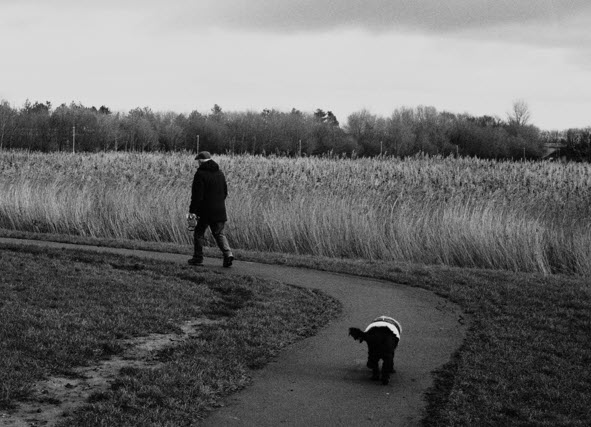
Robots in Human-Skin Suits

And round-and-round we go.

I’m more than a bit dismayed that I still wallow in work worry.

At 60 years old, I thought that shit would have dissipated by now, but it hasn’t.

I still lie awake at night and stress out about work.

And lately, worry is partnered (weirdly enough) with a growing and sustained apathy, where even though I’m frenzied and panicked about my job, I struggle to find the motivation needed to push through the mile-high mountain of inane yet necessary Zoom meetings, team stand-ups, One-on-ones with my managers, deliverable deadlines, and new processes, procedures, and tools.

You know you’ve reached a saturation point when you can’t summon the energy needed to organize your thoughts and quell your work worry.

And I’m beginning to think that’s where I am – at the intersection of panic and apathy.

If I never hear another “let’s jump on a call” or “find some time on my calendar,” I’ll be OK because honestly, after 35 years, work has become an exhaustingly joyless and life-draining endeavor – a toxic and twisted nest of feigned interest and stress made worse by the fact that our daily lives are unfolding against a devastatingly bleak backdrop of worldwide calamity; from our crumbling democracy to the rise of authoritarianism to the climate catastrophe, humanity is in shambles – making it damn-near impossible to focus on two-week Agile sprints and software deliverable deadlines.

At least, for me, it does.

And so, I’m itchy to retire. I want to step off the “dread mill,” put my work worry aside, and use the surplus of time and onset of calm to focus on things that matter – family, personal relationships, health and relaxation, and preparing for the apocalypse.

And actually, it’s beginning to feel like retirement might be close at hand — I mean, after 35 years, the next step, the one where my wife and I get to relax and smell the roses, should be just around the corner.

Right?

I consider myself one of the lucky ones. Barring a catastrophic financial meltdown, I hope to retire while I still have some tread on my soul. But for millions of Americans, the high cost of healthcare, housing, food, gas (and just about everything else) makes retirement a pipe dream.

If I had to continue the rest of my days writing bland and drier-than-dessert-dirt descriptions of software features, I don’t know what I’d do.

I did it for 35 years.

I’m ready to stop.

To keep at it when I no longer care would damage my emotional well-being.

Humans are strange; we keep doing what we do, even when we’re dead tired, exhausted, and deflated by it. Even when it brings us no joy and turns us into stressed-out, fidgety, and fragile work zombies, we keep on with it. Maybe because we have to. Maybe because we have no choice – we work or get swallowed up and spit out.

And fear prevents us from stopping (even for a minute), stepping back, and considering another path.

The system that we’re part of has turned millions of Americans into robots. Programmed and cultivated by the carrot-and-stick, the pot-of-gold-at-the-end-of-the-rainbow message of capitalism.

And so, we move ahead, expressionless, one foot in front of the other, until that final day when we stop and fall over into our shiny and perfectly polished coffins.

That’s no way to live, and not a good way to die either.

The Last Dance

When trouble sits in worry’s kettle

and scattered thoughts refuse to settle

we fold our days into tomorrow

and look at time as blood to borrow


Our parts are portions of the sum

we suck the pit out of the plum

and press its truth into our tongue


We swim around each other’s silence

Refuse the gift of self-reliance

then wear the badge of our defiance


We stretch our souls on to a drum

We beat it bare until it’s numb

then grind our smiles to the gum

to the nervous laughter of everyone


We paint the stars on to our eyes

We sing sad songs and lullabies

We crack the door, let in the light

to wrestle darkness from the night


We sit across from our despair

It smiles back, without a care

We let it in, we close the door

We dance above the kitchen floor

Mushroom Suit or Diamond Ring?

Death and burial used to be pretty straight forward:

You died.

They buried you (or maybe tossed your ashes to the wind).

They said a few words and got on with life.

The end.

Short and sweet.

Today there’s a plethora of creative ways to orchestrate your final exit.

Be One with the Earth

You can go with a “natural” burial, which involves being put directly in the soil in a way that promotes or even accelerates decomposition.

Here’s an interesting tidbit: Luke Perry of 90210 fame was buried in a mushroom burial suit containing mushroom spores that helped decompose his body and filter toxins from it.

The filtering and decomposition from a mushroom suit prevent surrounding plant life from being contaminated by the body. Not that Luke was any more contaminated than you or I.

I see natural burials as a form of human recycling, which I imagine is popular with the environmentally conscious – but I can also hear my conservative, non-environmentally conscious uncle quipping, “When I go, just put me out with the recyclables.”  

I suspect the squeamish might be put off by microbial decomposition, but I’m okay with it. It feels both altruistic and symbiotic.

People who choose this type of burial seem to be saying, “I’m no more important than the petunias” and “I don’t need to be memorialized with a headstone or plaque” – and as a humanist, that philosophy resonates with me. 

Be Above it All

Don’t want to be put in the ground? Then maybe a space burial is for you. 

Space burials launch your remains into space, where they orbit around the Earth or go to the Moon or somewhere further into space. Space burials even include cheaper “suborbital” excursions where the human remains are briefly transported into space before returning to Earth, where (hopefully) they can be recovered. 

To me, space burials seem braggadocios and sadly pathetic. 

“No, I’m not an astronaut – I’m an accountant. But I’m planning on being an astronaut after I die. So, yeah, I’m kinda like the Neil Armstrong of accounting.” 

I feel there’s an element of cowardice to space burials. It’s like being an astronaut without any of the risk. And from an ego perspective, space burials check all the boxes. They scream, “Look at me; I am one with the heavens! I AM A GOD!

Be Around Forever

The most fascinating alternative burial, at least to me, isn’t a burial at all.

The diamond growth process uses high-pressure technology to turn human ashes into diamonds for wearable “cremation jewelry.”

For anyone who isn’t religious but still wishes for eternal life, the diamond growth process puts a new spin on the old adage “diamonds are forever.” 

Personally, I have no delusions about an afterlife. As soon as I developed the ability to think critically, religion and eternal life registered as complete bullshit. I believe when you’re dead – you’re dead. Everything fades to black, and you cease to exist, except in the memories of loved ones – and even that is short-lived.

We’re all destined to fade away entirely, like the billions of ordinary people before us, who no one remembers – we will eventually be totally and irrevocably gone. And honestly, the thought of that doesn’t bother me in the least.

But something about an ashes to diamond after-life appeals to me. I like the idea of being an object amongst the living long after I’m dead – and even though I know I won’t be conscious or aware of this existence, the idea of it, as a living human being, interests me. 

Is that weird?

And being a ring on the finger or broach on the collar of a loved one might be a pretty cool icebreaker at a cocktail party.

What a lovely ring, where did you get it? Well, my dad gave it to me when he died – something to remember him by. And actually . . . 

I like the idea of being an heirloom passed down from generation to generation and remaining in the mix. And if someone in the future lineage of my family falls on hard times, and I end up in a pawn shop, that’s even better, because then the story of me goes in an entirely new direction.

To me, it’s all about the story; after all, what is life but a story.

When you’re a piece of jewelry, your destiny is fluid, unknown, and full of possibilities. Maybe you get lost at the beach, coming off your son’s finger as he body-surfs, only to be found a few weeks later by an elderly beachcomber who throws you in an old leather-bound jewelry box full of broken watches and faded polaroids and wears you every-now-and-then until the day he dies. At this point, you might end up as a mention in the final paragraph of the will of this total stranger and get passed along to the beachcomber’s favorite nephew, and off on new adventure you go.

The original story fades and gives way to another.

I’m aware that wanting to be turned into a diamond comes off as shallow. I can hear someone say, “Why can’t you die normal, like most people?” – and I guess I can see their point – but I don’t give a fuck.

And as an atheist, I like that we have this advanced scientific process that yells “Screw You” to the old Ashes to Ashes proverb from the Book of Common Prayer, which says that we’re made of dust and will return to ashes and dust after we die. 

No thanks, I’m returning as a diamond.

If you want to learn about the various burial options, check out Burial Alternatives – 23 Ultimate Ways To Check Out.

Tapestries

I’m going to be 61 this year. Looking back, there’s not a lot to brag about, but not much to be ashamed of either.

If I had to come up with a tombstone inscription, it might be:

Not a Hall of Famer, but a solid and dependable contributor (somewhere between Rico Petrocelli and Dwight Evans). 

As I head into my later years, I can say without hesitation that fatherhood has been the most consequential and vital endeavor in my relatively ordinary life.

On fatherhood, I’m by no means an expert. I failed many times, too many to count. But I learned a lot and improved over time (I think). 

One thing I learned is that our children are not us. 

Sure, they come into the world with DNA from both parents, but they’re not carbon copies of mom and dad. Instead, they’re pre-packaged with a distinctive thread of familial traits and characteristics going back generations, to be woven over time by master weavers’ Nature and Nurture into unique and complex tapestries. 

Those tapestries are colored and tamped by life’s sights, sounds, and touchpoints. From an early morning speckled splash of sunlight on the nursery ceiling – to the stony silence of a disengaged parent – to the warm embrace of a loving grandparent – every experience sets off a spark of emotion, which forms a memory to be stored and drawn upon continuously and subconsciously throughout their lives. 

Just “being” in the world exposes our kids to arbitrary cruelness and spectacular wonder (along with a healthy dose of the mundane). 

How they react to the cruel, wonderous, and mundane can’t be predicted. Their reactions depend on a sprawling range of environmental and sociological conditions and an unknown dose of biological and genetic factors. From the stability of the family unit to a kink in the banding pattern of a chromosome – it all gets factored into how kids develop and who they become.

Maybe there’s a proclivity for sadness, anxiety, or an innate gentle disposition. Maybe a child is born with an unbridled competitive spirit or an affinity for music or math. Perhaps there’s a dash of gender dysphoria. Whatever the case, the traits and characteristics kids are born with get stretched onto life’s loom, along with spools of environmental and sociological factors, out of which come these beautifully unique and flawed tapestries.

In life, there are no uniform patterns.

So, what’s our role as parents? How do we affect these tapestries that are our children?

As I see it, our primary role is to help our kids understand and accept their distinctive ” self ” to reach their fullest potential. 

This is easier said than done because even with the best intentions, our parenting skills are naturally dulled or diminished by the bias of our own experiences and expectations – I know mine were. 

I think many parenting failures are grounded in a shared belief; because our kids are borne from us, we have some innate understanding of them.

But we don’t.

And if we’re unwilling to recognize and accept that many of our preconceptions are wrong — or if we’re so hemmed in by our own experiences and expectations that we can’t break from them, we are liable to screw things up royally.

Parenting is a dynamic and fluid process.

Acknowledging we don’t genuinely know our children can open the door to getting to know them, which can lead to a more authentic understanding of them and help us parent more empathetically and effectively. 

Of course, for any of this to happen, parents must be present, loving, accepting, and willing to engage. When kids have someone in their life who is present, loving, accepting, and willing to engage – they’re more likely to open up and share. 

Recently I’ve been watching footage from parents of transgender kids testifying before committees on pending legislation restricting gender-affirming care for children. In almost all cases, there’s a point in their testimony where they recall the moment when they realized their child was different. That moment was often characterized by confusion and worry (this was not the tapestry they imagined!). What touched me as I listened to these parents was what they did after the confusion and worry settled. 

These parents listened to their children, talked to medical experts, and became advocates for their children. They overcame their biases (many of which were woven into their tapestries by their parents, churches, or communities) to see their children for who they are.  

These fathers and mothers learned that even though their own tapestries were of a particular color or pattern, their children’s tapestries differed. They understood that trying to prevent the child from being their authentic self was detrimental to their emotional well-being and that the best thing they could do for their child was to be present, loving, accepting, and engaged. 

Middle-Aged Joe

Today, at 55 years old, Joe realizes the rest of his tomorrows will never be as bright as most of his yesterdays. 

That epiphany catches him off guard.

The immediacy of it throws him off kilter. 

It wasn’t long ago that Joe felt relevant, steady, and somewhat optimistic about life, the world, and his place in it. 

Now he flounders. 

He’s a floundering Joe. 

A man-fish swimming against the steady current of uncertainty.

How did I not see this coming?” he mutters.

Moderately well-off, Joe is considered successful — especially in America, where success is measured by the home you own, the car you drive, and the stuff you have.

In America, materialism and success are inextricable. 

So, why does middle age feel like an existential threat to Joe?

Why (with his level of success) is Joe suddenly riddled with insecurities? 

Crisis set up shop in Joe’s head when he realized that success, as defined by society, is different from success as defined by biology and (more specifically) virility.

Virility provided a competitive advantage early in man’s evolution. It was sought after by the opposite sex and went hand-in-hand with male success. And though virility and success are not as tightly coupled today, the embers of that dynamic duo still smolder at the core of the male brain.

Virility improved the success rate of man’s biological directive to mate. That type of biologically controlled messaging is difficult to override — even in man’s evolved state. Because of this, something strange happens to men sociologically when they sense a decline in their virility.

It’s not that Joe feels less virile. It’s more of an awareness of how others perceive him — or how others barely notice him at all.

Gone are the days of side glances from attractive strangers.

A waning biological relevance makes Joe feel like he’s disappearing – like he’s being involuntarily airbrushed into the landscape – a crooked aging tree at the base of a mountain – an artist’s afterthought.

In the face of this involuntary disappearing act, Joe becomes desperate. He knows he can’t un-tick the clock, but he has access to cash.

They say money can’t buy happiness — but it can get you noticed.

And so, Joe begins the age-old American dance (often pathetic, rarely successful) of reclaiming virility through materialism – by heading to the local Chevy dealership and purchasing a brand-new ego booster.

At first, he feels pretty good about himself – heads are turning on the boulevard! 

But the feeling is short-lived.

Over time, squeezing in and out of his little red Corvette doesn’t turn back the clock; it just reminds Joe of the uncomfortable logistics of aging.

Joe parks the car in his garage and rarely takes it out.

Maybe it’s my style? Maybe I don’t have any style?” Joe says to himself in the mirror.

So, he treks to the mall, platinum card in hand, and treats himself to a hip new wardrobe of skinny jeans and UNTUCKit shirts, disregarding the well-known truth — that clothes always look better on the mannequin and catalog model. 

Joe’s clothes no longer hang on him fashionably. Instead, they bring unwanted attention to what he’s desperately trying to hide.

And what makes Joe think he can pull off the skinny jeans’ thing like he’s Mick Jagger? 

The audacity!

The one thing that makes Joe feel better is hitting the gym and changing his diet.

He isn’t turning any heads huffing and puffing on the Stairmaster, but he’s lost a little weight, and his mood is lighter. Even though he considers this a minor victory, he knows there’s no stopping father time from fucking with him.

Life is a conveyor belt.  

As Joe transitions from middle age, he realizes acceptance is his only play.  

Acceptance leads to tranquility, which leads to confidence, and confidence is like a fine wine – it ages well.

Tuesday, 6:45 AM

She’s been staring at him intently for 20 minutes, when finally, he awakes to her panting.

He raises his head from the pillow and, with eyes half-opened, pats the bed gently. She thumps the mattress with her tail, yawns, and wriggles up to him.

Good morning, friend. 

They begin their final day together with a loving scratch behind the ear. 

He scoops her into his arms and feels her heart’s clunky and irregular beat against his chest. He lowers her carefully to the floor; her hips wobble, her back legs fold, and she collapses.

This has been their morning routine for the last several weeks.

She looks at him apologetically. He whispers, “It’s okay, girl” and helps her to her feet.

She walks gingerly to her water bowl, takes a few sips, looks up at him, and wags her tail. For a decade, they’ve inhabited each other’s world. A life wrapped in routine and the warmth of deep companionship.

Age has slowly crept up on her – from the floating blue cataract cloud in her eyes to the rounded and tanned teeth in her mouth. Then, with resignation, the man mutters, “From pearly whites to tiger’s eyethey tell the tale of you and I” and gives her a pat.

He slips a frayed collar decorated with dog bones and frisbees over her head, clips the leash to it, and together they walk out the door. 

Even in her declining state, she relishes the ritual, nose to the ground, intently sniffing clover, dirt, thistle, and weed. A complex puzzle of smells awakens a flood of memories; momentarily, she becomes infused with a youthful spirit. A stiffened gate and spritelier walk return, bringing a slow smile to the man’s face. 

She raises her head towards a gentle gust of wind, wistfully smiling at the gift-bearing breeze. But by the time they return home she’s laboring. He carries her into the house.

He decided last year to take a leave from work when he noticed a change in her health. On a fast track for promotion and highly regarded throughout the company, he sometimes heard whispers in the halls, “For a dog—a DOG?

Their appointment with the veterinarian is an hour away. He sits with her on the kitchen floor and cries. She looks at him forgivingly, then places her head on his lap and closes her eyes. 

An Untapped Opportunity?

When it comes to AI, It’s not a matter of if but when.

When AI becomes smarter and when companies begin replacing employees with AI tools and applications.

Corporations are throwing money (see Microsoft’s multi-billion-dollar investment in OpenAI) and resources at AI technologies that can lower costs and improve outcomes for them and their customers. 

AI will be a disruptor and a differentiator for businesses across all sectors, from retail and manufacturing to research and transportation, to software and content development.

The latest AI technologies will touch everything and everyone. They’ll affect the world’s economic food chain in ways we’ve never experienced. And while companies scramble to beat their competitors to the punch when applying AI to their processes and applications, our society fidgets and nervously awaits the next brave new world.

Creating corporate-sponsored programs and government policies to train workers in AI might work in the short term. Still, the more advanced AI becomes, the less reliant on humans it will be. Of course, small numbers of people with specialized and advanced AI skills will find complementary roles in this new work paradigm, but many others will not. For the worker, jobs will disappear, and wages will drop. For corporations, profits will soar. 

We (especially Americans) measure personal success in terms of our work and compensation because most of what we value — the house we own, the car we drive, the family vacations we take, and the sense of safety and security we provide our children is inherently tied to our work and compensation. And thus, our definition of success and how we value ourselves are all balled up in what we do for a living, what we can afford, and how well we can provide. 

When automation began replacing workers in manufacturing, those workers lost more than their jobs. People (who just a few years before had a valued and specialized skillset) became obsolete. Unable to pay their mortgages, afford their car, take a family vacation, or provide security for their children, they lost their sense of self-worth. And because the skills they brought to their workplace could now be replicated by a machine, they also lost hope. To survive and be successful again, they’d need to start over – learn new skills, and claw their way back to relevance. For many, that challenge was too great, and they gave up on life. Research shows a causal link between investment in automation and rising mortality levels, “with this rise largely due to so-called deaths of despair, such as drug overdoses and suicides. This was especially so for men and women aged between 45 and 54.

So, how do we avoid future deaths of despair when the new AI takes hold across industries? 

What will our societal response be to millions of jobs disappearing in the wake of AI-driven software and automation? 

What happens when the magnitude of job replacement from AI exceeds what we experienced when automation in manufacturing became the norm?

AI is not inherently bad. Its impact on society will largely depend on our reaction to it. We need outside-the-box thinkers in economics, business, the social sciences, and government to begin planning for the consequences of success when it comes to AI, because the effect on humans will be broad, deep, and potentially devastating. 

If AI and automation become the benchmark for productivity and success within a corporation, then perhaps AI presents us with an opportunity to reshape what it means to be a productive and successful human.

What if AI allows people to focus on a higher purpose?  If AI kills more jobs than it creates (and I think it will), we might consider implementing universal basic income (UBI) to help people find purpose in this brave new world, without fear of losing the roof over their heads.

With the right social and economic safety nets in place, AI can give people the space and the time to become better humans, where instead of defining success by work and compensation, we define it by how we treat others, by volunteerism, and through our capacity to love and care for one another — you know, the things that machines and AI can’t do.

Dark Day Afternoon

Doomsday just inched a bit closer

So says the clock on the wall

Amused, nihilistic humans   

just waiting for mankind to fall!


We know the problem’s we’re facing

We know what needs to be done

We know that the weapon is loaded

but we like the taste of the gun


We’re ninety seconds from doomsday

So says that guy on the news

“It’s the end of the world as we know it”

A theme song to give us the blues


Doomsday just inched a bit closer

it nuzzles up to the fear in our head

The tick of the clock getting louder

It thickens our fear into dread


Religious to the point of destruction

Tribal to our own self-defeat

Chained to a blood-violent nature

Man and doomsday were destined to meet

The Cleaner and His Cat

He stares blankly at his coffee, wondering how long he’s been sitting, cup in hand. The last sip must have been hot. He can still feel the blister on the tip of his tongue.

A dark sadness hangs on his face like a Picasso. He hates the look.

“Definitely his blue period,” he muses, half smirking at his reflection in the dining room mirror.

He mostly avoids reflective surfaces. Feeling depressed is terrible enough; he doesn’t need to see it. He doesn’t need to be reminded of it.

His cat circles impatiently, rubbing against his calf. “Time to eat,” he purrs. . . . “Snap out of it!” he meows. 

On days like today, he’s grateful for his cat. The cat’s well-timed reminders keep the man from the doorknob and belt and the dark thoughts that tie everything together. 

He whispers, “My demise will have to wait; there’s a cat to feed and a litterbox to clean.”

His apartment is a shambles. It mirrors the cluttered chaos in his head. Based on experience, he knows a good house cleaning will lift his spirits.

He often wonders how feng shui works its magic on the mind. “I’ll have to google that,” he says toward his full-bellied cat, who bathes contently in a patch of sun on the kitchen floor.

The sink is full. There’s half-eaten food caked on dishes, the remnants of last week’s menu. Why not just clean up after each meal? Especially knowing that cleanliness and order help quell his anxiety.

“Why do I let things pile up?

What keeps me from staying on top of things? 

Will I ever grow out of this?

That last question knocks around the inside of his skull like an unselected lottery ping-pong ball.

Will I ever grow out of this?

Of course, he didn’t know the answer to that question. He remembers a bright era of pre-affliction, which gives him hope. He thinks, “If I magically went from being happy to depressed, why can’t I miraculously go from depressed to happy?”

Unfortunately, there’s a history – a consistent footprint on the ladder of his family’s DNA. He’s been branded in a sense, and sometimes that feels so fatalistic he simply wants to give up.

But he doesn’t.

He continues to clean.

An Ugly Lust for Power

Floating in his own orbit

absent from the ethos of ethics

he was driven by an ugly lust for power

fueled by an insatiable desire for attention

bootlicked and buttressed by a sycophantic public

and buoyed by yes men


The man was wholly unhinged from truth

divorced from morality

and devoid of integrity


Gripped by insecurity

and the crippling fear of being labeled a loser

he cultivated lies and deceit


Like a Shakespearean witch

hunched over a cauldron

of poisonous misinformation

he hatched his plan

to cling to the reins of power

just long enough to topple the republic


For a few hours that day

our democracy flickered and dimmed

teetering on the dark edge of an authoritarian abyss


and if not for the courage of a few

and the rationality of the rest

We’d have lost our democracy

and the hope and freedom it brings to us


It would be a fatal mistake to think

the bullet we dodged cannot be reloaded

The confederacy of cowards

who defended the snake

and helped perpetuate the crime

still walk the halls of congress

and just beneath the ashes

of the failed attempt

are the smoldering embers

of the next