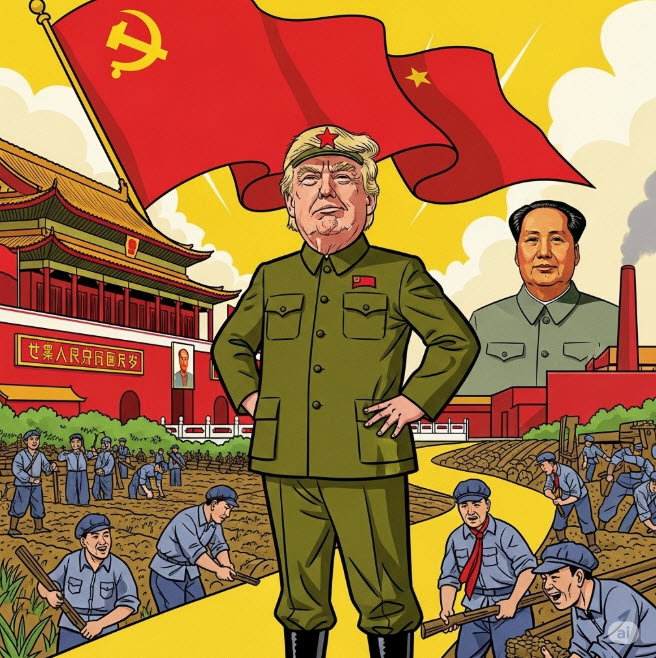
Comrade Donny

A few days ago, I had dinner with an acquaintance from China. He is an engaging and inquisitive young man, interested in America and American culture.

From our conversation, I learned that to the Chinese citizens, America is still that shining city on the hill. Well-off Chinese parents send their children to American prep schools, colleges, and universities because they believe doing so gives their children an advantage they can’t get in China.

I learned that in China, breaking free of the class you are born into is nearly impossible and that even white-collar professionals struggle to buy homes and save money, often relying on parents for support.

We discussed the many differences between our two countries before sitting down to dinner. Even though our countries couldn’t be more different, we connected on a human level. We loved our families and wanted a better world for them.

After dinner, I broached the subject of our President, asking my acquaintance how people in China view President Trump. He smiled politely and chuckled. “We refer to him as Comrade Trump – a member of the Chinese Communist Party.”

“We think he is insane, but ultimately helpful to China.”

Orange is the new Red

The unpredictability of Trump’s aggressive tariff policies, shifting trade strategies, and draconian immigration tactics presents an opportunity for China.

Here’s how China is taking advantage of President Trump’s ham-fisted and chaotic approach to global trade and why some Chinese refer to him as “Comrade Trump.”

Perception Shift

  • A global analysis reveals that while the U.S. has experienced a decline in favorability due to Trump’s tariffs and immigration policies, China’s image has improved in many countries.
  • China now enjoys a net favorability rating of +8.8, compared to the U.S.’s -1.5, marking a significant gain in soft power.

Trade Diversification and Realignment

  • China has responded to U.S. tariffs by intensifying trade with other partners, including the EU, ASEAN nations, and Belt and Road countries.
  • Trump’s tit-for-tat tariff war prompted China to reduce its reliance on U.S. imports and strengthen its domestic supply chains.

Boost to Domestic Industries

  • U.S. tariffs on Chinese goods have led to price hikes in the U.S., making Chinese alternatives more attractive in other markets.
  • China has used the opportunity to promote its own tech, energy, and manufacturing sectors, especially in regions where U.S. influence has waned.

Diplomatic Leverage

  • The Trump administration’s erratic trade policies have alienated traditional allies, giving China room to present itself as a more stable and predictable partner.
  • China has capitalized on this by deepening ties with countries affected by U.S. tariffs, including those in Africa, Latin America, and Southeast Asia.

Economic Resilience and Adaptation

  • Despite high tariffs (some reaching 145% on Chinese goods), China has adapted by shifting exports, investing in domestic innovation, and retaliating strategically.
  • The disruption has accelerated China’s push for self-reliance in key sectors like semiconductors, green energy, and AI.

Despite what he says, Donald Trump is not making America great or putting America first. Instead, his inability to read the “global” room, his misunderstanding of how tariffs work, combined with a noxious personality, inflated self-image, insatiable greed, and an unquenchable desire to be the center of attention, is causing irreparable harm to America while creating unprecedented opportunity for China.

Well done, Comrade Trump!
An Untapped Opportunity?

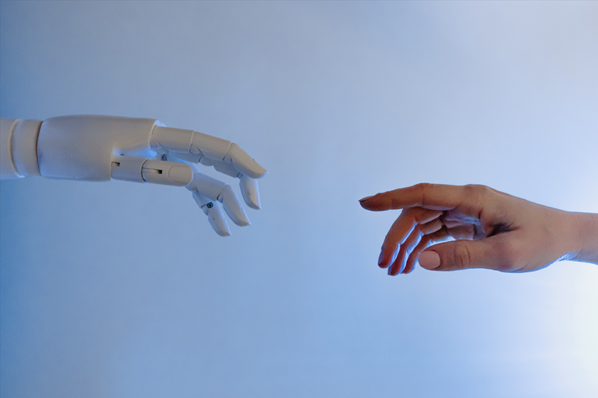
When it comes to AI, It’s not a matter of if but when.

When AI becomes smarter and when companies begin replacing employees with AI tools and applications.

Corporations are throwing money (see Microsoft’s multi-billion-dollar investment in OpenAI) and resources at AI technologies that can lower costs and improve outcomes for them and their customers. 

AI will be a disruptor and a differentiator for businesses across all sectors, from retail and manufacturing to research and transportation, to software and content development.

The latest AI technologies will touch everything and everyone. They’ll affect the world’s economic food chain in ways we’ve never experienced. And while companies scramble to beat their competitors to the punch when applying AI to their processes and applications, our society fidgets and nervously awaits the next brave new world.

Creating corporate-sponsored programs and government policies to train workers in AI might work in the short term. Still, the more advanced AI becomes, the less reliant on humans it will be. Of course, small numbers of people with specialized and advanced AI skills will find complementary roles in this new work paradigm, but many others will not. For the worker, jobs will disappear, and wages will drop. For corporations, profits will soar. 

We (especially Americans) measure personal success in terms of our work and compensation because most of what we value — the house we own, the car we drive, the family vacations we take, and the sense of safety and security we provide our children is inherently tied to our work and compensation. And thus, our definition of success and how we value ourselves are all balled up in what we do for a living, what we can afford, and how well we can provide. 

When automation began replacing workers in manufacturing, those workers lost more than their jobs. People (who just a few years before had a valued and specialized skillset) became obsolete. Unable to pay their mortgages, afford their car, take a family vacation, or provide security for their children, they lost their sense of self-worth. And because the skills they brought to their workplace could now be replicated by a machine, they also lost hope. To survive and be successful again, they’d need to start over – learn new skills, and claw their way back to relevance. For many, that challenge was too great, and they gave up on life. Research shows a causal link between investment in automation and rising mortality levels, “with this rise largely due to so-called deaths of despair, such as drug overdoses and suicides. This was especially so for men and women aged between 45 and 54.

So, how do we avoid future deaths of despair when the new AI takes hold across industries? 

What will our societal response be to millions of jobs disappearing in the wake of AI-driven software and automation? 

What happens when the magnitude of job replacement from AI exceeds what we experienced when automation in manufacturing became the norm?

AI is not inherently bad. Its impact on society will largely depend on our reaction to it. We need outside-the-box thinkers in economics, business, the social sciences, and government to begin planning for the consequences of success when it comes to AI, because the effect on humans will be broad, deep, and potentially devastating. 

If AI and automation become the benchmark for productivity and success within a corporation, then perhaps AI presents us with an opportunity to reshape what it means to be a productive and successful human.

What if AI allows people to focus on a higher purpose?  If AI kills more jobs than it creates (and I think it will), we might consider implementing universal basic income (UBI) to help people find purpose in this brave new world, without fear of losing the roof over their heads.

With the right social and economic safety nets in place, AI can give people the space and the time to become better humans, where instead of defining success by work and compensation, we define it by how we treat others, by volunteerism, and through our capacity to love and care for one another — you know, the things that machines and AI can’t do.