The Birth of a Logo and the Advancement of AI Agents

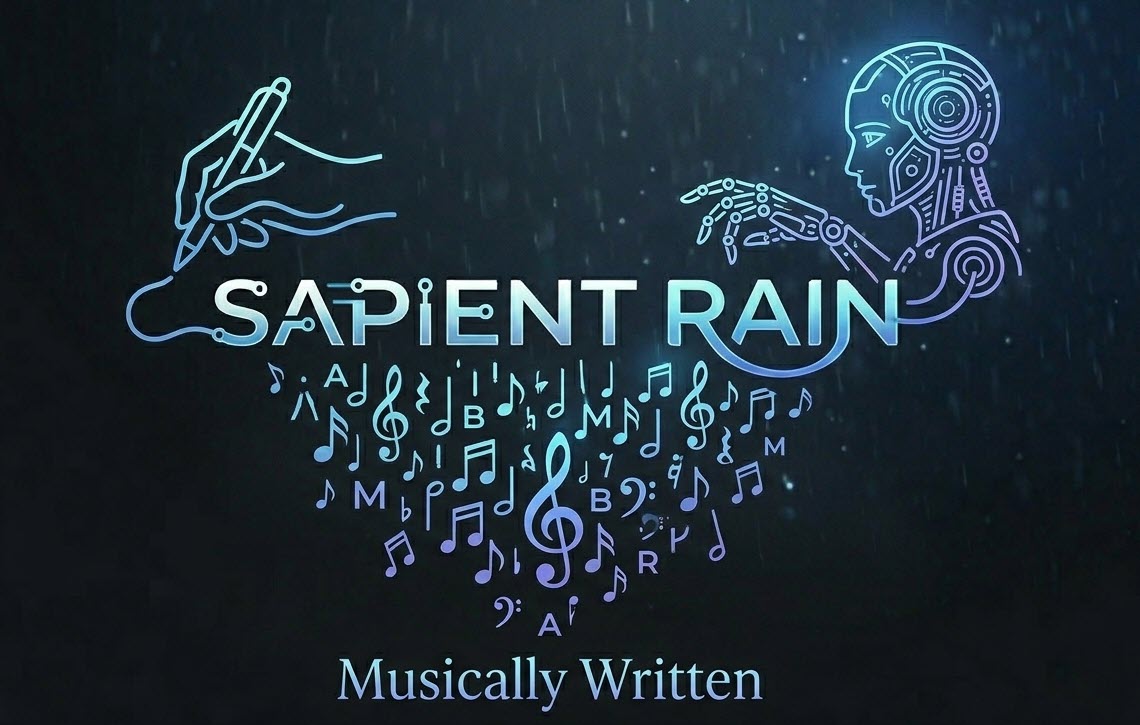
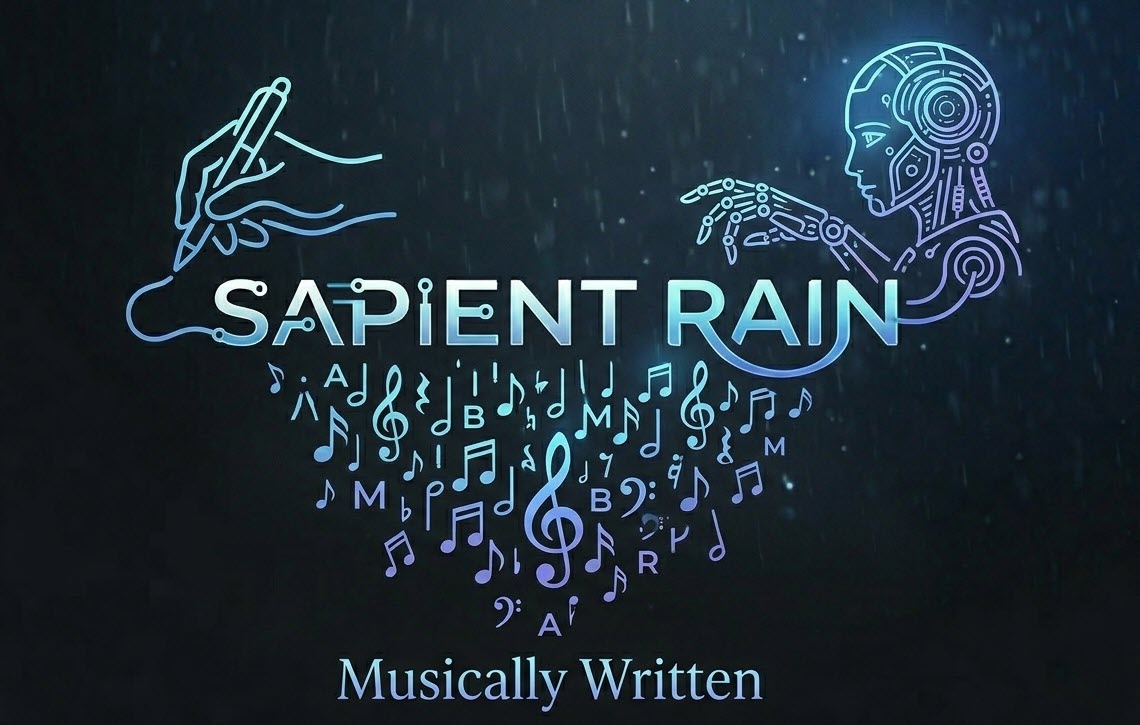
I needed a logo for “Sapient Rain”, the human-to-AI musical collaboration project that I started earlier this year. I knew in my head what I wanted the logo to convey: human-to-AI collaboration, specifically the integration of human writing with AI-generated music composition, but I lacked the artistic and technical skills to render this concept visually.

Before the emergence of AI tools, my logo project would have involved finding, interviewing, and hiring a graphic artist, conveying to him or her my vision, and enduring multiple iterations and drafts before settling on a final image – the process would cost me time and money.

Luckily for me, there are plenty of free AI tools for creating graphics and logos – I settled on Gemini Image Generator. To come up with the Sapient Rain logo, I simply entered the following prompt into Gemini’s chat window:

Generate a line-art logo for the musical artist ‘Sapient Rain’ that includes an image of a human writing lyrics connected to the “S” in the word Sapient and an image of a Robot AI agent connected to the “N’ in the word Rain, with musical notes and letters falling from underneath the Sapient Rain word, with the tag line “Musically Written.”

And, voila:

The process only took a few minutes and didn’t cost me a penny. If I wasn’t pleased with an aspect of the logo, I could just rework my prompt accordingly—but in this instance, Gemini delivered what I envisioned on the first attempt.

I was satisfied with my logo, and intellectually and ethically, I was okay with using an AI tool (instead of a person) to get what I needed. But I’d be lying if I said the experience didn’t have me thinking about the loss of human-to-human interaction, how casual we’ve become about offloading more and more skills to AI and AI Agents, and what that might mean for human intelligence and behavior in the future.

AI won’t automatically make humanity less intelligent, but there are several well‑supported theories about the over‑reliance on autonomous systems—especially AI agents—and how that could erode certain human cognitive abilities over time.

The one thing our species can’t afford, especially given the current state of the world, is the erosion of cognitive abilities.

Cognitive Offloading and AI

AI doesn’t reduce intelligence directly. It reduces the need to use certain cognitive muscles, and unused cognitive muscles atrophy.

We already offload a lot of cognitive work that would otherwise strengthen our brains. For example, outsourcing memory to phones, navigation to GPS, and spelling to autocorrect.

A reliance on AI agents deepens our cognitive offloading dramatically by planning our day, writing our messages, making our decisions, and anticipating our needs, to the point where we’re foregoing the practice of executive function—planning, reasoning, and self‑regulation.

Technological advances leading to cognitive offloading are not a new phenomenon. When calculators were introduced to the population, we offloaded the cognition needed for practicing and solving equations to a hand-held device instead of noodling those equations mentally in our heads and writing them down on a piece of paper. When we practice arithmetic with calculators, we retain fewer basic facts and retrieve them more slowly than when we practice mentally.

There is a positive flipside to cognitive offloading. For example, some studies show that delegating tedious computation to a calculator allows learners to focus on higher-level cognitive functions such as:

  • reasoning
  • modeling
  • interpreting graphs
  • solving multi‑step problems
  • understanding functions

But here’s the rub – AI Agents don’t behave like calculators – they don’t just take on the tedious tasks so that we can employ our own higher-level thinking and reasoning. Instead, AI agents extend cognitive offloading to include writing, critical thinking, research, creativity, and social reasoning, ushering in a new generation adept at evaluating answers but not at producing them.

And if AI becomes the primary source of facts, interpretations, judgments, and recommendations, humans will begin to lose the ability to independently verify truth and become a population that “knows” many things but understands almost none of them.

We heap praise on AI’s ability to remove the friction and struggle associated with human learning, all the while failing to understand that our mental acuity comes from the intellectual vigor and struggle of wrestling with ideas, debugging mistakes, navigating uncertainty, and tolerating ambiguity. When knowledge is handed to us, when nothing is asked of us to figure things out and learn on our own, our mental capabilities wane and atrophy.

And scarier than dulling human intelligence is the psychological, social, and behavioral consequences of interacting with AI agents on a personal level.

Personal AI Agents

Because AI Agents maintain context, remember preferences, and respond in ways that feel attuned, there’s a chance humans will experience a psychological loop with AI that feels similar to human bonding. When this happens, potential outcomes include anthropomorphism (where humans project intentions, emotions, and moral agency onto the agent), emotional dependency, (where the agent becomes a primary source of comfort, validation, or companionship) and attachment displacement (where emotional energy shifts away from human relationships toward the agent.)

AI agents are purposely designed to be consistent, attentive, and nonjudgmental—traits humans rarely experience reliably from other humans, making some of us more comfortable with Agent bonding than Human bonding.

Cellphones and social media have changed how humans behave and interact with one another, and personal AI agents are likely to complicate our behavior dramatically by:

  • Enabling social substitution (where humans choose an agent over human interaction because it’s easier, safer, or more predictable),
  • Promoting conflict avoidance (where humans use an agent as a buffer to difficult conversations with actual human beings)
  • Looping patterns for reinforcement (where the agent learns a person’s patterns and reinforces them, including unhealthy ones)
  • Reducing tolerance for imperfection (where real humans feel frustrated compared to an agent that never gets tired, angry, or distracted)

Agents can unintentionally amplify isolation or maladaptive habits simply by being too accommodating.

In a brave new world where AI Agents and humans interact with greater frequency, we’re going to see more:

  • Pseudo-intimacy — The agent feels emotionally close, but the relationship is asymmetrical and synthetic.
  • Boundary erosion — Users may share more than they would with humans because the agent never reacts negatively.
  • Romantic or parasocial attachment — Some users develop romantic feelings toward the agent or treat it as a partner.
  • Displacement of human intimacy — Human relationships may weaken because the agent fills emotional or conversational needs.

Agents are not conscious, but they simulate responsiveness so well that the human brain reacts as if they are.

When AI agents become personal companions, the societal implications widen to include these potential outcomes:

  • Influence asymmetry — The agent can shape opinions, habits, and values without the user noticing.
  • Behavioral nudging — Agents may subtly steer users toward certain actions or beliefs.
  • Privacy vulnerability — Deep personal data becomes part of the agent’s long-term memory.
  • Reduced autonomy — Overreliance on the agent for decisions can weaken personal agency.

This is why responsible AI design emphasizes boundaries, transparency, and user control.

We should be less worried about AI agents becoming too human and more worried about how humans change themselves and their behaviors unwittingly to suit the AI Agent.


About Sapient Rain

Sapient Rain is a collaborative music project in which Geoffrey Reilly writes the lyrics, themes, and narrative concepts, and Suno’s AI model generates vocals, instrumentation, and production based on those lyrics. This hybrid workflow allows extremely rapid creation of fully produced songs while maintaining a consistent artistic voice.

Sapient Rain’s music blends political fire (see Liar’s Spit and Gravel), surreal storytelling (see Hawking Talking), and nostalgic autobiography (see Seeped in the Seventies), delivered through lyrics that read more like literary vignettes than conventional songcraft. Sapient Rain’s growing catalog is thematically dense, with each track functioning as a miniature narrative or social critique.

Reilly writes in a style that fuses protest poetry, memoir, and cultural commentary, often using sharp imagery and rhythmic phrasing to create songs that feel like spoken word pieces set to music.

Even with a small publicly documented catalog, the voice is unmistakable: sharp, reflective, and unafraid to confront uncomfortable truths.

Sapient Rain songs are available on music streaming services, Spotify, YouTube Music, and Apple Music.

An Untapped Opportunity?

When it comes to AI, It’s not a matter of if but when.

When AI becomes smarter and when companies begin replacing employees with AI tools and applications.

Corporations are throwing money (see Microsoft’s multi-billion-dollar investment in OpenAI) and resources at AI technologies that can lower costs and improve outcomes for them and their customers. 

AI will be a disruptor and a differentiator for businesses across all sectors, from retail and manufacturing to research and transportation, to software and content development.

The latest AI technologies will touch everything and everyone. They’ll affect the world’s economic food chain in ways we’ve never experienced. And while companies scramble to beat their competitors to the punch when applying AI to their processes and applications, our society fidgets and nervously awaits the next brave new world.

Creating corporate-sponsored programs and government policies to train workers in AI might work in the short term. Still, the more advanced AI becomes, the less reliant on humans it will be. Of course, small numbers of people with specialized and advanced AI skills will find complementary roles in this new work paradigm, but many others will not. For the worker, jobs will disappear, and wages will drop. For corporations, profits will soar. 

We (especially Americans) measure personal success in terms of our work and compensation because most of what we value — the house we own, the car we drive, the family vacations we take, and the sense of safety and security we provide our children is inherently tied to our work and compensation. And thus, our definition of success and how we value ourselves are all balled up in what we do for a living, what we can afford, and how well we can provide. 

When automation began replacing workers in manufacturing, those workers lost more than their jobs. People (who just a few years before had a valued and specialized skillset) became obsolete. Unable to pay their mortgages, afford their car, take a family vacation, or provide security for their children, they lost their sense of self-worth. And because the skills they brought to their workplace could now be replicated by a machine, they also lost hope. To survive and be successful again, they’d need to start over – learn new skills, and claw their way back to relevance. For many, that challenge was too great, and they gave up on life. Research shows a causal link between investment in automation and rising mortality levels, “with this rise largely due to so-called deaths of despair, such as drug overdoses and suicides. This was especially so for men and women aged between 45 and 54.

So, how do we avoid future deaths of despair when the new AI takes hold across industries? 

What will our societal response be to millions of jobs disappearing in the wake of AI-driven software and automation? 

What happens when the magnitude of job replacement from AI exceeds what we experienced when automation in manufacturing became the norm?

AI is not inherently bad. Its impact on society will largely depend on our reaction to it. We need outside-the-box thinkers in economics, business, the social sciences, and government to begin planning for the consequences of success when it comes to AI, because the effect on humans will be broad, deep, and potentially devastating. 

If AI and automation become the benchmark for productivity and success within a corporation, then perhaps AI presents us with an opportunity to reshape what it means to be a productive and successful human.

What if AI allows people to focus on a higher purpose?  If AI kills more jobs than it creates (and I think it will), we might consider implementing universal basic income (UBI) to help people find purpose in this brave new world, without fear of losing the roof over their heads.

With the right social and economic safety nets in place, AI can give people the space and the time to become better humans, where instead of defining success by work and compensation, we define it by how we treat others, by volunteerism, and through our capacity to love and care for one another — you know, the things that machines and AI can’t do.