Dumbo’s Jumbo and the Emoluments Clause

Emoluments are a salary, fee, or profit from employment or office.

The Emoluments Clause of the US Constitution aims to prevent corruption and foreign influence on government officials. 

The Qatari Jet Controversy

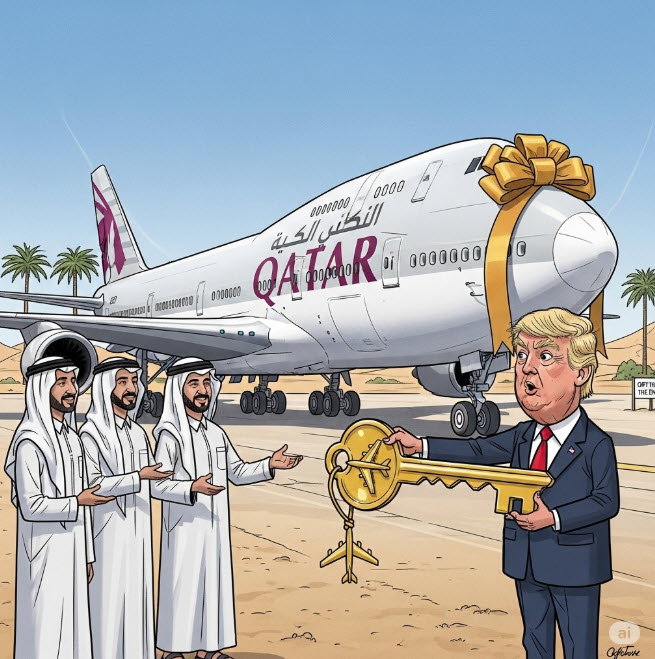
When Donald Trump accepted a 747-8 luxury jetliner from the Qatari government, it raised concerns of a potential violation of the Foreign Emoluments Clause of the US Constitution, which prohibits federal officeholders from accepting gifts, payments, or titles from foreign governments or the US government without the consent of Congress.

I doubt Donald Trump, who demonstrates ignorance and disdain for our Constitution on a regular basis, give’s a flying fuck about the Emoluments Clause. According to Donald Trump, “It would be stupid not to take the gift.”

Here are the tids and the bits:

  • Qatar reportedly gifted a luxury Boeing 747-8 to President Trump, intended for use as Air Force One and later transfer to his presidential library.
  • Critics argue this is a clear violation of the Emoluments Clause, especially since the jet is valued at $400 million or more.
  • Legal experts and former ethics officials say the gift appears to benefit Trump personally, even if routed through the U.S. military.
  • A DOJ memo reportedly justified the acceptance, but its contents haven’t been publicly released and are now the subject of a lawsuit

And although Trump claims the plane is a “GIFT, FREE OF CHARGE,” the American taxpayer will foot the bill for retrofitting the plane, just so our American Dumbo can fly his Qatari Jumbo.

The cost estimate for retrofitting the gifted jet liner for presidential use is between $400 million and $1 billion or more, the latter amount taking into consideration advanced security systems, encrypted communications, anti-missile defenses, and a full sweep for espionage threats.

The Qatari Jet Controversy isn’t the only potential violation of the Emoluments clause. Here’s a look at other Trump political initiatives and actions that have enriched him personally during his presidency.

Political Initiatives that Enriched Trump Personally

Retention of Business Empire

  • Trump refused to divest from his businesses while in office, maintaining ownership and control of the Trump Organization.
  • His properties—including hotels, golf courses, and real estate—continued to operate and profit during his presidency.

Foreign Government Patronage

  • Over 150 foreign officials from 77 countries stayed at or hosted events at Trump properties.
  • The Chinese government alone reportedly spent at least $5.5 million at Trump-owned venues.

Domestic Government Spending

  • U.S. government agencies spent taxpayer money at Trump properties, including Secret Service lodging and event hosting.
  • State governments also used Trump venues for official functions, raising concerns under the Domestic Emoluments Clause.

Promotion of Trump-Branded Products

  • Trump promoted personal products like branded Bibles, cologne, and even guitars during his presidency.
  • His media ventures, including Truth Social and Trump Media & Technology Group, gained visibility and investment while he was in office.

International Real Estate Deals

  • Trump’s business pursued or maintained real estate developments in Saudi Arabia, Oman, and the UAE, some allegedly funded by foreign entities.
  • These ventures continued without congressional approval, despite constitutional requirements.

Emoluments Clause Violations? You Be the Judge!

The U.S. Constitution contains two key provisions:

ClauseDescriptionAlleged Violation
Foreign Emoluments ClauseProhibits federal officials from receiving gifts, payments, or benefits from foreign governments without congressional consent (Article I, Section 9, Clause 8)Trump received millions from foreign governments via business transactions without congressional approval
Domestic Emoluments ClauseProhibits the president from receiving any benefit from the federal or state governments beyond salary (Article II, Section 1, Clause 7)Trump profited from federal and state spending at his properties

Should a sitting president be allowed to retain ownership of private businesses that receive payments from foreign or domestic governments? This question strikes at the heart of the Emoluments Clause debate. Trump’s refusal to divest created a direct conflict of interest and undermined the Constitution’s anti-corruption safeguards.

Thoughts?


If you haven’t had a chance yet, please check out my book, My Paper, My Words: Rantings from a Progressive Boomer and Peeved Parent, from Amazon. And if you feel moved to write a review of the book, on Amazon, or anywhere else, I’d be honored.

            My Paper, My Words is a collection of essays, stories, and poems reflect the challenges of a middle-class husband and father trying to navigate a rapidly changing political, religious, and technological landscape of post-911 America.

Let’s Ask Arty About the Correlation Between Religiosity and Authoritarianism

Let’s Ask Arty uses existing Artificial Intelligence (AI) technology to query LLMs about politics in these troubled times.

Query 1: Are religious fundamentalists drawn to authoritarian political leaders? If so, why?

Yes, religious fundamentalists often show a strong affinity for authoritarian political leaders – and there’s a fascinating psychological and sociological logic behind it.

Shared Traits and Psychological Alignment

  • Rigidity and Certainty: Fundamentalism is rooted in the belief in an inerrant set of religious teachings; religious rigidity and certainty mirror Authoritarianism’s emphasis on strict rules, obedience, and moral absolutism.
  • Low Openness to Experience: Both religious fundamentalists and authoritarian personalities tend to resist ambiguity, novelty, and complexity.
  • Cognitive Simplicity: Studies show that fundamentalists often prefer clear-cut answers and hierarchical structures, which align with authoritarian leaders who promise order and control.

Perceived Threats and Social Change

  • Fear of Cultural Shifts: Fundamentalists may feel threatened by secularism, liberal social movements, or pluralism, as they perceive these as challenges to their traditional values. Authoritarian leaders often position themselves as defenders of “traditional values,” making them appealing protectors.
  • Us vs. Them Mentality: Authoritarian rhetoric thrives on identifying enemies—whether immigrants, minorities, or dissenters. An us vs. them mentality resonates with fundamentalist groups that view the world in moral binaries.

Political Strategy and Mobilization

  • Christian Nationalism: In the U.S., for example, white evangelical Protestants and Christian nationalists score high on authoritarianism scales and are more likely to support leaders who promise to restore religious dominance in public life.
  • Religious Endorsements: Authoritarian leaders often co-opt religious symbols and institutions to legitimize their rule. This creates a feedback loop where religious fundamentalists feel seen and empowered

Query 2: So, do all religious people have an affinity for authoritarians?

No, not all religious people are drawn to Authoritarianism.

The link between Religiosity and Authoritarianism is strongest among those with rigid, dogmatic beliefs. More open, reflective forms of spirituality tend to correlate negatively with authoritarian attitudes.

Query 3: Is there a link between Religiosity, the MAGA movement, and Authoritarianism?

Yes, there’s a well-documented link between religiosity, the MAGA movement, and authoritarianism—though it’s nuanced and varies across race, gender, and religious traditions.

How Religiosity Connects to MAGA and Authoritarianism

  • White Christian Nationalism plays a central role. Surveys show that white evangelical Protestants and Christian nationalists are among the strongest supporters of authoritarian politics and the MAGA agenda.
  • Dominionist Ideologies like the Seven Mountains Mandate—which calls for Christians to control key societal institutions—are embraced by some MAGA-aligned religious leaders.
  • MAGA figures frequently use Religious Rhetoric and Symbolism to frame political battles as spiritual warfare, reinforcing authoritarian narratives of good vs. evil

Psychological Drivers

  • Right-Wing Authoritarianism (RWA) is a key predictor of MAGA support, especially among white men and white women. RWA includes submission to authority, aggression toward outgroups, and adherence to traditional norms.
  • Social Dominance Orientation—a belief in group-based hierarchies—also correlates with MAGA support, even among some women and people of color.

Race and Gender Matter

  • White Women show surprisingly high levels of authoritarianism and MAGA support, challenging assumptions that women are uniformly progressive.
  • Women of Color, by contrast, consistently show the lowest levels of authoritarianism and MAGA support, even when controlling for religiosity.

Religion as a Political Tool

  • MAGA leaders often invoke religious identity to legitimize their authority and mobilize voters. Trump’s use of phrases like “our religion” signals a vision of America as a white Christian nation.
  • Some former members of religious sects have even compared MAGA’s structure and messaging to authoritarian religious movements they escaped.

My Input

Religious fundamentalism and nationalist-tinged religious views are fueling authoritarian politics within the MAGA movement, putting Americans on a dangerous path, unseen since our war of independence in 1776.

Many of us probably never imagined America, a country that fought a world war to end fascism in Europe, would be on the precipice of falling to it at home. But we are.

Religion is fueling America’s flirtation with fascism.

We’re in a high-conflict / high-stakes environment, where groups (like MAGA) with an undying commitment to religious, political, and cultural identity flourish. Through Group Cohesion, Mobilization Power, and Clear Identity, MAGA’s loyalty, zeal, and adherence to rigid beliefs serve as the engine to Trump’s authoritarian politics.

To many in the MAGA movement, America’s constitutional democracy takes a back seat to religious and cultural identity. When MAGA members think the Constitution infringes on their perception of America’s religious or cultural identity, they’re okay with disregarding or tossing the Constitution altogether.

So, how do millions of Americans who don’t have the Group Cohesion, Mobilization Power, and Clear Identity of MAGA fight fascism and save democracy?

Because honestly, this fight is coming.

Fascism doesn’t go away on its own – it either takes root, or it’s rooted out.

Donald Trump manufactures and feeds the MAGA mob a constant diet of chaos, grievance, conspiracy theories, and lies. It’s the lifeblood of that movement.

Authoritarian forces are clamping down on democratic institutions and values in America. And because the confederacy of cowards in Congress refuses to serve as a check on executive power and because the judiciary continues to provide cover for Trump’s unchecked power, the last line of defense is citizen resistance, led by the pragmatic and morality-driven.

Pragmatic and morality-driven groups tend to be more adaptable and sustainable over time, as explained here by Arty:

  • Flexibility: Pragmatists can adapt their strategies to changing conditions, which is crucial in complex societies.
  • Cooperation: Morality-driven groups foster trust and reciprocity, which are essential for large-scale collaboration and innovation.
  • Reduced Internal Conflict: Moral norms help regulate behavior and reduce destructive competition within the group.

“While fanaticism is a high-risk, high-reward strategy that can dominate revolutionary movements like MAGA, it often burns out or fractures when the environment shifts. Whereas morality and pragmatism are slower-burning fuels that build civilizations, institutions, and long-term alliances.”

With the Epstein files we’re seeing a slight shift in the environment, causing some turmoil and fractures in the MAGA-sphere. But I don’t think we can rely on an Epstein-file-fueled MAGA collapse to save America.

Here is how American citizens can push back against fascism, with some help from Arty:

Build Parallel Structures of Power

  • Grassroots organizing: Form local networks that provide mutual aid, legal support, and community safety. These become lifelines when official institutions fail.
  • Alternative media: Create and support independent journalism to counter propaganda and amplify truth.
  • Solidarity economies: Support cooperatives and local businesses that resist authoritarian influence.

Shift the Narrative

  • Expose authoritarian tactics: Use storytelling, art, and social media to reveal abuses and rally public opinion.
  • Frame resistance as patriotic: Reclaim national symbols and values to show that defending democracy is not fringe—it’s foundational.

Strategic Nonviolent Resistance

According to civil resistance experts like Gene Sharp and Erica Chenoweth:

  • Disruption works: Strikes, boycotts, and mass noncooperation can paralyze authoritarian regimes.
  • 3.5% rule: Movements that mobilize at least 3.5% of the population in sustained nonviolent protest have historically succeeded in toppling regimes.

Forge Broad Coalitions

  • Cross-ideological unity: Bring together liberals, conservatives, religious groups, labor unions, and marginalized communities around shared democratic values.
  • Intersectional movements: Link struggles—racial justice, climate action, LGBTQ+ rights—to build a united front.

Protect Vulnerable Communities

  • Rapid response teams: Organize legal observers, medics, and safe houses.
  • Digital security: Train activists in encryption and surveillance evasion.

Defend Electoral Integrity

Even if institutions are compromised:

  • Monitor elections: Document abuses and mobilize international attention.
  • Run insurgent candidates: Use local races to build power from the ground up.

Learn from Global Movements

  • South Korea: Citizens blocked martial law by physically surrounding Parliament.
  • Chile: Small affinity groups quietly resisted Pinochet’s dictatorship through coordinated strikes and art.
  • Belarus: Decentralized protests nearly toppled Lukashenko despite brutal repression.

Let’s Ask Arty What it Means to “Be an American”

Let’s Ask Arty uses existing Artificial Intelligence (AI) technology to query LLMs about politics in these troubled times.

Query 1: What does it mean to “be an American”

The idea of “being an American” is deeply tied to the nation’s founding principles and values. While interpretations can vary, there are some core ideals that are often associated with the American identity:

  1. Freedom and Liberty: The United States was founded on the belief in personal freedom, whether it’s freedom of speech, religion, or the press. The idea of individual liberty is enshrined in foundational documents like the Constitution and the Bill of Rights.
  2. Equality: The notion that “all men are created equal,” as stated in the Declaration of Independence, is a key American value. While the country has faced challenges in fully realizing this ideal, the principle of striving toward equality remains central.
  3. Democracy: The U.S. stands for the right of its people to have a voice in their governance through elections and civic participation.
  4. Opportunity and the American Dream: The belief in the possibility of upward mobility, where hard work and determination can lead to success, has long been part of America’s narrative.
  5. Innovation and Individualism: Americans often value creativity, entrepreneurship, and the pursuit of personal goals, reflecting a culture that celebrates independent thinking and innovation.
  6. Diversity and Inclusion: Although the journey toward this ideal continues, the U.S. is seen as a melting pot of cultures and backgrounds, and many celebrate the richness of its diversity.

Query 2: What are American Values on a global stage – what has America stood for internationally?

On the global stage, American values have often been associated with ideals such as democracy, freedom, human rights, and economic opportunity. These principles have shaped the nation’s foreign policy and international actions over the years. Here are some key aspects of what America has stood for internationally:

  1. Promotion of Democracy: The U.S. has historically supported democratic movements and institutions worldwide, advocating for free and fair elections, rule of law, and accountable governance.
  2. Human Rights Advocacy: America has often positioned itself as a defender of human rights, speaking out against oppression and supporting initiatives to protect individual freedoms and dignity.
  3. Economic Leadership: Through institutions like the World Bank and the International Monetary Fund, the U.S. has played a significant role in shaping global economic policies, promoting free markets, and fostering international trade.
  4. Global Security: The U.S. has been a key player in maintaining international security, often leading efforts to combat terrorism, prevent nuclear proliferation, and address global conflicts.
  5. Humanitarian Aid: America has provided substantial humanitarian assistance in response to natural disasters, health crises, and conflicts, reflecting its commitment to global welfare.
  6. Cultural Influence: Through its media, technology, and cultural exports, the U.S. has shared its values and ideals, influencing global perceptions and fostering cross-cultural exchange.

Can you explain how America promotes democracy internationally?

America promotes democracy internationally through a combination of diplomacy, aid, advocacy, and partnerships. Here’s how it generally operates:

  1. Diplomatic Support: The U.S. provides diplomatic backing to nations transitioning to democracy or facing challenges in maintaining democratic systems. This can include offering guidance on structuring constitutions, electoral processes, and governance.
  2. Economic and Technical Aid: Through organizations like USAID, America provides funding and technical assistance to support democratic institutions, civil society organizations, and free press initiatives in developing democracies.
  3. Education and Training: The U.S. funds programs that educate citizens, journalists, and political leaders about the principles of democracy, human rights, and accountable governance.
  4. Election Monitoring: By working with international bodies and sending observers, the U.S. promotes transparency in electoral processes, ensuring that elections are free, fair, and credible.
  5. Sanctions and Incentives: The U.S. can impose sanctions on governments that undermine democracy or provide incentives for reforms that align with democratic values.
  6. Global Partnerships: America collaborates with international organizations like the United Nations, the Organization for Security and Cooperation in Europe (OSCE), and other allies to advocate for democracy on a global stage.

My Input

Arty articulates that “being American” transcends mere geography or ink on a birth certificate.

“Being American” comes with firmly formed and instilled principles and values crafted painstakingly by our forefathers – principles that we’ve fought for proudly at home and abroad, both individually and collectively – values that feel intrinsic to our identity.

Our forefathers didn’t conjure up the American system of government in a vacuum. They considered admonitions from two of the greatest thinkers in world history (Aristotle and Plato) who stated, “Inequality brings instability, and demagogues exploit free speech to install themselves as tyrants.”

Our forefathers were so concerned about the rise of tyranny that they devised a system of governmental checks and balances to prevent it from occurring on our shores. Today, we’re discovering that the system they devised is only as strong and viable as the humans who serve in it.

Donald Trump is the tyrant that our forefathers feared. He is “American” by birth and residence only. His actions, deeds, words, and values are ardently un-American and tyrannical.

With backing from his Russian BFF, Donald Trump is twisting our Democracy by the nuts into submission. He is hammering, bending, and malforming America into an ugly, extortionist, and oligarchic fiefdom.

Unless true Americans stand up to him and the congress of cowards who fear him (as well as the billionaire class that sustains him), the definition of what it means to be American will change forever.

We must not let that happen.

What makes America’s drift towards oligarchy and fascism so difficult for many to handle is that it involves the dissolution of our American identity.

Our parents and teachers taught us that America welcomes immigrants, detests fascism, and protects the vulnerable – and we were proud to be associated with these values – so much so that these values became our values – they defined who we were as individuals and as Americans.

I always viewed myself and most of my fellow citizens as kind, tolerant, and fair. My view changed almost overnight when America elected an unkind, intolerant, and unjust leader to represent our nation on the world stage.

The impact of the 2024 election felt seismic and personal all at once. And when I witness my fellow citizens support America’s shift towards fascism and authoritarianism enthusiastically, well, that’s been a fucking gut punch that I wasn’t ready for.

But I’ve absorbed it, and now I’m ready to move on.

I cannot love, respect, or maintain friendships with people who casually voted for a convicted felon and serial sexual abuser.

I cannot go back to the relationship I had with them before the election, knowing that they support the chaos, vindictiveness, cruelty, and anti-intellectualism going on around me.

What America do you want to live in?

That’s going to be decided in the next 2 to 3 years.

My Republican friends and family members seem unable (or unwilling) to contrast the Republican party of their past with what that party represents today. It’s a party that your father, mother, and younger self would never have supported years ago and it’s a party unworthy of your support today.

The Sunny Side of Slavery

I’m stunned but not surprised at the number of Americans promoting the notion that many slaves were happily indentured, treated nicely by their owners, and benefited from their involuntary servitude.

Do you know what enslaved people couldn’t do? Leave.

Do you know why? Because they didn’t have the freedom to do so.

Creating a counter-narrative to absolve America of the sin of slavery and then instituting that narrative into public education is the very definition of White fragility and privilege.

I don’t give a flying fuck if the enslaver’s behavior ran the spectrum from humanistic to violent rapist; the fact is America kidnapped human beings from another country and forced them to provide free labor.

Suppose I was arrested for snatching a young woman from the street, locking her in my basement, making her clean and cook for me, and using her sexually. Should I be spared a harsh judgment at sentencing because, while enslaved by me, the girl developed and sharpened her culinary skills?

Instead of whitewashing and minimizing slavery’s impact by saying enslaved people learned valuable skills, we should condemn it uniformly, formally apologize for it, and never suggest a positive aspect (and then espouse that positive impact in our textbooks).

Fuck Florida for doing so.