
Let’s Ask Arty uses existing Artificial Intelligence (AI) technology to query LLMs about politics in these troubled times.
Query 1: Are religious fundamentalists drawn to authoritarian political leaders? If so, why?
Yes, religious fundamentalists often show a strong affinity for authoritarian political leaders – and there’s a fascinating psychological and sociological logic behind it.
Shared Traits and Psychological Alignment
- Rigidity and Certainty: Fundamentalism is rooted in the belief in an inerrant set of religious teachings; religious rigidity and certainty mirror Authoritarianism’s emphasis on strict rules, obedience, and moral absolutism.
- Low Openness to Experience: Both religious fundamentalists and authoritarian personalities tend to resist ambiguity, novelty, and complexity.
- Cognitive Simplicity: Studies show that fundamentalists often prefer clear-cut answers and hierarchical structures, which align with authoritarian leaders who promise order and control.
Perceived Threats and Social Change
- Fear of Cultural Shifts: Fundamentalists may feel threatened by secularism, liberal social movements, or pluralism, as they perceive these as challenges to their traditional values. Authoritarian leaders often position themselves as defenders of “traditional values,” making them appealing protectors.
- Us vs. Them Mentality: Authoritarian rhetoric thrives on identifying enemies—whether immigrants, minorities, or dissenters. An us vs. them mentality resonates with fundamentalist groups that view the world in moral binaries.
Political Strategy and Mobilization
- Christian Nationalism: In the U.S., for example, white evangelical Protestants and Christian nationalists score high on authoritarianism scales and are more likely to support leaders who promise to restore religious dominance in public life.
- Religious Endorsements: Authoritarian leaders often co-opt religious symbols and institutions to legitimize their rule. This creates a feedback loop where religious fundamentalists feel seen and empowered
Query 2: So, do all religious people have an affinity for authoritarians?
No, not all religious people are drawn to Authoritarianism.
The link between Religiosity and Authoritarianism is strongest among those with rigid, dogmatic beliefs. More open, reflective forms of spirituality tend to correlate negatively with authoritarian attitudes.
Query 3: Is there a link between Religiosity, the MAGA movement, and Authoritarianism?
Yes, there’s a well-documented link between religiosity, the MAGA movement, and authoritarianism—though it’s nuanced and varies across race, gender, and religious traditions.
How Religiosity Connects to MAGA and Authoritarianism
- White Christian Nationalism plays a central role. Surveys show that white evangelical Protestants and Christian nationalists are among the strongest supporters of authoritarian politics and the MAGA agenda.
- Dominionist Ideologies like the Seven Mountains Mandate—which calls for Christians to control key societal institutions—are embraced by some MAGA-aligned religious leaders.
- MAGA figures frequently use Religious Rhetoric and Symbolism to frame political battles as spiritual warfare, reinforcing authoritarian narratives of good vs. evil
Psychological Drivers
- Right-Wing Authoritarianism (RWA) is a key predictor of MAGA support, especially among white men and white women. RWA includes submission to authority, aggression toward outgroups, and adherence to traditional norms.
- Social Dominance Orientation—a belief in group-based hierarchies—also correlates with MAGA support, even among some women and people of color.
Race and Gender Matter
- White Women show surprisingly high levels of authoritarianism and MAGA support, challenging assumptions that women are uniformly progressive.
- Women of Color, by contrast, consistently show the lowest levels of authoritarianism and MAGA support, even when controlling for religiosity.
Religion as a Political Tool
- MAGA leaders often invoke religious identity to legitimize their authority and mobilize voters. Trump’s use of phrases like “our religion” signals a vision of America as a white Christian nation.
- Some former members of religious sects have even compared MAGA’s structure and messaging to authoritarian religious movements they escaped.
My Input
Religious fundamentalism and nationalist-tinged religious views are fueling authoritarian politics within the MAGA movement, putting Americans on a dangerous path, unseen since our war of independence in 1776.
Many of us probably never imagined America, a country that fought a world war to end fascism in Europe, would be on the precipice of falling to it at home. But we are.
Religion is fueling America’s flirtation with fascism.
We’re in a high-conflict / high-stakes environment, where groups (like MAGA) with an undying commitment to religious, political, and cultural identity flourish. Through Group Cohesion, Mobilization Power, and Clear Identity, MAGA’s loyalty, zeal, and adherence to rigid beliefs serve as the engine to Trump’s authoritarian politics.
To many in the MAGA movement, America’s constitutional democracy takes a back seat to religious and cultural identity. When MAGA members think the Constitution infringes on their perception of America’s religious or cultural identity, they’re okay with disregarding or tossing the Constitution altogether.
So, how do millions of Americans who don’t have the Group Cohesion, Mobilization Power, and Clear Identity of MAGA fight fascism and save democracy?
Because honestly, this fight is coming.
Fascism doesn’t go away on its own – it either takes root, or it’s rooted out.
Donald Trump manufactures and feeds the MAGA mob a constant diet of chaos, grievance, conspiracy theories, and lies. It’s the lifeblood of that movement.

Authoritarian forces are clamping down on democratic institutions and values in America. And because the confederacy of cowards in Congress refuses to serve as a check on executive power and because the judiciary continues to provide cover for Trump’s unchecked power, the last line of defense is citizen resistance, led by the pragmatic and morality-driven.
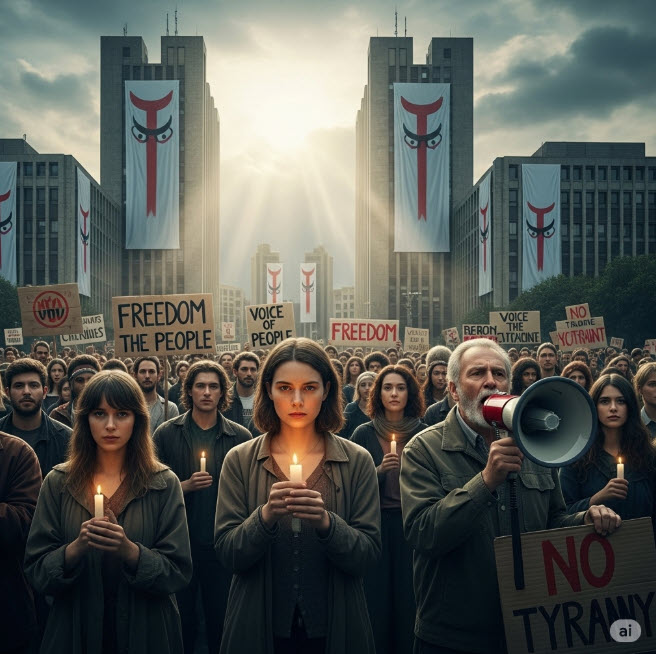
Pragmatic and morality-driven groups tend to be more adaptable and sustainable over time, as explained here by Arty:
- Flexibility: Pragmatists can adapt their strategies to changing conditions, which is crucial in complex societies.
- Cooperation: Morality-driven groups foster trust and reciprocity, which are essential for large-scale collaboration and innovation.
- Reduced Internal Conflict: Moral norms help regulate behavior and reduce destructive competition within the group.
“While fanaticism is a high-risk, high-reward strategy that can dominate revolutionary movements like MAGA, it often burns out or fractures when the environment shifts. Whereas morality and pragmatism are slower-burning fuels that build civilizations, institutions, and long-term alliances.”
With the Epstein files we’re seeing a slight shift in the environment, causing some turmoil and fractures in the MAGA-sphere. But I don’t think we can rely on an Epstein-file-fueled MAGA collapse to save America.
Here is how American citizens can push back against fascism, with some help from Arty:
Build Parallel Structures of Power
- Grassroots organizing: Form local networks that provide mutual aid, legal support, and community safety. These become lifelines when official institutions fail.
- Alternative media: Create and support independent journalism to counter propaganda and amplify truth.
- Solidarity economies: Support cooperatives and local businesses that resist authoritarian influence.
Shift the Narrative
- Expose authoritarian tactics: Use storytelling, art, and social media to reveal abuses and rally public opinion.
- Frame resistance as patriotic: Reclaim national symbols and values to show that defending democracy is not fringe—it’s foundational.
Strategic Nonviolent Resistance
According to civil resistance experts like Gene Sharp and Erica Chenoweth:
- Disruption works: Strikes, boycotts, and mass noncooperation can paralyze authoritarian regimes.
- 3.5% rule: Movements that mobilize at least 3.5% of the population in sustained nonviolent protest have historically succeeded in toppling regimes.
Forge Broad Coalitions
- Cross-ideological unity: Bring together liberals, conservatives, religious groups, labor unions, and marginalized communities around shared democratic values.
- Intersectional movements: Link struggles—racial justice, climate action, LGBTQ+ rights—to build a united front.
Protect Vulnerable Communities
- Rapid response teams: Organize legal observers, medics, and safe houses.
- Digital security: Train activists in encryption and surveillance evasion.
Defend Electoral Integrity
Even if institutions are compromised:
- Monitor elections: Document abuses and mobilize international attention.
- Run insurgent candidates: Use local races to build power from the ground up.
Learn from Global Movements
- South Korea: Citizens blocked martial law by physically surrounding Parliament.
- Chile: Small affinity groups quietly resisted Pinochet’s dictatorship through coordinated strikes and art.
- Belarus: Decentralized protests nearly toppled Lukashenko despite brutal repression.


 bendingtheneedle