I’m stunned but not surprised at the number of Americans promoting the notion that many slaves were happily indentured, treated nicely by their owners, and benefited from their involuntary servitude.
Do you know what enslaved people couldn’t do? Leave.
Do you know why? Because they didn’t have the freedom to do so.
Creating a counter-narrative to absolve America of the sin of slavery and then instituting that narrative into public education is the very definition of White fragility and privilege.
I don’t give a flying fuck if the enslaver’s behavior ran the spectrum from humanistic to violent rapist; the fact is America kidnapped human beings from another country and forced them to provide free labor.
Suppose I was arrested for snatching a young woman from the street, locking her in my basement, making her clean and cook for me, and using her sexually. Should I be spared a harsh judgment at sentencing because, while enslaved by me, the girl developed and sharpened her culinary skills?
Instead of whitewashing and minimizing slavery’s impact by saying enslaved people learned valuable skills, we should condemn it uniformly, formally apologize for it, and never suggest a positive aspect (and then espouse that positive impact in our textbooks).
When I worked for IBM, all employees were required to review and sign IBM’s Business Conduct Guidelines (BCGs) annually. IBM’s BCGs are the behavioral business principles and standards they expect from their employees.
Many companies send their version of BCGs annually to employees through training materials and reference documents. The employees complete the training, read the documents, and sign indicating compliance.
If an employee violates their company’s BCGs, the employer can terminate them.
Violating the guidelines can also lead to criminal or civil prosecution.
When the Government discovered that former President Trump had taken hundreds of their classified documents, they repeatedly asked (with deference) for him to return them. If former President Trump had done the right thing and returned the documents that were not “declassified,” not “Presidential records,” and that DID NOT BELONG TO HIM, he’d have one less scandal to worry about.
But, of course, Donald Trump didn’t do the right thing. Instead, he lied, deflected, and obstructed his way to a 37-count indictment.
If you or I purposely violated our employer’s Business Conduct Guidelines by stealing proprietary or classified information and then lying about it, we’d be in legal trouble—and rightfully so.
Concerning his conduct in general, former President Trump has a long record of dubious businesses and business deals, for which he’s paid millions of dollars in legal settlements – not to mention his abhorrent personal behavior.
And yet, this crooked, twice-impeached, ethically vacuous convicted felon is the Presidential candidate for the Republican party.
Intelligent and decent-minded people not tainted by political tribalism are appalled at the mere thought of Trump once again sitting at the helm of American democracy.
I usually refrain from making political posts on LinkedIn. But I’m at a point where I have zero fucks to give, so I’ll speak my mind regarding America and American values (regardless of the venue), especially when both are in jeopardy of being trampled.
Additionally, I firmly believe a second Trump presidency will damage the collective psyche of Americans, especially those who genuinely care about conduct, ethics, and integrity.
Our political parties, institutions, and businesses coexist in the same ecosystem. The rot from today’s GOP will seep into other areas of society unless we stop it at the ballot box.
The ballot box is America’s last line of defense against the rot of political grift, intolerance, and authoritarianism, which will erode the fabric of our country, including corporate America.
With that said, here we go.
After the 2020 election and the events of January 6th, most Americans just wanted to put our abusive relationship with Trump in the rearview mirror and return to normalcy.
Unfortunately, Trump lingers like a fart in a closet.
After eight years of Trump polluting our politics with dishonesty and unethical behavior, we continue to wallow in a palpable and inescapable MAGA malaise – because Trump is all around, all the time. He’s on the news, in the newspapers, on social media.
Most Americans are exhausted (not to mention ashamed and embarrassed) by Trump.
When hard-working Americans pull their noses away from the grindstone and look up to see the former highest official in the land lying and disregarding the rule of law, with an entire political party backing that behavior and an onslaught of propaganda aimed at deconstructing our democratic institutions, they begin to question the stability of the country in which they live and work.
And quite honestly, I think that’s the intent of the Trump-led GOP. To weaken Americans’ confidence in democratic institutions and systems so they can dismantle and replace them with authoritarian-based systems.
Americans generally refrain from discussing politics at work (historically, we know nothing good comes from it). We willingly accept our political differences because we know (or at least we thought we knew) that values like honesty and integrity transcend politics – that if a President were demonstrably dishonest and unethical, we’d put aside politics and condemn him uniformly.
Unfortunately, we discovered that with the Trump presidency, the reverse is true – politics transcends values. As former President Trump once said, he could shoot someone on Fifth Avenue and not lose any of his supporters.
The assault on truth and our democracy did not end when Trump-inspired rioters left the capital late in the afternoon on January 6th. The assault is ongoing. Today’s perpetrators are not violent insurrectionists beating police officers with American flags but elected and appointed officials with blind and cult-like allegiance to a corrupt demagogue. The assault and threat are equally, if not more dangerous, as it has the illusion of legitimacy.
Several months ago, Republicans voted unanimously to censure a member of the opposition party for his role in the impeachment trial of former President Trump. Republicans have floated a proposition to “expunge” the impeachments of President Trump, who knowingly tried to extort the leader of a foreign country and overturn a free and fair election.
The GOP crossed the Rubicon by embracing Trump and Trumpism – dragging millions of brainwashed Americans with them.
American corporations who spoke out against the events of January 6th and pulled support from candidates who knowingly lied about that day need to tap back into the sense of urgency and condemn what is happening currently with the Republican Party. So, when former President Trump gets on his social media platform, and spouts lie after lie about the 2020 election, companies need to return to form and explicitly and publicly denounce him and any member of Congress who regurgitates the lies. Silence provides a haven and fertile environment for unethical conduct to grow and spread.
The corporations we work for can help Make Americans Proud Again by speaking out against dishonest and unethical behavior and the assault on truth from Trump and Trump sycophants in the GOP. Otherwise, confidence in American institutions will wane, cynicism will take root, and morale will drop – which isn’t good for business.
Death and burial used to be pretty straight forward:
You died.
They buried you (or maybe tossed your ashes to the wind).
They said a few words and got on with life.
The end.
Short and sweet.
Today there’s a plethora of creative ways to orchestrate your final exit.
Be One with the Earth
You can go with a “natural” burial, which involves being put directly in the soil in a way that promotes or even accelerates decomposition.
Here’s an interesting tidbit: Luke Perry of 90210 fame was buried in a mushroom burial suit containing mushroom spores that helped decompose his body and filter toxins from it.
The filtering and decomposition from a mushroom suit prevent surrounding plant life from being contaminated by the body. Not that Luke was any more contaminated than you or I.
I see natural burials as a form of human recycling, which I imagine is popular with the environmentally conscious – but I can also hear my conservative, non-environmentally conscious uncle quipping, “When I go, just put me out with the recyclables.”
I suspect the squeamish might be put off by microbial decomposition, but I’m okay with it. It feels both altruistic and symbiotic.
People who choose this type of burial seem to be saying, “I’m no more important than the petunias” and “I don’t need to be memorialized with a headstone or plaque” – and as a humanist, that philosophy resonates with me.
Be Above it All
Don’t want to be put in the ground? Then maybe a space burial is for you.
Space burials launch your remains into space, where they orbit around the Earth or go to the Moon or somewhere further into space. Space burials even include cheaper “suborbital” excursions where the human remains are briefly transported into space before returning to Earth, where (hopefully) they can be recovered.
To me, space burials seem braggadocios and sadly pathetic.
“No, I’m not an astronaut – I’m an accountant. But I’m planning on being an astronaut after I die. So, yeah, I’m kinda like the Neil Armstrong of accounting.”
I feel there’s an element of cowardice to space burials. It’s like being an astronaut without any of the risk. And from an ego perspective, space burials check all the boxes. They scream, “Look at me; I am one with the heavens! I AM A GOD!
Be Around Forever
The most fascinating alternative burial, at least to me, isn’t a burial at all.
The diamond growth process uses high-pressure technology to turn human ashes into diamonds for wearable “cremation jewelry.”
For anyone who isn’t religious but still wishes for eternal life, the diamond growth process puts a new spin on the old adage “diamonds are forever.”
Personally, I have no delusions about an afterlife. As soon as I developed the ability to think critically, religion and eternal life registered as complete bullshit. I believe when you’re dead – you’re dead. Everything fades to black, and you cease to exist, except in the memories of loved ones – and even that is short-lived.
We’re all destined to fade away entirely, like the billions of ordinary people before us, who no one remembers – we will eventually be totally and irrevocably gone. And honestly, the thought of that doesn’t bother me in the least.
But something about an ashes to diamond after-life appeals to me. I like the idea of being an object amongst the living long after I’m dead – and even though I know I won’t be conscious or aware of this existence, the idea of it, as a living human being, interests me.
Is that weird?
And being a ring on the finger or broach on the collar of a loved one might be a pretty cool icebreaker at a cocktail party.
What a lovely ring, where did you get it? Well, my dad gave it to me when he died – something to remember him by. And actually . . .
I like the idea of being an heirloom passed down from generation to generation and remaining in the mix. And if someone in the future lineage of my family falls on hard times, and I end up in a pawn shop, that’s even better, because then the story of me goes in an entirely new direction.
To me, it’s all about the story; after all, what is life but a story.
When you’re a piece of jewelry, your destiny is fluid, unknown, and full of possibilities. Maybe you get lost at the beach, coming off your son’s finger as he body-surfs, only to be found a few weeks later by an elderly beachcomber who throws you in an old leather-bound jewelry box full of broken watches and faded polaroids and wears you every-now-and-then until the day he dies. At this point, you might end up as a mention in the final paragraph of the will of this total stranger and get passed along to the beachcomber’s favorite nephew, and off on new adventure you go.
The original story fades and gives way to another.
I’m aware that wanting to be turned into a diamond comes off as shallow. I can hear someone say, “Why can’t you die normal, like most people?” – and I guess I can see their point – but I don’t give a fuck.
And as an atheist, I like that we have this advanced scientific process that yells “Screw You” to the old Ashes to Ashes proverb from the Book of Common Prayer, which says that we’re made of dust and will return to ashes and dust after we die.
I’m going to be 61 this year. Looking back, there’s not a lot to brag about, but not much to be ashamed of either.
If I had to come up with a tombstone inscription, it might be:
Not a Hall of Famer, but a solid and dependable contributor (somewhere between Rico Petrocelli and Dwight Evans).
As I head into my later years, I can say without hesitation that fatherhood has been the most consequential and vital endeavor in my relatively ordinary life.
On fatherhood, I’m by no means an expert. I failed many times, too many to count. But I learned a lot and improved over time (I think).
One thing I learned is that our children are not us.
Sure, they come into the world with DNA from both parents, but they’re not carbon copies of mom and dad. Instead, they’re pre-packaged with a distinctive thread of familial traits and characteristics going back generations, to be woven over time by master weavers’ Nature and Nurture into unique and complex tapestries.
Those tapestries are colored and tamped by life’s sights, sounds, and touchpoints. From an early morning speckled splash of sunlight on the nursery ceiling – to the stony silence of a disengaged parent – to the warm embrace of a loving grandparent – every experience sets off a spark of emotion, which forms a memory to be stored and drawn upon continuously and subconsciously throughout their lives.
Just “being” in the world exposes our kids to arbitrary cruelness and spectacular wonder (along with a healthy dose of the mundane).
How they react to the cruel, wonderous, and mundane can’t be predicted. Their reactions depend on a sprawling range of environmental and sociological conditions and an unknown dose of biological and genetic factors. From the stability of the family unit to a kink in the banding pattern of a chromosome – it all gets factored into how kids develop and who they become.
Maybe there’s a proclivity for sadness, anxiety, or an innate gentle disposition. Maybe a child is born with an unbridled competitive spirit or an affinity for music or math. Perhaps there’s a dash of gender dysphoria. Whatever the case, the traits and characteristics kids are born with get stretched onto life’s loom, along with spools of environmental and sociological factors, out of which come these beautifully unique and flawed tapestries.
In life, there are no uniform patterns.
So, what’s our role as parents? How do we affect these tapestries that are our children?
As I see it, our primary role is to help our kids understand and accept their distinctive ” self ” to reach their fullest potential.
This is easier said than done because even with the best intentions, our parenting skills are naturally dulled or diminished by the bias of our own experiences and expectations – I know mine were.
I think many parenting failures are grounded in a shared belief; because our kids are borne from us, we have some innate understanding of them.
But we don’t.
And if we’re unwilling to recognize and accept that many of our preconceptions are wrong — or if we’re so hemmed in by our own experiences and expectations that we can’t break from them, we are liable to screw things up royally.
Parenting is a dynamic and fluid process.
Acknowledging we don’t genuinely know our children can open the door to getting to know them, which can lead to a more authentic understanding of them and help us parent more empathetically and effectively.
Of course, for any of this to happen, parents must be present, loving, accepting, and willing to engage. When kids have someone in their life who is present, loving, accepting, and willing to engage – they’re more likely to open up and share.
Recently I’ve been watching footage from parents of transgender kids testifying before committees on pending legislation restricting gender-affirming care for children. In almost all cases, there’s a point in their testimony where they recall the moment when they realized their child was different. That moment was often characterized by confusion and worry (this was not the tapestry they imagined!). What touched me as I listened to these parents was what they did after the confusion and worry settled.
These parents listened to their children, talked to medical experts, and became advocates for their children. They overcame their biases (many of which were woven into their tapestries by their parents, churches, or communities) to see their children for who they are.
These fathers and mothers learned that even though their own tapestries were of a particular color or pattern, their children’s tapestries differed. They understood that trying to prevent the child from being their authentic self was detrimental to their emotional well-being and that the best thing they could do for their child was to be present, loving, accepting, and engaged.
But Donald Trump is a creeping fracture on the hip of America’s democracy.
Biden is a danger to himself.
Trump is a danger to the republic and the freedom for which it stands.
Do I think Joe Biden is too old for the presidency? Yes, I do. But that problem will eventually take care of itself, as it does for all of us.
We must stop thinking about 2024 as a contest between two men, one who has clearly lost a step, the other hell-bent on lying his way back to the presidency.
The 2024 election is not about Biden or Trump; it’s about good versus bad ideas.
It’s about whether we move the country forward or backward. It’s about whether we expand rights or restrict them. It’s about whether we try to bridge our gaps and differences or widen them. In 2024, either we embrace and promote the ideas of western Democracy, or we don’t.
Trumpism – the metastasizing malignancy of malevolence and malfeasance has taken root in the Republican party. Trumpism is less of a political platform and more of a manifesto of intolerance, anger, fear-baiting, and grievance. And that’s today’s GOP.
To move the country forward and to trigger a “re-set” for the Republican party, we need to bury it under an avalanche of votes that screams DEMOCRACY MATTERS!
Today, banning books, demonizing “the other,” promoting one religion over others, and protecting unfettered access to weapons, even in the face of mass shooting after mass shootings, are Republican ideals, but they’re not American ideals.
While Republicans bitch and moan about pronouns, wokeness, and drag show readings, broken parents relive the scene of janitors mopping up the blood of their children from the hallways and classrooms in schools.
Most Americans are tired of nonsense in the face of real-life challenges and hardship.
The 2024 election, more than any other past election, is about ideas. Foundational ideas. The ideas upon which America will stand or crumble.
Today, at 55 years old, Joe realizes the rest of his tomorrows will never be as bright as most of his yesterdays.
That epiphany catches him off guard.
The immediacy of it throws him off kilter.
It wasn’t long ago that Joe felt relevant, steady, and somewhat optimistic about life, the world, and his place in it.
Now he flounders.
He’s a floundering Joe.
A man-fish swimming against the steady current of uncertainty.
“How did I not see this coming?” he mutters.
Moderately well-off, Joe is considered successful — especially in America, where success is measured by the home you own, the car you drive, and the stuff you have.
In America, materialism and success are inextricable.
So, why does middle age feel like an existential threat to Joe?
Why (with his level of success) is Joe suddenly riddled with insecurities?
Crisis set up shop in Joe’s head when he realized that success, as defined by society, is different from success as defined by biology and (more specifically) virility.
Virility provided a competitive advantage early in man’s evolution. It was sought after by the opposite sex and went hand-in-hand with male success. And though virility and success are not as tightly coupled today, the embers of that dynamic duo still smolder at the core of the male brain.
Virility improved the success rate of man’s biological directive to mate. That type of biologically controlled messaging is difficult to override — even in man’s evolved state. Because of this, something strange happens to men sociologically when they sense a decline in their virility.
It’s not that Joe feels less virile. It’s more of an awareness of how others perceive him — or how others barely notice him at all.
Gone are the days of side glances from attractive strangers.
A waning biological relevance makes Joe feel like he’s disappearing – like he’s being involuntarily airbrushed into the landscape – a crooked aging tree at the base of a mountain – an artist’s afterthought.
In the face of this involuntary disappearing act, Joe becomes desperate. He knows he can’t un-tick the clock, but he has access to cash.
They say money can’t buy happiness — but it can get you noticed.
And so, Joe begins the age-old American dance (often pathetic, rarely successful) of reclaiming virility through materialism – by heading to the local Chevy dealership and purchasing a brand-new ego booster.
At first, he feels pretty good about himself – heads are turning on the boulevard!
But the feeling is short-lived.
Over time, squeezing in and out of his little red Corvette doesn’t turn back the clock; it just reminds Joe of the uncomfortable logistics of aging.
Joe parks the car in his garage and rarely takes it out.
“Maybe it’s my style? Maybe I don’t have any style?” Joe says to himself in the mirror.
So, he treks to the mall, platinum card in hand, and treats himself to a hip new wardrobe of skinny jeans and UNTUCKit shirts, disregarding the well-known truth — that clothes always look better on the mannequin and catalog model.
Joe’s clothes no longer hang on him fashionably. Instead, they bring unwanted attention to what he’s desperately trying to hide.
And what makes Joe think he can pull off the skinny jeans’ thing like he’s Mick Jagger?
The audacity!
The one thing that makes Joe feel better is hitting the gym and changing his diet.
He isn’t turning any heads huffing and puffing on the Stairmaster, but he’s lost a little weight, and his mood is lighter. Even though he considers this a minor victory, he knows there’s no stopping father time from fucking with him.
Life is a conveyor belt.
As Joe transitions from middle age, he realizes acceptance is his only play.
Acceptance leads to tranquility, which leads to confidence, and confidence is like a fine wine – it ages well.
She’s been staring at him intently for 20 minutes, when finally, he awakes to her panting.
He raises his head from the pillow and, with eyes half-opened, pats the bed gently. She thumps the mattress with her tail, yawns, and wriggles up to him.
Good morning, friend.
They begin their final day together with a loving scratch behind the ear.
He scoops her into his arms and feels her heart’s clunky and irregular beat against his chest. He lowers her carefully to the floor; her hips wobble, her back legs fold, and she collapses.
This has been theirmorning routine for the last several weeks.
She looks at him apologetically. He whispers, “It’s okay, girl” and helps her to her feet.
She walks gingerly to her water bowl, takes a few sips, looks up at him, and wags her tail. For a decade, they’ve inhabited each other’s world. A life wrapped in routine and the warmth of deep companionship.
Age has slowly crept up on her – from the floating blue cataract cloud in her eyes to the rounded and tanned teeth in her mouth. Then, with resignation, the man mutters, “From pearly whitesto tiger’s eye, they tell the taleof you and I” and gives her a pat.
He slips a frayed collar decorated with dog bones and frisbees over her head, clips the leash to it, and together they walk out the door.
Even in her declining state, she relishes the ritual, nose to the ground, intently sniffing clover, dirt, thistle, and weed. A complex puzzle of smells awakens a flood of memories; momentarily, she becomes infused with a youthful spirit. A stiffened gate and spritelier walk return, bringing a slow smile to the man’s face.
She raises her head towards a gentle gust of wind, wistfully smiling at the gift-bearing breeze. But by the time they return home she’s laboring. He carries her into the house.
He decided last year to take a leave from work when he noticed a change in her health. On a fast track for promotion and highly regarded throughout the company, he sometimes heard whispers in the halls, “For a dog—a DOG?“
Their appointment with the veterinarian is an hour away. He sits with her on the kitchen floor and cries. She looks at him forgivingly, then places her head on his lap and closes her eyes.
According to a new poll, America is pulling back from the values that once defined it, such as patriotism and religion. One might look at the poll results and think, “Damn, that’s not good,” — but maybe we should look at the results as an awakening.
A Growing Disconnect
There’s a growing disconnect between the values Americans traditionally associate with religion and patriotism and what we witness behaviorally in society regarding religion and patriotism.
Christ is no longer Christianity’s messenger.
Instead, rich and powerful opportunists weave narratives that intertwine cherry-picked aspects of Christianity with firmly held socio-political beliefs. Deep pockets allow these opportunists to promote that narrative through lobbyists, who feed it to money-grubbing, power-hungry politicians.
Christianity isn’t about love and charity anymore. Instead, it’s transparently transactional – and more Americans (especially the skeptical and educated) view politically infused transaction-based religion with disdain. When you combine transparently transactional religion with the equally transparent absence of God in our lives, people will pull back from religion as a value.
The function of religion in American society has moved away from the individual and towards a political collective. This shift has transformed religion from a set of beliefs for coping with a chaotic and hate-filled world to a political directive that disrespects marginalized communities, restricts rights, and promotes hate.
Our Patriotic Divide
Concerning patriotism, America is split between the loud crowd of MAGA-hat-wearing Republicans hell-bent on transforming the country into a dystopian America-First Christian Nationalist society and progressives who want to expand rights and freedoms to everyone.
For patriotism to take root, citizens must agree on what it means to “be patriotic.” If there’s disagreement, the unifying knot of patriotism begins to fray. For example, millions of Americans view the assault on the capital as an act of patriotism and the protests against systemic racism in our justice system as un-American – while just as many (if not more) Americans hold the opposite view. Until most of us can agree on what is and isn’t patriotic, we’ll continue to retreat from patriotism as a value.
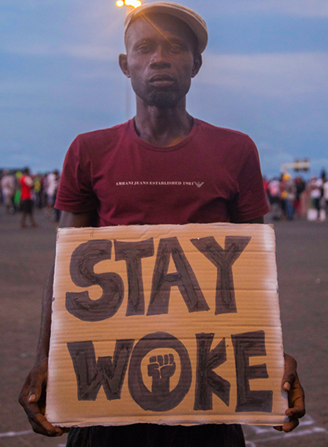
So, it’s no surprise Americans are rethinking the values around religion and patriotism. We’re woke to religion and patriotism being hijacked and manipulated by individuals and entities for political or personal gain, altering the meaning of both fundamentally.
Being aware is the first step to instituting change.
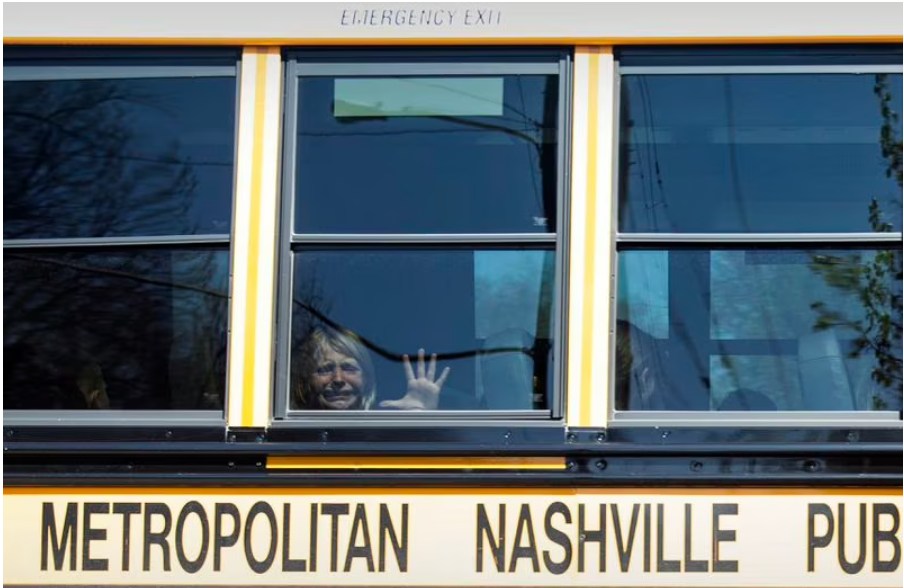
A child weeps while on the bus leaving The Covenant School following a mass shooting at the school in Nashville, Tenn., Monday, March 27, 2023. (Nicole Hester/The Tennessean via AP)
This is the America Republican politicians say we can’t do anything about.
This is the America where we raise our children.
This is the America that our children wake up to every day, sitting nervously at the kitchen table and wondering if today will be the day they die in a school shooting.
This is the America where parents send their kids to school and wonder, as their child enters the building, if they will come out alive.
This is the America where children practice active shooter drills and are coached on fighting off a deranged person with an AR-15 intent on slaughtering them and their classmates.
This is the America where that deranged person can easily obtain a weapon of war designed to afflict devastating injuries and mass casualties.
This is America, where even though most of the citizens support regulations that would make it more challenging to obtain these weapons, politicians refuse to enact legislation to make that so.