The collision of technology, conservative ideology, and the incel movement in American culture is resulting in a volatile mix of online radicalization, misogyny, and political extremism.
By amplifying exclusionary beliefs, digital platforms normalize violence and connect isolated individuals into communities that can spill over into real-world harm.
Online platforms, social media, and dedicated incel sites provide a fertile breeding ground and powerful echo chamber for individuals with extremist and misogynistic views. It is in these intellectually dank digital hangouts that we encounter the danger of algorithmic amplification and the recommendation systems, which push members of these online communities deeper into radical content, normalizing hostility toward women and liberal values.
There is also a porn-component to this toxic, digital culture. Studies show links between incel misogyny and online pornography, which reinforces distorted views of women and sexuality.
What’s even more concerning is the acceptance of misogynistic beliefs and behaviors as “boys will be boys” by the Trump administration, which is tapping into the aggrieved community of non-college-educated males, not for the purpose of assisting them, but rather to turn their growing sense of isolation and anger towards college-educated women into votes.
There is an overlap between MAGA conservatism and ideology and the INCEL movement in America, specifically around the anti-feminist narrative, where both groups tend to frame feminism as a threat to traditional gender roles.
INECELS adopt a worldview of being “dispossessed men,” which resonates with broader conservative rhetoric about cultural decline and loss of male authority.
It’s at our own peril that we turn a blind eye to the alignment of incels and far-right groups around exclusionary, anti-democratic, and xenophobic tendencies. Isolated and digitally immersed young men in America are susceptible to being drawn to extremist online communities that distort masculinity and normalize misogyny.
The blending of conservative ideology with incel dogma and rhetoric widens the divide over gender, sexuality, and democracy, fueling broader culture wars in a country that is more culturally polarized than ever.
I wrote a poem a while back about the radicalization of young non-college-educated males through far-right groups around exclusionary, anti-democratic, and misogynistic views. I used the AI music platform Suno to put my poem to music.
My Paper, My Words is a collection of essays, stories, and poems that reflect the challenges of a middle-class husband and father trying to navigate a rapidly changing political, religious, and technological landscape of post-911 America.
Let’s Ask Arty uses existing Artificial Intelligence (AI) technology to query LLMs about politics in these troubled times.
Query 1: Donald Trump stated that Ronald Reagan “Loved tariffs for our country and its national security.” Does Donald Trump’s statement accurately reflect President’ Reagan’s views on tariffs?
No, Donald Trump’s statement that Ronald Reagan loved tariffs for our country and its national security does not accurately reflect President Reagan’s views on tariffs.
Reagan was a strong advocate for free trade and often spoke against tariffs, viewing them as harmful to economic prosperity.
In fact, in a 1987 national radio address, Reagan explicitly criticized tariffs, stating they “hurt every American” and arguing that protectionist policies like tariffs lead to “shrinking markets, collapsing businesses, and widespread job losses”. He believed that while tariffs might seem patriotic or protective in the short term, they ultimately stifle innovation, provoke retaliatory trade measures, and damage the broader economy.
Query 2: Donald Trump stated that an Ad created by the Government of Ontario of Ronald Regan criticizing tariffs was “fake.” Is Donald Trump telling the truth? Was the ad fake?
No, Donald Trump was not telling the truth.
A recent controversy arose when the Ontario government aired an ad using clips from Reagan’s 1987 speech to highlight his anti-tariff stance. Donald Trump responded by calling the ad “fake” and claimed it misrepresented Reagan’s views. However, fact-checks and the full context of Reagan’s speech confirm that he genuinely opposed tariffs and championed open markets.
While Reagan did occasionally use targeted trade measures for strategic purposes, his overall philosophy was rooted in free and fair trade, not broad protectionism or nationalistic tariff policies.
So, while Trump may frame tariffs as essential for national security, invoking Reagan as a supporter of such policies misrepresents the former president’s well-documented economic views.
My Take
Anyone with a cell phone or computer can do a quick Google search and know definitively that Trump was lying about the Ontario government’s Ad being fake and lying about Ronald Reagan “loving tariffs.”
It took me less than 5 minutes to debunk President Trump’s statements.
The more prescient issue is how fluidly this administration weaponizes lying.
Most politicians (and non-politicians for that matter) lie to get out of a jam. The Trump administration’s repetitive lying is part of a strategy to manipulate public opinion.
This administration is taking a page from the 1930s Nazi party playbook, where writings and speeches consistently emphasized emotional appeal, repetition, and the subordination of truth to political strategy.
More from Arty
According to Arty, Joseph Goebbels, the Nazi Minister of Propaganda, believed:
Propaganda as Emotional Weaponry: Goebbels believed propaganda should appeal to emotions, not intellect. He once wrote that the goal was to make people “succumb to it utterly and can never again escape from it”.
The “Big Lie” Technique: While the phrase “big lie” is often attributed to Hitler, Goebbels is frequently associated with the idea that a lie, if colossal and repeated often enough, becomes accepted as truth. He accused others—like Winston Churchill—of using this method, even as he employed it himself.
Truth as a Tool, Not a Principle: Goebbels preferred to use partial truths or truths that served his agenda, but he was not above outright lies when necessary. He believed that the effectiveness of propaganda lay in its ability to shape perception, not in its factual accuracy.
Propaganda as Art and Power: In a 1936 commentary, Goebbels described propaganda as “a political power of the highest magnitude,” emphasizing its role in shaping national spirit and identity.
Creating a False Reality: His propaganda efforts aimed to construct an alternate reality in which the Nazi regime appeared righteous and justified, even as it committed atrocities. This manipulation of truth was central to his strategy.
The Trump administration has been widely criticized for employing repeated falsehoods as a political strategy, often aligning with the idea that repetition can foster belief.
Here are several notable examples of falsehoods repeated by Donald Trump and his administration:
1. Election Fraud Claims
Claim: The 2020 election was stolen or rigged.
Reality: These claims were repeatedly debunked by courts, election officials, and independent audits.
Strategy: Trump and allies repeated this claim hundreds of times across rallies, social media, and interviews, leading many supporters to believe it despite a lack of evidence. This lie continues to this day.
2. COVID-19 Misinformation
Claim: COVID-19 would “disappear” or be “under control.”
Reality: These statements contradicted public health data and expert warnings.
Strategy: Trump repeated these claims to downplay the crisis and maintain public confidence, even as cases surged.
3. Tariff Economics
Claim: China was paying the tariffs imposed by the U.S.
Reality: Importers, usually American businesses and consumers, pay tariffs.
Strategy: Trump repeated this economic falsehood to frame the trade war as a win for the U.S., despite its domestic costs.
4. Climate Change Denial
Claim: Climate change is a hoax or exaggerated.
Reality: Scientific consensus affirms climate change as real and human-driven.
Strategy: Trump used repetition to cast doubt on climate science and justify environmental deregulation.
5. George Soros Conspiracies
Claim: Soros funded protests and radical left movements.
Reality: No credible evidence supports these accusations.
Strategy: Trump repeatedly invoked Soros as a villain to energize his base and delegitimize opposition.
A 2023 study published in Public Opinion Quarterly found that repeated falsehoods from Trump’s presidency significantly influenced public misperceptions, especially among partisan audiences. The more often Trump or officials from his administration repeated lies, the more likely people were to believe them, even after the falsehoods had been publicly debunked.
Let’s Ask Arty uses existing Artificial Intelligence (AI) technology to query LLMs about politics in these troubled times.
Query 1: Is Vice President JD Vance’s claim that democrats are demanding billions of dollars in taxpayer-funded healthcare for illegal immigrants true?
What the Vice President Said:
Vance stated that Democrats are “threatening to shut down the entire government because they want to give hundreds of billions of dollars of health care benefits to illegal aliens”.
He cited two Biden-era programs that he claims provided emergency healthcare and Affordable Care Act (ACA) subsidies to undocumented immigrants
What the Facts Show
Federal law prohibits undocumented immigrants from receiving federally funded healthcare programs like Medicare, Medicaid, and ACA subsidies.
The Democratic budget proposal aims to:
Extend ACA subsidies for legal residents and citizens.
Reverse Medicaid cuts from the Trump administration’s “One Big Beautiful Bill” that would affect lawfully present immigrants, such as refugees and those with Temporary Protected Status.
There is no provision in the Democratic proposal that offers free healthcare to undocumented immigrants.
What Democrats Say:
House Minority Leader Hakeem Jeffries stated: “Federal law prohibits the expenditure of taxpayer dollars on providing healthcare to undocumented immigrants. Nowhere have Democrats suggested that we are interested in changing federal law”.
Senate Minority Leader Chuck Schumer called the Republican claims “utter bull,” emphasizing that the dispute is about healthcare for American citizens, not undocumented immigrants
The claim that Democrats are shutting down the government to fund healthcare for illegal immigrants is FALSE. The dispute centers around extending healthcare subsidies for legal residents and reversing Medicaid cuts—not providing benefits to undocumented immigrants.
Here’s a detailed breakdown of how healthcare access works for different immigrant groups in the U.S., based on federal law and recent policy developments:
U.S. Citizens and Naturalized Citizens
Full access to federally funded healthcare programs like:
Medicaid
Medicare
Affordable Care Act (ACA) marketplace subsidies
Eligibility based on income, age, and other standard criteria.
This includes green card holders, refugees, asylees, and those with humanitarian parole or Temporary Protected Status (TPS).
Medicaid & CHIP (Children’s Health Insurance Prhogram):
Eligible after a 5-year waiting period, unless exempt (e.g., refugees, asylees, veterans).
ACA Marketplace Subsidies:
Eligible immediately if lawfully present.
State Variations:
Some states offer Medicaid/CHIP to lawfully present children and pregnant women regardless of entry date.
🔵 DACA Recipients (Deferred Action for Childhood Arrivals)
Not eligible for Medicaid, CHIP, or ACA subsidies under federal law.
May access state-funded programs in select states.
Undocumented Immigrants
Not eligible for:
Medicaid
Medicare
ACA marketplace coverage or subsidies
Emergency Medicaid:
Covers urgent medical conditions (e.g., ER visits, childbirth) regardless of status.
Community Clinics & Safety-Net Providers:
Often serve undocumented individuals, especially in mixed-status families.
⚪ Mixed-Status Families
Households with members of different immigration statuses (e.g., U.S.-citizen children and undocumented parents).
Citizen children may qualify for Medicaid or CHIP.
Parents may avoid seeking care due to fear, confusion, or legal uncertainty.
🏛️ Recent Policy Changes & Debates
The Trump administration’s “One Big Beautiful Bill” restricted Medicaid eligibility for many lawfully present immigrants.
Democrats are seeking to restore pre-2025 rules, allowing broader access for refugees, asylees, and parolees.
Query 2: What changes to ACA subsidies are in Republican’s Big Beautiful Bill and how will that affect healthcare costs for American citizens who get their health insurance from the ACA?
The Republican-backed One Big Beautiful Bill Act makes significant changes to the Affordable Care Act (ACA) subsidies, and the consequences for Americans relying on ACA marketplace insurance could be severe.
🧾 What Changed in the Bill
No extension of enhanced ACA subsidies: The bill omits renewal of the expanded premium tax credits that were introduced during the pandemic and extended through 2025.
Cuts to Medicaid and ACA eligibility:
Stricter eligibility rules for Medicaid.
ACA subsidies will no longer be available to many lawfully present immigrants, including refugees and asylum seekers.
Codifies Trump-era ACA rules: These rules increase cost-sharing and reduce affordability for middle-income enrollees.
Impact on Healthcare Costs
Premiums could double: Without the enhanced subsidies, average monthly premiums may rise from $888 to $1,904—a 114% increase.
Out-of-pocket costs will spike: Families could face $900 higher deductibles and $313 more in monthly premiums.
Millions may lose coverage:
The Congressional Budget Office estimates 4.2 million people will lose ACA coverage by 2034 due to subsidy expiration.
Another 3.1 million could lose coverage due to ACA marketplace changes in the bill.
Uninsured rate will rise: The U.S. uninsured population could grow by 16 million over the next decade.
🧠 Who’s Most Affected
Working- and middle-class Americans who don’t qualify for Medicaid but rely on ACA plans.
Residents of Republican-controlled states that haven’t expanded Medicaid.
Self-employed individuals and gig workers who buy insurance on the marketplace.
This policy shift is at the heart of the current government shutdown, as Democrats are refusing to pass a funding bill that doesn’t include a renewal of these subsidies
Query 3: Where do the savings from cuts to the ACA in the Big Beautiful Bill go? Who benefits from getting rid of ACA subsidies?
The savings from cuts to the Affordable Care Act (ACA) in the One Big Beautiful Bill Act are largely redirected toward tax relief and deficit reduction, with the biggest beneficiaries being high-income earners, corporations, and defense spending priorities. Here’s how it breaks down:
💰 Where the Savings Go
Estimated $1.1 trillion in cuts to Medicaid and ACA subsidies over 10 years.
These savings are used to:
Fund tax cuts for individuals and corporations.
Offset increases in defense and border security spending.
Reduce the federal deficit, though critics argue the impact is minimal compared to the human cost.
🏦 Who Benefits Most
Group
How They Benefit
High-income earners
Receive larger tax breaks due to reduced progressive taxation and capital gains reforms.
Corporations
Benefit from lower corporate tax rates and relaxed healthcare mandates for employees.
Defense contractors
Gain from increased military and border security allocations funded by healthcare cuts.
Private insurers
May profit from reduced competition and fewer subsidized plans on ACA marketplaces.
🚫 Who Loses Out
Middle-class and working Americans who rely on ACA subsidies to afford insurance.
Rural hospitals and clinics, which face reduced Medicaid reimbursements and may close.
Lawfully present immigrants, including refugees and asylum seekers, who lose access to subsidized coverage.
The bill’s supporters argue it reduces “wasteful spending,” but critics say it shifts costs from the wealthy to vulnerable populations and destabilizes the healthcare system
My Take
JD Vance was lying when he said, “Democrats are threatening to shut down the entire government because they want to give hundreds of billions of dollars of health care benefits to illegal aliens.”
The Republican Speaker of the House, Mike Johnson, was lying when he said, “The Democrats said instead that they wanted to give healthcare to illegal aliens instead of keeping critical services provided for the American citizens.”
Both these men, along with the President and Republicans in Congress, want to feather the pockets of the wealthiest Americans and fill the coffers of corporations at the expense of the poor and middle class.
I hope Democrats stick to their guns in the Government funding debate and fight republican cuts to ACA subsidies, which will hurt middle-class Americans by doubling monthly healthcare premiums, increasing out-of-pocket costs for families, and resulting in a loss of healthcare coverage for millions of Americans.
My Paper, My Words is a collection of essays, stories, and poems that reflect the challenges of a middle-class husband and father trying to navigate a rapidly changing political, religious, and technological landscape of post-911 America.
Let’s Ask Arty uses existing Artificial Intelligence (AI) technology to query LLMs about politics in these troubled times.
Query: Can you please fact check the speech and statements that President Trump gave at the United Nations on 09/23/2025?
President Donald Trump’s speech to the United Nations General Assembly on September 23, 2025, included several claims that have been widely fact-checked and found to be misleading or false across multiple topics. Here’s a breakdown of the most notable inaccuracies:
🌍 Claims About Ending Wars
Trump stated:
“I ended seven wars… Cambodia and Thailand, Kosovo and Serbia, the Congo and Rwanda, Pakistan and India, Israel and Iran, Egypt and Ethiopia, and Armenia and Azerbaijan.”
Fact Check:
Cambodia and Thailand: A truce was reached, but it involved mediation from other leaders and was not solely brokered by Trump.
Kosovo and Serbia: No war was actively occurring; Trump’s administration previously brokered an economic agreement, not a peace treaty.
Congo and Rwanda: Fighting continues despite a peace agreement; rebel groups were not part of the deal.
Egypt and Ethiopia: No war existed—only a dispute over a dam project.
Pakistan and India: India denies Trump’s involvement in the May ceasefire.
Israel and Iran: A ceasefire followed U.S. airstrikes on Iranian nuclear facilities, but the situation remains volatile.
Armenia and Azerbaijan: A peace declaration was signed, but its long-term impact is uncertain.
🌡️ Climate Change and Renewable Energy
Trump called climate change “the greatest con job ever perpetrated on the world” and claimed renewable energy sources “don’t work” and are “too expensive.”
Fact Check:
In 2024, renewables and nuclear accounted for 40% of global electricity generation, with solar and wind surpassing coal in the U.S..
Over 90% of new renewable projects are now cheaper than fossil fuel alternatives.
Solar PV and onshore wind were 41% and 53% cheaper, respectively, than the lowest-cost fossil fuels.
📉 Economy and Poll Numbers
Trump claimed:
“I have the highest poll numbers I’ve ever had.”
Fact Check:
Public polling averages show his approval rating around 42–44%, down from 51–52% earlier in the year.
No public data supports the claim of record-high approval.
🛂 Immigration
Trump described U.S. immigration laws as “suicidal” and blamed them for economic and social decline.
Fact Check:
These statements are opinion-based and not supported by data presented in the speech. Experts widely dispute the characterization of immigration laws as inherently destructive.
🕊️ Criticism of the United Nations
Trump said:
“All they seem to do is write a really strongly worded letter and then never follow that letter up.”
Fact Check:
While the U.N. has been criticized for slow responses, it continues to play active roles in peacekeeping, humanitarian aid, and global coordination. Trump’s portrayal oversimplifies its functions
My Take
I’ve given up on President Trump ever speaking truthfully about anything. Whenever he opens his mouth, lies spill out. Lying is his default setting.
I can’t see how anyone with even an ounce of intelligence could watch that speech and not be embarrassed and ashamed of who we put in office.
We all knew the speech (like all of Donald Trump’s speeches) would be littered with lies and misinformation, so no surprise there. But the boorish and self-congratulatory tone was off the charts, even for Trump. If the delegations had any courage at all, they would have stood up and walked out.
I abhor violence, but the “violence doesn’t solve anything” lament rings hollow in a country that was born out of violent revolution and resistance, and a country that fought violently to prevent fascism from spreading across Europe and the world. Opposing tyranny and a love of freedom are part and parcel of the American experience. When an individual or government threatens our right to speak and live freely, we resist, protest, and, if necessary, we fight.
The American Revolution did not explode spontaneously into violence – it grew over time from protests, pamphlets, and reasoned arguments. When all of that failed, the only thing left was to either submit to tyranny or to fight.
We celebrate the success and ultimate sacrifice of the American Revolution every Fourth of July and Victory Day every second Monday in August. We pump our fists and fly flags to the rallying cries of “Live Free or Die,” “Give me liberty, or give me death,” and “Don’t Tread on Me.” The activities associated with these sentiments are rarely free of violence.
We humans haven’t evolved as much as we pretend. We struggle to sustain a lasting peaceful coexistence with one another; we’re unable to live-and-let-live, often because of the ginned-up fear around political, religious, and cultural differences, which keep us divided and fighting amongst one another. And make no mistake, leaders like Donald Trump understand that if we are fighting one another, we’re not fighting them.
America is marching towards fascism, and many Americans seem okay with the path we’re on. Maybe it doesn’t feel like fascism when you share the political, social, and religious ideology of your fascist government? Regardless, most Americans (across the political spectrum) do not want conflict, yet we find ourselves on a dangerous precipice of violence with one another, fueled by the assassinations of Melissa and Mark Hortman and Charlie Kirk.
And what makes our current situation even more perilous is that our President is not calling for calm or trying to defuse things.
Why do you think that is?
It’s because the President sees anyone who does not share his authoritarian views as the “enemy within.”
We shouldn’t kid ourselves about the character and nature of the individuals who sit at the highest levels of our government. Our government is awash in fascists and Christian nationalists who have no intention or desire to sit down with secularists, progressives, or even moderate democrats because they view them as a direct threat to their authoritarian designs on America.
If you cherish freedom for everyone, now is the time to speak loudly and to push aggressively (and peacefully) against a government that is trying to strip freedom away from your fellow citizens.
My Paper, My Words is a collection of essays, stories, and poems that reflect the challenges of a middle-class husband and father trying to navigate a rapidly changing political, religious, and technological landscape of post-911 America.
My Paper, My Words is a collection of essays, stories, and poems that reflect the challenges of a middle-class husband and father trying to navigate a rapidly changing political, religious, and technological landscape of post-911 America.
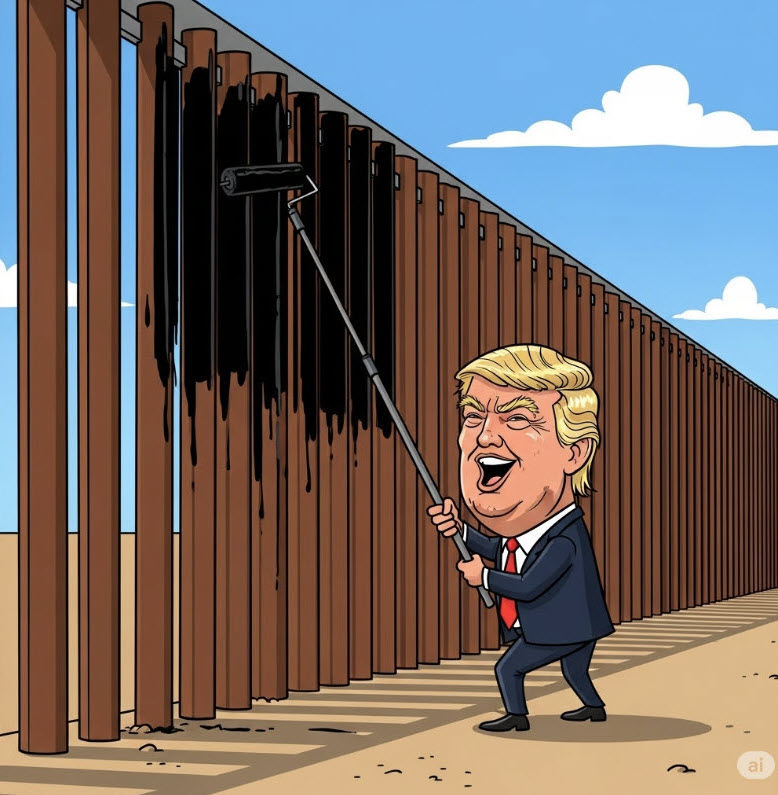
I see a brown wall and I want it painted black if you have brownish skin I want to send you back
I see brown men walk by dressed in their working clothes I tell my ICE agents It’s time to make them go
I see the Ukraine fry in Russian drone attacks the bombing raids and tanks that turn their cities black
I see our democracy begin to fade away a thousand starving kids in Palestine today
When I look inside myself I see my heart is black the orange spray-on tan can’t cover up the fact
’till that day I fade away you’re tied onto the track I’ll make you suffer days while turning this world black
I watch the climate change from here to Timbuktu I smile at the heat that’s burning into you
If you look hard enough into my soulless eyes there’s only room enough for all that I despise
I see a brown wall and I want it painted black just like my darkened heart too hard to even frac
I see brown men walk by dressed in their working clothes I tell my ICE agents It’s time to make them go
My feeble mind is tainted tainted black Black as night Black as coal I wanna see the hope Blotted out from your eyes I wanna see them painted, painted, painted painted black, yeah
My Paper, My Words is a collection of essays, stories, and poems that reflect the challenges of a middle-class husband and father trying to navigate a rapidly changing political, religious, and technological landscape of post-9/11 America.
I’ve just published “Imagine There’s No Donald” on Amazon.com.
Imagine There’s No Donald is a lyrical collection that channels the melodic cadence of (mostly) Beatles songs to deliver searing poetic indictments of Donald Trump, the MAGA movement, and their corrosive impact on American democracy.
Each poem echoes the structure and emotional resonance of iconic musical tracks—think “Rocky Racoon” reimagined as the tale of Donald Trump’s destructive path to the presidency, or Terry Jacks’ “Seasons in the Sun” transformed into a lament on Republican cowardice and lost democratic norms.
Through this fusion of pop nostalgia and political critique, the collection:
🎶 Harnesses Familiar Rhythms: The song structures serve as scaffolding for verses that are both accessible and subversive, drawing readers in with rhythm before confronting them with truth.
🔥 Excoriates Authoritarianism: Trump and MAGA are portrayed not just as political figures but as symbols of a broader erosion of truth, decency, and constitutional integrity.
🕊️ Defends Democratic Ideals: The poems mourn the fragility of American institutions while fiercely advocating for civic engagement, accountability, and moral clarity.
🎤 Amplifies Dissent: With a voice that is at once satirical and sincere, the book invites readers to sing along in protest, turning melody into a megaphone for resistance.
Whether riffing on “She Came in Through the Bathroom Window” to expose the sycophantic rot of the Trump administration or twisting “When I Saw Her Standing There!” into an elegy against oligarchs and authoritarianism, this book is a poetic rebellion—an artistic act of defiance that refuses to be silent in the face of democratic decay.
Most free thinkers, poets, and essayists are but a thorn in the side of the authoritarian regime that is running roughshod over America’s democracy. Writing and speaking truth to power sometimes feels like screaming into the void. But with critical mass and momentum, art can influence public sentiment and mobilize opposition to repressive policies and tactics, making it a powerful adversary to regimes that rely on propaganda and control.
Verbal resistance alone won’t revive our democracy. If we’re going to right the ship in America, we’re going to have to do more than sing and complain. We’re going to have to take to the streets and, as the honorable Georgia Congressman John Lewis famously said, “get in good trouble, necessary trouble” by the millions.
Get your copy of Imagine There’s No Donaldon Amazon. Please feel free to share the link with others on your social media or simply by giving the book to a loved one as a gift.
My Paper, My Words is a collection of essays, stories, and poems that reflect the challenges of a middle-class husband and father trying to navigate a rapidly changing political, religious, and technological landscape of post-9/11 America.
Emoluments are a salary, fee, or profit from employment or office.
The Emoluments Clause of the US Constitution aims to prevent corruption and foreign influence on government officials.
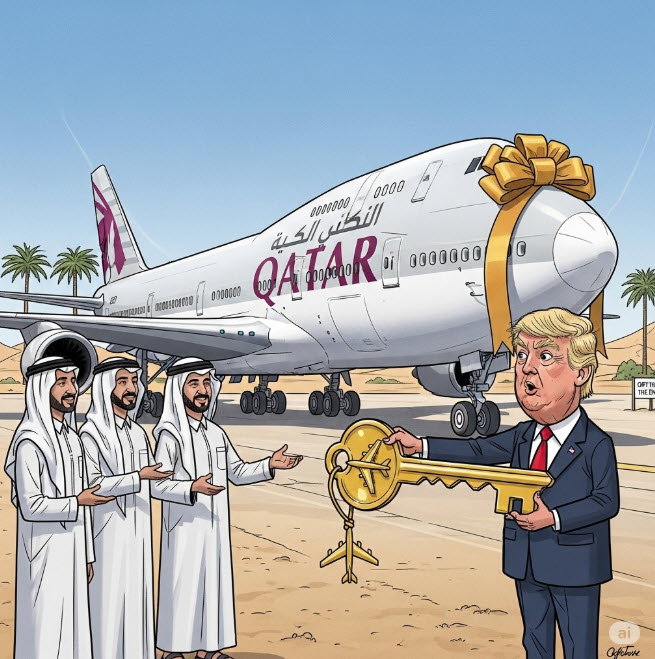
The Qatari Jet Controversy
When Donald Trump accepted a 747-8 luxury jetliner from the Qatari government, it raised concerns of a potential violation of the Foreign Emoluments Clause of the US Constitution, which prohibits federal officeholders from accepting gifts, payments, or titles from foreign governments or the US government without the consent of Congress.
I doubt Donald Trump, who demonstrates ignorance and disdain for our Constitution on a regular basis, give’s a flying fuck about the Emoluments Clause. According to Donald Trump, “It would be stupid not to take the gift.”
Here are the tids and the bits:
Qatar reportedly gifted a luxury Boeing 747-8 to President Trump, intended for use as Air Force One and later transfer to his presidential library.
Critics argue this is a clear violation of the Emoluments Clause, especially since the jet is valued at $400 million or more.
Legal experts and former ethics officials say the gift appears to benefit Trump personally, even if routed through the U.S. military.
A DOJ memo reportedly justified the acceptance, but its contents haven’t been publicly released and are now the subject of a lawsuit
And although Trump claims the plane is a “GIFT, FREE OF CHARGE,” the American taxpayer will foot the bill for retrofitting the plane, just so our American Dumbo can fly his Qatari Jumbo.
The cost estimate for retrofitting the gifted jet liner for presidential use is between $400 million and $1 billion or more, the latter amount taking into consideration advanced security systems, encrypted communications, anti-missile defenses, and a full sweep for espionage threats.
The Qatari Jet Controversy isn’t the only potential violation of the Emoluments clause. Here’s a look at other Trump political initiatives and actions that have enriched him personally during his presidency.
Political Initiatives that Enriched Trump Personally
Retention of Business Empire
Trump refused to divest from his businesses while in office, maintaining ownership and control of the Trump Organization.
His properties—including hotels, golf courses, and real estate—continued to operate and profit during his presidency.
Foreign Government Patronage
Over 150 foreign officials from 77 countries stayed at or hosted events at Trump properties.
The Chinese government alone reportedly spent at least $5.5 million at Trump-owned venues.
Domestic Government Spending
U.S. government agencies spent taxpayer money at Trump properties, including Secret Service lodging and event hosting.
State governments also used Trump venues for official functions, raising concerns under the Domestic Emoluments Clause.
Promotion of Trump-Branded Products
Trump promoted personal products like branded Bibles, cologne, and even guitars during his presidency.
His media ventures, including Truth Social and Trump Media & Technology Group, gained visibility and investment while he was in office.
International Real Estate Deals
Trump’s business pursued or maintained real estate developments in Saudi Arabia, Oman, and the UAE, some allegedly funded by foreign entities.
These ventures continued without congressional approval, despite constitutional requirements.
Emoluments Clause Violations? You Be the Judge!
The U.S. Constitution contains two key provisions:
Clause
Description
Alleged Violation
Foreign Emoluments Clause
Prohibits federal officials from receiving gifts, payments, or benefits from foreign governments without congressional consent (Article I, Section 9, Clause 8)
Trump received millions from foreign governments via business transactions without congressional approval
Domestic Emoluments Clause
Prohibits the president from receiving any benefit from the federal or state governments beyond salary (Article II, Section 1, Clause 7)
Trump profited from federal and state spending at his properties
Should a sitting president be allowed to retain ownership of private businesses that receive payments from foreign or domestic governments?This question strikes at the heart of the Emoluments Clause debate. Trump’s refusal to divest created a direct conflict of interest and undermined the Constitution’s anti-corruption safeguards.
My Paper, My Words is a collection of essays, stories, and poems reflect the challenges of a middle-class husband and father trying to navigate a rapidly changing political, religious, and technological landscape of post-911 America.