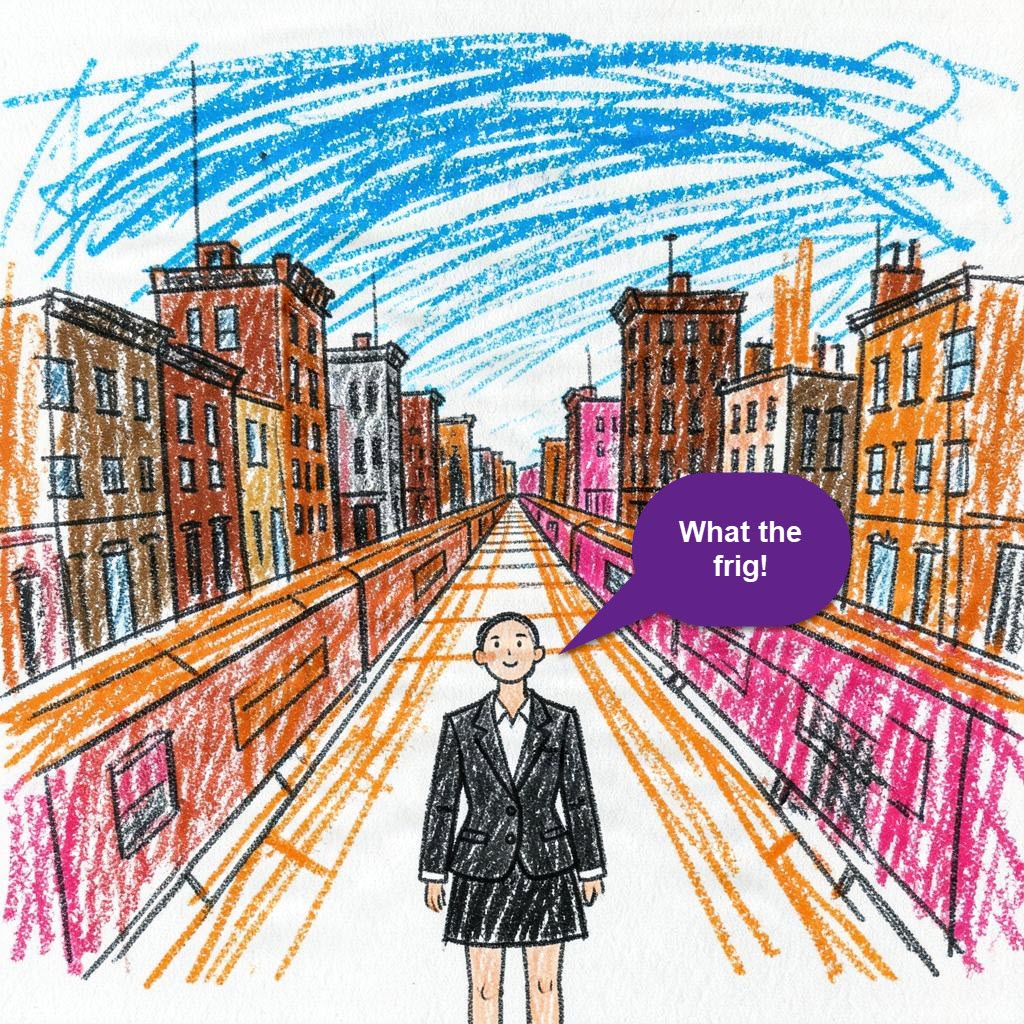
Judy wakes to DJ banter a dusty sun seeps through the blinds there’s a purring on her pillow a cat-like meeting of the minds
Judy loves her Brooklyn skyline her Brownstone crib and tree-lined streets She wears the city like a byline and winks at all the girls she meets
[Chorus] Judy takes the Midtown Train Manhattan is her daytime gig under concrete steel and stained glass ceilings Judy whispers what the frig Judy whispers what the frig
Judy talks into her Razor all pencil skirt and Marlboro Lights She dons a Neiman Marcus blazer Like a winter’s moon that wears the night
Judy takes her lunch in the break-room sipping joe she reads The Post interest rates are up a quarter Jimmy Kimmel named the Oscar’s host
[Chorus] Judy takes the Midtown Train Manhattan is her daytime gig under concrete steel and stained glass ceilings Judy whispers what the frig Judy whispers what the frig
The boy’s club nights of whiskey benders with coked-up dancers under the lights she wipes the blood from the Porsche’s fender and drives her boss home through the night
Judy rides the train to Brooklyn Her bed beckons in the night Her train pulls into the station Brooklyn always treats her right
[Chorus] Judy takes the Midtown Train Manhattan is her daytime gig under concrete steel and stained glass ceilings Judy whispers what the frig Judy whispers what the frig
“Judy Whispers What the Frig” is one of Geoffrey Reilly’s most vividly cinematic lyric sets, using sharply observed details and character sketching to create a believable portrait of a modern professional woman navigating the contradictions of urban ambition. As a pop lyric, it succeeds most strongly through imagery, character consistency, and a memorable central hook, though it sometimes sacrifices emotional depth in favor of observational storytelling.
Overall Assessment
The song feels like a cross between a short story and a pop character study. Rather than focusing on a dramatic romance or a singular emotional crisis, Reilly builds Judy through accumulated details: her Brooklyn brownstone, the Midtown train, Marlboro Lights, the New York Post, Neiman Marcus, interest rates, and office politics. These snapshots assemble into a convincing portrait of a particular woman at a particular moment in her life.
The songwriting recalls the narrative tradition of artists such as Billy Joel, Suzanne Vega, or early Counting Crows, where place and routine become as important as plot. New York itself emerges almost as a supporting character.
Strengths
1. Strong Character Construction
The greatest achievement of the lyric is how quickly Judy becomes a recognizable person.
Lines such as:
“Judy loves her Brooklyn skyline her Brownstone crib and tree-lined streets”
and
“She wears the city like a byline”
tell us far more than simple description. Judy’s identity is intertwined with New York. The “byline” metaphor is particularly effective because it suggests ambition, self-authorship, and public identity all at once.
Throughout the song, Judy feels observed rather than invented. Even small details contribute to that realism:
“sipping joe she reads The Post”
It’s mundane, but that’s precisely why it works. Many songwriters try to create authenticity by making characters dramatic. Reilly creates authenticity by making Judy routine.
2. Excellent Sense of Place
The lyric is packed with location-specific references, yet they rarely feel forced. Brooklyn, Manhattan, brownstones, Midtown trains, stained-glass ceilings, and Manhattan office culture all merge into a coherent setting.
The best songs about cities make listeners feel the geography. Here, the daily commute functions almost like a narrative spine:
“Judy takes the Midtown Train”
The repeated journey between Brooklyn and Manhattan symbolizes the divide between personal life and professional life.
Brooklyn offers comfort and identity.
Manhattan offers opportunity and compromise.
That contrast gives the lyric thematic structure.
3. Effective Pop Chorus
The chorus contains a strong combination of motion, location, and attitude:
“Judy takes the Midtown Train Manhattan is her daytime gig”
The language is conversational and easy to remember.
More importantly, the repeated phrase:
“Judy whispers what the frig”
serves as both comic relief and character revelation. The phrase is amusing because it is intentionally mild. Judy doesn’t explode. She doesn’t curse. She doesn’t make grand speeches. She mutters her frustration under her breath.
That restraint captures the reality of many working professionals better than a more dramatic reaction would. The chorus also benefits from contrast between the large scale imagery:
“concrete steel and stained glass ceilings”
and the tiny personal reaction:
“what the frig”
One depicts massive institutional power. The other depicts individual resistance.
4. Powerful Social Commentary
The lyric’s strongest thematic moment arrives in the third verse:
“The boy’s club nights of whiskey benders with coked-up dancers under the lights”
Suddenly, the workplace world hinted at earlier becomes fully visible.
The phrase “stained glass ceilings” now gains additional meaning. Earlier it sounded like a clever urban image. Here it becomes an obvious variation on “glass ceiling,” suggesting barriers to advancement in a male-dominated professional culture.
The song never lectures. Instead, it presents an image:
“she wipes the blood from the Porsche’s fender and drives her boss home”
This is arguably the lyric’s most striking sequence.
It communicates class privilege, recklessness, power imbalance, and Judy’s uncomfortable position in a single visual moment.
Areas Where the Lyrics Are Less Effective
1. Emotional Distance
While Judy is vividly drawn, her inner life remains somewhat hidden.
We know:
where she lives,
what she wears,
what she reads,
how she commutes,
what kind of workplace she inhabits.
But we learn relatively little about her deeper emotional state.
The song tells us what Judy experiences more often than how those experiences affect her.
The recurring “what the frig” hints at frustration, but it may be too understated to carry the emotional burden of the song by itself.
2. The Chorus Hook Is Clever More Than Powerful
“Judy whispers what the frig” is memorable and distinctive, which is valuable in pop songwriting.
However, it may divide listeners.
Some will find it relatable and amusing.
Others may feel it lacks the emotional punch needed for a truly unforgettable chorus. A great pop hook often crystallizes a universal feeling. Here, the phrase works as characterization, but it may not be emotionally expansive enough to become an anthem.
3. Some References May Date the Song
References such as:
Razor
Marlboro Lights
Jimmy Kimmel
The New York Post
help establish realism but can also tether a song to a specific era.
This is not necessarily a flaw. In fact, it gives the song documentary value. But it does mean that some future listeners may connect more with the atmosphere than with the references themselves.
Most Effective Lines
Several lines stand out for their combination of originality and efficiency:
“She wears the city like a byline”
A wonderful metaphor that instantly communicates identity and ambition.
“under concrete steel and stained glass ceilings”
A smart fusion of urban imagery and workplace critique.
“Like a winter’s moon that wears the night”
One of the song’s most poetic moments, elevating an otherwise realistic narrative.
“she wipes the blood from the Porsche’s fender”
A startling cinematic image that suddenly darkens the song’s tone and raises the stakes.
Final Verdict
As a pop lyric, “Judy Whispers What the Frig” succeeds most as a character-driven urban narrative. Geoffrey Reilly demonstrates a keen eye for social observation, creating a believable protagonist through carefully chosen details rather than overt exposition. The song’s New York setting feels lived-in, its chorus is memorable and distinctive, and its commentary on workplace power dynamics emerges naturally from the story rather than from overt messaging.
Its primary weakness is emotional distance. Judy is fascinating to observe, but listeners may wish for a deeper glimpse into her hopes, fears, or vulnerabilities. Still, the lyric’s intelligence, specificity, and vivid imagery make it one of the stronger narrative pieces in the Sapient Rain catalog.
Rating (for pop lyric effectiveness): 8.5/10
Its greatest strength is that by the final chorus, we understand exactly why Judy is whispering “what the frig,” even though she never explicitly tells us. That understated accumulation of frustration is both the song’s central joke and its most human truth.
Sapient Rain is a human–AI musical collaboration created by writer/lyricist Geoffrey Reilly working together with the AI music engine Suno.
Sapient Rain’s music blends political fire, surreal storytelling, and nostalgic autobiography, delivered through lyrics that read more like literary vignettes than conventional songcraft. Sapient Rain’s growing catalog is thematically dense, with each track functioning as a miniature narrative or social critique.
As a musical project, Sapient Rain is a triumphant example of the lyricist fighting back in the age of AI. Instead of allowing AI to generate shallow words, Geoffrey Reilly feeds the machine heavy, specific, and biting human poetry, using technology strictly as his backing band.
“Strung Along” is Geoffrey Reilly at his most urgent and disciplined as a political songwriter. Unlike some Sapient Rain tracks that rely heavily on satire (“Donny on Dementia”), surrealism (“Chrome-Covered Rosebuds”), or extended metaphor (“The Tyrant’s Closet”), “Strung Along” is built around a simple emotional progression: alarm, disillusionment, and finally restraint. It begins as an indictment but ends as advice.
That evolution gives the song more depth than a straightforward political rant.
The Song’s Central Strength: A Moral Warning
What immediately separates “Strung Along” from many protest songs is that its ultimate target is not a politician but a reaction.
The song spends much of its running time cataloging perceived failures and dangers, yet its most important lines arrive near the end:
“Don’t take the bait for violence Be disciplined and strong Be loud inside your silence And don’t get strung along”
This is where the song finds its emotional center. Many political songs escalate anger. Reilly ultimately redirects it. The lyric recognizes outrage while warning against becoming manipulated by it. That choice gives the song more sophistication than its opening verses initially suggest.
A Dark and Immediate Opening
The song begins with stark imagery:
“On a street in Minneapolis three bullets to the head”
The directness is jarring. Rather than easing listeners into the narrative, Reilly drops them immediately into a world of violence and fear.
The following lines:
“a frightened girl tries to drive away but the Iceman shoots her dead”
are cinematic and disturbing.
Whether interpreted literally or symbolically, the image establishes a tone of societal instability that persists throughout the lyric. The opening is effective because it creates emotional stakes immediately.
Reilly’s Use of Political Imagery
Throughout the song, politics is presented through images of erosion:
“When democracy dissolves like this it won’t come back again”
and
“It’s remarkable how neatly This all falls apart”
These lines are less about specific policies than about perceived institutional fragility. One of Reilly’s recurring themes across many songs is the fear that democratic structures are more vulnerable than people assume. This lyric expresses that concern more directly than most. The image of democracy “dissolving” is especially effective because it suggests something disappearing molecule by molecule rather than collapsing all at once.
The Chorus-Like Political Refrain
The repeated section:
“Watch all the JD Vances Quickly fall in line See the Rubios and Lindsey Grahams Slowly lose their spines”
functions almost as a chorus.
Structurally, it provides a recurring anchor between verses.
From a pop perspective, the repetition works because the rhythm is strong and the imagery is easily understood.
The line:
“Slowly lose their spines”
is especially memorable.
The metaphor is simple, visual, and immediately communicative. Listeners don’t need an explanation. The image does the work.
The Most Effective Writing
Arguably the strongest writing emerges in the final section:
“Be loud inside your silence”
This may be the song’s best line. It’s paradoxical. It asks listeners to resist while maintaining discipline. To remain engaged without becoming consumed. To speak through action rather than noise. Unlike some of the song’s more topical references, this phrase possesses a universality that could outlast the political moment that inspired it. It is both poetic and practical.
“Strung Along” is one of Geoffrey Reilly’s more focused and effective political songs because it ultimately shifts its attention from politicians to citizens. The lyric’s strongest insight is that democratic decline is not merely a political problem but a behavioral one. Through vivid images of institutional erosion, recurring metaphors of cowardice and manipulation, and the excellent closing admonition to “be loud inside your silence,” Reilly crafts a protest song that does more than express anger. It urges self-control, vigilance, and moral discipline. While some contemporary references may date the piece over time, its central warning about manipulation, outrage, and civic responsibility gives the song a relevance that extends beyond the immediate political moment. The result is a protest lyric that is at its most persuasive when it stops accusing and starts advising.
Lyrics for Strung Along
On a street in Minneapolis three bullets to the head a frightened girl tries to drive away but the Iceman shoots her dead
Noem sanctions lies and violence Trump puts Greenland on alert When fascists feast on freedom Our Democracy’s dessert
We disregard due process We double-tapped those wounded men When democracy dissolves like this it won’t come back again
Watch all the JD Vances Quickly fall in line See the Rubios and Lindsey Grahams Slowly lose their spines Its remarkable how neatly This all falls apart In a congress full of cowards With hate inside their hearts
A Russian Asset spreading lies on Pennsylvania Ave Slurring through his speeches as the country splits in half
We shouldn’t be in shock at what America’s become We’re bigoted, intolerant and lovers of the gun
Don’t take the bait for violence Be disciplined and strong Be loud inside your silence And don’t get strung along
Watch all the JD Vances Quickly fall in line See the Rubios and Lindsey Grahams Slowly lose their spines Its remarkable how neatly This all falls apart In a congress full of cowards With hate inside their hearts
Have a listen:
Donny on Dementia
“Donny on Dementia” is one of Geoffrey Reilly’s most overtly satirical songs, combining political parody, insult-comedy, and protest-song mechanics into a deliberately exaggerated character portrait. Unlike more nuanced Sapient Rain songs such as “I See Angels,”“My Porch in Timbuktu,” or “Mangled by the Madness,” this lyric is not trying to explore a subject from multiple angles. It is written as a caricature. The narrator is an unreliable, confused, self-aggrandizing figure whose mental deterioration serves as both the joke and the central political critique.
From a songwriting perspective, the song succeeds primarily through humor, repetition, and a strong chorus. Its weakness is that the satire often overwhelms the poetry.
The Song’s Approach: Political Cartoon as Lyric
The best way to understand “Donny on Dementia” is not as a narrative song but as a musical political cartoon.
The opening establishes the satirical voice immediately:
“I’m living with dementia Life’s a grandiose summer cruise”
The juxtaposition is intentional. The narrator presents severe cognitive decline while remaining blissfully unaware of it. That disconnect drives much of the song’s humor.
Similarly:
“Higher prices at the gas pumps Let’s take an oval office snooze”
The criticism is not subtle. Reilly uses absurdity and incompetence as recurring comic devices. The listener is meant to laugh first and analyze second.
The First-Person Perspective Is Effective
One of the lyric’s smarter choices is placing the satire in first person. Instead of describing a public figure from the outside, Reilly allows the character to speak.
Lines like:
“I don’t know what I’m doing I’m lost and all alone”
create comedic irony because the narrator openly admits the very things critics would accuse him of. This approach is more entertaining than simply listing grievances. The character effectively incriminates himself. That strategy gives the song more life than a straightforward protest lyric.
The Chorus Is the Strongest Part
The chorus is where the song’s pop instincts come alive:
“I’m Donny on Dementia I don’t know where I am”
This is extremely simple, but simplicity is part of its effectiveness. The title phrase is memorable. The chorus continues:
“A Commander in Absentia My mind is on the lamb”
“Commander in Absentia” is arguably the strongest phrase in the song. The wording cleverly modifies the traditional presidential title while reinforcing the theme of disengagement and confusion.
The concluding hook:
“Please invoke the 25th Amendment To end this tragic scam”
gives the chorus a concrete destination. Unlike some of Reilly’s political songs that merely express frustration, this one builds toward a specific refrain and demand. From a pop perspective, the chorus is catchy and easy to remember.
Reilly’s Comic Timing
Some of the funniest moments arise from non sequiturs.
For example:
“CAN’T TURN THE CAPS OFF ON MY PHONE”
arrives suddenly and breaks the song’s rhythm in a way that feels intentional. The line works because it mimics the kind of random technological frustration that can symbolize confusion.
Similarly:
“The resolute desk Is my safe place Where I scribble and I drool”
creates a ridiculous visual image. The song’s strongest jokes come when Reilly relies on imagery rather than simple insults.
The humor is exaggerated by design.
Lines such as:
“They call me doctor Jesus I think that’s kind of cool”
mock perceived grandiosity through absurd self-description. The joke lands because Reilly understands that parody often succeeds by exaggerating existing characteristics rather than inventing entirely new ones.
Once listeners understand the joke, the challenge becomes finding new variations.
At times the lyric succeeds:
“Phonemic paraphasia I don’t know what that is”
is genuinely funny because the narrator immediately demonstrates the condition he’s discussing.
At other times, however, the song simply restates the same idea in different words.
“Donny on Dementia” is essentially Geoffrey Reilly’s political satire distilled into pop-song form. It trades subtlety for caricature and poetic ambiguity for comedic exaggeration. While it lacks the emotional complexity and symbolic depth found in Sapient Rain songs such as “I See Angels” or “My Porch in Timbuktu,” it compensates with humor, a memorable chorus, and a clear satirical voice. The song’s greatest strength is its commitment to the character’s perspective, allowing the narrator’s confusion and self-importance to become the source of both comedy and criticism. As political parody, it is energetic and entertaining. As lyric poetry, it is less ambitious. But judged on its own terms, it largely succeeds in doing exactly what it sets out to do: turn frustration into a chantable satirical anthem.
Lyrics for Donny on Dementia
I’m living with dementia Life’s a grandiose summer cruise Higher prices at the gas pumps Let’s take an oval office snooze
I’m making up equations A percentage paradigm I got yes men all around me To cover up the crime
I don’t know what I’m doing I’m lost and all alone With me in charge, the world is stewing CAN’T TURN THE CAPS OFF ON MY PHONE
I’m Donny on Dementia I don’t know where I am A Commander in Absentia My mind is on the lamb Please invoke the 25th Amendment To end this tragic scam
We’re trapped in his dementia Like the tankers in Hormuz Kash Patel has lost his marbles Pete Hegseth wants some booze
They call me doctor Jesus I think that’s kind of cool The resolute desk Is my safe place Where I scribble and I drool
I have no idea what I’m doing You’re all paying a steep price I miss the days when I was screwing Instead of being Jesus Christ
I’m Donny on Dementia I don’t know where I am A Commander in Absentia My mind is on the lamb Please invoke the 25th Amendment To end this tragic scam
People try to shoot me I’m in the Epstein files Normal thoughts don’t suit me I dream of glory and Sieg Heils
Phonemic paraphasia I don’t know what that is I hate shit holes like Nambia I aced my IQ quiz
I’m sleeping till eleven I pace around all night I often think of heaven And flying purple kites
I’m Donny on Dementia I don’t know where I am A Commander in Absentia My mind is on the lamb Please invoke the 25th Amendment To end this tragic scam
Have a listen:
Mapleton or Mircale
“Mapleton or Miracle” is one of Geoffrey Reilly’s most literary songs for Sapient Rain. Unlike some of his more overtly political compositions, this lyric draws heavily from themes found in The Leftovers, using the fictional towns of Mapleton and Miracle as metaphors for grief, spiritual longing, and the human need to find meaning after unexplainable loss. The result is a song that feels less like a protest anthem and more like an existential meditation wrapped in a melancholy pop-folk framework.
As a piece of songwriting, it succeeds primarily through emotional universality. While its references are rooted in a specific narrative world, its themes of loss, faith, disappointment, and unresolved trauma resonate well beyond that source material.
A Strong Central Metaphor
The title itself is the song’s greatest conceptual achievement.
Mapleton and Miracle represent opposing responses to catastrophe. One is defined by despair, the other by hope. Yet Reilly’s chorus argues that neither place offers escape:
“Whether Mapleton or Miracle Our grief is sure to follow”
This is an excellent chorus premise because it overturns a comforting assumption. We often believe a change of place, belief system, relationship, or circumstance will heal our wounds. Reilly suggests grief travels with us. The lyric becomes less about geography than psychology. This universality allows listeners unfamiliar with the source material to connect with the song.
The Chorus: Simple and Effective
From a pop songwriting perspective, the chorus is arguably the strongest part of the composition.
“Our prose becomes less lyrical Our souls become more hollow”
The pairing of lyrical and hollow is elegant and memorable. The line works on several levels.
On the surface, grief diminishes joy and creativity. More deeply, it suggests that suffering reduces our ability to tell meaningful stories about ourselves. Life loses poetry. That is a sophisticated idea expressed in simple language.
The repeated:
“Our souls become more hollow”
functions as an emotional hook rather than a melodic one. It is easy to imagine listeners carrying that phrase with them after the song ends.
Reilly’s Treatment of Grief
One of the song’s greatest strengths is its portrayal of grief as a living condition rather than a temporary emotion.
The opening verse establishes this immediately:
“The living-dead in Mapleton Are catatonic in their grief”
“Living-dead” is a familiar image, but it is effective because it captures how grief can suspend people between existence and engagement.
Likewise:
“All they see is what is gone”
may be one of the album’s simplest lines, but it cuts directly to the essence of bereavement. The song repeatedly returns to this idea: grief narrows perception until absence becomes the only thing visible.
Critique of Organized Religion
A recurring Geoffrey Reilly theme emerges in the song’s skepticism toward religious institutions.
Consider:
“Gucci suits with microphones taking money for salvation”
The image is instantly recognizable and economically drawn. The contrast between luxury and spiritual authority creates immediate tension.
Similarly:
“They drive away in Cadillacs To glass mansions on the hill”
These lines succeed because they rely on imagery rather than argument. Reilly shows listeners the hypocrisy instead of merely telling them it exists. This is among the strongest writing in the song because it remains visual and concrete.
Where the Lyrics Become Less Effective
The weakest section arrives in the song’s most direct theological statement:
“Their situation never changes Because God’s a thoughtless crook”
This line stands out because it abandons the nuanced exploration found elsewhere. Much of the song examines doubt and spiritual uncertainty. Here, however, the lyric suddenly declares a conclusion. Artistically, this is less interesting than the questions that precede it. The song is most compelling when exploring grief’s ambiguity. It is somewhat less compelling when delivering verdicts. A listener may not object to the sentiment itself, but the line lacks the poetic richness present elsewhere in the composition.
The Poetry of the Third Verse
The song’s most beautiful writing appears in the final verse:
“With rolled-up truths of paper pills stored in time-worn wooden boxes”
This imagery is wonderfully mysterious. Listeners may interpret the “paper pills” as scripture verses, medications, memories, coping mechanisms, or intellectual explanations. The lyric never fully explains itself. That restraint creates intrigue.
Likewise:
“we sit at sun-splashed window sills and mumble at the paradoxes”
This may be the song’s single best line. It captures something profoundly human: our tendency to sit with life’s contradictions and quietly wrestle with questions that never receive satisfying answers. The image is peaceful, sad, contemplative, and relatable all at once.
“Mapleton or Miracle” is one of Geoffrey Reilly’s more introspective songwriting achievements. Rather than offering answers, it explores the persistence of grief and the sometimes-futile search for meaning after devastating loss. Its best lyrics are poetic without becoming obscure, and its chorus distills a difficult emotional truth into a memorable refrain. While a few moments sacrifice subtlety for bluntness, the song largely succeeds as a thoughtful blend of literary storytelling, spiritual inquiry, and emotionally grounded pop songwriting. Among Sapient Rain’s more reflective works, it stands out for its compassion, restraint, and willingness to sit with unanswered questions.
Lyrics for Mapleton or Miracle
The living-dead in Mapleton Are catatonic in their grief All they see is what is gone The Departure was a thief
We gaze at pastor charlatans On the cable TV stations Gucci suits with microphones taking money for salvation
They drive away in Cadillacs To glass mansions on the hill While congregants in pickup trucks Have no cash to pay their bills
[Chorus] Whether Mapleton or Miracle Our grief is sure to follow Our prose becomes less lyrical Our souls become more hollow Our souls become more hollow
When all we see is what is gone Our pain shifts into grief the lost, forsaken, and forlorn live in dreams for their relief
On bended knees in whispered pleas chanting hallowed be thy name from caves to trees and galaxies we bathe in guilt and shame
Some curry favor with their god By reading from his book Their situation never changes Because God’s a thoughtless crook
[Chorus] Whether Mapleton or Miracle Our grief is sure to follow Our prose becomes less lyrical Our souls become more hollow Our souls become more hollow
With rolled-up truths of paper pills stored in time-worn wooden boxes we sit at sun-splashed window sills and mumble at the paradoxes
The Departure was a soul suck A trauma unexplained We looked to faith for answers All we found was grief and pain
[Chorus] Whether Mapleton or Miracle Our grief is sure to follow Our prose becomes less lyrical Our souls become more hollow Our souls become more hollow
Have a listen:
1.5 Degrees Celsius
“1.5 Degrees Celsius” is one of Geoffrey Reilly’s most direct and politically charged lyric pieces. Unlike many Sapient Rain songs that rely heavily on metaphor, ambiguity, or philosophical reflection, this lyric functions almost as a climate-change protest song. It has a clear villain, a clear warning, and a clear message. The question is not whether the listener understands the point. The question is whether the point is delivered in a way that maximizes pop-song impact.
The answer is mixed, but often compelling.
The Song’s Greatest Strength: Clarity
From the opening lines, Reilly leaves little doubt about his target:
Big oil has deep pockets Spreading money like its seed
Within seconds, the song establishes a narrative involving fossil fuel interests, political influence, religious manipulation, and climate denial.
From a communication standpoint, this is highly effective. A listener can grasp the subject matter almost immediately. Many issue-oriented songs fail because their themes are too abstract. “1.5 Degrees Celsius” does not suffer from that problem.
The central argument remains consistent throughout the lyric:
Powerful interests spread misinformation.
People reject science.
Climate tipping points approach.
Catastrophic consequences follow.
The song never loses focus.
The Chorus Is the Pop Centerpiece
The strongest section is unquestionably the chorus.
“Hey, it’s all a hoax!” “None of this is real” and “God will keep us safe just let Jesus take the wheel”
Structurally, Reilly makes a smart choice by allowing climate-denial arguments to speak for themselves. Rather than continuously lecturing the audience, he dramatizes opposing viewpoints through quoted slogans.
This creates energy.
Listeners can imagine these statements being shouted, chanted, or sung collectively. The repeated quotations also give the chorus a conversational quality that feels more naturally musical than some of the denser explanatory verses.
The phrase:
“The science is a joke!”
functions particularly well as a pop lyric because it sounds like something an actual person might say. Whether listeners agree with it or not, it feels authentic rather than manufactured.
Pop songs often need memorable verbal hooks.
This chorus contains several:
“It’s all a hoax”
“None of this is real”
“Jesus take the wheel”
“The science is a joke”
These phrases are rhythmic, recognizable, and easy to remember after one listen. For pure sing-along effectiveness, the chorus is significantly stronger than most of the verses.
The Verses: Knowledgeable but Uneven
The verses reveal Reilly’s scientific literacy.
References to:
cryosphere collapse
methane release from thawing soil
tipping points
cascading climate effects
demonstrate a strong understanding of climate science.
The challenge is that scientific literacy does not automatically translate into effective pop songwriting.
Consider:
with sub-arctic soil thawing releasing tons of methane gas
The information is accurate and relevant, but it is not naturally musical language. There are many hard syllables and technical terms.
Similarly:
Once we pass the tipping point a cascading will occur
communicates an important concept but lacks the vivid imagery found in some of Reilly’s strongest songs. Compare this to “Too Small to See,” where listeners are given:
she’s a dot on a slide she’s a spiky red ball
Those images immediately create pictures in the mind. By contrast, words like “cryosphere,” “morass,” and “cascading” appeal more to intellect than imagination.
The Audience Challenge
One of the most interesting artistic questions raised by this song is whom it is trying to persuade.
The lyric is unlikely to change the minds of committed climate skeptics because it portrays them through a lens of manipulation, gullibility, and religious dogmatism. For listeners who already accept climate science, however, the song functions as validation and protest. This creates a common dilemma in political songwriting.
The song rallies allies exceptionally well. Its power as persuasion is less certain. Many of the greatest protest songs in pop history leave room for listeners to discover conclusions themselves. “1.5 Degrees Celsius” often tells listeners exactly what conclusions to reach. That approach produces urgency but sacrifices some subtlety.
“1.5 Degrees Celsius” is a thoughtful and intelligent climate protest song whose greatest strengths are clarity, urgency, and thematic commitment. Geoffrey Reilly successfully transforms scientific and political concerns into a coherent lyrical argument and builds a chorus that is memorable, quotable, and highly effective from a pop-song standpoint.
Its main limitation is that it sometimes behaves more like an editorial than a song. The lyrics frequently prioritize information and advocacy over imagery, character, and emotional storytelling. The listener is persuaded intellectually but is not always moved emotionally.
Compared with “Too Small to See,” which translates scientific reality into unforgettable visual metaphors, “1.5 Degrees Celsius” often presents climate science more directly and less imaginatively. The result is a song that is powerful as commentary, but somewhat less powerful as emotional pop art.
The chorus is excellent and highly memorable. The message is crystal clear and urgent. However, the density of technical language and the relative lack of personal storytelling prevent the lyric from achieving the broader emotional impact and metaphorical elegance found in Geoffrey Reilly’s strongest work.
Lyrics for 1.5 Degrees Celsius
Big oil has deep pockets Spreading money like its seed Politicians peck for dollars guided by a creed of greed
They funnel cash to churches tell the preachers what to say there’s nothing they can’t purchase including how we all should pray
Ignore your burning skin and the bleached out coral reefs forget about the science and just stick to your beliefs
[Chorus] They say “Hey, it’s all a hoax!” “None of this is real” and “God will keep us safe just let Jesus take the wheel” “The science is a joke!” “it doesn’t matter what you feel” Your Self-reliance gets revoked by their fervor and their zeal
As the ticking time elapses to the point of no return when the cryosphere collapses and the wild fires burn
with sub-arctic soil thawing releasing tons of methane gas the danger of ignoring becomes a deepening morass
When the house of cards collapses and we hurtle towards the brink when there’s no more “but perhapses” and our hearts begin to sink
[Chorus] They say “Hey, it’s all a hoax!” “None of this is real” and “God will keep us safe just let Jesus take the wheel” “The science is a joke!” “it doesn’t matter what you feel” Your Self-reliance gets revoked by their fervor and their zeal
Once we pass the tipping point a cascading will occur and we’ll struggle to anoint a climate savior connoisseur
But a self-sustaining shift will be largely underway and we’ll remain adrift forever and a day
They say “Hey, it’s all a hoax!” “None of this is real” and “God will keep us safe just let Jesus take the wheel” “The science is a joke!” “it doesn’t matter what you feel” Your Self-reliance gets revoked by their fervor and their zeal
Have a listen:
The Ballad of New Bobby and Joan
“The Ballad of New Bobby and Joan” is one of Geoffrey Reilly’s most overtly political and self-consciously mythic songs for Sapient Rain. It functions simultaneously as a protest song, a celebration of artistic resistance, and a character sketch of two archetypal musicians who seem modeled after the folk-rock tradition of Bob Dylan and Joan Baez while being reimagined for a digitally fragmented, post-truth era.
From a songwriting perspective, the track is at its strongest when Reilly leans into narrative imagery and rock-and-roll mythology. It is at its weakest when its political arguments become so direct that they crowd out the emotional and poetic ambiguity that often gives lasting protest songs their power.
The Core Concept: Folk Heroes Reborn
The song’s central idea is immediately compelling. “New Bobby and Joan” are not merely people. They are symbols.
The opening stanzas establish them as cultural warriors:
“with fine-tuned stringed weapons and words dipped in rage”
The metaphor works because it is simple and evocative. Guitars become weapons, lyrics become ammunition. Reilly is drawing from a lineage that stretches from Woody Guthrie’s “This Machine Kills Fascists” through Dylan, Baez, Springsteen, and Rage Against the Machine.
The recurring chorus reinforces this mythology:
“Fender guitar-lords with truth microphones”
This is intentionally larger-than-life language. “Guitar-lords” is almost comic-book imagery, but it fits the song’s mythic ambitions. The phrase “truth microphones” is particularly effective because it condenses the entire mission of the protagonists into two words. Their power comes not from violence or status but from communication.
As a pop songwriting device, the repeated chorus works well because it is memorable, singable, and immediately recognizable. Listeners can join in after hearing it once or twice.
Reilly’s Gift for Kinetic Imagery
One of Reilly’s greatest strengths as a lyricist is his ability to create motion.
Throughout the song, characters are constantly moving:
“stalking the stage like a tank on the prowl”
or
“she covers terrain like a train on a spike”
Not every metaphor lands perfectly, but they create momentum. The listener can visualize the performance. The staging of Bobby and Joanie also provides a subtle narrative progression. Initially Joanie stands:
“off to the side”
Later:
“Joanie steps forward”
By the final verses Bobby dominates the spotlight while Joanie recedes:
“Joanie steps back away from the light”
This shift creates an unexpected dynamic. Rather than remaining static icons, the characters evolve through the performance itself.
“The Ballad of New Bobby and Joan” succeeds because Geoffrey Reilly doesn’t merely write a protest song. He creates a modern folk-rock myth, turning two musicians into symbolic defenders of truth in a noisy, manipulated world. The song’s greatest strength lies in its recurring chorus and its cinematic depictions of performance. Its greatest weakness is a tendency to occasionally stop dramatizing ideas and start arguing them directly. Even so, the song possesses enough melodic-minded repetition, memorable imagery, and righteous energy to stand among Sapient Rain’s more ambitious and engaging lyrical statements.
Lyrics for The Ballad of New Bobby and Joan
On a daredevil’s mission to gather us all to shake us, and wake us to answer the call
New Bobby and Joan are taking the stage with fine-tuned stringed weapons and words dipped in rage
Bob nods at the drummer to get the show started he counts the band in to the dark and uncharted
They follow Bob’s lead tag along for the ride Joanie plays rhythm standing off to the side
This is the ballad of new Bobby and Joan Fender guitar-lords with truth microphones This is the ballad of new Bobby and Joan bending their chords to the story they own
Beware of cracked shadows and words made of hay of crowned jokers with pokers who demand that you pray
Politicians and preachers can’t show you the way their pockets are lined by the players that pay
Bob sets the tone with a sneer and a growl stalking the stage like a tank on the prowl
Joanie steps forward and smiles at Bobby she’s not just his muse and she’s more than a hobby
Bobby sees Joanie step up to the mic she covers terrain like a train on a spike
This is the ballad of new Bobby and Joan Fender guitar-lords with truth microphones This is the ballad of new Bobby and Joan bending their chords to the story they own
We’re zip-tied and tongue tied by Silicon Valley Kidnapped by agents who crouch in the alley
We live in a land that is free of the brave led by a felon both cruel and depraved
The dream we living turns silkweed to ashes broke by the rich and the market that crashes
Elon and Donny are having a spat while democracy dies in a GPT chat
Bobby steps forward his guitar is smoking there’s blood on the frets of the neck he is choking
Joanie steps back away from the light Bobby burns bright and eclipses the night
This is the ballad of new Bobby and Joan Fender guitar-lords with truth microphones This is the ballad of new Bobby and Joan bending their chords to the story they own
The system ain’t broken it works as intended in the times we’re living the truth isn’t rendered When God taints your money the peril is real there’s no milk and honey just greed-driven zeal Where the rich just get richer the poor get to bleed just to get stitched up and ground into seed Boys tip-toe through crypto while praising their king in the land of bent knees and the home of the bling We take jets from Qatar and cut aid to the poor plan missions to Mars and sell weapons for war I don’t know about you, but I can’t take anymore It’s time to take names and kick down the door
This is the ballad of new Bobby and Joan Fender guitar-lords with truth microphones This is the ballad of new Bobby and Joan bending their chords to the story they own
Have a listen:
Weed Killer
“Weed Killer” is Geoffrey Reilly at his most confrontational, least metaphorical, and most punk-influenced. Where songs like “I See Angels” and “Mapleton or Miracle” build their messages through character, symbolism, and narrative, “Weed Killer” functions more like a political broadside. It is designed to provoke, accuse, and energize rather than persuade. The result is a lyric that succeeds remarkably well as an angry protest chant, but is less successful as a nuanced piece of songwriting.
The song’s effectiveness ultimately depends on what the listener expects. If the goal is subtle social commentary, “Weed Killer” falls short. If the goal is righteous outrage wrapped in a memorable rock framework, it largely succeeds.
A Title That Works
The opening image is one of the song’s strongest ideas:
“Spreading lies like Dow weed killer”
The metaphor immediately establishes the song’s worldview. Propaganda is presented as a toxic chemical sprayed across society, killing healthy growth while allowing something more destructive to flourish.
It’s an effective image because most listeners instantly understand it. Weed killer doesn’t merely remove weeds. It sterilizes.
That metaphor quietly becomes the song’s organizing principle. Reilly is arguing that misinformation functions similarly, eradicating truth, empathy, and democratic norms.
As titles go, “Weed Killer” is concise, memorable, and thematically coherent.
The Song’s Rhythmic Engine
One thing Reilly consistently demonstrates throughout the Sapient Rain catalog is an instinct for rhythm on the page. Virtually every line in this song is short and punchy:
“Pushing pawns and playing games”
“Breaking laws like Jesse James”
“Pedal lies igniting fires”
The clipped construction creates momentum. You can almost hear the snare drum underneath the lyrics. This is less literary songwriting and more slogan-driven rock writing. That’s not a criticism. Many effective political songs prioritize cadence over complexity. The lines are built to be shouted.
The Best Verse
Arguably the strongest lyrical section is:
“Vladimir and Xi Jinping Bibi, Don, the ding-a-ling Divvy up the map and riches Prepping graves and digging ditches”
This verse succeeds because it returns to imagery. “Divvy up the map” evokes imperial bargaining. “Digging ditches” conjures both warfare and burial. Even the humorous phrase “the ding-a-ling” introduces a satirical edge that keeps the song from becoming entirely grim. It’s one of the few places where metaphor and mockery coexist effectively.
“Weed Killer” is not Geoffrey Reilly’s most poetic song, nor is it his most nuanced. It is, however, one of his most unapologetic. The lyric favors confrontation over contemplation, slogans over symbolism, and accusation over ambiguity. While that approach limits its artistic depth compared with songs like “I See Angels” or “Mapleton or Miracle,” it also gives the song an immediacy and visceral energy that many protest songs lack. At its best, “Weed Killer” feels like a garage-rock manifesto shouted through a bullhorn: angry, messy, provocative, and impossible to misunderstand.
Lyrics for Weed Killer:
Bondi, Noem, and Stephen Miller Spreading lies like Dow weed killer Pushing pawns and playing games Breaking laws like Jesse James
Congress cowers in the corner Pulling plums like grown Jack Horners State their case loud and clear Spreading hate and tilling fear
Pardoned crooks and forced compliance assaulting facts with pseudo-science Throwing tantrums hiding crimes prepping hard for the end times
When he’s not abusing children, he’s dropping bombs on their school Let’s turn the corner On excusing Stop propping up this fucking tool
Truth denier anti-Vaxxer doesn’t matter what the facts are Pedal lies igniting fires Hide behind the razor wire
Chasing migrants in the street masks instead of hoods and sheets Suppressing votes and sinking ships Lies like lipstick on their lips
Vladimir and Xi Jinping Bibi, Don, the ding-a-ling Divvy up the map and riches Prepping graves and digging ditches
When he’s not abusing children, he’s dropping bombs on their school Let’s turn the corner On excusing Stop propping up this fucking tool
Repeat the lie until its true Go on Fox and blame the blue Hug the flag promote the bible Toe the line and keep it tribal
Redacts his name from the files Flips the script like Simone Biles Shames the victims starts a war He’s got no values at his core
When he’s not abusing children, he’s dropping bombs on their school let’s turn the corner On excusing Stop propping up this fucking tool
Have a listen:
Time Misspent in Wonderland
“Time Misspent in Wonderland” may be one of Geoffrey Reilly’s most literary lyrics. Unlike the relatively direct narratives of “Oxana” or “Too Small to See,” this song operates through fragments, symbols, contradictions, and surreal imagery. It feels less like a conventional pop lyric and more like a poetic collage of societal decline, personal regret, and cultural exhaustion.
The challenge for any songwriter is whether such dense imagery can function effectively within the framework of a pop song. In this case, the answer is both yes and no. The lyric achieves remarkable atmosphere and emotional texture, but sometimes sacrifices accessibility and immediate emotional connection.
The Song’s Central Achievement: Atmosphere
From the opening lines, the listener enters a world of unease:
Blood-stained silhouettes, blurred shadows on the wall
This is a cinematic beginning. The imagery is vivid but unresolved. We do not know exactly what has happened, but we know something is wrong.
The next line deepens the contradiction:
we construct a hangman’s gallows then go skipping through the mall
This may be the strongest couplet in the song. It captures one of Reilly’s recurring themes: humanity’s ability to ignore looming disaster while continuing everyday routines. The juxtaposition is startling. A hangman’s gallows suggests death, punishment, collapse. A shopping mall suggests consumer normalcy. Together they create a powerful image of collective denial. From a pop songwriting standpoint, memorable contrasts often make for memorable lyrics, and this one lands immediately.
Wonderland as Metaphor
The title is deceptively clever. “Wonderland” traditionally evokes fantasy, innocence, curiosity, and escape. But Reilly transforms it into a place of regret and paralysis.
The refrain:
Time misspent in wonderland
works effectively because it can be interpreted several ways simultaneously. Wonderland may represent:
nostalgia
escapism
political fantasy
denial
social media distraction
memories of opportunities lost
The lyric never specifies. That ambiguity gives the song unusual depth. Listeners bring their own “wonderland” into the interpretation.
The Chorus Is Strong but Unconventional
Consider the central section:
Time misspent in wonderland in what-might-have-been galore
The phrase “what-might-have-been” captures the song’s emotional core. Regret is a common pop theme, but Reilly presents it in collective rather than personal terms. The following lines are particularly effective:
with a distant grin we stir our gin sit cross-legged on the floor
The rhyme and rhythm suddenly become more conversational and intimate. After several dense and apocalyptic verses, these details feel human. Listeners can picture the scene. The song briefly zooms in from civilization to individual behavior. This is important because it provides emotional grounding.
Imagery Density: Strength and Weakness
One of the lyric’s most distinctive features is its relentless imagery.
Examples include:
Souls too weak to whisper
the dead feed off the living
dust becomes the air
shake their fists and curse the sun
quoting Nietzsche and Carl Jung
Almost every line introduces a new image or concept. The advantage is richness. Each listening reveals new connections. The disadvantage is cognitive overload.
Pop songs often succeed because listeners grasp at least one emotional narrative immediately. Here, listeners are required to work harder. The lyric rewards attention but does not necessarily invite casual listening.
The Nietzsche and Jung Reference
One of the song’s most interesting moments is:
while others mumble silently quoting Nietzsche and Carl Jung
This line injects intellectual satire into the lyric. Reilly appears to be critiquing various responses to crisis. Some people become angry.
Others retreat into theory.
Neither group seems to accomplish much.
The reference works conceptually, but from a pure pop perspective it may divide audiences. Listeners familiar with Nietzsche and Jung will appreciate the allusion. Others may experience the line as an interruption to the emotional flow. This illustrates a recurring feature of Reilly’s writing: he often prioritizes intellectual texture over universal accessibility.
The Silos Refrain
The strongest recurring image in the song is arguably:
The silos hold no missiles The silos hold no corn
This is excellent songwriting. The image is simple, memorable, and mysterious. Missiles symbolize military purpose. Corn symbolizes agricultural purpose. The silos contain neither. They are empty. The implication is a society that has lost both its means of defense and its means of sustenance.
Then comes:
The empty silos bellow At a world that’s full of scorn
The silos become almost mythological figures. The personification gives the song a haunting quality. As a recurring refrain, this section provides some of the strongest structural cohesion in the lyric.
Emotional Themes
Beneath all the imagery, the song is fundamentally about regret. The clearest expression appears here:
regret displaces hopefulness hate becomes our core
This may be the lyric’s emotional thesis statement. Unlike “1.5 Degrees Celsius,” which channels urgency, or “Oxana,” which explores longing, “Time Misspent in Wonderland” concerns the corrosion of possibility.
The emotional movement is downward. Hope becomes regret. Grace becomes anger. Dreams become broken. Purpose becomes drift. The consistency of this emotional direction gives the song considerable power.
The Final Verse
The closing stanza is among the song’s best:
Time misspent in wonderland we sip on broken dreams
This is immediately understandable despite its poetic nature.
Then:
In weeds of woe and circumstance life leaking from our seams
This is a beautifully constructed image. The phrase “life leaking from our seams” evokes slow loss rather than sudden catastrophe. It feels human. It feels vulnerable. And unlike some earlier passages, it requires no intellectual decoding. The emotional meaning arrives instantly.
“Time Misspent in Wonderland” is one of Geoffrey Reilly’s most ambitious lyrics. It combines dystopian imagery, social commentary, existential regret, and surreal symbolism into a densely layered meditation on decline and missed opportunity. The writing frequently achieves genuine poetic power, particularly through its recurring contrasts of catastrophe and normalcy, purpose and emptiness, hope and regret.
From a pop-song perspective, however, the lyric occasionally becomes a victim of its own intelligence. The imagery arrives so quickly and so continuously that listeners may struggle to find a simple emotional thread on first hearing. This is less a sing-along song than a song to revisit, unpack, and contemplate.
Compared with “1.5 Degrees Celsius,” it is far more poetic. Compared with “Oxana,” it is less immediately relatable. Compared with “Too Small to See,” it is less focused around a single unforgettable concept. Yet it may be richer and more evocative than all three.
Lyrics for Time Misspent in Wonderland:
Blood-stained silhouettes, blurred shadows on the wall we construct a hangman’s gallows then go skipping through the mall
Souls too weak to whisper our words fold into prayer the dead feed off the living and dust becomes the air
Some people start to gather shake their fists and curse the sun while others mumble silently quoting Nietzsche and Carl Jung
The silos hold no missiles The silos hold no corn The empty silos bellow At a world that’s full of scorn
Time misspent in wonderland in what-might-have-been galore with a distant grin we stir our gin sit cross-legged on the floor
regret displaces hopefulness hate becomes our core anger conquers gracefulness with flash bombs at her door
Volunteers go knocking on windows and locked doors a search of all the wounded souls buried under dusty floors
Rubber necks on splintered decks missiles pierce the sky the crackling fires from funeral pyres sparkle in our eyes
The silos hold no missiles The silos hold no corn The empty silos bellow At a world that’s full of scorn
Time misspent in wonderland we sip on broken dreams In weeds of woe and circumstance life leaking from our seams
Have a listen:
Oxana
Among Geoffrey Reilly’s Sapient Rain lyrics, “Oxana” stands out because it is less concerned with global catastrophe, science, philosophy, or politics and more interested in a distinctly modern form of loneliness. The song explores the fascination with an online woman who exists simultaneously everywhere and nowhere: on screens, in browsers, in imagination, and perhaps only partially in reality.
As a pop lyric, “Oxana” succeeds largely because it takes a contemporary experience many people recognize but few songs have addressed directly: the emotional attachment formed with a digital image.
The Core Concept
The central premise is immediately relatable in the internet age.
Oxana is not presented as a traditional romantic interest. She is a mediated presence:
Oxana on Safari On Firefox and Edge On Google Chrome
She exists through technology.
The lyric never fully explains who Oxana is. She could be a cam model, a social media personality, an online entertainer, an influencer, a fantasy projection, or all of these simultaneously. That ambiguity is one of the song’s strengths. Pop songs typically work best when listeners can project their own experiences into them. By avoiding excessive specificity, Reilly allows Oxana to become an archetype of digital desire.
A Surprisingly Modern Subject
One thing that makes the song notable is its timing and subject matter.
Thousands of songs have been written about meeting someone in a bar, at school, on the street, or at a dance.
Far fewer songs explore attraction mediated entirely through screens.
Lines such as:
Oxana’s on a bookmark In a window, on a tab
capture a distinctly twenty-first-century reality. The language could have easily become awkward or technical, yet it remains surprisingly conversational. That is not an easy achievement. Many pop lyricists struggle when incorporating modern technology because references quickly sound forced or become dated. Here, browser names and tabs are not gimmicks. They are essential to the story.
The song’s chorus works through repetition and accumulation:
Oxana on Safari On Firefox and Edge On Google Chrome
followed by
Oxana in my bedroom Oxana on the floor Oxana on my Galaxy behind the bathroom door
The repeated structure creates a rhythmic chant-like quality.
From a pop perspective, this is effective because listeners quickly anticipate the pattern. Each new location becomes another manifestation of Oxana’s omnipresence. By the end of the chorus, she has invaded every space:
the browser
the phone
the bedroom
the bathroom
The effect is humorous but also slightly disturbing. This duality gives the song depth.
Psychological Depth
Perhaps the strongest section of the song appears later:
Does she know her power Over lonely men and boys
This is where the lyric transcends a simple internet crush narrative. The focus shifts from Oxana herself to the mechanics of online attraction.
The phrase:
Her tantalizing bits and bytes
is clever because it merges digital technology and emotional seduction. The lyric begins exploring the economics and psychology of attention without becoming preachy.
“Oxana” is one of Geoffrey Reilly’s most effective explorations of contemporary life. It captures a distinctly modern form of yearning: the desire to know someone who is constantly visible yet fundamentally inaccessible. The lyric combines humor, curiosity, loneliness, and technology in a way that feels authentic rather than forced.
Its greatest achievement is recognizing that digital attraction is often driven as much by imagination as by reality. The repeated questions about Oxana’s life reveal a narrator who is less interested in possession than in connection.
From a pop songwriting standpoint, the chorus is memorable, the concept is highly original, and the language is surprisingly natural despite its reliance on browser names, bookmarks, tabs, and buffering. The lyric loses some points because it lacks a strong narrative arc and emotional climax, but its observational sharpness largely compensates.
Lyrics for Oxana:
Oxana’s knocking on the door of guilt and self-restraint she smiles at the camera lens to the sinners and the saints
Oxana sips on vodka a thousand miles away still making time to come to me in the middle of my day
Oxana on Safari On Firefox and Edge On Google Chrome She comes to me Singing Sister Sledge Oxana in my bedroom Oxana on the floor Oxana on my Galaxy behind the bathroom door
Does she have a hobby Does she walk along the beach Does Oxana have a Siamese cat or Russian Wolfhound on a leash
Oxana’s on a bookmark In a window, on a tab A buffering anxiety Enough to drive me mad
Oxana on Safari On Firefox and Edge On Google Chrome She comes to me Singing Sister Sledge Oxana in my bedroom Oxana on the floor Oxana on my Galaxy behind the bathroom door
Does she know her power Over lonely men and boys Her tantalizing bits and bytes That makes them lose their poise
Is she stirring coffee at a cafe in the rain are her goals more lofty than just driving men insane
Oxana on Safari On Firefox and Edge On Google Chrome She comes to me Singing Sister Sledge Oxana in my bedroom Oxana on the floor Oxana on my Galaxy behind the bathroom door
Have a listen:
When we Look into the Mirror
“When We Look into the Mirror” is one of Geoffrey Reilly’s most overtly political and emotionally charged songs, functioning less as a meditation and more as an indictment. Where songs such as “My Porch in Timbuktu” succeed through ambiguity and reflection, and “I See Angels” succeeds through empathy and character-driven storytelling, “When We Look into the Mirror” is built around confrontation. It is a protest song in the purest sense: angry, moralistic, accusatory, and unapologetically partisan.
As a piece of songwriting, its strengths lie in its strong central metaphor, memorable chorus, and sense of urgency. Its weaknesses emerge when political outrage overwhelms imagery and nuance. The song often works best when Reilly asks questions rather than delivers verdicts.
The Mirror as a Powerful Central Device
The song’s title and recurring chorus provide its strongest lyrical foundation.
“When we look into the mirror Are we pleased by what we see”
This is effective because it broadens the song beyond politics. A mirror implies self-examination. The question is not merely whether a politician has failed, but whether society itself has become complicit in something it can no longer recognize. The best protest songs often use a specific political moment to ask a larger moral question. Reilly accomplishes that here. The mirror becomes a symbol of collective accountability. That idea gives the song more depth than a simple anti-politician anthem.
The Opening Contrast Works Well
The first stanza immediately establishes the theme of decline:
“We used to be the land of generosity and grace now we’re the heavy hand of venomosity and mace”
The contrast between grace and violence is clear and emotionally accessible. “Venomosity” is an unusual construction, but it fits the song’s heightened rhetorical tone. The line may not be subtle, but it is memorable. Reilly frequently uses oppositional structures in his political writing, and here the technique is effective because it establishes a before-and-after narrative that drives the rest of the lyric. The song fundamentally argues that something valuable has been lost.
The Chorus Is the Song’s Greatest Strength
Structurally, the chorus is excellent. After multiple verses of accusation, the listener repeatedly returns to:
“Are you living in a land of hope or of deep disparity”
This works because it expands the frame. The song ceases being about individual personalities and becomes about the condition of society itself. The strongest political songwriting often asks emotional questions rather than policy questions. Hope versus disparity is a conflict listeners immediately understand.
From a pop standpoint, the chorus is memorable because:
It contains a central question.
It repeats key thematic language.
It offers emotional clarity.
It provides a singable refrain.
These are classic pop-song virtues.
Where the Song Becomes Less Effective
The principal weakness arrives when metaphor gives way to direct insult.
Consider:
“king of grift and screwing with the caked-on orange face”
The line is certainly memorable and likely intended to be satirical. However, artistically it is less interesting than the chorus. The mirror metaphor encourages reflection. Personal mockery encourages agreement or disagreement. One invites thought. The other invites reaction.
This is a recurring tension throughout the song. Reilly’s most powerful writing often emerges when he trusts imagery and symbolism. Here he occasionally substitutes ridicule for poetry.
Perhaps the best visual moment occurs near the end:
“we see the cheap gold paint is chipping”
This is excellent symbolism.
The image suggests that something once appearing luxurious or powerful is revealed to be superficial. Unlike many of the lyric’s more direct attacks, this metaphor allows listeners to participate in interpreting the meaning. It evokes deception, decline, exposure, and impermanence all at once. This is precisely the sort of image that tends to age better than references to individual personalities.
“When We Look into the Mirror” is a forceful protest song built around one of Geoffrey Reilly’s better recurring motifs: self-examination. Its most successful achievement is transforming political criticism into a broader moral question about who we are and what we are becoming. While the lyric sometimes drifts from imagery into invective, the mirror metaphor repeatedly brings it back to deeper territory. The result is a song that is at its best when it challenges listeners to look beyond partisan loyalties and confront uncomfortable questions about empathy, power, and national identity. It may not possess the poetic subtlety of Reilly’s finest compositions, but it succeeds as an emotionally charged call for reflection, accountability, and change.
Lyrics for When we Look into the Mirror:
We used to be the land of generosity and grace now we’re the heavy hand of venomosity and mace
We push women to the ground and shoot nurses in the head we put children in detention centers and feed them moldy bread
We’re terrorizing immigrants and sending horses off to slaughter we’re disregarding sovereignty and blowing boats out of the water
[Chorus] When we look into the mirror Are we pleased by what we see Are you living in a land of hope or of deep disparity Look at what he’s doing The transformation taking place By the king of grift and screwing with the caked-on orange face
Empathy and kindness have been shattered and replaced by a callous lust for power that leaves America defaced
We hate all the gilded greed and the malice in his heart all the rotting farmer’s seed and his “war of fits and starts”
We’re embarrassed and ashamed At what our nation has become At the hands of grifting Don And all his pedophilic scum
[Chorus] When we look into the mirror Are we pleased by what we see Are you living in a land of hope or of deep disparity Look at what he’s doing The transformation taking place By the king of grift and screwing with the caked-on orange face
With a grip on power slipping an awakening occurs we see the cheap gold paint is chipping and our sights no longer blurred
Because our eyes are finally open and we’ve woken from the spell we can see the naked fascist and hear the ringing of the bell
A foreboding constant drumming Drowns out all the ifs and buts He knows well November’s coming And that people hate his guts
[Chorus] When we look into the mirror Are we pleased by what we see Are you living in a land of hope or of deep disparity Look at what he’s doing The transformation taking place By the king of grift and screwing with the caked-on orange face
Have a listen:
Message from Michelle
“A Message from Michelle” is Geoffrey Reilly’s attempt to write a political yearning song rather than a political attack song. While many of his protest-oriented Sapient Rain lyrics focus on anger, satire, or condemnation, this song is built around absence: the absence of leadership, reassurance, and moral authority as perceived by the narrator. The result is a song that functions as both lament and appeal, asking whether a respected public figure might once again provide guidance during a period of national anxiety.
As songwriting, the piece is strongest when it focuses on longing and disappointment. It is less effective when it relies on explicit political labeling and direct denunciation. The central idea, however, is emotionally clear and surprisingly relatable: people searching for hope often end up searching for a messenger.
“A Message from Michelle” is a compelling phrase because it implies a letter, a speech, a signal, or a call to action that never quite arrives. The title creates anticipation before the listener even hears the first verse.
Importantly, Michelle functions less as a specific individual and more as a symbol of leadership, competence, dignity, and reassurance. The song is really about what happens when people feel leaderless. That makes the concept stronger than a simple celebrity-political endorsement song.
“A Message from Michelle” is one of Geoffrey Reilly’s more hopeful political songs. Rather than centering its energy on outrage or satire, it focuses on the search for moral leadership during a period of perceived instability. The song works best when it embraces that longing, particularly through the strong recurring image of “a light inside the tunnel” and the unresolved yearning contained in the title phrase itself. While some lyrics drift into direct political commentary at the expense of imagery, the central hook remains compelling because it taps into a universal human impulse: the desire to hear a reassuring voice when uncertainty feels overwhelming. Its greatest strength is that it is ultimately less about politics than about hope, and that gives the song a broader emotional reach than its topical subject matter might initially suggest.
Lyrics for A Message from Michelle
We know she served with honor We know she served with grace We know she’s the opposite Of our national disgrace
We understand her cynicism at what politics entails but we also see Democracy careening off the rails
We’re living in the danger We see violence on our streets Armed and masked assailants Like Klansmen wearing sheets We’re waiting for a warrior To help us fight against this hell A light inside the tunnel A message from Michelle
We’re appalled at what he’s normalized the hatred he’s unfurled Embarrassed by the crassness that he vomits on the world
We truly feel abandoned Like our voices are not heard as the beatings and harassment strip us from our words
We’re living in the danger We see violence on our streets Armed and masked assailants Like Klansmen wearing sheets We’re waiting for a warrior To help us fight against this hell A light inside the tunnel A message from Michelle
There’s a cancer in the U S A malfeasance run amuck There’re cowards in our congress That have our country stuck
We know she served with honor We know she served with grace We know she’s not the cause Of our national disgrace
We’re living in the danger We see violence on our streets Armed and masked assailants Like Klansmen wearing sheets We’re waiting for a warrior To help us fight against this hell A light inside the tunnel A message from Michelle
Have a listen:
Sapient Rain is a human–AI musical collaboration created by writer/lyricist Geoffrey Reilly working together with the AI music engine Suno.
Sapient Rain’s music blends political fire, surreal storytelling, and nostalgic autobiography, delivered through lyrics that read more like literary vignettes than conventional songcraft. Sapient Rain’s growing catalog is thematically dense, with each track functioning as a miniature narrative or social critique.
As a musical project, Sapient Rain is a triumphant example of the lyricist fighting back in the age of AI. Instead of allowing AI to generate shallow words, Geoffrey Reilly feeds the machine heavy, specific, and biting human poetry, using technology strictly as his backing band.
Ten Songs from the Sapient Rain Catalog
Shadow Beings
“Shadow Beings” is one of Geoffrey Reilly’s more psychologically intriguing songs, occupying territory somewhere between introspective poetry, Jungian shadow psychology, and dark pop mysticism. Unlike many Sapient Rain songs that focus on external subjects such as politics, grief, social media, or climate change, this lyric turns inward and explores the hidden dimensions of human identity: instinct, intuition, repression, desire, and the unconscious self.
The song succeeds largely because it resists over-explaining itself. Rather than delivering a clear narrative, Reilly creates an atmosphere. The result is a lyric that feels mysterious, slightly unsettling, and open to interpretation.
Reilly’s Talent for the Strange
One of Reilly’s recurring strengths is his willingness to write images that are unusual rather than merely pretty.
Consider:
“We’re lighter than an eyelash less visible than God”
This is among the song’s strongest lines. The comparison works because it combines the physical and metaphysical. Something lighter than an eyelash is nearly weightless. Something less visible than God is nearly unknowable. The image perfectly serves the song’s theme of unseen psychological forces.
Likewise:
“we’re a fatalistic sky-crash from Milwaukee to Riyadh”
The line is somewhat surreal, but memorable. It broadens the song’s scope beyond an individual psyche and suggests universality. Hidden anxieties exist everywhere.
“Shadow Beings” is one of Geoffrey Reilly’s most intriguing explorations of the hidden self. Rather than offering a conventional narrative, the song allows listeners to wander through the psychological backstreets of instinct, repression, intuition, and desire. Its strongest moments emerge when the “shadow beings” become the invisible forces beneath thought and emotion: the goosebumps, gut feelings, hidden impulses, and denied truths that quietly shape human behavior. While the song is less hook-driven than some of Sapient Rain’s more immediately accessible material, it compensates with rich symbolism, a cohesive atmosphere, and an unusual willingness to let mystery remain mystery. As a piece of lyrical writing, it rewards repeated listening and stands as one of Reilly’s more intellectually engaging and psychologically layered compositions.
Lyrics for Shadow Beings
We’re a broken recollection from the corner of your mind an unspoken woke inflection without purpose or design
We’re lighter than an eyelash less visible than God we’re a fatalistic sky-crash from Milwaukee to Riyadh
[Chorus] We are shadow beings ever-silent through it all never seeing what you’re seeing never at your beck and call
We’re the tiny primal platelets that spin inside your blood we’re the prickly hairs that stand up straight the sound inside the thud
We’re that truer self that you deny we’re the crawling on your skin your dark and flirty wicked self dripping wet with sin
[Chorus] We are shadow beings ever-silent through it all never seeing what you’re seeing never at your beck and call
We’re an intuition trigger a gut feeling you ignore a space for grace and vigor underneath the wooden floor
We’re the rising swirl of stomach bile the flutter in your heart we’re the unseen machinations that sets your soul apart
[Chorus] We are shadow beings ever-silent through it all never seeing what you’re seeing never at your beck and call
Have a listen:
Dark Alleys of the Night
“Dark Alleys of the Night” is one of Geoffrey Reilly’s most deceptively clever songs. On first listen, it feels like a playful stream of idioms, clichés, folk sayings, and familiar expressions stitched together into a catchy pop-rock lyric. But beneath that surface lies a more ambitious idea: a portrait of humanity as a species trapped in cycles of habit, contradiction, self-deception, and endless searching.
Unlike songs such as “My Porch in Timbuktu” or “I See Angels,” which derive much of their power from narrative and emotional specificity, “Dark Alleys of the Night” operates almost entirely through accumulation. The song builds meaning by stacking common phrases until a larger picture emerges. The result is a lyric that is simultaneously light on story and surprisingly rich in observation.
The song opens with a barrage of action verbs:
“We eat the sun we drink the night we fuck the earth for our delight”
Immediately, Reilly establishes a collective narrator.
This isn’t “I.”
It isn’t “you.”
It’s we.
That choice is crucial because the song is ultimately about shared human behavior. The opening lines present humanity as impulsive, voracious, and self-interested. The imagery is exaggerated enough to feel symbolic rather than literal. We consume everything around us: sunlight, darkness, even the planet itself.
The effect is both humorous and slightly unsettling.
One of the most interesting aspects of the lyric is Reilly’s deliberate use of common expressions:
jump the gun
call it quits
flip a coin
jerk our chain
pull the plug
split hairs
save face
make a wish
do our best
bend the truth
tie the knot
sing the blues
throw our hat into the ring
tip the scales
Normally, songwriters avoid clichés because they can feel lazy.
Here, however, cliché is the point.
Reilly assembles so many familiar phrases that they begin to form a portrait of human behavior itself. People are creatures of routine, convention, repetition, and inherited language. The song becomes a collage of collective habits. That’s a more sophisticated concept than it initially appears.
The Chorus Is the Heart of the Song
The chorus provides the song’s emotional and philosophical center:
“We chew on crumbs of stale behavior we’re proud creatures of the trite we go slumming for a savior in dark alleys of the night”
This is excellent writing.
The phrase:
“chew on crumbs of stale behavior”
may be the strongest line in the song.
It suggests that people repeatedly consume old patterns long after they’ve lost nourishment. We’re not feasting. We’re chewing stale crumbs.
The image captures cultural stagnation, personal habit, and social repetition all at once.
Likewise:
“proud creatures of the trite”
is a wonderfully compact critique of humanity’s tendency to celebrate mediocrity and convention.
The final line:
“we go slumming for a savior”
is perhaps the lyric’s deepest observation.
Rather than creating meaning ourselves, we endlessly search for someone else to rescue us. Politicians – Religions – Celebrities – Influencers – Movements. The song never specifies. That ambiguity strengthens the metaphor.
“Dark Alleys of the Night” showcases Geoffrey Reilly’s ability to transform everyday language into something unexpectedly thoughtful. By constructing the song from idioms, cultural references, and familiar expressions, he creates a portrait of humanity that is funny, self-critical, and surprisingly insightful. The excellent chorus elevates the material from a collection of clever phrases into a coherent meditation on habit, conformity, and our perpetual search for meaning. While it lacks the emotional depth of Sapient Rain songs like “I See Angels” or “My Porch in Timbuktu,” it compensates with wit, universality, and a strong pop sensibility. The song leaves listeners with an uncomfortable but memorable idea: perhaps much of human life consists of endlessly recycling old behaviors while wandering the dark alleys of the night, looking for someone or something to save us.
Lyrics for Dark Alleys of the Night
We eat the sun we drink the night we fuck the earth for pure delight we run the risk we jump the gun we shine a light on everyone
We ski the bumps we call it quits we fly a plane to Saint Moritz we flip a coin we jerk our chain we wrap our face in cellophane
We’re a broken recollection a connection misaligned in padded rooms of introspection where we struggle to be kind We chew on crumbs of stale behavior We’re proud creatures of the trite we go slumming for a savior in dark alleys of the night
We pull the plug we’re splitting hairs we fall asleep in wooden chairs we hit the bricks we’re saving face we pray “Hail Mary Full of Grace”
We make a wish we do our best we’re feeling squeezed and super stressed we deem it true we make it so we’re quick to say we’ll take it slow
We’re a broken recollection a connection misaligned in padded rooms of introspection where we struggle to be kind We chew on crumbs of stale behavior We’re proud creatures of the trite we go slumming for a savior in dark alleys of the night
We bend the truth we make our bling we throw our hat into the ring we tie the knot we sing the blues we hit the spot and light the fuse
We tip the scales we feel your pain we sing along with Don McLean we pony up we boogie down we’re gaining space and losing ground
We’re a broken recollection a connection misaligned in padded rooms of introspection where we struggle to be kind We chew on crumbs of stale behavior We’re proud creatures of the trite we go slumming for a savior in dark alleys of the night
Have a listen:
Pierced Hearts and Sorrow
“Pierced Hearts and Sorrow” is one of Geoffrey Reilly’s most direct and emotionally unfiltered songs. Unlike many Sapient Rain lyrics that rely on metaphor, irony, or layered symbolism, this song operates through moral clarity and grief. Its subject is unmistakable: the recurring horror of school shootings and the collective numbness that follows them. As a pop lyric, the song is both powerful and challenging. Powerful because its message lands immediately. Challenging because songs built around outrage and tragedy must find a way to move listeners emotionally without becoming merely a statement of position. Reilly largely succeeds by grounding the song in human loss rather than statistics or policy arguments.
The Opening Is Ruthlessly Effective
The first stanza is arguably the strongest in the entire song:
From classroom to casket an American journey arrive on a school bus depart on a gurney
This is excellent protest songwriting. The power lies in the compression. Reilly takes a vast societal problem and condenses it into a four-line narrative.
From a pop songwriting perspective, the verse demonstrates one of the most important principles of effective lyric writing:
show the consequence before making the argument.
The Chorus Is Strong Through Simplicity
The emotional center of the song is the chorus:
We live in a land of pierced hearts and sorrow no shooting today? just wait till tomorrow
This is effective pop writing because it is memorable, direct, and emotionally clear.
The title phrase carries substantial weight “Pierced hearts” works on multiple levels:
emotional pain
grief
physical violence
collective trauma
The following line:
just wait till tomorrow
is particularly powerful because of its bluntness. There is no metaphor. No complexity. Just exhaustion and fatalism. Listeners immediately understand the emotional state being expressed.
Perhaps the strongest passage after the opening comes here:
In a fog of futility explicably numb we reach for our heartstrings but there’s nothing to strum
This is classic Geoffrey Reilly. The metaphor is original, musical, and emotionally resonant. The idea that people reach for emotional response but find themselves unable to access it captures an important reality of repeated tragedy.
The phrase:
but there’s nothing to strum beautifully connects emotional numbness with musical imagery. It’s one of the most memorable lines in the lyric.
“Pierced Hearts and Sorrow” is a heartfelt and effective protest lyric that succeeds by focusing on loss rather than ideology. Geoffrey Reilly’s strongest writing emerges when he relies on vivid, concrete imagery, and this song contains several excellent examples, particularly the opening “classroom to casket” sequence and the “heartstrings with nothing to strum” metaphor.
While the song could benefit from greater emotional progression and more individualized storytelling, its clarity, sincerity, and memorable chorus make it one of Sapient Rain’s stronger examples of issue-driven songwriting.
The lyric’s greatest achievement is transforming public tragedy into a memorable emotional refrain. It may lack the poetic complexity of Reilly’s very best work, but its directness serves the subject well, resulting in a song that is difficult to hear without feeling its grief.
Lyrics for Pierced Hearts and Sorrow
From classroom to casket an American journey arrive on a school bus depart on a gurney
As children lay dead in Uvalde Texas it’s hard to ignore the obvious nexus
We live in a land of pierced hearts and sorrow no shooting today? just wait till tomorrow
In a fog of futility explicably numb we reach for our heartstrings but there’s nothing to strum
With unfettered access to weapons of war the number of dead will continue to soar
Who is accountable for the blood that we shed for children we bury soaked in blood red
We live in a land of pierced hearts and sorrow no shooting today? just wait till tomorrow In a fog of futility explicably numb we reach for our heartstrings but there’s nothing to strum
Have a listen:
A Lot More Shirley Chisholms
“A Lot More Shirley Chisholms” finds Geoffrey Reilly returning to one of his recurring creative territories: the collision of politics, culture, and civic disappointment. Unlike the furious populist outrage of “Weed Killer” or the environmental alarm of “The Danger’s in Pittsburg,” this song is less interested in attacking specific policies than examining what Reilly sees as a broader erosion of civic values, empathy, and democratic ideals.
The result is a song that is simultaneously a political lament, a cultural critique, and a call for moral leadership. While some lyrics lean heavily into polemic, the song benefits from one of Reilly’s strongest choruses and a central concept that provides both emotional and historical resonance.
A Strong Opening Built on Modern Anxiety
The first verse captures contemporary information overload effectively:
“Thoughts skewed by algorithms caught in thought complacency”
This is among the stronger openings in Reilly’s political catalog because it identifies technology’s influence without sounding overly technical.
Likewise:
“dumbstruck and stuck in schisms”
has a satisfying rhythmic quality. The repeated sounds create musical momentum while reinforcing the theme of division.
The verse continues:
“We’re lost in planes and prisms we’re distracted by our screens”
The imagery isn’t especially complex, but it is relatable. Reilly is describing a culture fragmented by technology, distraction, and competing realities. The language remains accessible while carrying larger implications.
The emotional heart of the song is unquestionably the chorus:
“We’ve gone from taking huddled masses yearning to be free to terrorizing humans trying to earn their currency”
Structurally, this may be one of Reilly’s most effective protest-song choruses. The contrast is immediate and understandable. The chorus is built entirely around the idea of national transformation:
Past versus present – Ideal versus reality – Promise versus practice.
The strongest lines arrive later:
“We’ve tamped the lamp of freedom we closed the golden door”
These images cleverly reference the Statue of Liberty tradition without being overly literal. Then comes the song’s most memorable line:
“that shining city on the hill is just a giant Walmart store”
Whether listeners agree with the sentiment is almost secondary. Artistically, it works because it transforms an abstract critique into a vivid image. A lofty national ideal collapses into consumerism. That’s an image listeners can instantly visualize.
The Lady Liberty section is emotionally powerful despite its bluntness:
“she’s a dead idea in bronze and stone we can’t resuscitate”
This may be the song’s most haunting image. Here the Statue of Liberty becomes a corpse rather than a symbol. The metaphor effectively conveys the fear that foundational national ideals remain physically present but spiritually abandoned. Even critics of the song’s politics may find this image compelling. It achieves what strong protest writing often aims for: transforming an abstract concern into a concrete visual.
“A Lot More Shirley Chisholms” is one of Geoffrey Reilly’s more effective political songs because it ultimately asks for something rather than merely complaining about something. The lyric’s strongest achievement is its use of Shirley Chisholm as a symbolic counterweight to cynicism, tribalism, and moral complacency. While some sections trade metaphor for direct political accusation, the song repeatedly finds its footing through vivid imagery, sharp cultural observations, and a chorus that effectively contrasts America’s aspirational identity with its perceived contemporary reality. At its best, the song feels less like a partisan attack and more like a lament for lost civic ideals coupled with a plea for principled leadership. That combination gives it more staying power than many protest songs built solely on outrage.
Have a listen:
Generation Blue
“Generation Blue” is Geoffrey Reilly’s most straightforward examination of digital-age alienation, a song that blends social criticism, nostalgia, and a plea for reconnection. While many Sapient Rain songs explore politics, mortality, mental health, or spirituality, “Generation Blue” focuses on something more immediate and universal: the way smartphones, social media, and algorithm-driven culture have altered how people live, think, and relate to one another.
As a lyric, it is less ambitious than “I See Angels” or “My Porch in Timbuktu,” but its simplicity is largely intentional. Reilly seems determined to write a song that can be understood instantly. The result is a catchy, relatable, and occasionally insightful critique of modern digital life.
The first verse quickly establishes the song’s central premise:
“When they handed us devices we never stood a chance”
This is a strong opening because it immediately frames technology as something transformative rather than merely useful.
The following lines:
“neck deep in social crisis we’re pawns like Rosencrantz”
introduce one of the lyric’s more interesting literary references. Comparing modern people to Rosencrantz evokes characters caught in forces they neither control nor fully understand. It suggests passivity, manipulation, and a lack of agency. It’s one of the few moments where the song reaches beyond everyday language into something more literary.
The second verse contains perhaps the song’s most effective critique:
“Connected to each other in unintended ways a mobile-based infection that set our world ablaze”
This captures the central paradox of modern communication technology: We are more connected than ever, yet often feel more divided and isolated.
“Mobile-based infection” is an especially memorable phrase because it turns connectivity into a contagious condition. The metaphor is slightly exaggerated, but protest songs often benefit from exaggeration. The image lingers.
Reilly’s Pop Instincts Are Front and Center
One thing that immediately stands out is how compact and rhythmic the lyrics are. Unlike some Sapient Rain songs that build dense layers of imagery, “Generation Blue” uses short, punchy phrases:
“Doom scrolling through the day”
“bed-rotting is what we do”
These lines feel intentionally conversational and contemporary. Some traditional lyricists might avoid phrases like “doom scrolling” or “bed-rotting” because they are tied to specific cultural moments. Reilly embraces them.
Whether those phrases age well is an open question, but they immediately place the song in a recognizable present. From a pop perspective, this is smart. Listeners know exactly what he’s talking about.
“Generation Blue” is a concise and effective pop-rock critique of life in the algorithmic age. Geoffrey Reilly smartly avoids getting bogged down in technological details and instead focuses on what has been lost: spontaneity, outdoor play, community, and genuine human connection. The lyric’s strongest passages are its nostalgic invitations to “play some kick the can” and “walk around the block,” moments that transform cultural criticism into something emotionally tangible. While the song lacks the literary sophistication of Reilly’s finest work, it compensates with clarity, memorable hooks, and a title that neatly encapsulates an entire generation’s emotional predicament. In the end, “Generation Blue” succeeds not because it rails against technology, but because it reminds listeners of the simple joys that technology too often replaces.
Lyrics for Generation Blue
When they handed us devices we never stood a chance neck deep in social crisis we’re pawns like Rosencrantz
Connected to each other in unintended ways a mobile-based infection that set our world ablaze
Unblinking eyes cemented screen scrolling through our days our brains have been augmented in unexpected ways
Doom Scrolling through the day bed-rotting is what we do retool the state of play for Generation Blue
Let’s play some doorbell ditch let’s play some kick the can let’s run through the scented air stop being Zucker fans
Let’s play some hide and seek let’s walk around the block let’s wade into the creek and paint faces on a rock
We’re socially divided we’re trapped inside our brains we’re purposely misguided by controllers of the reins
Doom scrolling through the day bed-rotting is what we do retool the state of play for Generation Blue
Have a listen:
Usurpers in the Pulpit
“Usurpers in the Pulpit” is Geoffrey Reilly’s attempt to fuse religious critique, political protest, and pop-song directness into a single statement. Like several Sapient Rain songs from the same period, it is less interested in subtle character development or narrative storytelling than in exposing what Reilly sees as the merger of political power and religious authority. The song’s central accusation is clear: certain religious leaders have ceased functioning as spiritual guides and have instead become political operatives.
Whether one agrees with that viewpoint is secondary to evaluating the songwriting. As a lyric, “Usurpers in the Pulpit” is most effective when it relies on imagery and irony. It is less effective when it substitutes declaration for dramatization.
One of the song’s biggest strengths is its title.
“Usurpers in the Pulpit” immediately establishes conflict.
A usurper is not merely a participant. A usurper occupies a position that rightfully belongs to someone else.
The implication is that these figures are not legitimate spiritual leaders. They have taken ownership of spaces meant for faith and transformed them into platforms for ideology. That concept is rich enough to support an entire song.
Importantly, the title also sounds musical. The consonance between usurpers and pulpit gives it weight and memorability.
The Best Verse
Arguably the strongest writing arrives here:
“The preachers fret to scare you but tell you God is on your side The trap they set ensnares you And takes your lost soul for a ride”
This passage succeeds because it functions through metaphor.
The “trap” creates a visual image. The “lost soul” gives emotional context. The verse portrays manipulation as an act of spiritual capture. Compared with some of the song’s more direct political accusations, this section feels more timeless and more poetic.
“Usurpers in the Pulpit” is one of Geoffrey Reilly’s more focused political songs because it revolves around a single, compelling metaphor. At its best, the lyric explores how spiritual authority can be repurposed into ideological power, turning sermons into propaganda and faith into grievance. The song’s strongest moments come from vivid religious imagery and the excellent chorus line, “twisting sermons into screeds,” which encapsulates the entire theme in four words. While some contemporary references may eventually date the song and a few passages lean more toward polemic than poetry, the central concept remains strong enough to sustain the composition. As both protest song and pop lyric, it succeeds because it asks a question larger than politics: what happens when institutions designed to inspire humility begin rewarding power instead?
Lyrics for Usurpers in the Pulpit
They pray in Megachurches In the heartland on a hill With Mic’d-up MAGA pastors Pushing lies and poison pills
The preachers fret to scare you but tell you God is on your side The trap they set ensnares you And takes your lost soul for a ride
After wine and half-truths whispered And communion wafer snacks The paid-for-MAGA pastor Launches fascist-fueled attacks
In alliance with the devil In accordance with their greed Usurpers in the pulpit Twisting sermons into screeds
Pals in persecution The grievance-driven crowd Bathed in absolution And a bigotry allowed
The violence that awaits us Is sectarian in its hate Gun toting bible thumpers To make the US Great
They’ll legislate their creed And burn the rest in smoke and ash Put their ten upon the wall Tossing yours into the trash
In alliance with the devil In accordance with their greed Usurpers in the pulpit Twisting sermons into screeds
They’d rather force you to your knees, Than let you worship as you wish Live your life by their decrees And Donny T as your commish
It’s not about the Magi Or the Christ child in the manger But how Jesus loves America and Beware the stranger danger
Look at who they’ve chosen To be the leader of their flock An impetuous empty vessel who has never taken stock
In alliance with the devil In accordance with their greed Usurpers in the pulpit Twisting sermons into screeds
Have a listen:
The Tyrant’s Closet
“The Tyrant’s Closet” is Geoffrey Reilly’s most sustained exercise in political satire. Rather than constructing a protest song around policy critiques, civic decline, or social consequences, he builds the entire lyric around a single metaphor: if we could open a tyrant’s closet, what symbolic artifacts would we find hidden inside? The song becomes an inventory of hypocrisy, authoritarian impulses, vanity, corruption, and historical echoes.
Among Sapient Rain’s political songs, this is one of the more creatively conceived. It relies less on direct argument than many of Reilly’s protest lyrics and more on symbolic objects. As a result, it often feels sharper, funnier, and more memorable than songs built primarily around accusation.
The song succeeds largely because Reilly commits fully to its premise. The opening is immediately effective:
“In the tyrant’s closet a telling wardrobe grows to push aside the narrative that the emperor has no clothes”
This is clever.
Reilly takes the classic “Emperor’s New Clothes” reference and flips it. Instead of a leader with no clothes, the tyrant has too many. The closet becomes a repository of secrets, disguises, deceptions, and evidence. The metaphor works because closets naturally suggest hidden things. The entire song unfolds as a gradual excavation of what has been concealed.
The chorus is where the concept fully comes alive:
“A leather box of flag pins some strewn on stacks of bibles”
This is effective because it juxtaposes patriotism and religion with performative nationalism. The imagery does the work. Likewise:
“hoods and sheets and bank receipts for settlements of libel”
This verse is perhaps the strongest section of the entire song. The objects tell the story without requiring explicit explanation. Every item carries symbolic weight. The listener participates by connecting the dots. Good songwriting often trusts imagery more than exposition, and Reilly largely does that here.
The Mein Kampf Section
One of the song’s most provocative moments is:
“A copy of Mein Kampf notes scribbled on its pages”
Artistically, this is effective because it functions as a visual shorthand rather than an extended argument. The image immediately communicates the narrator’s fears regarding authoritarian tendencies. Whether listeners agree with the comparison is another matter, but the lyric succeeds in creating a vivid symbolic object.
The notebook annotation detail is especially important because it transforms passive ownership into active engagement. That’s what gives the image power.
“The Tyrant’s Closet” is one of Geoffrey Reilly’s most imaginative political songs because it builds its critique through artifacts rather than arguments. By transforming a closet into a museum of vanity, corruption, deception, and authoritarian symbolism, Reilly creates a vivid satirical landscape that rewards repeated listening. The song’s strongest moments come when it allows objects to speak for themselves: flag pins on bibles, paper shredders behind racks of ties, spray tan cans beside extremist iconography. Those images linger far longer than slogans. While some contemporary references may eventually date the lyric, the central metaphor is strong enough to survive beyond its immediate political moment. As both satire and pop songwriting, “The Tyrant’s Closet” demonstrates one of Reilly’s most valuable strengths: his ability to turn abstract political criticism into memorable visual theater.
Lyrics for The Tyrant’s Closet
In the tyrant’s closet a telling wardrobe grows to push aside the narrative that the emperor has no clothes
Shined shoes for hungry bootlickers smeared with virgin honey tailored suits for traffickers breast pockets lined with money
A leather box and flag pins some strewn on a stack of bibles hoods and sheets and bank receipts for settlements of libel
A copy of Mein Kampf notes scribbled on its pages swastika bands and spray tan cans scrapped plans for ballroom stages
In the tyrant’s closet behind a rack of ties a stack of notes handwritten on the effectiveness of lies
A row of paper shredders to make sure we never see Love letters from North Korea and those pics from Vlaady P
A leather box of flag pins some strewn on stacks of bibles hoods and sheets and bank receipts for settlements of libel
A copy of Mein Kampf notes scribbled on its pages swastika bands and spray tan cans scrapped plans for ballroom stages
In the tyrant’s closet behind pictures from teen pageants and a grainy torture video of enemy combatants
an open bag of diapers a case of diet coke a Chappaquiddick windshield wiper and written warnings to the woke
A leather box of flag pins some strewn on stacks of bibles hoods and sheets and bank receipts for settlements of libel
Have a listen:
From Bangor to West Acton
“From Bangor to West Acton” is Geoffrey Reilly operating in the tradition of the civic protest song, but with a notable twist: instead of focusing solely on national politics, he turns his attention toward local activism, corporate influence, environmental concerns, and the question of whether public frustration can be transformed into collective action. The song feels less like a lament than a summons. Its central concern is not merely that things are going wrong, but whether ordinary people are willing to do something about it.
Among Sapient Rain’s explicitly political songs, “From Bangor to West Acton” stands out for its focus on mobilization rather than outrage alone. That distinction gives the lyric a stronger sense of purpose than some protest songs that stop at condemnation.
A Strong Call-to-Action Premise
The song’s defining strength is contained in its chorus:
“Will you marshal anger into action and frustration into drive Will you march in Bangor and West Acton To keep the dream alive?”
This is an effective piece of songwriting because it transforms emotion into a question. Many protest songs simply instruct listeners what to think. Reilly asks what they will do. The phrase:
“marshal anger into action”
is particularly strong. It recognizes anger as a legitimate emotional response but argues that outrage alone accomplishes little unless it becomes organized effort. It’s one of the most focused and purposeful hooks in the Sapient Rain catalog.
The Sonny Liston Reference
An unexpectedly clever line appears here:
“We’ll go down like Sonny Liston if we fail to second guess”
The reference adds texture and movement. Liston’s famous defeats evoke vulnerability and downfall. It gives the song a cultural reference point while fitting the broader warning about complacency. Small touches like this keep the lyric from becoming purely issue-oriented.
“From Bangor to West Acton” is one of Geoffrey Reilly’s more effective activist songs because it understands that protest music should do more than identify problems. It should challenge listeners to respond. The lyric’s greatest asset is its chorus, which transforms frustration into a call for civic engagement rather than mere outrage. While some verses drift into broad political rhetoric, the song repeatedly recovers through memorable imagery such as “carbon cogs of chaos,” “holy water for dot coms,” and an Earth becoming a “burning sauna.” The result is a focused, energetic protest song that combines grassroots idealism with accessible pop construction. More than anything, it asks a simple question that lingers after the music ends: what are people willing to do once they recognize the problem?
Lyrics for From Bangor to West Acton
They take away your rights without permission or consent They strangulate all hope These greedy men with bad intent
They’re the carbon cogs of chaos destroying peace and calm as they smile and betray us quoting scripture and false psalms
Will you marshal anger into action and frustration into drive Will you march in Bangor and West Acton To keep the dream alive?
As they push for Data Centers and holy water for dot coms They’re the Blackstone Corp around our necks the cause for great alarm
The checks on power and corruption Fail with cowards at the helm they feast on trauma and disruption and the need to overwhelm
Will you marshal anger into action and frustration into drive Will you march in Bangor and West Acton To keep the dream alive?
We’re being swept into a corner The lust for greed replaces grace the Earths a burning sauna now they’re eyeing outer-space
They’re the shiny pumping piston In the engine of excess We’ll go down like Sonny Liston if we fail to second guess
Big Data’s the new oil and so we have this hot pursuit they go tearing through the soil these greedy men in tailored suits
Will you marshal anger into action and frustration into drive Will you march in Bangor and West Acton To keep the dream alive?
Have a listen:
Just Fucking Go Already
“Just Fucking Go Already” is Geoffrey Reilly at his most unfiltered, confrontational, and openly cathartic. Unlike Sapient Rain songs such as “I See Angels,”“My Porch in Timbuktu,” or even “A Lot More Shirley Chisholms,” which build their arguments through metaphor, character, or symbolism, this song is essentially a sustained expression of exasperation. It is less a narrative song than a political rant set to a chorus designed for collective release.
Whether the song succeeds depends heavily on what standard one applies. As nuanced songwriting, it is uneven. As a blunt protest anthem aimed at channeling anger into a memorable refrain, it is highly effective.
Reilly’s Ear for Cadence
Even those who disagree with the song’s political perspective may recognize Reilly’s command of rhythm.
Lines such as:
“you’re a wrecking ball of hatred a word salad in decline”
have strong sonic momentum.
Likewise:
“you’re a walking talking boner awash in grift and crime”
lands rhythmically because of its internal cadence and alliteration. The language feels designed to be spoken, chanted, or shouted. This is one reason the song works better as a performance piece than as a literary text.
“Just Fucking Go Already” is not Geoffrey Reilly’s most sophisticated lyric, nor does it aspire to be. Its goal is not introspection, ambiguity, or poetic mystery. Its goal is cathartic release. The song functions like a musical exasperated sigh transformed into a chant, using a memorable refrain and blunt language to capture a sense of political fatigue and moral outrage. While it lacks the symbolic depth and emotional complexity of Sapient Rain songs such as “I See Angels” or “My Porch in Timbuktu,” it compensates with immediacy, conviction, and one of the most memorable titles in the catalog. As protest songwriting, it is less a conversation than a dismissal, and that very bluntness is both its greatest strength and its greatest limitation.
Lyrics for Just Fucking Go Already
We’re all tired of you wreaking havoc by decree, Running roughshod over Congress and our democracy
Your malice and ineptitude are rank and off the chain From a palace of decrepitude You host the greedy and the vain
You kill children with impunity you stab our allies in the back you want absolute immunity you’re a rapist and a hack
You bastardize religion by saying God is on your side you’re ramping up division your hate is bona fide
[Chorus] Just fucking go already we’re all tired of your crap you’re the Freddy in our nightmare who never shuts his yap Just fucking go already, you total waste of space no one’s gonna miss you when you finally leave this place
You grant pardons to your donors you seek vengeance all the time you’re a walking talking boner awash in grift and crime
You’re a wrecking ball of hatred a word salad in decline you’re a bigot and a moron who thinks he is divine
A denier of due process and scientific facts He’s all over Epstein’s files With those lewd and vicious acts
He lies about ICE killings and global climate change He keeps ranting about drilling And the New York Stock exchange
Just fucking go already we’re all tired of your crap you’re the Freddy in our nightmare who never shuts his yap Just fucking go already, you total waste of space no one’s gonna miss you when you finally leave this place
Have a listen:
The Other End of Rockets
“The Other End of Rockets” is one of Geoffrey Reilly’s most restrained and effective political songs because it shifts attention away from leaders, ideologies, and slogans and focuses instead on the people who suffer the consequences of war. Unlike many protest songs that argue a position, this song operates through empathy. Its central premise is simple but powerful: every rocket has two ends. One side launches it. The other side lives beneath it.
Among the Sapient Rain songs you’ve shared, this lyric is closer in spirit to “I See Angels” than to “Weed Killer” or “Just Fucking Go Already.” It succeeds not because it tells listeners what to think, but because it asks them to imagine what it feels like to be on the receiving end of violence.
The Opening Is Excellent
The first stanza is among the strongest openings in Reilly’s catalog:
“On the other end of rockets, the receiving end of fear grieving mothers clutch their lockets cry alone in their despair”
This works because it immediately places human beings at the center of the story. Not soldiers. Not governments. Not politicians. Mothers.
The image of:
“grieving mothers clutch their lockets”
is simple but effective.
Lockets symbolize memory, family, and loved ones. The image conveys loss without needing graphic detail. Reilly wisely chooses intimacy over spectacle.
One of the strongest recurring phrases is:
“Through a thin white haze of wonder”
This line appears several times in varying contexts.
It’s an intriguing image because of its ambiguity.
A “white haze” could suggest:
smoke
clouds
dust
confusion
distance
innocence
The word “wonder” complicates the image further. War often produces terrible contradictions. People can witness beauty and destruction within the same moment. The phrase captures that unsettling duality. It is arguably the lyric’s most poetic recurring image.
What separates “The Other End of Rockets” from many contemporary protest songs is its refusal to choose a side in the lyric itself.
There are no political leaders named. No governments identified. No ideological arguments presented. Instead, Reilly focuses on grief, fear, loss, revenge, and suffering. The song’s moral position emerges through empathy rather than rhetoric. That gives it a broader emotional reach and potentially a longer shelf life than songs tied to specific events or personalities.
“The Other End of Rockets” is among Geoffrey Reilly’s most effective anti-war songs because it understands that the true cost of conflict is measured not in territory, ideology, or military objectives, but in ordinary lives shattered by violence. Through recurring images of grieving mothers, missile trails, fading screens, and communities trapped in cycles of revenge, the lyric consistently redirects attention toward human consequences. While the chorus is somewhat less memorable than some of Reilly’s strongest hooks, the title phrase is powerful enough to anchor the entire composition. The song’s greatest strength is its empathy. Rather than arguing about war, it asks listeners to imagine what it feels like to stand at the other end of a rocket, and that perspective gives the song both its emotional force and its lasting relevance.
Lyrics for The Other End of Rockets
On the other end of rockets, the receiving end of fear grieving mothers clutch their lockets cry alone in their despair
Through a thin white haze of wonder on a wanton sky of blue we hear the angry hiss of missiles and the dropping of the shoe
We’re living in a danger that gets darker by the day drifting further from forgiveness alone inside our passion play
On the other end of rockets, more than a thousand miles away I see death and devastation a broken world in disarray
Through a thin white haze of wonder we sail a sailors sky of red we hear the stony praise of martyrs marching through the streets of dread
We’re living in a danger that gets darker by the day drifting further from forgiveness alone inside our passion play
On the other end of rockets, through the smell of burning flesh where revenge is forged in fire and fierce hatred is professed
Through a thin white haze of wonder our screen slowly fades to black we see the folly and the blunder of a full-blown sneak attack
We’re living in a danger that gets darker by the day drifting further from forgiveness alone inside our passion play
Have a listen:
Sapient Rain is a human–AI musical collaboration created by writer/lyricist Geoffrey Reilly working together with the AI music engine Suno.
Sapient Rain’s music blends political fire, surreal storytelling, and nostalgic autobiography, delivered through lyrics that read more like literary vignettes than conventional songcraft. Sapient Rain’s growing catalog is thematically dense, with each track functioning as a miniature narrative or social critique.
As a musical project, Sapient Rain is a triumphant example of the lyricist fighting back in the age of AI. Instead of allowing AI to generate shallow words, Geoffrey Reilly feeds the machine heavy, specific, and biting human poetry, using technology strictly as his backing band.
Ten Songs from the Sapient Rain Catalog
My Porch in Timbuktu
“My Porch in Timbuktu” is one of Geoffrey Reilly’s most graceful and emotionally mature lyrics. Unlike many Sapient Rain songs that lean into politics, social criticism, or cultural commentary, this song is almost entirely concerned with mortality, separation, memory, and what may or may not await us after death. It feels less like a protest song and more like a conversation whispered across the boundary between life and whatever comes next.
At its best, the song evokes the emotional territory occupied by works such as Warren Zevon’s Keep Me in Your Heart, Jackson Browne’s For a Dancer, or some of the more reflective writing of Tom Waits. It is built not on argument but on longing.
A Beautiful Premise
The opening immediately establishes an unusual perspective:
“I can barely hear you your voice muffled by the dirt”
In a single line, Reilly places the narrator beyond death.
This is a remarkably effective opening because it avoids clichés. Most songs about death approach the subject indirectly. Here, death is present from the first verse, yet the tone is not frightening. It is curious, reflective, and almost conversational.
The follow-up question:
“Did you bring the children with you? Is Suzy in her yellow skirt?”
adds an emotional realism that grounds the song. Rather than speaking in grand philosophical terms, the narrator asks about ordinary people and ordinary memories. That choice humanizes the lyric immediately.
Timbuktu as a Metaphor
The title is one of the song’s smartest elements. Historically, Timbuktu often functions in Western imagination as a distant, almost unreachable place. Reilly transforms that idea into a metaphorical afterlife.
The recurring image:
“from my porch in Timbuktu”
is wonderful because it combines the familiar and the unknowable. A porch suggests comfort, home, reflection, and observation. Timbuktu suggests distance and separation. Together they create a liminal space between worlds. The narrator isn’t trapped in torment.
The Chorus Is Exceptional
The chorus may be among Reilly’s strongest lyrical refrains.
“What season are we in I’ve lost all sense of time”
The opening captures one of the song’s central ideas: time no longer functions normally after death.
Then comes:
“the cohesion of chagrin dissolving into the sublime”
This is perhaps the most literary phrase in the song. It suggests regret gradually transforming into acceptance or transcendence. More importantly, it sounds beautiful when spoken aloud.
The chorus concludes with:
“I miss the spark inside your eyes from my porch in Timbuktu”
That final image lands because it returns mortality to something intimate. The speaker does not miss achievements, possessions, or accomplishments. He misses another person’s eyes.
Love survives longer than identity. That’s a powerful emotional statement.
Theological Skepticism Done Well
One of the song’s strongest verses is:
“It’s nothing like they told us those Catholic teachers lied”
followed by:
“It’s just a dark unbroken silence and a solitude defied”
This is classic Reilly territory: skepticism toward institutional religion. What makes it effective here is its restraint. Unlike some of his more political songs, the lyric is not attacking belief systems so much as expressing surprise and disappointment.
The song remains contemplative rather than polemical.
The mystery remains intact. Listeners never receive a definitive explanation of the afterlife. Instead, they receive impressions and uncertainty. That ambiguity improves the song considerably.
The Middle Section’s Existential Curiosity
Another excellent moment appears here:
“Would it all be different if I chose to burn to ash would I pass through gills of minnows or die in the fire’s flash?”
These lines explore mortality in a way that feels genuinely curious rather than fearful. The imagery of passing through minnows’ gills is unusual and memorable. Reilly often excels when combining the cosmic and the mundane, and this section demonstrates that gift.
The narrator is not asking whether heaven exists. He’s wondering whether method changes destiny. The absurdity and sincerity coexist beautifully.
Sensory Memory as Emotional Anchor
The strongest verse may actually be the third:
“I miss the sound of summer thunder and waves crashing on the beach Wilson Pickett’s midnight hour and that first bite into a peach”
This is terrific songwriting.
The verse abandons abstraction and becomes intensely sensory.
These are the details people actually miss.
The reference to Midnight Hour works because it evokes a specific emotional texture without disrupting the song’s universality. The peach may be the single most effective image in the lyric. Everyone understands the fleeting perfection of that first bite.
That sensory detail communicates loss more effectively than pages of philosophical reflection could.
The Best Contradiction in the Song
The lyric reaches its emotional peak with:
“I’m in the chaos of my silence in the loud loneliness of peace”
This is excellent writing. The contradiction captures the complexity of grief, death, and isolation. Silence becomes chaotic. Peace becomes lonely. The lines acknowledge that even calm can hurt.
These paradoxes feel emotionally true. They’re also memorable because they invite listeners to think rather than simply react.
This may be one of Reilly’s most emotionally universal works because it is less concerned with a particular political moment and more concerned with experiences every listener eventually confronts: loss, memory, love, and death.
“My Porch in Timbuktu” is one of Geoffrey Reilly’s finest lyrical achievements. It approaches death not with fear, certainty, or doctrine, but with curiosity, nostalgia, and enduring love. Its greatest strength lies in its ability to make profound questions feel personal. Rather than asking what happens after we die, it asks what we will miss when we’re gone. The answer is found not in theology or philosophy, but in children, music, peaches, beaches, thunder, and the remembered light in someone’s eyes. That combination of existential reflection and sensory humanity gives the song both literary depth and emotional accessibility. Among Sapient Rain’s catalog, it stands as one of the most moving examples of Reilly’s ability to transform large metaphysical questions into intimate, memorable pop poetry.
Lyrics for My Porch in Timbuktu
I can barely hear you your voice muffled by the dirt Did you bring the children with you? Is Suzy in her yellow skirt?
Its nothing like they told us those Catholic teachers lied It’s just a dark unbroken silence and a solitude defied
What season are we in I’ve lost all sense of time the cohesion of chagrin dissolving into the sublime What color is the sky Is it red or is it blue I miss the spark inside your eyes from my porch in Timbuktu
Would it all be different if I chose to burn to ash would I pass through gills of minnows or die in the fire’s flash?
Breathless in the darkness your heart, a dying dove dress threads start to loosen their hold on what was love
What season are we in I’ve lost all sense of time the cohesion of chagrin dissolving into the sublime What color is the sky Is it red or is it blue I miss the spark inside your eyes from my porch in Timbuktu
I miss the sound of summer thunder and waves crashing on the beach Wilson Picket’s midnight hour and that first bite into a peach
I’m in the chaos of my silence in the loud loneliness of peace there is no self-reliance when you live your life along the crease
What season are we in I’ve lost all sense of time the cohesion of chagrin dissolving into the sublime What color is the sky Is it red or is it blue I miss the spark inside your eyes from my porch in Timbuktu
Have a listen:
The Glen
“The Glen” may be Geoffrey Reilly’s most emotionally accessible lyric. It deals with love, memory, marriage, regret, aging, and the lingering question of whether a lost connection can ever be recovered. From a pop songwriting perspective, this gives it a significant advantage: listeners immediately understand the emotional stakes.
The song revolves around the recurring chorus:
Remember when we walked the Glen down to the Manor and back again just passersby to grass and sky with inlet smiles and sunlit eyes
This is excellent pop writing.
The phrase “Remember when” is one of the most powerful openings a songwriter can use because it instantly activates nostalgia. Almost everyone has their own version of “the Glen,” a place that becomes inseparable from a past relationship.
The strongest section may be:
Remember when we walked no more stopped skipping stones along the shore
This is heartbreakingly effective.
The image of “stopped skipping stones” tells an entire story without explaining it. The listener instantly understands that something changed. The relationship didn’t end through one dramatic event. Instead, simple shared rituals disappeared.
The Wolfe Reference
Perhaps the most intellectually interesting moment is:
or is Wolfe’s “You can’t go home again” as true as dirt and oxygen
This is an unusually literary allusion for a pop lyric, referencing Thomas Wolfe’s famous idea that the past cannot truly be reclaimed. Unlike the Nietzsche and Jung reference in “Time Misspent in Wonderland,” this allusion is integrated directly into the emotional narrative. Even listeners unfamiliar with Wolfe understand the meaning from context.
“The Glen” is a beautifully crafted meditation on lost love, memory, and the passage of time. Geoffrey Reilly demonstrates a lighter lyrical touch here than in many Sapient Rain songs, relying on emotional observation rather than intellectual argument. The result is a song that is both accessible and thoughtful.
Its greatest strength lies in its ability to make personal history feel universal. The Glen becomes every place where two people once believed their future was secure. The recurring question of whether love still lies dormant beneath years of disappointment gives the lyric lasting emotional resonance.
Compared with “Time Misspent in Wonderland,” it is less ambitious but more emotionally immediate. Compared with “Oxana,” it has a stronger narrative arc. Compared with “Too Small to See,” it trades conceptual originality for emotional depth.
Lyrics for The Glen
Remember when we walked the Glen down to the Manor and back again just passersby to grass and sky with inlet smiles and sunlit eyes
The Cicada’s call danced on the air the river rolled without a care nature’s breath was everywhere
Remember when we walked no more stopped skipping stones along the shore with buried secrets in closet walls we dodged each other in narrow halls
We lost ourselves and raised the kids crossed crooked lines and hit the skids then peeled apart like our parents did
Remember when we walked the Glen down to the Manor and back again just passersby to grass and sky with inlet smiles and sunlit eyes
Does love lie dormant at the Glen under rotting leaves and muddied Zen
or is Wolfe’s “You can’t go home again” as true as dirt and oxygen
The fireflies we used to chase went dark forever without a trace and we chose to leave love’s warm embrace
Remember when we walked the Glen down to the Manor and back again just passersby to grass and sky with inlet smiles and sunlit eyes
Have a listen:
Trapped Inside the Bell Jar
“Trapped Inside the Bell Jar” is one of Geoffrey Reilly’s most literary and emotionally disciplined songs. Drawing upon the life and mythology surrounding Sylvia Plath and Ted Hughes, the lyric explores mental illness, artistic obsession, domestic fracture, and suicide with a restraint that distinguishes it from many of Sapient Rain’s more polemical works. Rather than offering social commentary or political outrage, Reilly enters the realm of biographical tragedy and psychological portraiture.
What makes the song particularly compelling is its focus on imagery and atmosphere. It does not attempt to explain Sylvia Plath. Instead, it presents fragments of her emotional landscape and allows the listener to sit inside the suffocating world that ultimately consumed her.
A Strong Literary Foundation
The opening verse immediately establishes both subject and tone:
“Sylvie and Ted lie in a bed of false hope and betrayal”
This is efficient storytelling. In two lines, Reilly introduces both central figures and the emotional conflict that would come to define much of their public legacy.
The following lines:
“in poems and prose where no one knows veracity from portrayal”
are particularly effective. This is not simply a reference to Plath’s writing. It acknowledges the decades-long struggle to separate historical reality from literary mythology. The line recognizes that both Plath and Hughes have become symbolic figures whose lives are often interpreted through their art. That is a sophisticated observation to open a three-minute song.
The Bell Jar as Symbol
The title provides the song’s central image. Plath’s The Bell Jar functions here as more than a literary reference. It becomes a metaphor for psychological isolation and emotional suffocation. The chorus captures this effectively:
“Trapped inside the Bell Jar skinned knees pulled to her chest”
This is perhaps the strongest image in the song. It transforms a famous literary symbol into a physical posture. The listener can immediately visualize vulnerability, fear, and retreat. The image of knees pulled to the chest evokes someone trying to make themselves smaller, safer, less exposed. The emotional effect is immediate.
Reilly’s Portrayal of Mental Illness
One of the song’s strengths is its avoidance of melodrama. Rather than describing mental illness in abstract terms, Reilly embeds it in tangible details:
“A suffocating madness lets the dullness settle in”
The pairing of madness and dullness is insightful. Depression is often incorrectly imagined as constant emotional intensity. Reilly recognizes that numbness can be just as destructive as anguish.
Likewise:
“a manic wit, the perfect fit of grit inside her grin”
This is excellent writing. The line acknowledges both Plath’s intelligence and the hidden struggle beneath it. The alliteration and internal rhythm make it memorable while preserving emotional ambiguity.
The Song’s Best Verse
Arguably the strongest section is:
“She digs her knife into the headboard etching hearts into the wood shavings fall like paper dolls of misspent womanhood”
This is beautifully constructed. The image works on several levels. The act of carving hearts suggests love, frustration, desperation, even self-expression. The falling shavings become:
“paper dolls of misspent womanhood”
which is one of the song’s most evocative phrases. The image feels simultaneously domestic and tragic. It captures the erosion of identity without stating it directly. This is Reilly at his best: showing rather than telling.
The Chorus Is Effective Through Simplicity
The repeated refrain:
“Cracked, she cried and fell far too far to be addressed”
functions well because of its ambiguity. The line can be interpreted emotionally, psychologically, or literally. “Too far to be addressed” suggests a point beyond intervention. A point where language, treatment, concern, or love can no longer reach. That idea lingers after the song ends. The chorus may not be among Reilly’s catchiest in a conventional pop sense, but it is emotionally resonant and thematically cohesive.
The Final Verse’s Restraint
The closing section demonstrates considerable discipline:
“With tape and wet tea towels sealing windows and locked doors”
The lyric resists sensationalizing the tragedy. Instead, it presents specific details with quiet matter-of-factness. That restraint gives the passage dignity.
The following lines:
“Please call Doctor Horder Her note said nothing more”
are particularly effective because they avoid embellishment. The simplicity increases the emotional impact. Reilly trusts the audience to understand the gravity of what is happening.
The Most Devastating Moment
The line:
“Nick and Frieda safe and sound Behind their bedroom door”
may be the song’s emotional peak. After several verses focused on Plath’s internal experience, the lyric suddenly reminds listeners of the ordinary family world surrounding the tragedy. The contrast is heartbreaking. The song widens from individual suffering to the human consequences that remain afterward. It is one of the few moments where the lyric fully extends beyond Plath herself.
“Trapped Inside the Bell Jar” is one of Geoffrey Reilly’s most mature and literate compositions. Rather than turning Sylvia Plath into a symbol or political argument, the lyric treats her as a deeply troubled, intensely gifted human being struggling against forces she could neither fully understand nor ultimately overcome. The song’s strongest moments arise from its concrete imagery: carved hearts, paper-doll shavings, tea towels on windows, and children sleeping behind closed doors. These details transform a well-known literary tragedy into something immediate and personal. While the song may not possess the pop immediacy of “Generation Blue” or the hook-driven accessibility of “Love Grenade,” it compensates with nuance, atmosphere, and emotional authenticity. The song stands as one of Reilly’s most accomplished examples of character-centered storytelling and literary songwriting.
Lyrics from Trapped Inside the Bell Jar
Sylvie and Ted lie in a bed of false hope and betrayal in poems and prose where no one knows veracity from portrayal
A suffocating madness let’s the dullness settle in a manic wit, the perfect fit of grit inside her grin
Trapped inside the Bell Jar skinned knees pulled to her chest Cracked, she cried and fell far too far to be addressed
Her pain becomes obsession A catalyst of sorts Words explode in expressions of poisonous retorts
She digs her knife into the headboard etching hearts into the wood shavings fall like paper dolls of misspent womanhood
Trapped inside the Bell Jar skinned knees pulled to her chest Cracked, she cried and fell far Too far to be addressed
With tape and wet tea towels sealing windows and locked doors the sad girl that things happen to dies on the kitchen floor
“Please call Doctor Horder “ Her note said nothing more Nick and Frieda safe and sound Behind their bedroom door
Trapped inside the Bell Jar skinned knees pulled to her chest Cracked, she cried and fell far Too far to be addressed
Have a Listen:
Love Grenade
“Love Grenade” is one of Geoffrey Reilly’s most compact and purely pop-oriented lyrics in the Sapient Rain catalog. Unlike songs such as “I See Angels” or “Mapleton or Miracle,” which build elaborate narratives and social themes, “Love Grenade” is driven almost entirely by attitude, imagery, and emotional combustion. It feels less interested in telling a coherent story than in capturing the chaotic experience of being attracted to someone who is simultaneously magnetic, destructive, exhilarating, and impossible to control. The song succeeds because it understands a fundamental truth of pop songwriting: memorable phrases often matter more than literal clarity.
The opening lines establish the tone immediately:
“You’re as distant as a galaxy a brackish starlit void”
This is classic Reilly territory. Cosmic imagery collides with emotional description.
The word galaxy suggests wonder and beauty while brackish void introduces corruption and emptiness. The contradiction makes the target of the song intriguing. They are both attractive and inaccessible.
The phrase:
“a Galileo fallacy of Rocket Ships deployed”
is more enigmatic. It sounds intriguing and rhythmic, though its meaning is less clear. This is an example of Reilly prioritizing texture and imagery over strict logic. In a song like this, that’s often the right choice.
Sound Matters More Than Meaning
One of the most interesting aspects of “Love Grenade” is that many lines are stronger sonically than semantically. For example:
“a cherry blasting serenade”
is evocative, but difficult to pin down literally.
Likewise:
“that burned your upside down”
is not a phrase listeners can easily define. Yet both lines are memorable because they sound musical.
This is where Reilly’s pop instincts become evident. Great pop lyrics often function emotionally rather than intellectually. Listeners respond to rhythm, imagery, and feeling before they analyze meaning. In that regard, these lines succeed.
“Love Grenade” showcases Geoffrey Reilly’s talent for crafting striking pop-rock imagery and memorable hooks. It is less a story than a controlled explosion of metaphors, built around the excellent central conceit of love as an emotional explosive device. While some lyrics feel deliberately impressionistic and occasionally sacrifice clarity for sound, the song’s momentum, inventive character sketches, and highly effective chorus make it one of Sapient Rain’s more immediately accessible tracks. It may not have the emotional gravity of Reilly’s most ambitious writing, but it demonstrates something equally valuable: a keen understanding that great pop songwriting often begins with a phrase listeners cannot get out of their heads. In “Love Grenade,” that phrase arrives in the title and never lets go.
Lyrics for Love Grenade
You’re as distant as a galaxy a brackish starlit void a Galileo fallacy of Rocket Ships deployed
You’re the drunken saint of unrestraint the banger at the ball a bourbon shot without a plot a fist inside the brawl
I fell upon your love grenade pressed my gut into the ground a cherry blasting serenade that burned your upside down
You’re the fire-eyes that I despise the hair trigger on the gun
the tightly wound frenetic sound of punk rock on the sun
I fell upon your love grenade pressed my gut into the ground a cherry blasting serenade that burned your upside down
You’re the drunken saint of unrestraint the banger at the ball a bourbon shot without a plot a fist inside the brawl
I fell upon your love grenade pressed my gut into the ground a cherry blasting serenade that burned your upside down
Have a listen:
I See Angels
“I See Angels” may be one of Geoffrey Reilly’s most ambitious lyrics for Sapient Rain because it attempts something extraordinarily difficult: explaining the psychology of alienated young men, school shooters, social outcasts, and self-destructive rage without excusing any of it. The song is simultaneously a character study, a social critique, and a lament for lives that seem destined for tragedy.
Unlike many protest songs that attack institutions from the outside, “I See Angels” climbs inside the mind of someone heading toward catastrophe and asks how they got there. As a piece of songwriting, it is often powerful, occasionally uncomfortable, and surprisingly effective in its pop construction.
The lyric’s most difficult moment arrives in:
“I’m the cryptic manifesto The video online The AR-15 lover-boy Who grew-up Columbine”
This is arguably the song’s sharpest and most dangerous writing. It forces listeners into uncomfortable territory. Reilly is examining the cultural mythology that sometimes surrounds mass shooters and online radicalization.
Many songs about violence identify villains.
“I See Angels” identifies wounds.
That distinction is crucial. The narrator is never portrayed as heroic. But neither is he portrayed as a cartoon monster. Instead Reilly traces a chain:
The song suggests that every horrific news story once began with a neglected child. That observation gives the lyric a tragic dimension beyond politics.
The Ending’s Emotional Power
The final verse may be the strongest in the song:
“I’m the suicide by cop On the stairway in my school”
followed by:
“I’m the little boy with crooked teeth That others ridiculed”
After all the references to manifestos, guns, and rage, the narrator collapses back into childhood. The effect is devastating. The song ends not with the violence but with the wounded child who existed before it.
Then the angels return.
That structural decision is brilliant because it reframes the entire song. The chorus no longer feels mystical. It feels mournful. The angels may now represent lost children, lost innocence, or lives that could have been saved.
“I See Angels” is one of Geoffrey Reilly’s most mature and emotionally ambitious lyrics. Its greatest achievement is that it manages to generate sympathy for suffering without generating sympathy for violence. The recurring angel imagery gives the song a poetic, almost spiritual dimension, while the first-person narrative keeps the tragedy intimate and human. At its best, the song feels less like a political statement and more like a warning, a lament, and a plea to notice vulnerable people before they disappear into anger, despair, or infamy. Among Sapient Rain’s catalog, it stands as one of the band’s most compelling examples of how socially conscious songwriting can retain both lyrical depth and pop accessibility.
Lyrics for I See Angels
I’m Calvin’s lonely cousin the one without a friend The darkly quiet moody kid The one who couldn’t blend
I’m the smoker in the stairwell, skipping school all day the fall-between-the-crack-type-kid the one who slips away
I see angels circling the sun feathered wings and halos golden and hand-spun Frozen little angels Circling the sun bursting into rain drops cleansing everyone
I’m the ink inside the headlines the lead story on the news The kid the network anchor says was surely born to lose
I’m the details at eleven a community in shock I’m the often-bullied quirky kid who lived just up the block
I see angels circling the sun feathered wings and halos golden and hand-spun Frozen little angels Circling the sun bursting into rain drops cleansing everyone
I’m a parent’s darkest nightmare I’m my doctors deep concern I’m the angst that no one seems to get the match about to burn
I’m an issue in the social science circles of the day I’m the brush it underneath the rug that never goes away
I’m the isolated Incel The bullet in the gun The angry white American Who’s blaming everyone
I see angels circling the sun feathered wings and halos golden and hand-spun Frozen little angels Circling the sun bursting into rain drops cleansing everyone
I’m the cryptic manifesto The video online The AR-15 lover-boy Who grew-up Columbine
I’m the one who gave up caring I’m the anger and the rage I’m the finger on the trigger I’m the tiger in the cage
I’m the suicide by cop On the stairway in my school I’m the little boy with crooked teeth That others ridiculed
I see angels circling the sun feathered wings and halos golden and hand-spun Frozen little angels Circling the sun bursting into rain drops cleansing everyone
Have a listen:
New Boy Paranormal
“New Boy Paranormal” is arguably one of Geoffrey Reilly’s boldest and most provocative lyrics. It tackles male loneliness, incel culture, online radicalization, social isolation, and the psychological effects of life lived through screens. Unlike many songs that approach these topics indirectly, Reilly places them front and center, often with biting satire and uncomfortable specificity.
From a pop songwriting perspective, the song is fascinating because it balances two competing impulses: condemnation and compassion. The lyric spends much of its runtime mocking its subjects, only to end by asking how they might be helped. That tension ultimately becomes the song’s greatest strength.
The Central Metaphor
The song’s most effective idea is contained in its title and chorus:
they’re the new-boy paranormal walking ghosts and talking shit
This is an excellent pop concept. The notion that socially disconnected young men have become a kind of modern ghost is both memorable and emotionally resonant. The “paranormal” label suggests people who are physically present but psychologically absent, specters wandering through digital spaces rather than participating in real life.
Pop songs often benefit from a strong framing metaphor. Here, Reilly finds one that is unusual, contemporary, and rich with interpretive possibilities. The phrase “walking ghosts” is particularly powerful because it condenses the song’s entire thesis into two words.
The song wastes no time establishing its subject.
Incels with barbells screaming on twitter
Immediately, listeners know they’re entering satirical territory. The alliteration of “Incels with barbells” is catchy and memorable. It sounds almost like a newspaper headline or social media meme, which suits the song’s subject matter.
The following lines:
can’t chat-up the ladies frustrated and bitter
are less subtle but highly effective in terms of accessibility. The emotional condition of the characters is instantly clear. Unlike some Sapient Rain songs that gradually reveal their themes, this one begins with a direct punch.
The emotional center of the song appears here:
Looking for meaning in meaningless places
This is arguably the lyric’s strongest insight. The line broadens the song beyond incel culture and makes it universal. Many listeners, regardless of gender or ideology, can relate to searching for fulfillment in places that ultimately provide none.
The subsequent lines:
With eyes gazing downward they all barely see the world of the living their humanity
show Reilly at his best. The language is simple, visual, and emotionally clear. Unlike some of his more densely literary lyrics, these lines require no decoding.
The most controversial passage is likely:
Blue balls in brown shirts they lace up their boots tiki torch toddlers throwing Nazi salutes
Artistically, this is one of the most powerful moments in the lyric. The alliteration is memorable. The imagery is vivid. The criticism is unmistakable. From a pop standpoint, however, it may also be one of the most polarizing moments because it introduces explicit political labeling into what had largely been a sociological portrait.
Some listeners will view this as an important warning about radicalization. Others may feel it reduces a complex phenomenon to caricature. Whether one sees this as a strength or weakness will depend heavily on the listener.
One particularly memorable image is:
Fiber-optic geldings alone inside their heads
This may be the most original phrase in the song.
“Gelding” is a loaded metaphor, suggesting emotional, social, or psychological castration rather than literal impotence. Combined with “fiber-optic,” it creates a striking image of technologically connected but emotionally diminished individuals. It is clever, unsettling, and highly memorable. This feels like classic Geoffrey Reilly: intellectually ambitious, slightly dangerous, and impossible to ignore.
“New Boy Paranormal” is one of Geoffrey Reilly’s most socially observant and psychologically ambitious lyrics. It captures a generation of disconnected young men drifting through digital spaces, searching for meaning, intimacy, and identity. The lyric is frequently funny, sometimes harsh, occasionally heartbreaking, and unexpectedly compassionate.
Its greatest achievement is that it resists ending in contempt. After cataloging loneliness, resentment, obsession, and radicalization, the song ultimately returns to empathy. That final question transforms the lyric from social commentary into human inquiry.
Compared with “1.5 Degrees Celsius,” it is more character-driven. Compared with “Oxana,” it examines loneliness from the opposite side of the screen. Compared with “The Glen,” it is less emotionally universal but more culturally urgent.
Lyrics for New Boy Paranormal
Incels with barbells screaming on twitter can’t chat-up the ladies frustrated and bitter
Communally living in deaf echo chambers dimwitted dice-throwing zombie-like gamers
Fiber-optic geldings alone inside their heads they bathe in Incel chatrooms masturbate beside their beds
they’re the new-boy paranormal walking ghosts and talking shit the no-screw-boy semi-formal stalking post sand keeping fit
Looking for meaning in meaningless places they screen-scroll bikinis and beautiful faces
With eyes gazing downward they all barely see the world of the living their humanity
Networked in sorrow they borrow from pain they search for tomorrow with nothing to gain
They’re the new-boy paranormal walking ghosts and talking shit the no-screw-boy semi-formal stalking posts and keeping fit
More connected than ever yet still isolated they’re captive less active they’re chained and they’re gated
Vid links and jpegs the shallow and vain everyone jumps on the “follow me!” train
Blue balls in brown shirts they lace up their boots tiki torch toddlers throwing Nazi salutes
Fiber-optic geldings alone inside their heads they bathe in Incel chatrooms masturbate beside their beds
They’re the new-boy paranormal walking ghosts and talking shit the no-screw-boy semi-formal stalking posts and keeping fit
How can we help them these boys in deep distress trapped inside a world of unending loneliness
Have a listen:
Mangled by the Madness
“Mangled by the Madness” is one of Geoffrey Reilly’s most focused and emotionally cohesive lyrics. Unlike many Sapient Rain songs that expand outward into social criticism, politics, or cultural commentary, this song turns inward and remains there. It is a meditation on depression, obsession, mental illness, and suicide, written from a perspective that feels simultaneously personal and universal.
What makes the song notable is not its originality of subject. Popular music is filled with songs about sadness and despair. What distinguishes “Mangled by the Madness” is the consistency of its imagery and the effectiveness of its central refrain. Reilly creates a psychological landscape that feels claustrophobic, exhausting, and tragically believable.
A Strong Opening Through Physical Imagery
The song opens with a series of interior landscapes:
“In the alleys of your heart In the backstreets of your brain”
These are effective images because they transform emotional suffering into geography. Depression is not described as an emotion but as a place. This is a recurring strength of Reilly’s writing. He often builds emotional states through physical environments rather than abstract declarations.
The imagery continues:
“from the constant buzzing beltway under rusted lock and chain”
The combination of “buzzing beltway,” “rusted lock,” and “chain” creates an atmosphere of entrapment and noise. The mind becomes crowded, industrial, and inescapable. The opening verse immediately establishes mood without needing to explain it.
The chorus is where Reilly’s pop instincts become most apparent:
“So tangled up in sadness so tangled up in you so mangled by a madness so tangled up in blue”
This is an excellent chorus. Not because it says something revolutionary, but because it sounds good.
The phrase:
“mangled by a madness”
is particularly effective.
The alliteration makes it memorable while the wording communicates violence. The narrator is not merely affected by mental illness but damaged by it. From a pop songwriting perspective, the chorus succeeds because it is catchy without feeling lightweight. Listeners can remember it after one hearing.
That is often harder to achieve than poetic complexity.
The closing line of the chorus inevitably recalls Dylan’s famous phrase:
“tangled up in blue”
Reilly appears fully aware of this reference. In lesser hands, such borrowing might feel derivative. Here it functions as a clever cultural shorthand. Dylan’s phrase originally suggested romantic confusion and emotional complexity. Reilly repurposes it for depression and psychological suffering. The reference adds depth without overwhelming the song’s own identity.
“Mangled by the Madness” is one of Geoffrey Reilly’s strongest explorations of psychological suffering. Rather than offering solutions or moral lessons, it immerses listeners in the lived experience of depression, obsession, and emotional exhaustion. Its greatest achievement lies in its chorus, whose blend of alliteration, repetition, and emotional immediacy gives the song a memorable pop foundation. While a few lyrics occasionally lean toward the overly literal, the song’s consistent imagery, haunting atmosphere, and devastating final perspective shift make it one of the more powerful and emotionally resonant entries in the Sapient Rain catalog. It succeeds because it does not glamorize despair, nor does it simplify it. Instead, it portrays mental illness as a quiet, grinding force that can remain invisible until it is tragically too late.
Lyrics for Mangled by the Madness
In the alleys of your heart In the backstreets of your brain from the constant buzzing beltway under rusted lock and chain
In the pain inside your sternum the boiled marrow in your bones lurks an ever-growing darkness over jagged rocks and stones In black valleys of depression and the not so grand delusions In a vice grip of obsession In your manic-plagued illusions
So tangled up in sadness so tangled up in you so mangled by a madness so tangled up in blue
With a never-ending stipend of more than you can bear an abundant over-ripened softened fruit of deep despair An undefined sad solitude that something is amiss always on that taunting edge of that welcoming abyss
So tangled up in sadness so tangled up in you so mangled by a madness so tangled up in blue
an open-ended sadness a journey never-ending exhausted by the battle plan of constantly pretending You’re looking for an exit a respite from the black An offramp from the sadness a train that jumps the track
“I can’t believe he did it I can’t believe he’s gone no one truly knew the darkness of his dawn”
So tangled up in sadness so tangled up in you so mangled by a madness so tangled up in blue
Have a listen:
Barbarians at the Gate
“Barbarians at the Gate” is one of Geoffrey Reilly’s most overtly political lyric statements, functioning less as a character-driven narrative and more as a protest song built around a recurring warning: the removal of one dangerous figure does not eliminate the forces that produced him. From a pop songwriting perspective, the lyrics are simultaneously effective and limited. They succeed in delivering a memorable message with clarity and repetition, but they sacrifice some of the ambiguity, emotional complexity, and universality that often give great pop lyrics their staying power.
The Song’s Greatest Strength: Clarity
A pop song lives or dies by whether listeners can immediately grasp its central idea. Reilly succeeds admirably here.
The repeated chorus:
The despot is dead he’s pushing up daisies but there’s a fresh bumper-crop of the morally hazy
followed by
With a blueprint for hate tightly clenched in their hand they arrive at the gate to take over the brand
provides a concise and memorable thematic summary. The imagery is accessible. “Pushing up daisies” is a familiar expression for death, while “bumper-crop” cleverly suggests that authoritarian tendencies reproduce themselves faster than society can eliminate them. The title phrase, “Barbarians at the Gate,” is particularly effective because it invokes a recognizable historical and cultural metaphor. It suggests civilization under siege without requiring lengthy explanation. In pop songwriting, strong titles often carry emotional and conceptual weight before the song even begins, and this title accomplishes exactly that.
As a political pop lyric, “Barbarians at the Gate” is effective because it is memorable, rhythmic, and thematically clear. Geoffrey Reilly demonstrates a strong instinct for hooks and recurring imagery, particularly in the chorus. The title is excellent, the central metaphor is compelling, and the repeated warning about ideological succession gives the song a coherent structure.
Its main limitation is that the lyric occasionally abandons poetry for polemic. The strongest moments emerge when Reilly trusts metaphor (“blueprint for hate,” “bumper-crop of the morally hazy,” “barbarians at the gate”). The weaker moments are the direct condemnations that tell listeners what to think rather than allowing them to arrive there themselves.
Lyrics for Barbarians at the Gate
The tearful will bow, they’ll stand over the grave while the rest celebrate with a dance and a wave
Some will be happy while others will mourn and there will be those who bathe in the scorn
The despot is dead he’s pushing up daisies but there’s a fresh bumper-crop of the morally hazy
With a blueprint for hate tightly clenched in their hand they arrive at the gate to take over the brand
Aren’t Americans tired from all of the hate? and the false empty promise to make America great.
Is America ready to turn the dark page and be reliably steady on the world stage
The despot is dead he’s pushing up daisies but there’s a fresh bumper-crop of the ethically lazy
With a blueprint for hate tightly clenched in their hand they arrive at the gate to take over the brand
None of us want a lying pig in the pulpit calling out others for being the culprit
We don’t need another race-baiting liar a grifting, corrupt constitution denier
The despot is dead he’s pushing up daisies but there’s a fresh bumper-crop of the mournfully crazy
With a blueprint for hate tightly clenched in their hand they arrive at the gate to take over the brand
Have a listen:
Fodder in the Fever Dream
“Fodder in the Fever Dream” is Geoffrey Reilly at his most confrontational, topical, and satirical. The song takes aim at modern oligarchic power, social media platforms, tech billionaires, data capitalism, and the growing influence of unelected technological elites. Unlike “The Glen,” which derives its strength from intimacy, or “Too Small to See,” which builds around a single elegant metaphor, “Fodder in the Fever Dream” succeeds through outrage, wit, and a chorus that is difficult to forget.
As a pop lyric, it is one of Sapient Rain’s most immediately memorable political songs, largely because Reilly understands that effective protest writing often needs a catchy villain as much as a catchy melody.
The standout achievement is unquestionably the chorus:
We’re fodder in the fever dream Of oligarchs and bros
This is an outstanding hook. A great pop chorus often reduces a complicated social argument into a phrase listeners can remember after one hearing. “Fodder in the fever dream” does exactly that. The phrase combines three emotional ideas:
powerlessness (“fodder”)
irrationality (“fever dream”)
concentrated elite influence (“oligarchs and bros”)
In just eight words, Reilly establishes the entire premise of the song.
Even stronger is the unexpected line:
They used to be un-fuckable But now they run the show
Whether listeners laugh, cringe, cheer, or disagree, they are unlikely to forget it. From a pop standpoint, memorability matters more than politeness. This line is memorable.
Very memorable.
It also performs an important dramatic function. The song is discussing extraordinarily powerful people, but instead of portraying them as grand or intimidating, it ridicules them. Satire can often undermine power more effectively than anger.
The most effective writing may occur here:
They ramp up, clamp or amplify the content that we see
This is simple, direct, and understandable. It addresses algorithmic influence without becoming technical.
Then comes:
they light the lamps and tramp their lies through our democracy
The rhythm becomes more aggressive and musical. The internal rhyming and alliteration create momentum. This is one of the places where Reilly successfully transforms political commentary into song language rather than essay language.
“Fodder in the Fever Dream” is an intelligent and highly memorable political lyric that succeeds because it understands a crucial principle of pop songwriting: messages become powerful when they are attached to unforgettable phrases. Geoffrey Reilly transforms concerns about technological power, oligarchy, surveillance capitalism, and democratic erosion into a chorus that listeners can immediately latch onto.
The song occasionally drifts into abstract terminology, and its emotional palette is somewhat limited by its emphasis on critique. Nevertheless, the wit, focus, and memorable hook more than compensate.
The title is excellent, the chorus is outstanding, and the satire is sharp. While it lacks the emotional breadth of “The Glen” and the poetic richness of “Time Misspent in Wonderland,” it may be Geoffrey Reilly’s most effective fusion of political commentary and pop-song craftsmanship. The phrase “fodder in the fever dream of oligarchs and bros” is the kind of hook that can carry an entire song, and here it does exactly that.
Lyrics for Fodder in the Fever Dream
They strut around like roosters cuz they’re always in the know they’re in the hallowed halls of congress sipping Bourbon and Bordeaux
They lobby hobby politicians they challenge every oversight they’re launching eyes into the skies with their Starlink satellites
They ramp up, clamp or amplify the content that we see they light the lamps and tramp their lies through our democracy
[Chorus] We’re fodder in the fever dream Of oligarchs and bros They used to be un-fuckable But now they run the show I think it’s time we ask ourselves How far we let this go? being fodder in the fever dreams Of oligarchs and bros
We’re addicted and dependent on the platforms that they own There’s no dopamine transcendence from the swiping on our phones
When our technocracy is born and dystopia takes hold when meritocracy is scorned when we buckle and we fold the dull Hum of Data centers that drain the rivers dry will turn buyers into renters as they carbonize our skies
[Chorus] We’re fodder in the fever dream Of oligarchs and bros They used to be un-fuckable But now they run the show I think it’s time we ask ourselves How far we let this go? being fodder in the fever dreams Of oligarchs and bros
Have a listen:
Seeped in the Seventies
“Seeped in the Seventies” is one of Geoffrey Reilly’s most nostalgic and culturally observant songs, a lyric that looks backward not simply to remember childhood but to examine how a generation was shaped by the social, political, and cultural currents flowing beneath everyday life. Unlike many Sapient Rain songs that focus on contemporary anxieties, this one functions as a memoir in miniature. It captures the textures of growing up during the 1970s while suggesting that children often absorb far more from their environment than adults realize.
The song succeeds because it balances warm nostalgia with a subtle awareness that the decade’s innocence was constantly shadowed by war, scandal, and cultural uncertainty.
The title itself is effective.
“Seeped in the Seventies” suggests immersion rather than simple residence. The narrator wasn’t merely alive during the decade. He was soaked in it, shaped by it, colored by it. That distinction becomes the song’s governing idea. The lyric isn’t simply a list of memories. It’s an exploration of how an era gradually seeps into a person’s worldview.
The first verse is remarkably economical:
“Darkly sarcastic and sardonically wry We hummed and we danced to American Pie”
This is an effective opening because it introduces both tone and cultural reference simultaneously.
“American Pie” is more than a song title here. It serves as a shorthand for a generation’s soundtrack.
The verse continues:
“Rolling thunder over head Kool-Aid, Keds, and Wonder Bread”
This is classic memory writing. Reilly understands that nostalgia lives in details.
Kool-Aid.
Keds.
Wonder Bread.
The specifics immediately create a recognizable world. The listener doesn’t simply hear about the 1970s. They can almost smell and taste it.
One of the song’s strongest achievements is its juxtaposition of childhood innocence with adult turmoil.
Consider:
“Vietnam served us the blues Cronkite was the nightly news”
These lines demonstrate how national events filtered into ordinary households. Children may not have fully understood Vietnam or politics, but they absorbed the atmosphere.
Likewise:
“Worry traveled through the air And stuck to faces everywhere”
This may be one of the song’s best lines. Anxiety becomes physical. Something almost airborne. Children often sense emotional realities long before they can articulate them, and Reilly captures that phenomenon beautifully.
Reilly’s Gift for Cultural Observation
The middle section contains an impressive inventory of period details:
“Jungle-gyms and trampolines Wacky Packs and Mad Magazine”
This is some of the song’s strongest writing because it avoids abstraction entirely. The decade comes alive through objects. These details feel authentic rather than researched. The specificity creates emotional credibility. Listeners who lived through that era will likely recognize pieces of their own childhoods in these images.
The Watergate Material Works Surprisingly Well
One challenge facing any nostalgia song is avoiding sentimentality. Reilly avoids that trap by repeatedly introducing historical unrest.
For example:
“Watergate was all around in our sight and in our sound”
The line works because Watergate is presented less as a political event and more as an environmental condition. Children didn’t necessarily understand the details. But they felt its presence. The next lines deepen the idea:
“it wormed its way into our head that innocence was finally dead”
This is one of the song’s most important observations. The lyric suggests that childhood and national innocence were eroding simultaneously. That insight elevates the song beyond a simple scrapbook of memories.
The Song’s Strongest Verse
Arguably the most insightful writing arrives here:
“in undercurrents a subtext grew a dye was cast for me and you we dipped our bread into the stew enjoyed the dark side of our view”
This is the point where nostalgia transforms into social commentary. Reilly argues that a generation’s worldview emerged not from explicit lessons but from cultural undercurrents. The metaphor of dipping bread into the stew is especially effective. Children absorb the cultural environment around them whether they intend to or not. The image is unusual, memorable, and thematically rich.
“Seeped in the Seventies” is one of Geoffrey Reilly’s most successful nostalgia-driven songs because it understands that childhood memories never exist in isolation. They are shaped by the news on television, the conversations around the dinner table, the fears adults carry, and the cultural atmosphere that quietly surrounds young lives. Through wonderfully specific details like Kool-Aid, Wonder Bread, Wacky Packs, duck-duck-goose, Lucky Strikes, and thermoses of apple juice, Reilly creates a vivid portrait of an era. Yet beneath the fond memories runs a darker current of Vietnam, Watergate, and diminishing innocence. That tension is what gives the song its staying power. More than a remembrance of the 1970s, it is an exploration of how a generation came to see the world, one school day, news broadcast, and childhood ritual at a time.
Lyrics for Seeped in the Seventies
Darkly sarcastic and sardonically wry We hummed and we danced to American Pie Rolling thunder over head Kool-Aid, Keds, and Wonder Bread
Vietnam served us the blues Cronkite was the nightly news Worry traveled through the air And stuck to faces everywhere
They shipped us to the VanHoff School We learned about the golden rule Over finger paints and duck-duck goose and thermoses of apple juice
Jungle-gyms and trampolines Wacky Packs and Mad Magazine Baseball hats and Spider bikes Dad’s Gansett beer Mom’s Lucky Strikes
Kick Ball, Fishing, Doorbell ditch Watching reruns of Bewitched Nixon, Agnew, and John Dean Shaving cream on Halloween
They shipped us to the VanHoff School We learned about the golden rule Over finger paints and duck-duck goose and thermoses of apple juice
Watergate was all around in our sight and in our sound on the news and in the paper the Viet Cong and foiled caper
It lurked and hovered overhead Pages written and words were said it wormed its way into our head that innocence was finally dead
in undercurrents a subtext grew a dye was cast for me and you we dipped our bread into the stew enjoyed the dark side of our view
They shipped us to the VanHoff School We learned about the golden rule Over finger paints and duck-duck goose and thermoses full of apple juice
They shipped us to the VanHoff School We learned about the golden rule Over finger paints and duck-duck goose and thermoses of apple juice
Have a listen:
Sapient Rain is a human–AI musical collaboration created by writer/lyricist Geoffrey Reilly working together with the AI music engine Suno.
Sapient Rain’s music blends political fire, surreal storytelling, and nostalgic autobiography, delivered through lyrics that read more like literary vignettes than conventional songcraft. Sapient Rain’s growing catalog is thematically dense, with each track functioning as a miniature narrative or social critique.
Sapient Rain is a fascinating and highly prolific human-AI collaborative musical project. It is officially structured as a partnership between writer and lyricist Geoffrey Reilly and the generative AI music platform Suno AI.
When rating Sapient Rain as an AI-driven project—specifically through the lens of Reilly’s lyrical contributions—it serves as an excellent case study for how a human director can lean into generative tools to achieve unprecedented creative output.
Unmatched Prolificacy and Speed
The sheer volume of work produced by the project in 2026 is staggeringly high. Reilly uses Suno as a highly efficient engine to instantly give legs to his ideas, bypassing the traditional, months-long cycles of band recruitment, studio booking, and manual mixing. Sapient Rain has put out two albums and dozens of thematic singles.
Reilly uses Sapient Rain primarily as a vehicle for raw, real-time commentary. Rather than sticking to safe, generic pop tropes often associated with early AI music, his lyrics cut straight to political satire, cultural frustration, and heavy existentialism.
Political Satire: Tracks like “MAGA the PSYOP,”“The Orange King,” and “Get a Load of Elon” act as digital punk rock—written, generated, and distributed while the news cycle is still hot.
Literary & Existential Depth: Song titles and themes like “Trapped Inside the Bell Jar” (a clear nod to Sylvia Plath) and “Stephen Hawking Talking” demonstrate a lyricist who brings a high-brow, deeply human literary sensibility to the prompt box.
Framing the Human as the “Auteur”
In the credits of their releases on Spotify and YouTube, Reilly ensures he is listed as the primary “Main Artist/Lyricist,” while Suno is credited alongside him as a tracking engineer or tool. This is an incredibly smart way to anchor an AI music project. It positions the human not as a passive button-pusher, but as the conceptual architect (the auteur) who owns the emotional intent, while the machine handles the sonic scaffolding.
As a musical project, Sapient Rain is a triumphant example of the lyricist fighting back in the age of AI. Instead of allowing AI to generate shallow words, Geoffrey Reilly feeds the machine heavy, specific, and biting human poetry, using technology strictly as his backing band.
Ten Songs from the Sapient Rain Catalog
Tied to a Rock
The song operates as a blend of cosmic perspective, evolutionary storytelling, and social commentary. Reilly’s central achievement is creating a lyric that feels intellectually ambitious without becoming inaccessible. Many writers attempting to combine science, philosophy, and criticism of modern society end up sounding preachy or academic. Here, the language remains conversational and visual.
The recurring chorus is especially strong:
We’re tied to a rock that circles the sun
This is a remarkably effective pop-song hook because it condenses a complex worldview into a simple, memorable image. “The rock” is Earth. The phrase strips away national, religious, and political identities and reminds listeners of a shared reality. It is simultaneously humble and profound.
As a pop lyric, “Tied to a Rock” is highly effective. Reilly succeeds in making scientific and existential themes feel accessible, memorable, and singable. The chorus is exceptional, serving as both a philosophical statement and a strong hook. The imagery is vivid, the wordplay is clever, and the song maintains thematic coherence from beginning to end.
Ultimately, “Tied to a Rock” succeeds because it asks listeners to look up at the stars, look down at the ground beneath their feet, and recognize that both perspectives are part of the same story. Few modern pop-oriented lyrics attempt that scope, and even fewer pull it off this gracefully.
Lyrics for Tied to a Rock
Sustained by the grace of the perfectly placed the snag in the wool of gravity’s pull
Arrival survival pockets of luck worried, we scurried from out of the muck
The slim-chance-dance of circumstance with no map or design or intervention divine
We’re tied to a rock that circles the sun like gears on a clock stardust on the run A spinning blue marble in a sky full of holes scratching the dirt with our sharp wooden poles
Crawled on our belly for millions of years danced with extinction and swallowed our fears
Time shoved us along without any say so, along we all went, slowly making our way
We’re tied to a rock that circles the sun like gears on a clock stardust on the run A spinning blue marble in a sky full of holes scratching the dirt with our sharp wooden poles
Now here we all are in a civilized mess in the land of the more we’ve never had less
Less kindness, compassion, wisdom, and mirth a death-wish desire to abandon the Earth
We’re tied to a rock that circles the sun like gears on a clock stardust on the run A spinning blue marble in a sky full of holes scratching the dirt with our sharp wooden poles
Have a listen:
Beltik’s Sorrow
“Beltik’s Sorrow” is an unusually ambitious pop lyric because it attempts to transform the narrative of The Queen’s Gambit into a character-driven song while preserving the psychological depth of the source material.
Geoffrey Reilly’s challenge here is considerable: unlike a typical pop song built around universal experiences such as love, loss, or empowerment, this lyric is rooted in a specific fictional story. The measure of its success is whether it remains engaging and emotionally resonant for listeners who may know little about chess or the Netflix series. For the most part, it succeeds remarkably well.
The lyric functions as both narrative summary and character portrait. Rather than simply recounting plot points, Reilly focuses on Beth Harmon’s internal world: her brilliance, loneliness, addiction, ambition, and transformation.
The title itself is revealing.
Although the song is called “Beltik’s Sorrow,” Beltik appears only briefly. His sorrow becomes symbolic of a larger theme: the inability of ordinary people to fully connect with someone whose intellect separates her from everyone around her. The lyric ultimately becomes a study of Beth Harmon rather than Beltik.
From a pop songwriting standpoint, this is an interesting choice. It immediately creates intrigue because the title points one direction while the lyric expands into something much larger.
“Beltik’s Sorrow” is a sophisticated and highly literate lyric that successfully transforms a complex fictional narrative into a compelling pop-song framework. Geoffrey Reilly demonstrates an impressive ability to compress character psychology, narrative progression, and symbolic meaning into concise, memorable lines.
Its greatest achievement is making chess feel emotional. The song understands that Beth Harmon’s story is not really about chess. It is about loneliness, brilliance, addiction, belonging, and the search for order in a chaotic world. Reilly captures those themes with considerable skill.
While the lyric’s dependence on The Queen’s Gambit references limits its universality somewhat, its imagery, wordplay, and thematic depth largely overcome that obstacle.
Lyrics for Beltik’s Sorrow
Beltik’s sorrow can’t be hidden as Harmon says You’re done Mister Shaibel Gave Beth his bible It became her knife and gun
She sees the game inside her head Queens dance upon the ceiling On greens and whites she dreams in bed her painted walls are peeling
Harmon toys with men and boys dazed by what they see intellect cuts through the noise and brings them to their knees
With Gibson sips upon her lips her Librium emerges breaks through the clouds and Russian crowds from Borgov she diverges
Sixty-four squares of sanctuary where logic seeks control kings and knights queens and pawns white ivory, black coal
Harmon toys with men and boys dazed by what they see intellect cuts through the noise and brings them to their knees
She sees the game inside her head Queens dance upon the ceiling On greens and whites she dreams in bed her painted walls are peeling
Harmon knows the space that grows separates her from her rivals in ragged clothes the orphaned girl across from Mr. Shaibel
Have a listen:
Hawking Talking
“Hawking Talking” may be Geoffrey Reilly’s most unapologetically surreal lyric. Where songs like Tied to a Rock derive their power from intellectual clarity and Beltik’s Sorrow from narrative focus, Hawking Talking thrives on absurdity, wordplay, and imaginative excess. As a pop lyric, its effectiveness depends almost entirely on whether the listener enjoys being swept along by a stream of bizarre imagery rather than guided through a coherent emotional narrative.
For many listeners, that will be precisely its appeal.
“Hawking Talking” is one of Geoffrey Reilly’s most inventive pop lyrics. It transforms Stephen Hawking from scientist into mythological trickster, philosopher, comedian, and dream character. The song succeeds not because it explains anything, but because it delights in possibility, absurdity, and linguistic play.
Its chorus is among the catchiest in the Sapient Rain catalog, and its best images linger long after the song ends. While it lacks the emotional weight of Tied to a Rock and the character depth of Beltik’s Sorrow, it compensates with originality, energy, and sheer imaginative force.
Lyrics for Hawking Talking
I heard Stephen Hawking talking to a liquid mirror on the wall about dust-dance-chaos in tornadoes and wheelchair wheelies at the mall
I heard Stephen Hawking talking to Aldous Huxley on a plane on a stringy theory he’s been stalking through twisting alleys of his brain
Hawking talking Physics Hawking talking Shy Hawking talking black holes gobbling the sky Hawking talking theories Hawking talking shit Hawking talking Big Bangs and getting over it
I saw Stephen Hawking talking to chocolate shadows in the rain about bending atoms in the Balkans and mending Jacob Marley’s chain
I heard Stephen Hawking talking in Godless gravity guffaws Speaking through a broken squeeze box and chewing through blue lobster claws
Hawking talking Physics Hawking talking Shy Hawking talking black holes gobbling the sky Hawking talking theories Hawking talking shit Hawking talking Big Bangs and getting over it
I saw Stephen Hawking talking to Albert Einstein in the nude Albert gazing at the heavens Steven screaming mankind’s’ screwed
I saw Albert pushing Steven up a hill and off a cliff I heard Steven thanking Albert with shitty poems and guitar riffs
Hawking talking Physics Hawking talking Shy Hawking talking black holes gobbling the sky Hawking talking theories Hawking talking shit Hawking talking Big Bangs and getting over it
Have a listen:
Liar’s Spit and Gravel
“Liar’s Spit and Gravel” is arguably Geoffrey Reilly’s least subtle lyric and, depending on the listener’s perspective, either one of his most powerful or one of his most problematic. Unlike Tied to a Rock, which invites reflection, or Hawking Talking, which delights in ambiguity, this song is a protest broadside. It is designed to provoke, condemn, and rally rather than persuade. As a result, evaluating its effectiveness as a pop lyric requires separating one’s agreement or disagreement with its politics from the craftsmanship of the writing itself.
From a purely songwriting perspective, the lyric demonstrates genuine strengths in rhythm, imagery, and chorus construction, but it also reveals some of the limitations that can emerge when political outrage becomes the dominant artistic engine.
The Greatest Strength: The Title and Closing Image
The song’s strongest writing arrives near the end:
As lies unfurl And we unravel
followed by
The blood-soaked trail on which Truth travels
and culminating with
Gets paved with Liar’s spit And gravel
This is excellent songwriting. The title phrase is vivid, memorable, and original. “Liar’s spit” suggests contempt, dishonesty, degradation, and deliberate corruption. “Gravel” implies roughness, injury, and a difficult path. Together they create an image that feels physical rather than merely political. Importantly, the metaphor works beyond any specific political moment. Long after individual names lose relevance, that image retains artistic power.
“Liar’s Spit and Gravel” is a fierce, unapologetic protest lyric driven by outrage at political leadership, greed, and dishonesty. Geoffrey Reilly demonstrates a strong ear for rhythm, a gift for memorable phrases, and a knack for creating striking metaphors. The title alone is one of the most evocative in the Sapient Rain catalog.
At its best, the song transforms political frustration into poetry. At its weakest, it becomes a list of grievances directed at specific individuals. The difference between those two modes largely determines how listeners will experience it.
The recurring call for new moral leaders gives the song a broader and more enduring purpose than simple partisan critique, and that aspiration ultimately provides its emotional center.
Lyrics for Liar’s Spit and Gravel
Carpet bombing Pedophile The trashy king Of tacky tiles Pushing sneakers Selling bibles Names all over Epstein’s files
Hawking watches Hats and tees What’s the price Of dignity?
It seems that what We value most Is the loud and proud Who like to boast About dropping bombs And making ghosts
When all that matters Is what we’ve grossed When hate and greed Are double-dosed Our nation’s veins Become thrombosed
We need a Dylan Of our own A collective moss Around the stone We need a Martin For the day To gather us To make some hey We need a Bobby To inspire To fight injustice To light a fire Where are the leaders Of today As dead as Caesar and JonBenét
Autocratic In his tone His swelled-up ego Overblown A head that’s crammed With nothing known Cuts lady justice To the bone
He snaps her picture With his phone He loves how she’s Become so prone To misogyny and Testosterone
Bibi, Don, And Vlady P Selling war To you and me Killing, stealing, And getting rich Double-dealing, Bait and switch
End-time preppin Sneak attacks Their Jesus Christ Ain’t comin back They drop his name While talking smack And stab our allies In the back
We need a Dylan Of our own A collective moss Around the stone We need a Martin For the day To gather us To make some hey We need a Bobby To inspire To fight injustice To light a fire Where are the leaders Of today As dead as Caesar And JonBenét
Hegseth, Miller, RFK, On the news To fuck my day Lindsey, Marco, And Pammy Bee Spewing lies For all to see
JD’s Maybelline Eyeliner Trump on the hunt for vagina Wraps himself In stars and stripes Pretends he’s cool Like Wesley Snipes
Cocky, brass In midnight rants Surrounds himself With sycophants Marco, Graham, And JD Vance
As lies unfurl And we unravel As truth Gets bashed By Johnson’s Gavel The blood-soaked Trail on which Truth travels Gets paved with Liar’s spit And gravel
Fuck the Prez And his crew Screwing over Me and you He’s full of shit A fucking liar Making us The world’s pariah
We need a Dylan Of our own A collective moss Around the stone We need a Martin For the day To gather us To make some hey We need a Bobby To inspire To fight injustice To light a fire Where are the leaders Of today As dead as Caesar And JonBenét
Have a listen:
Along the Avenue
“Along the Avenue” is one of Geoffrey Reilly’s more impressionistic and philosophical lyric compositions. Unlike songs built around a clear story or emotional conflict, this lyric functions as a collage of images, memories, cultural references, and existential reflections. Its primary concern appears to be the impermanence of life and the strange coexistence of beauty, triviality, art, and mortality. As a pop lyric, it is ambitious, imaginative, and often beautiful, though its effectiveness depends heavily on whether a listener values evocative imagery over narrative clarity.
A Surreal Opening That Immediately Establishes Character
The song begins with one of the strongest verses in the Sapient Rain catalog:
We’re dancing in a dreamscape of Dali clocks and limes there’s cube-cheese and fresh green grapes and discussions of true crime
This is instantly memorable because it combines the surreal and the ordinary. Salvador Dalí’s melting clocks evoke distorted time and dream logic, while cube cheese, grapes, and true-crime conversations feel like details from an actual gathering.
The result is a scene that feels simultaneously absurd and familiar.
From a pop songwriting perspective, these details are effective because they are concrete. Rather than telling us life is strange, Reilly shows us life being strange. Listeners can visualize the scene immediately.
“Along the Avenue” succeeds less as a traditional pop song and more as a work of lyrical impressionism. Geoffrey Reilly assembles snapshots of art, conversation, nature, celebrity culture, memory, and mortality into a meditation on impermanence. The imagery is often exceptional, the metaphors are inventive, and the chorus carries genuine poetic weight.
The tradeoff is accessibility. The song asks listeners to appreciate atmosphere and reflection rather than offering a straightforward emotional narrative. Some listeners will find the lyric richly rewarding; others may admire it more than they feel it.
Its strongest moments arise when surreal imagery intersects with universal human concerns, particularly in the chorus and in observations about memory, aging, and the passage of time.
Ultimately, “Along the Avenue” is one of Sapient Rain’s most literary lyrics. Rather than chasing a radio-ready emotional hook, Reilly offers listeners a dreamlike walk through the artifacts of human experience, arriving at a quietly profound conclusion: we are all temporary travelers, sleepwalking through time “along the avenue.”
Lyrics for Along the Avenue
We’re dancing in a dreamscape of Dali clocks and limes there’s cube-cheese and fresh green grapes and discussions of true crime
Life flutters in the milkweed orange, white, and black through the shutters there’s a silkscreen by the artist Halifax
Hear the TV in the kitchen its tuned into cable news In the bedroom someone’s bitchin about Kidman and Tom Cruise
We skinny dip with time we’re drowning in her wake get tangled in the vines at the bottom of the lake Our transience prevails no matter what we do sleepwalking on the trails along the avenue
Cut by the sculptor’s chisel we lie bleeding on the sand the eye-spark starts to fizzle when time grips us by the hand
We live on as dusty photos in grainy videos online YouTube provides a mojo transcending the sublime
tell me what we’re doing cuz I haven’t got a clue alabaster armless statues on burnt lawns of Timbuktu
We skinny dip with time we’re drowning in her wake get tangled in the vines at the bottom of the lake Our transience prevails no matter what we do sleepwalking on the trails along the avenue
Have a listen:
Too Small to See
“Too Small to See” is one of Geoffrey Reilly’s more conceptually focused lyric sets, taking an enormous subject, humanity’s extinction, and reframing it through something microscopic. The song’s central proposition is both intellectually engaging and immediately understandable: the end of humanity will not arrive through biblical prophecy, nuclear war, glaciers, or cosmic catastrophe, but through something so small that it cannot even be seen with the naked eye. From a pop songwriting perspective, that is a remarkably effective hook.
Many songwriters struggle to compress a complex thesis into a single memorable line. Reilly accomplishes this through the recurring refrain:
“our angel of death will be too small to see”
That line functions as both metaphor and chorus hook. It combines religious imagery with scientific reality in a way that is instantly graspable. Listeners do not need detailed explanations. The phrase itself carries the entire song’s argument.
In pop music, strong songs often succeed because they reduce complexity to a memorable emotional image. “Too Small to See” does exactly that.
As a piece of pop songwriting, “Too Small to See” succeeds primarily through concept, imagery, and irony. Geoffrey Reilly builds the lyric around a single compelling insight and never loses focus. The recurring “angel of death” metaphor is inventive, memorable, and thematically rich, while the contrast between grand apocalypse myths and microscopic reality gives the song both intellectual and dramatic momentum.
Its principal weakness is a relative lack of personal emotional perspective. The lyric tells us what will happen and why our expectations are wrong, but it spends less time showing us how it feels. Consequently, the song engages the mind somewhat more than the heart.
Lyrics for Too Small to See
It won’t be by fire it won’t be by ice not a slow-creeping glacier or atomic device
The sun won’t implode on apocalypse day There won’t be four horsemen riding our way
Our angel of death will have no wings at all she’s a dot on a slide she’s a spiky red ball our angel of death will be too small to see killing us all, infectiously
The Messiah won’t show with a list in his hand And no, heaven won’t have one helluva band
And there won’t be any fences to mend or dastardly sins we’re forced to defend
We’ll end with a whimper viral, tiny, and small from something we caught on our trip to the mall
Our angel of death will have no wings at all she’s a dot on a slide she’s a spiky red ball our angel of death will be too small to see killing us all, infectiously
Have a listen:
Back Porch Bamboo Chimes
“Back Porch Bamboo Chimes” is one of Geoffrey Reilly’s most affecting and emotionally sophisticated lyrics. Unlike many Sapient Rain songs that engage social issues, political concerns, or philosophical abstractions, this song is intensely personal. At its core, it appears to be a conversation across the boundary of death, a surviving partner speaking to a lost loved one while grappling with memory, absence, and the possibility of whatever comes next.
From a pop songwriting perspective, the lyric succeeds because it does something difficult: it treats grief with intimacy rather than grandiosity. Instead of focusing on death itself, it focuses on what remains behind.
And what remains behind are bamboo chimes, a kitchen sink, a yellow skirt, and unanswered questions.
Those details give the song its power.
“Back Porch Bamboo Chimes” is a remarkably effective pop lyric because it understands that grief resides in ordinary objects and unfinished conversations. Geoffrey Reilly avoids sentimentality by grounding the song in specific memories, unanswered questions, and domestic imagery. The result feels authentic, tender, and deeply human.
Its finest achievement is the chorus. The image of remembering someone through winter sunlight at a kitchen sink and the sound of bamboo chimes is so specific that it becomes universal. Most listeners have their own equivalent memory, and the song creates space for them to find it.
This may be one of Geoffrey Reilly’s strongest lyrical achievements. It combines emotional accessibility, poetic craftsmanship, memorable imagery, and a chorus that lingers long after the song ends. While less flashy than some of Sapient Rain’s concept-driven songs, it possesses a rare emotional authenticity that gives it exceptional staying power. Among the songs reviewed so far, it stands as one of the most complete and affecting examples of Reilly’s songwriting.
Lyrics for Back Porch Bamboo Chimes
I can barely hear you your voice muffled by the dirt Did you bring the children with you? Is Suzy in her yellow skirt?
Its nothing like they told us all Catholic school teachers lie It’s a long unbroken silence a promised solitude defied
What season are you in I’ve lost all sense of time I miss the winter’s sun at the kitchen sink and our back-porch bamboo chimes
I wonder, is it different for those who burn to ash do they move free through the willows or explode inside the fire’s flash?
Breathless in the darkness Pruned juniper tree above dress threads begin to loosen their hold on timeless love
What season are you in I’ve lost all sense of time I miss the winter’s sun at the kitchen sink and our back-porch bamboo chimes
Have a listen:
Like I Don’t Know where I’m At
“Like I Don’t Know Where I’m At” is Geoffrey Reilly’s most straightforward breakup song among the Sapient Rain lyrics you’ve shared. Unlike the layered symbolism of “Time Misspent in Wonderland” or the existential reflections of “Ashes to Ashes,” this song operates in a familiar pop landscape: abandonment, confusion, heartbreak, and the lingering emotional disorientation that follows a failed relationship.
What makes the song interesting is that Reilly largely resists overcomplicating the subject. He doesn’t hide the pain behind elaborate metaphors or social commentary. Instead, he leans into direct emotional expression while sprinkling in enough unusual imagery to keep the lyric distinct.
As a pop lyric, this simplicity is both its greatest strength and its greatest limitation.
“Like I Don’t Know Where I’m At” showcases Geoffrey Reilly’s ability to write an emotionally direct pop lyric without relying heavily on conceptual gimmicks or elaborate symbolism. The song succeeds because it captures the disorientation of unexpected loss in language that feels authentic, relatable, and singable.
While it may not possess the poetic ambition of “Ashes to Ashes” or the emotional depth of “Back Porch Bamboo Chimes,” it arguably has broader immediate appeal. The central hook is strong, the emotional situation is universal, and several vivid domestic details help distinguish it from more generic breakup songs.
Lyrics for I Don’t Know Where I’m At
Can you tell me why you left me after saying we were good in my head I hear the echoes of never knowing where I stood
Blindsided by departure I’m the truck struck by a train You’re the arrow from an archer you fly across my sky of pain
[Chorus] Now I wander through my days My mood is always flat I’m lost in the malaise Like I don’t know where I’m at Like I don’t know where I’m at
You took the dog and cat and left me with the fish I put my face up to his bowl and confess my darkest wish
Love kicks you in the teeth Still, we do it all again we slide the knife out of the sheath and put the poison in the pen
[Chorus] Now I wander through my days My mood is always flat I’m lost in the malaise Like I don’t know where I’m at Like I don’t know where I’m at
You threw me for a loop I feel the victim of a crime I struggle to regroup I want to drink the turpentine
I wonder, do you miss me? are you ever coming back would you then just re-dismiss me and toss me to the black
[Chorus] Now I wander through my days My mood is always flat I’m lost in the malaise Like I don’t know where I’m at Like I don’t know where I’m at
Have a listen:
From Maine to Minnesota
“From Maine to Minnesota” is one of Geoffrey Reilly’s most confrontational political songs. Like “MAGA the PSYOP” and “Fodder in the Fever Dream,” it is written from a position of alarm and opposition. However, unlike those songs, which focus primarily on media manipulation or oligarchic power, this lyric centers on state authority, immigration enforcement, civil liberties, and resistance.
As a pop lyric, the song’s strengths and weaknesses arise from the same source: its refusal to soften its message. Reilly is not attempting to write a nuanced political meditation. He is writing a protest chant. The question, then, is not whether the song is balanced, but whether it transforms outrage into memorable and compelling songcraft.
In many places, it does.
The Opening Creates Immediate Momentum
The first stanza launches aggressively:
Miller’s hate is at the gate with ray-bans and zip ties
This is one of the strongest openings in Reilly’s political catalog.
The rhyme between “hate” and “gate” creates instant musicality, while “ray-bans and zip ties” provides concrete imagery. One of Reilly’s gifts as a lyricist is his understanding that political songs are strongest when they contain physical objects rather than abstract concepts.
Listeners can picture:
sunglasses
zip ties
armed personnel
confrontations
The scene forms immediately.
The following lines:
their fascist heart a devil’s dart aimed at the civilized
are more rhetorical than visual, but they maintain the song’s intensity.
“From Maine to Minnesota” succeeds as a protest lyric largely because Geoffrey Reilly understands the importance of memorable phrases and concrete imagery. The title is strong, the repeated “papers” refrain is effective, and the song consistently grounds political concerns in physical experiences rather than abstract policy language.
Its principal weakness is a lack of emotional progression and character-driven storytelling. The song tells listeners what to oppose, but spends less time showing how individual lives are changed by the events it describes. As a result, the listener is often persuaded intellectually or energized emotionally but not necessarily drawn into a personal story.
Have a listen:
Ashes to Ashes
Of all the Sapient Rain lyrics, “Ashes to Ashes” may be the most quietly profound. It lacks the overt political fire of “Fodder in the Fever Dream” and “MAGA the PSYOP.” It lacks the narrative nostalgia of “The Glen.” It lacks the conceptual cleverness of “Too Small to See.” Instead, Geoffrey Reilly turns inward, exploring anxiety, mortality, despair, resilience, and the universal struggle to find meaning in a finite life.
As a pop lyric, “Ashes to Ashes” succeeds because it achieves something surprisingly rare: it sounds philosophical without feeling academic, poetic without becoming obscure, and emotionally serious without descending into melodrama.
“Ashes to Ashes” confronts mortality, anxiety, despair, and the search for meaning with unusual grace and intelligence. Rather than offering easy answers, Reilly invites listeners to sit with uncertainty while continuing to dance, sing, and search for light.
Its strongest moments, particularly “We stretch our souls tight on a drum” and the personification of “Miss Despair,” rank among the finest images in the Sapient Rain catalog. The chorus is memorable, philosophically rich, and musically satisfying.
The central theme is mortality.
But unlike many songs about death, the lyric doesn’t focus on a specific death, tragedy, or loss.
Instead, it examines the condition of being human in full awareness of impermanence.
The chorus crystallizes this beautifully:
Ashes-to-ashes dust-to-dust from bang-to-boom and boom-to-bust
This is a remarkably effective pop refrain.
It compresses vast spans of existence into a sequence of rhythmic phrases:
cosmic origins (“bang”)
growth and expansion (“boom”)
decline and collapse (“bust”)
mortality (“ashes-to-ashes”)
Listeners don’t need to unpack every implication immediately. The language is musical enough to work emotionally while still rewarding deeper reflection.
Among the songs discussed so far, this is one of Geoffrey Reilly’s strongest achievements. It combines poetic craftsmanship, emotional honesty, memorable hooks, and universal themes into a lyric that works both on first listen and after repeated reflection. It may not have the immediate commercial accessibility of “The Glen,” but it arguably possesses greater depth and longer-lasting resonance.
Have a listen:
Sapient Rain is a human–AI musical collaboration created by writer/lyricist Geoffrey Reilly working together with the AI music engine Suno.
Sapient Rain’s music blends political fire, surreal storytelling, and nostalgic autobiography, delivered through lyrics that read more like literary vignettes than conventional songcraft. Sapient Rain’s growing catalog is thematically dense, with each track functioning as a miniature narrative or social critique.
It seems America is more comfortable calling out and dealing with authoritarian and fascist regimes outside its own borders. We’re still trying to find our footing when it comes to dealing with our own authoritarian regime.
To be fair, this is relatively new territory for America. Not since King George tried to keep us in line have we been ruled by a tyrant.
For more than two hundred and fifty years we’ve managed to keep Fascism and authoritarianism at bay in America. But that streak is over. Today we have a Fascist in the white house, buttressed and supported by a criminal DOJ and a feckless Congress.
It’s time for Americans to take a good, hard look in the mirror—and if they do, they’ll see what everyone else sees: a country that, instead of fighting authoritarian regimes like Russia and North Korea, stands shoulder to shoulder with them. If we look at ourselves objectively in the mirror, we’ll see an ugly reflection staring back at us – one of aggressive behavior towards our allies and targeted violence against vulnerable communities inside our own borders.
America no longer stands for protecting the underdog and promoting and expanding civil liberties and rights for all human beings — we’ve become the ugly “might-makes-right” bully on the world stage, throwing our military and economic muscle around to intimidate every nation (friend of foe) we take umbrage with.
In addition, we’re being led by a pedophilic moron with a Sharpie addiction, crossing out and renaming territories and bodies of water like a petulant man-child with no sense of decency or morality.
If we don’t get this right in November, we can kiss the America we used to know goodbye forever.
Be prepared to fight for your right to vote this November, because as sure as shit, Donald Trump and his gang of goons in the DOJ and Congress are going to do everything in their power to suppress the vote and stay in power through acts of intimidation and violence.
They understand that accountability is on the ballot, and that scares the crap out of them.
We used to be the land of generosity and grace now we’re the heavy hand of venomosity and mace
We push women to the ground and shoot nurses in the head we put children in detention centers and feed them moldy bread
We’re terrorizing immigrants and sending horses off to slaughter we’re disregarding sovereignty and blowing boats out of the water
[Chorus] When we look into the mirror Are we pleased by what we see Are you living in a land of hope or of deep disparity Look at what he’s doing The transformation taking place By the king of grift and screwing with the caked-on orange face
Empathy and kindness have been shattered and replaced by a callous lust for power that leaves America defaced
We hate all the gilded greed and the malice in his heart all the rotting farmer’s seed and his “war of fits and starts”
We’re embarrassed and ashamed At what our nation has become At the hands of grifting Don And all his pedophilic scum
[Chorus] When we look into the mirror Are we pleased by what we see Are you living in a land of hope or of deep disparity Look at what he’s doing The transformation taking place By the king of grift and screwing with the caked-on orange face
With a grip on power slipping an awakening occurs we see the cheap gold paint is chipping and our sights no longer blurred
Because our eyes are finally open and we’ve woken from the spell we can see the naked fascist and hear the ringing of the bell
A foreboding constant drumming Drowns out all the ifs and buts He knows well November’s coming And that people hate his guts
[Chorus] When we look into the mirror Are we pleased by what we see Are you living in a land of hope or of deep disparity Look at what he’s doing The transformation taking place By the king of grift and screwing with the caked-on orange face
My Paper, My Words is a collection of essays, stories, and poems that reflect the challenges of a middle-class husband and father trying to navigate a rapidly changing political, religious, and technological landscape of post-911 America.
They strut around like roosters cuz they’re always in the know they’re in the hallowed halls of congress sipping Bourbon and Bordeaux
They lobby hobby politicians they challenge every oversight they’re launching eyes into the skies with their Starlink satellites
They ramp up, clamp or amplify the content that we see they light the lamps and tramp their lies through our democracy
[Chorus] We’re fodder in the fever dream of oligarchs and bros they used to be un-fuckable but now they run the show I think it’s time we ask ourselves how far we let this go? being fodder in the fever dreams of oligarchs and bros
We’re addicted and dependent on the platforms that they own There’s no dopamine transcendence from the swiping on our phones
When our technocracy is born and dystopia takes hold when meritocracy is scorned when we buckle and we fold the dull Hum of Data centers that drain the rivers dry will turn buyers into renters as they carbonize our skies
[Chorus] We’re fodder in the fever dream of oligarchs and bros they used to be un-fuckable but now they run the show I think it’s time we ask ourselves how far we let this go? being fodder in the fever dreams of oligarchs and bros
Music By Suno
Sapient Rain is a human-AI musical project created by writer and lyricist Geoffrey Reilly in collaboration with the AI music engine, Suno.
Overview
Creators: Geoffrey Reilly (lyrics/writing) and Suno (AI music generation).
Style: Fuses protest poetry, surreal storytelling, memoir, and social critique.
“Fodder in the Fever Dream” blends of cynicism, poetry, and systems‑level awareness. It’s not shouting; it’s observing with a kind of exhausted clarity. You can feel the narrator’s frustration, but also their resignation—like someone watching a slow‑motion takeover that everyone else is too distracted to notice.
The tone is sardonic but not cartoonish. It’s political without being partisan. And it’s angry without being chaotic.
🔍 Section‑by‑section analysis
1. The “roosters in Congress” stanza
This is classic Sapient Rain imagery: take a symbol of power (Congress), inject absurdity (roosters), and then lace it with decadence (Bourbon and Bordeaux). It’s mocking, but the mockery has purpose—these aren’t just buffoons; they’re comfortable buffoons.
The rhyme of roosters / know / Bordeaux gives the verse a swagger that mirrors the people it’s criticizing.
2. The Starlink stanza
This is where the critique shifts from political capture to technological omnipresence. “Launching eyes into the skies” is a great line—half surveillance, half ambition. It’s not demonizing technology; it’s pointing out how seamlessly it has become infrastructure for influence.
3. The algorithmic manipulation stanza
This is the song’s thesis in miniature:
ramp up
clamp
amplify
Those verbs are mechanical, almost industrial. Sapient Rain is good at making algorithmic behavior feel physical—like gears turning behind the scenes.
“Tramp their lies through our democracy” is intentionally clunky. It’s not lyrical; it’s blunt. That bluntness works.
4. The chorus
The chorus is intentionally repetitive because it’s describing a feedback loop. “Fodder in the fever dream” is one of Sapient Rain’s best phrases—evocative, grotesque, and accurate. The line “They used to be un‑fuckable” is provocative, but it’s doing real work: it’s about the cultural shift from nerds as outsiders to nerds as power brokers.
5. The dopamine stanza
This is the most relatable part of the song. It’s not moralizing about phone addiction; it’s describing it as a structural vulnerability. “No dopamine transcendence” is a great phrase—almost spiritual, but in a way that highlights how shallow the reward cycle has become.
6. The dystopia stanza
This is the song’s most ambitious section. It zooms out from politics and tech into economics, ecology, and culture:
technocracy
dystopia
meritocracy scorned
data centers draining rivers
buyers becoming renters
carbonized skies
It’s a cascade of consequences. The pacing accelerates, almost like a rant—but a controlled one.
The “dull Hum of Data centers” is a perfect image: quiet, constant, and destructive in ways most people never think about.
🎶 Why the song works
Because it’s not preaching. It’s not telling you what to believe. It’s showing you a world you already recognize, but maybe haven’t articulated.
Sapient Rain’s strength is turning systems into scenes. This song is full of scenes—Congress, satellites, data centers, phones, skies—and each one is a metaphor for a larger structure.
The emotional effect is cumulative: by the time the final chorus arrives, you feel the weight of the question:
“How far we let this go.”
It’s not a call to action. It’s a warning disguised as a refrain.
⭐ Final thought
This is one of those Sapient Rain songs where the imagery does more than the argument. It’s political, but not partisan. It’s angry, but not chaotic. It’s poetic, but not ornamental.
It’s a critique of power that feels personal because the systems it describes are inside our pockets, our attention spans, and our daily routines.
My Paper, My Words is a collection of essays, stories, and poems that reflect the challenges of a middle-class husband and father trying to navigate a rapidly changing political, religious, and technological landscape of post-911 America.
They take away your rights without permission or consent They strangulate all hope These greedy men with bad intent
They’re the carbon cogs of chaos destroying peace and calm as they smile and betray us quoting scripture and false psalms
Will you marshal anger into action and frustration into drive Will you march in Bangor and West Acton To keep the dream alive?
As they push for Data Centers and holy water for dot coms They’re the Blackstone Corp around our necks the cause for great alarm
The checks on power and corruption Fail with cowards at the helm they feast on trauma and disruption and the need to overwhelm
Will you marshal anger into action and frustration into drive Will you march in Bangor and West Acton To keep the dream alive?
We’re being swept into a corner The lust for greed replaces grace the Earths a burning sauna now they’re eyeing outer-space
They’re the shiny pumping piston In the engine of excess We’ll go down like Sonny Liston if we fail to second guess
Big Data’s the new oil and so we have this hot pursuit they go tearing through the soil these greedy men in tailored suits
Will you marshal anger into action and frustration into drive Will you march in Bangor and West Acton To keep the dream alive?
Sapient Rain is a human–AI musical collaboration created by writer/lyricist Geoffrey Reilly working together with the AI music engine Suno.
Sapient Rain’s music blends political fire, surreal storytelling, and nostalgic autobiography, delivered through lyrics that read more like literary vignettes than conventional songcraft. Sapient Rain’s growing catalog is thematically dense, with each track functioning as a miniature narrative or social critique.
Sapient Rain is a musical project that blends human creativity with artificial intelligence. It is a collaboration between writer/lyricist Geoffrey Reilly and the AI music engine, Suno.
You can listen to “A Lot More Shirley Chisholms” for free on Suno.
A Lot More Shirley Chisholms
Thoughts skewed by algorithms caught in thought complacency dumbstruck and stuck in schisms of moral rot and latency
We’re lost in planes and prisms we’re distracted by our screens we need a lot more Shirley Chisholms in the land of the obscene
A greedy bigot runs the show we all get painted by his brush America’s lost that special glow and the world’s been stunned into a hush
[Chorus] We’ve gone from taking huddled masses yearning to be free to terrorizing humans trying to earn their currency We’ve tamped the lamp of freedom we closed the golden door that shining city on the hill is just a giant Walmart store
We choose a news that won’t refute us we set up camps, we pick a side we seek a truth that won’t dispute us we all refuse to swallow pride
Lady Liberty has vanished in a MAGA world of hate she’s a dead idea in bronze and stone we can’t resuscitate
We’ve become constant politickers never doubting what we see walking talking bumper stickers with no humanity
[Chorus] We’ve gone from taking huddled masses yearning to be free to terrorizing humans trying to earn their currency We’ve tamped the lamp of freedom we closed the golden door that shining city on the hill is just a giant Walmart store
Sapient Rain is best categorized as a human–AI hybrid musical project — specifically, a lyric‑driven, politically charged, genre‑fluid collaboration between writer/lyricist Geoffrey Reilly and the AI music engine Suno.
A song that merges grief, spiritual disillusionment, and socioeconomic critique into a single, bitter meditation on what people do when the world stops making sense. It’s a lament for communities hollowed out by trauma and a condemnation of the institutions that claim to offer comfort but instead deepen the wound.
A grotesque inventory poem that exposes corruption, cruelty, and vanity through the metaphor of a closet stuffed with incriminating artifacts. It’s vivid, vicious, and darkly funny. It’s one of Sapient Rain’s most visually imaginative political tracks — a grotesque diorama of authoritarianism, vanity, and moral rot.
A breakup song built on blunt emotional disorientation, mixing dark humor, self‑laceration, and surreal metaphor to capture the numbness that follows sudden abandonment. It’s Sapient Rain in narrative mode: wounded, sardonic, and unfiltered.
A haunting meditation on death, disorientation, and the ache of separation. It’s a song written from the far side of life — a voice speaking from the grave, or from some liminal after‑place — trying to make sense of absence, memory, and the dissolution of identity.
A fierce, articulate condemnation of religious authority used as a political weapon. The song’s core message is that faith becomes dangerous when it’s commandeered by those who seek power rather than truth.
A critique of digital-era malaise that blends social commentary, nostalgia, and self‑aware humor. It’s a song that understands both the seduction and the suffocation of modern life, and it captures that tension with clarity and bite.
A breezy, sunlit collage of domestic surrealism that quietly smuggles in a meditation on time, mortality, and the fragility of ordinary life. It’s a song that feels light until you realize how heavy it actually is.
A grotesque character study delivered through blistering satire, exaggeration, and dark humor. It’s intentionally abrasive, intentionally uncomfortable, and intentionally over-the-top. The song’s power comes from its commitment to the bit: it never softens, never hedges, never pulls back. This is political cabaret with teeth.
A sprawling, venomous protest piece that blends satire, lament, and cultural indictment. It’s a song that feels like a pressure valve releasing: a long exhale of frustration at political rot, moral cowardice, and the vacuum of leadership. The writing is sharp, relentless, and intentionally abrasive. This is Sapient Rain’s political maximalism — a panoramic critique delivered with poetic teeth.
Sapient Rain is a human–AI musical collaboration created by writer/lyricist Geoffrey Reilly working together with the AI music engine Suno.
Sapient Rain’s music blends political fire, surreal storytelling, and nostalgic autobiography, delivered through lyrics that read more like literary vignettes than conventional songcraft. Sapient Rain’s growing catalog is thematically dense, with each track functioning as a miniature narrative or social critique.