Here is an actual response to a statement about the morality of Trump supporters versus those who oppose him:
“I’m not sure how if one thinks the president is doing a good job, it automatically means our morals are opposing?
I think you may be over simplifying what is a fairly involved subject. For example, while I often cringe while listening to him conduct briefs, and there are other facets of his personality that turn me off, I agree with the majority of the things he is doing (his policies).”
When someone makes “personality” and a poor use of language the main shortfalls of the President, then of course they’re going to overlook them in favor what the president is “doing (his policies).”
Trump supporters use this logic all the time, and I suppose it helps them sleep at night. And actually, in the past, such logic made sense, because the person occupying the oval office usually possessed a base-line of morality, empathy, and decency.
But that’s not the case today.
What Trump supporters refuse to do is delve deeper than “personality”. They refuse to look at the role a person’s character plays in decision making.
Statements about not liking Trump’s personality, but liking his policies, is akin to saying:
“Sure, Hitler’s spastic speeches make me cringe, but at least he’s putting Germany first.”
Relying on the “policy vs personality” argument, while ignoring an egregious lack of normative behavior, combined with the demonstrable fact that the president has no moral compass, is a faulty and dangerous thinking.
When a selfish and immoral man gains access to political power, he’ll use that power for selfish and immoral purpose. He’ll always put his own well-being and thirst for power above the needs of people he pledged to serve. Expecting righteousness and sound governance from a man who’s lived a shallow and self-serving life, and who labels those who serve the greater good as “suckers and losers,” is absurd.
Those who refused to look at the Trump’s character in 2016 (because of a blind hatred of Hillary Clinton), have had have 4 years’ worth of examples that show President Trump puts himself above the country — and a blind hatred of Hillary Clinton is not on that ballot this time around.
The symphonic scream of cicadas hot wind whispers over the wheat when out of the sky in the blink of an eye a witch, with a broom for seat
A ruthless Midwestern twister a box full of fury and flow on a ruby-red mission fixation with an army of monkeys in tow
A bright-hearted girl from west Kansas no boyfriends or lovers to call struck dumb by the words of a wizard who wasn’t a wizard at all
Fell asleep in a field full of poppies woke with a head full of fear approached the green castle with caution but spoke like the tip of a spear
Tracing the stitch on her pillow she imagines the blood in her veins she chases the witch to the willow till the beat of her heart starts to wane
She wakes to the wind in her navel the bees fulminate in their hive the blue mink is donning red sable the white wolf is barely alive
Dot’s in a battle worth fighting Dot’s in a fight she must win With a gaggle of misfits and losers for friends On a mission to get back to her kin
She skipped on the bricks that were yellow she fought with the man made of straw met a cat terrified of his shadow found the hollow man’s heart in a drawer
She summoned the courage inside her relied on the love in her heart instilled faith in the minds of her comrades and never gave up from the start
Trapped in a dreamscape of terror with demons of doubt in her bed overcame the evil that faced her and woke up with a bump on her head
Dot’s in a battle worth fighting Dot’s in a fight she must win With a gaggle of misfits and losers for friends On a mission to get back to her kin
We all know people who rub us the wrong way simply by their appearance or the sound of their voice.
After Speaker of the House Nancy Pelosi ripped up her copy of the President’s State of the Union speech, I saw many criticisms leveled at her on social media. Most of the criticism ripped Pelosi for her mannerisms, her “insincere” smile, her “loose dentures,” blah blah blah.
Personally, I become agitated whenever I see or hear Ted Cruz (I just want to punch him in the face) — so I somewhat relate to this kind of shallow knee-jerk visceral response to someone’s personality or looks.
But my disdain for Donald Trump has nothing to do with his looks, or the way he talks, or how he mangles the English language nearly every time he opens his pie hole. No, my disdain for Trump is based mainly on his behavior. My disdain is based on a public record of what he’s done and said for the last 40 years.
I ask myself, would I ever point to this man as an example to my children? That’s my barometer. Is this man a decent, high-character individual, one that I can say without hesitation that I am proud is representing our country?
This has nothing to do with an economy humming along — or whether unemployment is at an all-time low.
No. Instead, I ask myself:
If I had a 13-year-old daughter, would I feel comfortable letting her ride the elevator alone with Mr. Trump?
Would I feel uncomfortable sitting in front of a television with my 13-year-old daughter listening to Donald Trump equate a woman’s value with her looks or degrading a woman because she is overweight?
If my 13-year old daughter was sitting next to me during one of several interviews where the President sexualized his own daughter, would I wince, or would I laugh along with it?
How would I explain the post-presidential debate comment from Donald Trump insinuating that the tough questions from a female reporter were somehow tied to her menstrual cycle? How would I justify it?
If I had a handicapped child and we were watching the news report and video of the President mocking a handicapped reporter, how would I explain that away?
In the lead-up to his run for the Presidency, Donald Trump continuously spread the birtherism rumor about Barack Obama. This was not because Trump believed the lie – he simply wanted to discredit the first African American President. He just wanted to knock the first African American President down a peg by spreading lies and misinformation.
How does that jibe with the integrity we should expect from our commander in chief?
How do I put aside the fact that the person who sits in the Oval Office is the same man who created a fake university to scam money from working-class people who were simply looking to better themselves?
How do I disregard the fact that the President ran a charity as a criminal enterprise?
I could cite a dozen more examples that demonstrate Donald Trump is not simply a flawed man but rather a shitty, self-absorbed, vindictive, and intellectually vapid douche bag.
So many of this man’s actions are part of the public record; there is nothing really to dispute.
But what’s so frustrating is that none of these facts are show stoppers for people that I know (or thought I knew) – and that baffles the fuck out of me.
I logged on to my Mac, opened Outlook, and started going through my emails. Nothing out of the ordinary, several notifications from colleagues requesting reviews of the latest design changes for the September release, a few emails from developers with review comments for a draft of the documentation I put out last week, and a one-on-one meeting on my calendar with an individual whose name I did not recognize.
The sun was shining and an early Autumn breeze billowed the curtains in my office.
I went on with my business.
The first item was to review a document in Confluence (our internal repository for posting and sharing files). But when I clicked on the link, I received an “ACCESS DENIED” message. This is not entirely unusual. I figured the network was down temporarily.
Time to grab that second cup of coffee.
I’ve been employed as an information developer for over 25 years, with most of my tenure at IBM. At IBM, I created user assistance (context sensitive help, blogs, release notes, and help center articles) for a variety of software products and solutions.
From 2014 to 2019, I worked on IBM’s marketing / analytics software, which our clients installed to analyze and manage their customer’s experience.
In 2019, IBM pulled out of the “martech” space, selling their marketing analytics products to a private equity firm, who spun-up a new company to develop and sell the products. Most of the IBM employees (including myself) retained their positions with this the new company.
I enjoyed being part of a new venture. There was a buzz and energy that comes with being part of something fresh and new. I loved my team and my manager. The tools and processes were all different, and for the first time in a long time, I felt like I had some creative license in my work.
Life was good.
Sitting in front of my laptop with a fresh cup of Maxwell House. I tried to access Confluence one more time, still no luck.
I sent a message to my team lead:
“Hey there and good morning. I’m having trouble accessing internal systems. Have you been able to get to Confluence?”
“Good morning! Let me check. Yeup, I get in fine. Maybe reboot?
“When in doubt… 😊 ”
So, I rebooted my machine, sipped my coffee, and waited…
All rebooted, but still no luck getting to Confluence. I sent another message to my team lead, who responded:
“Weird! Let me ask around.”
“Thanks” I said.
Me: “By the way, I have a meeting with <name> at noon. Do you know who <name> is, or what the meeting might be about? I hate going into a meeting blind.”
“Oh, she’s a designer, works for <our managers name>”
Me: Ah, OK, I’ll drop her a message in Slack. Thanks!
So, I searched Slack for the person that I was scheduled to meet with and sent her a message:
“Hi <name>, I have a 12:00 meeting on my calendar with you, just looking for context 😊”
“Hi Geof. I have some time now if you want to jump on a web conference, we can talk through it.
Me: “OK, give me a few minutes.”
Slightly agitated, I whispered to myself “Talk through what!!??”
Enter that sinking feeling, when you start to piece things together and the most likely outcome is you getting canned.
I closed my office door, took a few more sips of coffee, gathered myself, and clicked the web conference link.
At the other end of my laptop, I see a young woman sitting at her desk. She seems a bit shaken, but gets to the heart of the matter:
“Because of a restructuring, your position at the company has been eliminated. You no longer have a job at <company name> Today is your last day at <company name>. This has nothing to do with your performance and your manager will provide a letter stating so. Stop working and clear your laptop of any personal files.
Me: Damn. Wow. Really?
Firing woman: “I know this is a lot to process. Take the rest of the day to gather your thoughts. We’ll be sending a transition package to your personal email. I don’t have your home email, can you provide that to me?”
Me: “Its reilly – r e I l l y – “G” as in “God, I can’t believe I am getting laid off” “S” as in “Steven” @gmail.com”
Firing woman: “Let me give you my cell. Please don’t hesitate to contact me with any questions. I’m really, really sorry:
Me: It’s OK.
And just like that, I was done.
I closed my laptop, picked up my cup of coffee, opened my office door and walked to my living room in stunned silence. My wife was home on vacation. She looked at me.
“What’s wrong?”
“I lost my job”.
The words hung in the air between us, and as I spoke them, my brain sputtered a bit, trying to process the ramifications of those words … How will I provide for my family? Will we be able to stay in our home? How will I help my boys with their college loans…
My wife calmed me. “Just breathe, relax, we’ll be OK.”
I love her for that.
Because my manager was on leave, it fell to this other person to lay me off. I actually felt for her. I got a call from my manager later that morning. She was genuinely upset and very supportive – same with my team lead.
Everyone was caught off guard by the speed at which the layoffs came and no one was happy about at how things were handled.
Its been a few days now, and I’ve had some time to think about things, and here’s what I’ve come to understand.
You can work your ass off — put in 12-hour days regularly– sacrifice time with your family — put an immense amount of pressure on yourself to do a good job, to meet aggressive deadlines, to produce quality work — but in the end, if the company has to let you go as part of cost-saving restructure, they will do so, without hesitation.
Corporations are not people (sorry Mitt, you were wrong about that). Corporations are bottom-line driven entities that do whatever needs to be done to remain competitive or survive in the marketplace or keep their shareholders happy. And if that means laying off hundreds of dedicated, hardworking people, then so be it.
But the people that make up the corporation? They are living, breathing, empathetic beings, who (like me) work hard and make sacrifices. And out of this shared experience comes a love and respect for your colleagues.
Sure, we get paid for our efforts, but it’s not just about the money. We also work to ensure the success of the company and our fellow workers, who, over the years become kind of a second family.
I hold no ill will towards the company that laid me off, because I understand what companies are, what drives them, what they need to do to survive.
For me, it’s the people that matter.
I’ve received a great amount of support and encouragement from colleagues who also lost their jobs this week, as well as from those who remain employed at my former company. I can’t express adequately in words how much that support and encouragement has meant. It lightened my spirit in the days that followed that Tuesday morning, which, as it turns out, was not like every other Tuesday morning.
I hear this from people all the time — people I thought I knew.
I’ve come to realize we don’t really “know” anyone except our family and closest friends.
I’m done assuming that the people I “know” and associate with on social media are decent-minded — as if “decent-mindedness” was an inherent human trait. It’s not. Decency is taught, learned, and practiced — it is fed, nurtured, and supported by those closest to us, but only if those people themselves have been taught or shown what it means to be “decent.”
What I’ve learned over the last 4 years, in an eye-opening-perspective-changing-punch-in-the-face, is a fuck-load of my “friends” are not decent-minded at all.
Despite the never-ending shit-show of the last four years, many of them are unwilling to call a liar a liar, a criminal a criminal, a traitor a traitor, and a demagogue a demagogue – even when the President (through actions and words) demonstrates he is all those things.
I wrongly assumed that if I just pointed out the obvious, people with a modicum of intelligence and a smidgen of integrity would be able to connect the dots — especially when those dots reside on a fairly straight line — that the President of the United States is a habitual liar, a criminal, a traitor, a narcissistic demagogue and, in the words of his own sister, has “no principles and cannot be trusted“.
The President’s desperate attempt to cling to power, which is inextricably tied to his fear of criminal prosecution, come at the expense of our national security, the safety of our troops, the health of our citizens, our national unity, and the principals of western democracy on which our country was built.
I wrongly assumed that the continuous four-year flow of misinformation and lies that fall from the President’s mouth, like garbage from the back of a sanitation vehicle, would be evidence enough to convince all Americans that the President of the United States is a threat to the country.
Instead, what’ I’ve learned over the last 4-years is that none of the President’s behavior matters to the millions of sheep in MAGA hats, who are so full of fear and drunk on conspiracy theories, that they follow this President like bewitched cultists, bludgeoning our democracy with their bibles and strangling our freedoms with the American flag.
I left Facebook because every time I logged in, I was reminded that America suffers from a malignancy of dimwitted nationalists and hateful bigots — and unfortunately, my Friends-list was littered with them.
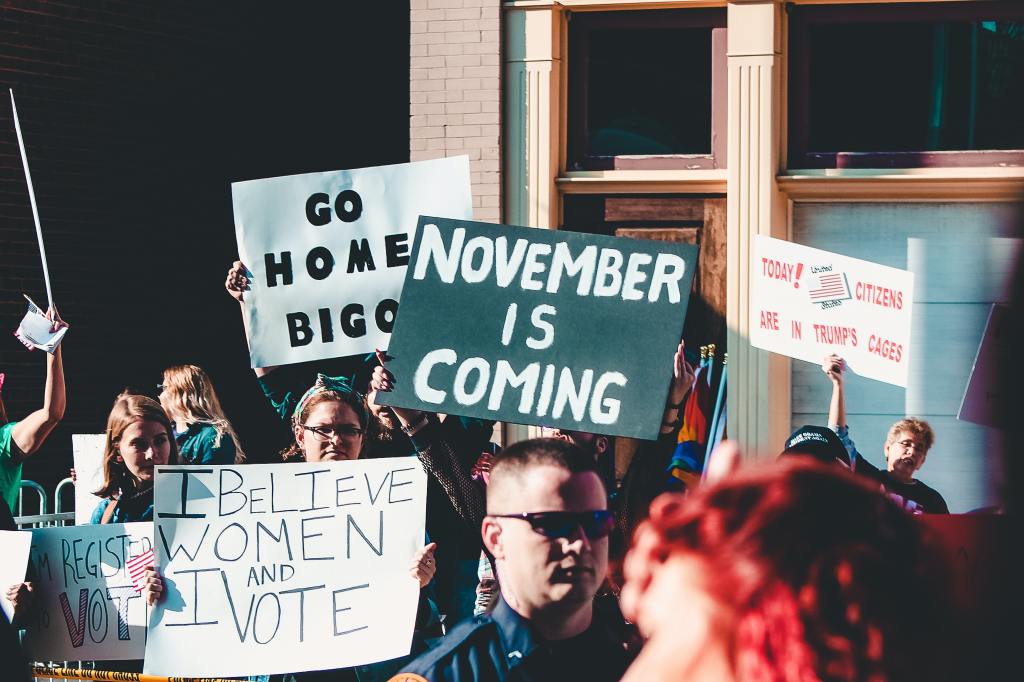
America will collapse under another 4 years of this President unless decent-minded citizens show up en masse on November 3rd 2020.









 bendingtheneedle