
For the last several weeks, I’ve been pushing my poems through the Suno AI music generator to see how they work as song lyrics.
I’m no Suno expert. In fact, I’m sure that I’m barely scratching the surface of its capabilities.
My process is simple (bordering on rudimentary).
- I copy and paste a poem from my blog into the “Lyrics” window in the Suno song generator.
- I enter a free-form description of the music style to use for the poem. For example: “Rap, Hip Hop, with Grunge Guitar licks, Female Vocals“.
- I add a title for the song and click Create.
Suno generates two songs based on the criteria I entered. Next, I listen to the songs. I can tell right away whether I like what I hear, and often, I delete the song only after the first few bars. Other times, I find that some of my lyrics “work” nicely, while others don’t flow with the music and need tweaking.
I usually have the lyrics open in a text document as I listen to the song, pausing to rework my phrasing to better match the song’s cadence and rhythm. I add or delete verses, move chunks of text around, then have Suno create a new version of the song (with the same criteria). When I have the new songs with my lyrical updates, I go through the same listening and editing exercise.
It’s a very iterative process—and probably not the best way to use the tool. I haven’t managed to fiddle with the remixing and song editing features.
Poems don’t always have a verse-chorus structure commonly found in songs, so reworking these poems into lyrics often involves coming up with a memorable/catchy chorus. That has been the most fun and challenging part of this project.
Some poems that I envisioned as rap or hip-hop songs end up sounding better as rockabilly/country western songs. Switching the vocals from male to female can give a song an entirely new feel.
With Suno, I’ve repurposed my poems into thoughtful, memorable, and singable songs, even though I have no musical skills (I’m not sure if that is a good thing or a bad thing, but it’s definitely a thing). The following table summarizes my “collaborations” with Suno that are publicly available for listening.
I’d love to hear what folks think of these songs or of AI music in general. Post your comments here or on Suno. And please follow me on either platform.
| Song | About the Lyrics |
| Baby Teeth and Bullets | These lyrics are from a poem I wrote years ago after a spate of school shootings. I really like how Suno split the lyrics between male and female vocalists without me specifically directing it. I always heard this poem musically in my head, even when I was writing it. And, I always envisioned a female vocalist singing the “I see angels” part – it was like Suno was reading my mind on how to turn this poem into a song. Favorite Verse: I’m the isolated Incel The bullet in the gun The angry white American Who’s blaming everyone I’m the cryptic manifesto The video online The AR-15 lover-boy Who grew-up Columbine |
| Pierced Hearts and Sorrow | I wrote the poem “Pierced Hearts and Sorrow” after the mass shooting in Uvalde, Texas. I also wrote a short story titled “That Final Hug” inspired by that horrible day. I’d gladly give up this type of inspiration if it meant fewer mass shootings where children are murdered in their classrooms. I hate that I feel compelled to write these types of poems. I think Suno captured the mood and tone of what I was trying to convey with my words. Favorite Lyric: We live in a land of pierced hearts and sorrow no shooting today? just wait till tomorrow In a fog of futility explicably numb we reach for our heartstrings but there’s nothing to strum |
| Hey Fascist, Catch | These lyrics are from a poem I wrote after the Charlie Kirk assassination. It’s about how dangerously divided America is and the potential for spiraling political violence that seems increasingly likely in the second Trump term. Favorite Verse: We ought to run from martyrdom not pin it to our chest not canonize the hateful guys who scream that they know best |
| Ashes to Ashes | I wrote a poem called “Ashes to Ashes” ten or more years ago. I fiddled with it and published it on my blog about 5 years ago. With some significant edits and a revamped chorus, here it is with Suno’s light touch. Favorite Verse: We stretch our souls tight on a drum We beat it bare till it goes numb We feel the eyes of everyone |
| Fury and Flow | Bored one afternoon, I challenged myself to write a poem about Dorothy from The Wizard of Oz. With Suno’s assistance, here is the musical version of that poem. Favorite Verse: Tracing the stitch on her pillow she imagines the blood in her veins she chases the witch up a willow till the beat of her heart starts to wane |
| The Glen | I wrote the poem this song is based on about a month or so ago. It takes a familiar place for Portsmouth, RI, residents (The Glen) and builds a song about the realities of relationships around that place. I trimmed the poem quite a bit for the song and changed some wording. In fact, the verse about chasing fireflies does not appear in the poem at all. That verse came to me as I was listening to the rhythm of the music, and it turned out to be my favorite lyric in the song. I chose a country-western style, which I think works nicely. Favorite Verse: The fireflies we used to chase went dark forever without a trace and we chose to leave love’s warm embrace |
| Get a Load of Elon | I wrote the poem “Get a Load of Elon” after seeing the sickening footage of that smiling dirtbag laughing it up and swinging a chainsaw around like some fake-ass efficiency hero. Fuck that guy and everything he represents. I think Suno captured the tone I was looking for on this one. Favorite Verse: He pulled into Washington Black MAGA cap on his head He spent a ton of cash put a felon in our bed |
| The Orange King | Donald Trump is my fat, ugly muse. There, I said it. Shame on everyone who voted for this criminal, and fuck all the cowards in Congress who are failing to stand up to this two-bit thug. And that’s all I have to say about this song. Favorite Lyric: My heart is full of pennies there’s no light inside my eyes there’s only room for Donny and all that I despise My mind is fully tainted I can’t connect the dots I’m more and more acquainted with Russian drones and bots |
| Pandora’s Vox Pandora’s Vox (Blues Version) | I wrote a poem in May of 2024 titled “Bonjour, Borg”, which was about the headlong way we are embracing AI, without fully understanding the consequences. I reworked that poem, added a chorus, and handed it to Suno. I include two versions (a power pop version and a blues version). Favorite Lyric: We’re messing with knowledge we don’t understand playing our cards without knowing our hand A sprint to the finish But where are we going? Dimmed and diminished We’ve no way of knowing |
| New Boy Paranormal | I wrote a poem in May of 2024 called “Boys in Distress”. I took bits and pieces from that poem and wrote the lyrics “New Boy Paranormal”. It’s about young adult men in America not being able to find their footing socially to the point where they retreat into a digital world of grievance, anger, and misogyny. This is an example of a previously written poem serving as a concept for new lyrics for a song. I wrote this specifically for Suno. The chorus: Fiber-optic geldings alone inside their heads they bathe in Incel chatrooms masturbate beside their beds they’re the new-boy paranormal walking ghosts and talking shit the no-screw-boy semi-formal stalking post sand keeping fit is new and does not appear in “Boys in Distress” – I came up with it on the fly and added it after listening to Suno’s first attempt at creating the song from my poem. This song went through several renditions before I settled on a “Surf rock-influenced” beat. I smiled broadly when I heard the finished product for the first time. Favorite Verse: Fiber-optic geldings alone inside their heads they bathe in Incel chatrooms masturbate beside their beds |
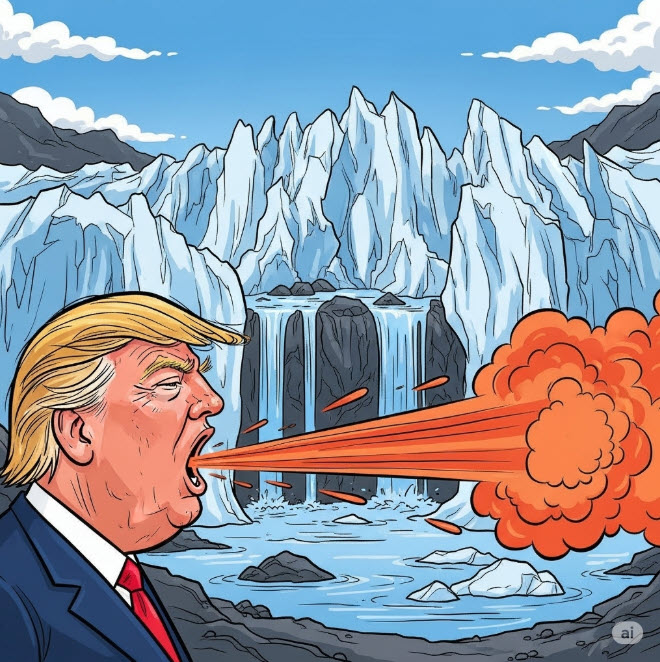
| The Danger’s in Pittsburgh | I wrote this poem about the climate crisis about 4 years ago. I kept the words pretty much the same for the musical version – just adding a second verse to the chorus. I can see Greta Thunberg belting this out on the bow of the Greenpeace Rainbow Warrior, with a hard-rocking band of Norwegian’s backing her. Greta, if you’re interested, text me. 😊 Favorite Verse: The dangers in Pittsburg the dangers in Norway wherever we live it’s outside our doorway The science is speaking the numbers aren’t lying The danger is global With temperatures rising |
| The Orange Morass | I came up with these lyrics based on a poem I wrote in 2017 called “Resist”, which was about pushing back against Donald Trump and his policies, which I saw as an existential threat to America’s democracy. I added several new verses for the song and reworked the verse that would become the chorus. I can see the Dixie Chicks or Dolly Parton belting this out. I’m not a big fan of country or rockabilly music, but I think that musical style works well with the words here. Favorite Verse: He belittles and threatens those who oppose him He stomps up and down screams America chose him! |
| Love Grenade | The phrase “love grenade” came into my head when I was noodling around a text file. I created this song entirely around that one phrase. No previous poem for this rocker – it just came to me very quickly, all of it from that one phrase “love grenade” – I like the vibe of the music that Suno generated – it’s got a female punk energy that’s fun to listen to (at least to me it is). Favorite Verse: You’re the drunken saint of unrestraint the banger at the ball a bourbon shot without a plot a fist inside the brawl |
| Oligarchic Kings | Suno and I, channeling our best Pat Benatar impression. I wrote the poem “Oligarchic Kings” recently and published it on my blog. I changed it quite a bit for the song version. Favorite Verse: Oligarchic Kings are here to clip your wings to wrap a rope around your throat to cast dark shadows over hope to crush your dreams of better days to dress your colors in shades of greys |
| Neo-Fascist-Oligarchic-Expialidocious | When I wrote this poem originally, I wrote it to the cadence of Supercalifragilisticexpialidocious from “Mary Poppins” and included it in my book “Imagine There’s No Donald” (available on Amazon😉 ). I asked Suno to create a power-pop song from the poem. It’s the only poem I used as is (not changing any of the words). It’s a campy/poppy version of a Disney classic. Favorite Verse: Neo-fascist-oligarchic-expialidocious Elon-Bezos-Zuckerberg are really quite atrocious We need to fight them in the streets and call them on their grossness Neo-fascist-oligarchic-expialidocious |
| Seeped in the 70s | When I was a youngster (I’m talking elementary school age), I remember “feeling” the news of the times – Watergate and Vietnam were in the news all the time. And though I was just a child and could not comprehend the realities swirling around me, I could sense a tension in the air – parents and other adults in heated conversations, the constant coverage of Watergate and Vietnam seeping into our subconscious among all the wonderful distractions of childhood at that time. That’s what inspired me to write the poem that this song’s about. Favorite Verse: Watergate was all around in our sight and in our sound on the news and in the paper the Viet Cong and foiled caper It lurked and hovered overhead Pages written and words were said it wormed its way into our head that innocence was finally dead |
| Too Small to See Too Small to See (Surf-Rock) version | I wrote a poem titled “Too Small to See” some 20 years ago after reading Robert Frost’s poem “Fire and Ice,” which is about “the destructive power of human emotions, suggesting the world could end through either fiery desire or icy hate, with both leading to the same annihilation, equating intense passion (fire) with destructive greed/lust and cold indifference (ice)” – I remember taking more literal slant on the subject of human mortality against the backdrop of an e-bola outbreak, which made me think that the way humanity ends is less likely to be from nuclear annihilation or climate-related disaster and more likely to be something “too small to see” – like a virus – When COVID came along it only reinforced my belief that our angel of death will be too small to see, killing us all, infectiously. I used to Suno to create two versions of this song with different styles (I’m not sure which one I like better). Favorite Verse: We’ll end with a whimper viral, tiny, and small from something we caught on our trip to the mall |
| Time Misspent in Wonderland | This song combines verses from two separate poems I wrote a few years back – one about regret and the other about a post-apocalyptic world. The result here is both bleak and sweet. Favorite Verse: Some people start to gather shake their fists and curse the sun while others mumble silently quoting Nietzsche and Carl Jung |
| Mangled by the Madness | This song is based on a poem I wrote, which was published in Beyond Words Literary Magazine a few years back. I did not change any words in the poem. I just added a chorus, and Suno did the rest. Favorite Verse: With a never-ending stipend of more than you can bear an abundant over-ripened softened fruit of deep despair |


 bendingtheneedle