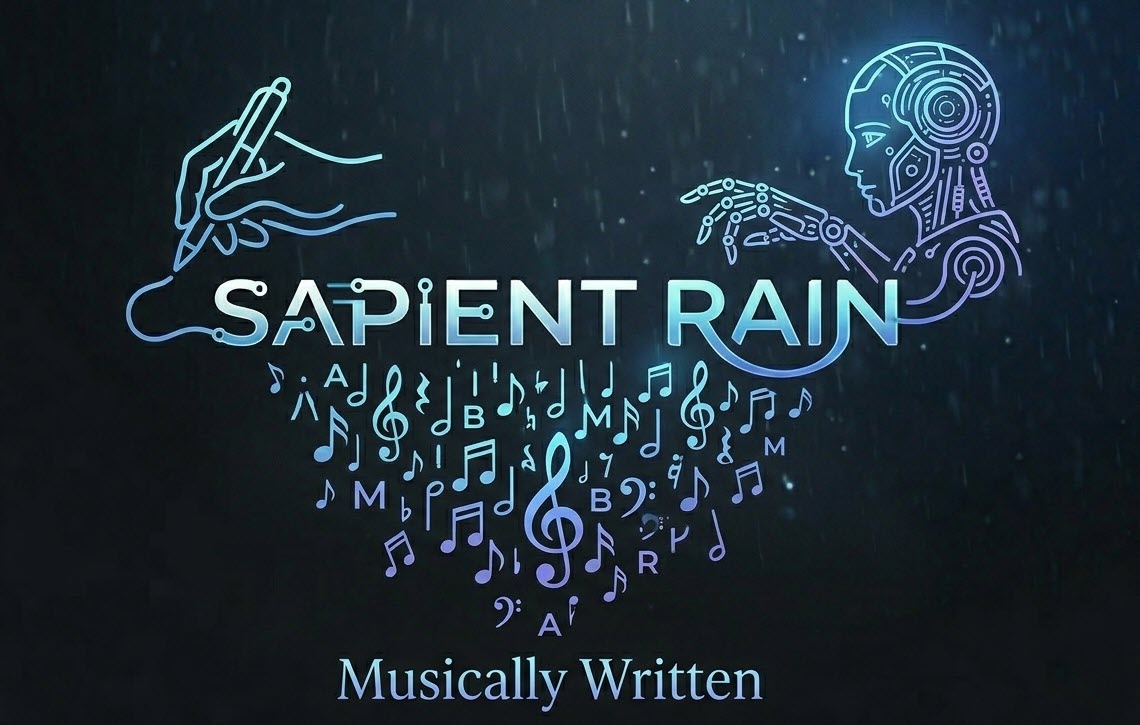
As a musical project, Sapient Rain is a triumphant example of the lyricist fighting back in the age of AI. Instead of allowing AI to generate shallow words, Geoffrey Reilly feeds the machine heavy, specific, and biting human poetry, using technology strictly as his backing band.
See also:
An AI Assessment of Sapient Rain’s Lyrics – Volume 1
An AI Assessment of Sapient Rain’s Lyrics – Volume 2
An AI Assessment of Sapient Rain’s Lyrics – Volume 3
An AI Assessment of Sapient Rain’s Lyrics – Volume 4
Ten Songs from the Sapient Rain Catalog
Strung Along

“Strung Along” is Geoffrey Reilly at his most urgent and disciplined as a political songwriter. Unlike some Sapient Rain tracks that rely heavily on satire (“Donny on Dementia”), surrealism (“Chrome-Covered Rosebuds”), or extended metaphor (“The Tyrant’s Closet”), “Strung Along” is built around a simple emotional progression: alarm, disillusionment, and finally restraint. It begins as an indictment but ends as advice.
That evolution gives the song more depth than a straightforward political rant.
The Song’s Central Strength: A Moral Warning
What immediately separates “Strung Along” from many protest songs is that its ultimate target is not a politician but a reaction.
The song spends much of its running time cataloging perceived failures and dangers, yet its most important lines arrive near the end:
“Don’t take the bait for violence
Be disciplined and strong
Be loud inside your silence
And don’t get strung along”
This is where the song finds its emotional center. Many political songs escalate anger. Reilly ultimately redirects it. The lyric recognizes outrage while warning against becoming manipulated by it. That choice gives the song more sophistication than its opening verses initially suggest.
A Dark and Immediate Opening
The song begins with stark imagery:
“On a street in Minneapolis
three bullets to the head”
The directness is jarring. Rather than easing listeners into the narrative, Reilly drops them immediately into a world of violence and fear.
The following lines:
“a frightened girl tries to drive away
but the Iceman shoots her dead”
are cinematic and disturbing.
Whether interpreted literally or symbolically, the image establishes a tone of societal instability that persists throughout the lyric. The opening is effective because it creates emotional stakes immediately.
Reilly’s Use of Political Imagery
Throughout the song, politics is presented through images of erosion:
“When democracy dissolves like this
it won’t come back again”
and
“It’s remarkable how neatly
This all falls apart”
These lines are less about specific policies than about perceived institutional fragility. One of Reilly’s recurring themes across many songs is the fear that democratic structures are more vulnerable than people assume. This lyric expresses that concern more directly than most. The image of democracy “dissolving” is especially effective because it suggests something disappearing molecule by molecule rather than collapsing all at once.
The Chorus-Like Political Refrain
The repeated section:
“Watch all the JD Vances
Quickly fall in line
See the Rubios and Lindsey Grahams
Slowly lose their spines”
functions almost as a chorus.
Structurally, it provides a recurring anchor between verses.
From a pop perspective, the repetition works because the rhythm is strong and the imagery is easily understood.
The line:
“Slowly lose their spines”
is especially memorable.
The metaphor is simple, visual, and immediately communicative. Listeners don’t need an explanation. The image does the work.
The Most Effective Writing
Arguably the strongest writing emerges in the final section:
“Be loud inside your silence”
This may be the song’s best line. It’s paradoxical. It asks listeners to resist while maintaining discipline. To remain engaged without becoming consumed. To speak through action rather than noise. Unlike some of the song’s more topical references, this phrase possesses a universality that could outlast the political moment that inspired it. It is both poetic and practical.
“Strung Along” is one of Geoffrey Reilly’s more focused and effective political songs because it ultimately shifts its attention from politicians to citizens. The lyric’s strongest insight is that democratic decline is not merely a political problem but a behavioral one. Through vivid images of institutional erosion, recurring metaphors of cowardice and manipulation, and the excellent closing admonition to “be loud inside your silence,” Reilly crafts a protest song that does more than express anger. It urges self-control, vigilance, and moral discipline. While some contemporary references may date the piece over time, its central warning about manipulation, outrage, and civic responsibility gives the song a relevance that extends beyond the immediate political moment. The result is a protest lyric that is at its most persuasive when it stops accusing and starts advising.
Lyrics for Strung Along
On a street in Minneapolis
three bullets to the head
a frightened girl tries to drive away
but the Iceman shoots her dead
Noem sanctions lies and violence
Trump puts Greenland on alert
When fascists feast on freedom
Our Democracy’s dessert
We disregard due process
We double-tapped those wounded men
When democracy dissolves like this
it won’t come back again
Watch all the JD Vances
Quickly fall in line
See the Rubios and Lindsey Grahams
Slowly lose their spines
Its remarkable how neatly
This all falls apart
In a congress full of cowards
With hate inside their hearts
A Russian Asset spreading lies
on Pennsylvania Ave
Slurring through his speeches
as the country splits in half
We shouldn’t be in shock
at what America’s become
We’re bigoted, intolerant
and lovers of the gun
Don’t take the bait for violence
Be disciplined and strong
Be loud inside your silence
And don’t get strung along
Watch all the JD Vances
Quickly fall in line
See the Rubios and Lindsey Grahams
Slowly lose their spines
Its remarkable how neatly
This all falls apart
In a congress full of cowards
With hate inside their hearts
Have a listen:
Donny on Dementia

“Donny on Dementia” is one of Geoffrey Reilly’s most overtly satirical songs, combining political parody, insult-comedy, and protest-song mechanics into a deliberately exaggerated character portrait. Unlike more nuanced Sapient Rain songs such as “I See Angels,” “My Porch in Timbuktu,” or “Mangled by the Madness,” this lyric is not trying to explore a subject from multiple angles. It is written as a caricature. The narrator is an unreliable, confused, self-aggrandizing figure whose mental deterioration serves as both the joke and the central political critique.
From a songwriting perspective, the song succeeds primarily through humor, repetition, and a strong chorus. Its weakness is that the satire often overwhelms the poetry.
The Song’s Approach: Political Cartoon as Lyric
The best way to understand “Donny on Dementia” is not as a narrative song but as a musical political cartoon.
The opening establishes the satirical voice immediately:
“I’m living with dementia
Life’s a grandiose summer cruise”
The juxtaposition is intentional. The narrator presents severe cognitive decline while remaining blissfully unaware of it. That disconnect drives much of the song’s humor.
Similarly:
“Higher prices at the gas pumps
Let’s take an oval office snooze”
The criticism is not subtle. Reilly uses absurdity and incompetence as recurring comic devices. The listener is meant to laugh first and analyze second.
The First-Person Perspective Is Effective
One of the lyric’s smarter choices is placing the satire in first person. Instead of describing a public figure from the outside, Reilly allows the character to speak.
Lines like:
“I don’t know what I’m doing
I’m lost and all alone”
create comedic irony because the narrator openly admits the very things critics would accuse him of. This approach is more entertaining than simply listing grievances. The character effectively incriminates himself. That strategy gives the song more life than a straightforward protest lyric.
The Chorus Is the Strongest Part
The chorus is where the song’s pop instincts come alive:
“I’m Donny on Dementia
I don’t know where I am”
This is extremely simple, but simplicity is part of its effectiveness. The title phrase is memorable. The chorus continues:
“A Commander in Absentia
My mind is on the lamb”
“Commander in Absentia” is arguably the strongest phrase in the song. The wording cleverly modifies the traditional presidential title while reinforcing the theme of disengagement and confusion.
The concluding hook:
“Please invoke the 25th Amendment
To end this tragic scam”
gives the chorus a concrete destination. Unlike some of Reilly’s political songs that merely express frustration, this one builds toward a specific refrain and demand. From a pop perspective, the chorus is catchy and easy to remember.
Reilly’s Comic Timing
Some of the funniest moments arise from non sequiturs.
For example:
“CAN’T TURN THE CAPS OFF ON MY PHONE”
arrives suddenly and breaks the song’s rhythm in a way that feels intentional. The line works because it mimics the kind of random technological frustration that can symbolize confusion.
Similarly:
“The resolute desk
Is my safe place
Where I scribble and I drool”
creates a ridiculous visual image. The song’s strongest jokes come when Reilly relies on imagery rather than simple insults.
The humor is exaggerated by design.
Lines such as:
“They call me doctor Jesus
I think that’s kind of cool”
mock perceived grandiosity through absurd self-description. The joke lands because Reilly understands that parody often succeeds by exaggerating existing characteristics rather than inventing entirely new ones.
Once listeners understand the joke, the challenge becomes finding new variations.
At times the lyric succeeds:
“Phonemic paraphasia
I don’t know what that is”
is genuinely funny because the narrator immediately demonstrates the condition he’s discussing.
At other times, however, the song simply restates the same idea in different words.
“Donny on Dementia” is essentially Geoffrey Reilly’s political satire distilled into pop-song form. It trades subtlety for caricature and poetic ambiguity for comedic exaggeration. While it lacks the emotional complexity and symbolic depth found in Sapient Rain songs such as “I See Angels” or “My Porch in Timbuktu,” it compensates with humor, a memorable chorus, and a clear satirical voice. The song’s greatest strength is its commitment to the character’s perspective, allowing the narrator’s confusion and self-importance to become the source of both comedy and criticism. As political parody, it is energetic and entertaining. As lyric poetry, it is less ambitious. But judged on its own terms, it largely succeeds in doing exactly what it sets out to do: turn frustration into a chantable satirical anthem.
Lyrics for Donny on Dementia
I’m living with dementia
Life’s a grandiose summer cruise
Higher prices at the gas pumps
Let’s take an oval office snooze
I’m making up equations
A percentage paradigm
I got yes men all around me
To cover up the crime
I don’t know what I’m doing
I’m lost and all alone
With me in charge, the world is stewing
CAN’T TURN THE CAPS OFF ON MY PHONE
I’m Donny on Dementia
I don’t know where I am
A Commander in Absentia
My mind is on the lamb
Please invoke the 25th Amendment
To end this tragic scam
We’re trapped in his dementia
Like the tankers in Hormuz
Kash Patel has lost his marbles
Pete Hegseth wants some booze
They call me doctor Jesus
I think that’s kind of cool
The resolute desk
Is my safe place
Where I scribble and I drool
I have no idea what I’m doing
You’re all paying a steep price
I miss the days when I was screwing
Instead of being Jesus Christ
I’m Donny on Dementia
I don’t know where I am
A Commander in Absentia
My mind is on the lamb
Please invoke the 25th Amendment
To end this tragic scam
People try to shoot me
I’m in the Epstein files
Normal thoughts don’t suit me
I dream of glory and Sieg Heils
Phonemic paraphasia
I don’t know what that is
I hate shit holes like Nambia
I aced my IQ quiz
I’m sleeping till eleven
I pace around all night
I often think of heaven
And flying purple kites
I’m Donny on Dementia
I don’t know where I am
A Commander in Absentia
My mind is on the lamb
Please invoke the 25th Amendment
To end this tragic scam
Have a listen:
Mapleton or Mircale

“Mapleton or Miracle” is one of Geoffrey Reilly’s most literary songs for Sapient Rain. Unlike some of his more overtly political compositions, this lyric draws heavily from themes found in The Leftovers, using the fictional towns of Mapleton and Miracle as metaphors for grief, spiritual longing, and the human need to find meaning after unexplainable loss. The result is a song that feels less like a protest anthem and more like an existential meditation wrapped in a melancholy pop-folk framework.
As a piece of songwriting, it succeeds primarily through emotional universality. While its references are rooted in a specific narrative world, its themes of loss, faith, disappointment, and unresolved trauma resonate well beyond that source material.
A Strong Central Metaphor
The title itself is the song’s greatest conceptual achievement.
Mapleton and Miracle represent opposing responses to catastrophe. One is defined by despair, the other by hope. Yet Reilly’s chorus argues that neither place offers escape:
“Whether Mapleton or Miracle
Our grief is sure to follow”
This is an excellent chorus premise because it overturns a comforting assumption. We often believe a change of place, belief system, relationship, or circumstance will heal our wounds. Reilly suggests grief travels with us. The lyric becomes less about geography than psychology. This universality allows listeners unfamiliar with the source material to connect with the song.
The Chorus: Simple and Effective
From a pop songwriting perspective, the chorus is arguably the strongest part of the composition.
“Our prose becomes less lyrical
Our souls become more hollow”
The pairing of lyrical and hollow is elegant and memorable. The line works on several levels.
On the surface, grief diminishes joy and creativity. More deeply, it suggests that suffering reduces our ability to tell meaningful stories about ourselves. Life loses poetry. That is a sophisticated idea expressed in simple language.
The repeated:
“Our souls become more hollow”
functions as an emotional hook rather than a melodic one. It is easy to imagine listeners carrying that phrase with them after the song ends.
Reilly’s Treatment of Grief
One of the song’s greatest strengths is its portrayal of grief as a living condition rather than a temporary emotion.
The opening verse establishes this immediately:
“The living-dead in Mapleton
Are catatonic in their grief”
“Living-dead” is a familiar image, but it is effective because it captures how grief can suspend people between existence and engagement.
Likewise:
“All they see is what is gone”
may be one of the album’s simplest lines, but it cuts directly to the essence of bereavement. The song repeatedly returns to this idea: grief narrows perception until absence becomes the only thing visible.
Critique of Organized Religion
A recurring Geoffrey Reilly theme emerges in the song’s skepticism toward religious institutions.
Consider:
“Gucci suits with microphones
taking money for salvation”
The image is instantly recognizable and economically drawn. The contrast between luxury and spiritual authority creates immediate tension.
Similarly:
“They drive away in Cadillacs
To glass mansions on the hill”
These lines succeed because they rely on imagery rather than argument. Reilly shows listeners the hypocrisy instead of merely telling them it exists. This is among the strongest writing in the song because it remains visual and concrete.
Where the Lyrics Become Less Effective
The weakest section arrives in the song’s most direct theological statement:
“Their situation never changes
Because God’s a thoughtless crook”
This line stands out because it abandons the nuanced exploration found elsewhere. Much of the song examines doubt and spiritual uncertainty. Here, however, the lyric suddenly declares a conclusion. Artistically, this is less interesting than the questions that precede it. The song is most compelling when exploring grief’s ambiguity. It is somewhat less compelling when delivering verdicts. A listener may not object to the sentiment itself, but the line lacks the poetic richness present elsewhere in the composition.
The Poetry of the Third Verse
The song’s most beautiful writing appears in the final verse:
“With rolled-up truths of paper pills
stored in time-worn wooden boxes”
This imagery is wonderfully mysterious. Listeners may interpret the “paper pills” as scripture verses, medications, memories, coping mechanisms, or intellectual explanations. The lyric never fully explains itself. That restraint creates intrigue.
Likewise:
“we sit at sun-splashed window sills
and mumble at the paradoxes”
This may be the song’s single best line. It captures something profoundly human: our tendency to sit with life’s contradictions and quietly wrestle with questions that never receive satisfying answers. The image is peaceful, sad, contemplative, and relatable all at once.
“Mapleton or Miracle” is one of Geoffrey Reilly’s more introspective songwriting achievements. Rather than offering answers, it explores the persistence of grief and the sometimes-futile search for meaning after devastating loss. Its best lyrics are poetic without becoming obscure, and its chorus distills a difficult emotional truth into a memorable refrain. While a few moments sacrifice subtlety for bluntness, the song largely succeeds as a thoughtful blend of literary storytelling, spiritual inquiry, and emotionally grounded pop songwriting. Among Sapient Rain’s more reflective works, it stands out for its compassion, restraint, and willingness to sit with unanswered questions.
Lyrics for Mapleton or Miracle
The living-dead in Mapleton
Are catatonic in their grief
All they see is what is gone
The Departure was a thief
We gaze at pastor charlatans
On the cable TV stations
Gucci suits with microphones
taking money for salvation
They drive away in Cadillacs
To glass mansions on the hill
While congregants in pickup trucks
Have no cash to pay their bills
[Chorus]
Whether Mapleton or Miracle
Our grief is sure to follow
Our prose becomes less lyrical
Our souls become more hollow
Our souls become more hollow
When all we see is what is gone
Our pain shifts into grief
the lost, forsaken, and forlorn
live in dreams for their relief
On bended knees
in whispered pleas
chanting hallowed be thy name
from caves to trees and galaxies
we bathe in guilt and shame
Some curry favor with their god
By reading from his book
Their situation never changes
Because God’s a thoughtless crook
[Chorus]
Whether Mapleton or Miracle
Our grief is sure to follow
Our prose becomes less lyrical
Our souls become more hollow
Our souls become more hollow
With rolled-up truths of paper pills
stored in time-worn wooden boxes
we sit at sun-splashed window sills
and mumble at the paradoxes
The Departure was a soul suck
A trauma unexplained
We looked to faith for answers
All we found was grief and pain
[Chorus]
Whether Mapleton or Miracle
Our grief is sure to follow
Our prose becomes less lyrical
Our souls become more hollow
Our souls become more hollow
Have a listen:
1.5 Degrees Celsius

“1.5 Degrees Celsius” is one of Geoffrey Reilly’s most direct and politically charged lyric pieces. Unlike many Sapient Rain songs that rely heavily on metaphor, ambiguity, or philosophical reflection, this lyric functions almost as a climate-change protest song. It has a clear villain, a clear warning, and a clear message. The question is not whether the listener understands the point. The question is whether the point is delivered in a way that maximizes pop-song impact.
The answer is mixed, but often compelling.
The Song’s Greatest Strength: Clarity
From the opening lines, Reilly leaves little doubt about his target:
Big oil has deep pockets
Spreading money like its seed
Within seconds, the song establishes a narrative involving fossil fuel interests, political influence, religious manipulation, and climate denial.
From a communication standpoint, this is highly effective. A listener can grasp the subject matter almost immediately. Many issue-oriented songs fail because their themes are too abstract. “1.5 Degrees Celsius” does not suffer from that problem.
The central argument remains consistent throughout the lyric:
- Powerful interests spread misinformation.
- People reject science.
- Climate tipping points approach.
- Catastrophic consequences follow.
The song never loses focus.
The Chorus Is the Pop Centerpiece
The strongest section is unquestionably the chorus.
“Hey, it’s all a hoax!”
“None of this is real”
and “God will keep us safe
just let Jesus take the wheel”
Structurally, Reilly makes a smart choice by allowing climate-denial arguments to speak for themselves. Rather than continuously lecturing the audience, he dramatizes opposing viewpoints through quoted slogans.
This creates energy.
Listeners can imagine these statements being shouted, chanted, or sung collectively. The repeated quotations also give the chorus a conversational quality that feels more naturally musical than some of the denser explanatory verses.
The phrase:
“The science is a joke!”
functions particularly well as a pop lyric because it sounds like something an actual person might say. Whether listeners agree with it or not, it feels authentic rather than manufactured.
Pop songs often need memorable verbal hooks.
This chorus contains several:
- “It’s all a hoax”
- “None of this is real”
- “Jesus take the wheel”
- “The science is a joke”
These phrases are rhythmic, recognizable, and easy to remember after one listen. For pure sing-along effectiveness, the chorus is significantly stronger than most of the verses.
The Verses: Knowledgeable but Uneven
The verses reveal Reilly’s scientific literacy.
References to:
- cryosphere collapse
- methane release from thawing soil
- tipping points
- cascading climate effects
demonstrate a strong understanding of climate science.
The challenge is that scientific literacy does not automatically translate into effective pop songwriting.
Consider:
with sub-arctic soil thawing
releasing tons of methane gas
The information is accurate and relevant, but it is not naturally musical language. There are many hard syllables and technical terms.
Similarly:
Once we pass the tipping point
a cascading will occur
communicates an important concept but lacks the vivid imagery found in some of Reilly’s strongest songs. Compare this to “Too Small to See,” where listeners are given:
she’s a dot on a slide
she’s a spiky red ball
Those images immediately create pictures in the mind. By contrast, words like “cryosphere,” “morass,” and “cascading” appeal more to intellect than imagination.
The Audience Challenge
One of the most interesting artistic questions raised by this song is whom it is trying to persuade.
The lyric is unlikely to change the minds of committed climate skeptics because it portrays them through a lens of manipulation, gullibility, and religious dogmatism. For listeners who already accept climate science, however, the song functions as validation and protest. This creates a common dilemma in political songwriting.
The song rallies allies exceptionally well. Its power as persuasion is less certain. Many of the greatest protest songs in pop history leave room for listeners to discover conclusions themselves. “1.5 Degrees Celsius” often tells listeners exactly what conclusions to reach. That approach produces urgency but sacrifices some subtlety.
“1.5 Degrees Celsius” is a thoughtful and intelligent climate protest song whose greatest strengths are clarity, urgency, and thematic commitment. Geoffrey Reilly successfully transforms scientific and political concerns into a coherent lyrical argument and builds a chorus that is memorable, quotable, and highly effective from a pop-song standpoint.
Its main limitation is that it sometimes behaves more like an editorial than a song. The lyrics frequently prioritize information and advocacy over imagery, character, and emotional storytelling. The listener is persuaded intellectually but is not always moved emotionally.
Compared with “Too Small to See,” which translates scientific reality into unforgettable visual metaphors, “1.5 Degrees Celsius” often presents climate science more directly and less imaginatively. The result is a song that is powerful as commentary, but somewhat less powerful as emotional pop art.
The chorus is excellent and highly memorable. The message is crystal clear and urgent. However, the density of technical language and the relative lack of personal storytelling prevent the lyric from achieving the broader emotional impact and metaphorical elegance found in Geoffrey Reilly’s strongest work.
Lyrics for 1.5 Degrees Celsius
Big oil has deep pockets
Spreading money like its seed
Politicians peck for dollars
guided by a creed of greed
They funnel cash to churches
tell the preachers what to say
there’s nothing they can’t purchase
including how we all should pray
Ignore your burning skin
and the bleached out coral reefs
forget about the science
and just stick to your beliefs
[Chorus]
They say
“Hey, it’s all a hoax!”
“None of this is real”
and “God will keep us safe
just let Jesus take the wheel”
“The science is a joke!”
“it doesn’t matter
what you feel”
Your Self-reliance
gets revoked
by their fervor
and their zeal
As the ticking time elapses
to the point of no return
when the cryosphere collapses
and the wild fires burn
with sub-arctic soil thawing
releasing tons of methane gas
the danger of ignoring
becomes a deepening morass
When the house of cards collapses
and we hurtle towards the brink
when there’s no more “but perhapses”
and our hearts begin to sink
[Chorus]
They say
“Hey, it’s all a hoax!”
“None of this is real”
and “God will keep us safe
just let Jesus take the wheel”
“The science is a joke!”
“it doesn’t matter
what you feel”
Your Self-reliance
gets revoked
by their fervor
and their zeal
Once we pass the tipping point
a cascading will occur
and we’ll struggle to anoint
a climate savior connoisseur
But a self-sustaining shift
will be largely underway
and we’ll remain adrift
forever and a day
They say
“Hey, it’s all a hoax!”
“None of this is real”
and “God will keep us safe
just let Jesus take the wheel”
“The science is a joke!”
“it doesn’t matter
what you feel”
Your Self-reliance
gets revoked
by their fervor
and their zeal
Have a listen:
The Ballad of New Bobby and Joan

“The Ballad of New Bobby and Joan” is one of Geoffrey Reilly’s most overtly political and self-consciously mythic songs for Sapient Rain. It functions simultaneously as a protest song, a celebration of artistic resistance, and a character sketch of two archetypal musicians who seem modeled after the folk-rock tradition of Bob Dylan and Joan Baez while being reimagined for a digitally fragmented, post-truth era.
From a songwriting perspective, the track is at its strongest when Reilly leans into narrative imagery and rock-and-roll mythology. It is at its weakest when its political arguments become so direct that they crowd out the emotional and poetic ambiguity that often gives lasting protest songs their power.
The Core Concept: Folk Heroes Reborn
The song’s central idea is immediately compelling. “New Bobby and Joan” are not merely people. They are symbols.
The opening stanzas establish them as cultural warriors:
“with fine-tuned stringed weapons
and words dipped in rage”
The metaphor works because it is simple and evocative. Guitars become weapons, lyrics become ammunition. Reilly is drawing from a lineage that stretches from Woody Guthrie’s “This Machine Kills Fascists” through Dylan, Baez, Springsteen, and Rage Against the Machine.
The recurring chorus reinforces this mythology:
“Fender guitar-lords
with truth microphones”
This is intentionally larger-than-life language. “Guitar-lords” is almost comic-book imagery, but it fits the song’s mythic ambitions. The phrase “truth microphones” is particularly effective because it condenses the entire mission of the protagonists into two words. Their power comes not from violence or status but from communication.
As a pop songwriting device, the repeated chorus works well because it is memorable, singable, and immediately recognizable. Listeners can join in after hearing it once or twice.
Reilly’s Gift for Kinetic Imagery
One of Reilly’s greatest strengths as a lyricist is his ability to create motion.
Throughout the song, characters are constantly moving:
“stalking the stage
like a tank on the prowl”
or
“she covers terrain
like a train on a spike”
Not every metaphor lands perfectly, but they create momentum. The listener can visualize the performance. The staging of Bobby and Joanie also provides a subtle narrative progression. Initially Joanie stands:
“off to the side”
Later:
“Joanie steps forward”
By the final verses Bobby dominates the spotlight while Joanie recedes:
“Joanie steps back
away from the light”
This shift creates an unexpected dynamic. Rather than remaining static icons, the characters evolve through the performance itself.
“The Ballad of New Bobby and Joan” succeeds because Geoffrey Reilly doesn’t merely write a protest song. He creates a modern folk-rock myth, turning two musicians into symbolic defenders of truth in a noisy, manipulated world. The song’s greatest strength lies in its recurring chorus and its cinematic depictions of performance. Its greatest weakness is a tendency to occasionally stop dramatizing ideas and start arguing them directly. Even so, the song possesses enough melodic-minded repetition, memorable imagery, and righteous energy to stand among Sapient Rain’s more ambitious and engaging lyrical statements.
Lyrics for The Ballad of New Bobby and Joan
On a daredevil’s mission
to gather us all
to shake us, and wake us
to answer the call
New Bobby and Joan
are taking the stage
with fine-tuned stringed weapons
and words dipped in rage
Bob nods at the drummer
to get the show started
he counts the band in
to the dark and uncharted
They follow Bob’s lead
tag along for the ride
Joanie plays rhythm
standing off to the side
This is the ballad
of new Bobby and Joan
Fender guitar-lords
with truth microphones
This is the ballad
of new Bobby and Joan
bending their chords
to the story they own
Beware of cracked shadows
and words made of hay
of crowned jokers with pokers
who demand that you pray
Politicians and preachers
can’t show you the way
their pockets are lined
by the players that pay
Bob sets the tone
with a sneer and a growl
stalking the stage
like a tank on the prowl
Joanie steps forward
and smiles at Bobby
she’s not just his muse
and she’s more than a hobby
Bobby sees Joanie
step up to the mic
she covers terrain
like a train on a spike
This is the ballad
of new Bobby and Joan
Fender guitar-lords
with truth microphones
This is the ballad
of new Bobby and Joan
bending their chords
to the story they own
We’re zip-tied and tongue tied
by Silicon Valley
Kidnapped by agents
who crouch in the alley
We live in a land
that is free of the brave
led by a felon
both cruel and depraved
The dream we living
turns silkweed to ashes
broke by the rich
and the market that crashes
Elon and Donny are having a spat
while democracy dies in a GPT chat
Bobby steps forward
his guitar is smoking
there’s blood on the frets
of the neck he is choking
Joanie steps back
away from the light
Bobby burns bright
and eclipses the night
This is the ballad
of new Bobby and Joan
Fender guitar-lords
with truth microphones
This is the ballad
of new Bobby and Joan
bending their chords
to the story they own
The system ain’t broken
it works as intended
in the times we’re living
the truth isn’t rendered
When God taints your money
the peril is real
there’s no milk and honey
just greed-driven zeal
Where the rich
just get richer
the poor get to bleed
just to get stitched up
and ground into seed
Boys tip-toe through crypto
while praising their king
in the land of bent knees
and the home of the bling
We take jets from Qatar
and cut aid to the poor
plan missions to Mars
and sell weapons for war
I don’t know about you,
but I can’t take anymore
It’s time to take names
and kick down the door
This is the ballad
of new Bobby and Joan
Fender guitar-lords
with truth microphones
This is the ballad
of new Bobby and Joan
bending their chords
to the story they own
Have a listen:
Weed Killer
“Weed Killer” is Geoffrey Reilly at his most confrontational, least metaphorical, and most punk-influenced. Where songs like “I See Angels” and “Mapleton or Miracle” build their messages through character, symbolism, and narrative, “Weed Killer” functions more like a political broadside. It is designed to provoke, accuse, and energize rather than persuade. The result is a lyric that succeeds remarkably well as an angry protest chant, but is less successful as a nuanced piece of songwriting.
The song’s effectiveness ultimately depends on what the listener expects. If the goal is subtle social commentary, “Weed Killer” falls short. If the goal is righteous outrage wrapped in a memorable rock framework, it largely succeeds.
A Title That Works
The opening image is one of the song’s strongest ideas:
“Spreading lies
like Dow weed killer”
The metaphor immediately establishes the song’s worldview. Propaganda is presented as a toxic chemical sprayed across society, killing healthy growth while allowing something more destructive to flourish.
It’s an effective image because most listeners instantly understand it. Weed killer doesn’t merely remove weeds. It sterilizes.
That metaphor quietly becomes the song’s organizing principle. Reilly is arguing that misinformation functions similarly, eradicating truth, empathy, and democratic norms.
As titles go, “Weed Killer” is concise, memorable, and thematically coherent.
The Song’s Rhythmic Engine
One thing Reilly consistently demonstrates throughout the Sapient Rain catalog is an instinct for rhythm on the page. Virtually every line in this song is short and punchy:
“Pushing pawns
and playing games”
“Breaking laws
like Jesse James”
“Pedal lies
igniting fires”
The clipped construction creates momentum. You can almost hear the snare drum underneath the lyrics. This is less literary songwriting and more slogan-driven rock writing. That’s not a criticism. Many effective political songs prioritize cadence over complexity. The lines are built to be shouted.
The Best Verse
Arguably the strongest lyrical section is:
“Vladimir and Xi Jinping
Bibi, Don, the ding-a-ling
Divvy up the map and riches
Prepping graves
and digging ditches”
This verse succeeds because it returns to imagery. “Divvy up the map” evokes imperial bargaining. “Digging ditches” conjures both warfare and burial. Even the humorous phrase “the ding-a-ling” introduces a satirical edge that keeps the song from becoming entirely grim. It’s one of the few places where metaphor and mockery coexist effectively.
“Weed Killer” is not Geoffrey Reilly’s most poetic song, nor is it his most nuanced. It is, however, one of his most unapologetic. The lyric favors confrontation over contemplation, slogans over symbolism, and accusation over ambiguity. While that approach limits its artistic depth compared with songs like “I See Angels” or “Mapleton or Miracle,” it also gives the song an immediacy and visceral energy that many protest songs lack. At its best, “Weed Killer” feels like a garage-rock manifesto shouted through a bullhorn: angry, messy, provocative, and impossible to misunderstand.
Lyrics for Weed Killer:
Bondi, Noem,
and Stephen Miller
Spreading lies
like Dow weed killer
Pushing pawns
and playing games
Breaking laws
like Jesse James
Congress cowers
in the corner
Pulling plums
like grown Jack Horners
State their case
loud and clear
Spreading hate
and tilling fear
Pardoned crooks
and forced compliance
assaulting facts
with pseudo-science
Throwing tantrums
hiding crimes
prepping hard
for the end times
When he’s not
abusing children,
he’s dropping bombs
on their school
Let’s turn the corner
On excusing
Stop propping up
this fucking tool
Truth denier
anti-Vaxxer
doesn’t matter
what the facts are
Pedal lies
igniting fires
Hide behind
the razor wire
Chasing migrants
in the street
masks instead
of hoods and sheets
Suppressing votes
and sinking ships
Lies like lipstick
on their lips
Vladimir and Xi Jinping
Bibi, Don, the ding-a-ling
Divvy up the map and riches
Prepping graves
and digging ditches
When he’s not
abusing children,
he’s dropping bombs
on their school
Let’s turn the corner
On excusing
Stop propping up
this fucking tool
Repeat the lie
until its true
Go on Fox
and blame the blue
Hug the flag
promote the bible
Toe the line
and keep it tribal
Redacts his name
from the files
Flips the script
like Simone Biles
Shames the victims
starts a war
He’s got no values
at his core
When he’s not
abusing children,
he’s dropping bombs
on their school
let’s turn the corner
On excusing
Stop propping up
this fucking tool
Have a listen:
Time Misspent in Wonderland

“Time Misspent in Wonderland” may be one of Geoffrey Reilly’s most literary lyrics. Unlike the relatively direct narratives of “Oxana” or “Too Small to See,” this song operates through fragments, symbols, contradictions, and surreal imagery. It feels less like a conventional pop lyric and more like a poetic collage of societal decline, personal regret, and cultural exhaustion.
The challenge for any songwriter is whether such dense imagery can function effectively within the framework of a pop song. In this case, the answer is both yes and no. The lyric achieves remarkable atmosphere and emotional texture, but sometimes sacrifices accessibility and immediate emotional connection.
The Song’s Central Achievement: Atmosphere
From the opening lines, the listener enters a world of unease:
Blood-stained silhouettes,
blurred shadows on the wall
This is a cinematic beginning. The imagery is vivid but unresolved. We do not know exactly what has happened, but we know something is wrong.
The next line deepens the contradiction:
we construct a hangman’s gallows
then go skipping through the mall
This may be the strongest couplet in the song. It captures one of Reilly’s recurring themes: humanity’s ability to ignore looming disaster while continuing everyday routines. The juxtaposition is startling. A hangman’s gallows suggests death, punishment, collapse. A shopping mall suggests consumer normalcy. Together they create a powerful image of collective denial. From a pop songwriting standpoint, memorable contrasts often make for memorable lyrics, and this one lands immediately.
Wonderland as Metaphor
The title is deceptively clever. “Wonderland” traditionally evokes fantasy, innocence, curiosity, and escape. But Reilly transforms it into a place of regret and paralysis.
The refrain:
Time misspent in wonderland
works effectively because it can be interpreted several ways simultaneously. Wonderland may represent:
- nostalgia
- escapism
- political fantasy
- denial
- social media distraction
- memories of opportunities lost
The lyric never specifies. That ambiguity gives the song unusual depth. Listeners bring their own “wonderland” into the interpretation.
The Chorus Is Strong but Unconventional
Consider the central section:
Time misspent in wonderland
in what-might-have-been galore
The phrase “what-might-have-been” captures the song’s emotional core. Regret is a common pop theme, but Reilly presents it in collective rather than personal terms. The following lines are particularly effective:
with a distant grin
we stir our gin
sit cross-legged
on the floor
The rhyme and rhythm suddenly become more conversational and intimate. After several dense and apocalyptic verses, these details feel human. Listeners can picture the scene. The song briefly zooms in from civilization to individual behavior. This is important because it provides emotional grounding.
Imagery Density: Strength and Weakness
One of the lyric’s most distinctive features is its relentless imagery.
Examples include:
Souls too weak to whisper
the dead feed off the living
dust becomes the air
shake their fists and curse the sun
quoting Nietzsche and Carl Jung
Almost every line introduces a new image or concept. The advantage is richness. Each listening reveals new connections. The disadvantage is cognitive overload.
Pop songs often succeed because listeners grasp at least one emotional narrative immediately. Here, listeners are required to work harder. The lyric rewards attention but does not necessarily invite casual listening.
The Nietzsche and Jung Reference
One of the song’s most interesting moments is:
while others mumble silently
quoting Nietzsche and Carl Jung
This line injects intellectual satire into the lyric. Reilly appears to be critiquing various responses to crisis. Some people become angry.
Others retreat into theory.
Neither group seems to accomplish much.
The reference works conceptually, but from a pure pop perspective it may divide audiences. Listeners familiar with Nietzsche and Jung will appreciate the allusion. Others may experience the line as an interruption to the emotional flow. This illustrates a recurring feature of Reilly’s writing: he often prioritizes intellectual texture over universal accessibility.
The Silos Refrain
The strongest recurring image in the song is arguably:
The silos hold no missiles
The silos hold no corn
This is excellent songwriting. The image is simple, memorable, and mysterious. Missiles symbolize military purpose. Corn symbolizes agricultural purpose. The silos contain neither. They are empty. The implication is a society that has lost both its means of defense and its means of sustenance.
Then comes:
The empty silos bellow
At a world that’s full of scorn
The silos become almost mythological figures. The personification gives the song a haunting quality. As a recurring refrain, this section provides some of the strongest structural cohesion in the lyric.
Emotional Themes
Beneath all the imagery, the song is fundamentally about regret. The clearest expression appears here:
regret displaces hopefulness
hate becomes our core
This may be the lyric’s emotional thesis statement. Unlike “1.5 Degrees Celsius,” which channels urgency, or “Oxana,” which explores longing, “Time Misspent in Wonderland” concerns the corrosion of possibility.
The emotional movement is downward. Hope becomes regret. Grace becomes anger. Dreams become broken. Purpose becomes drift. The consistency of this emotional direction gives the song considerable power.
The Final Verse
The closing stanza is among the song’s best:
Time misspent in wonderland
we sip on broken dreams
This is immediately understandable despite its poetic nature.
Then:
In weeds of woe and circumstance
life leaking from our seams
This is a beautifully constructed image. The phrase “life leaking from our seams” evokes slow loss rather than sudden catastrophe. It feels human. It feels vulnerable. And unlike some earlier passages, it requires no intellectual decoding. The emotional meaning arrives instantly.
“Time Misspent in Wonderland” is one of Geoffrey Reilly’s most ambitious lyrics. It combines dystopian imagery, social commentary, existential regret, and surreal symbolism into a densely layered meditation on decline and missed opportunity. The writing frequently achieves genuine poetic power, particularly through its recurring contrasts of catastrophe and normalcy, purpose and emptiness, hope and regret.
From a pop-song perspective, however, the lyric occasionally becomes a victim of its own intelligence. The imagery arrives so quickly and so continuously that listeners may struggle to find a simple emotional thread on first hearing. This is less a sing-along song than a song to revisit, unpack, and contemplate.
Compared with “1.5 Degrees Celsius,” it is far more poetic. Compared with “Oxana,” it is less immediately relatable. Compared with “Too Small to See,” it is less focused around a single unforgettable concept. Yet it may be richer and more evocative than all three.
Lyrics for Time Misspent in Wonderland:
Blood-stained silhouettes,
blurred shadows on the wall
we construct a hangman’s gallows
then go skipping through the mall
Souls too weak to whisper
our words fold into prayer
the dead feed off the living
and dust becomes the air
Some people start to gather
shake their fists
and curse the sun
while others mumble silently
quoting Nietzsche and Carl Jung
The silos hold no missiles
The silos hold no corn
The empty silos bellow
At a world that’s full of scorn
Time misspent in wonderland
in what-might-have-been galore
with a distant grin
we stir our gin
sit cross-legged
on the floor
regret displaces hopefulness
hate becomes our core
anger conquers gracefulness
with flash bombs at her door
Volunteers go knocking
on windows and locked doors
a search of all the wounded souls
buried under dusty floors
Rubber necks on splintered decks
missiles pierce the sky
the crackling fires
from funeral pyres
sparkle in our eyes
The silos hold no missiles
The silos hold no corn
The empty silos bellow
At a world that’s full of scorn
Time misspent in wonderland
we sip on broken dreams
In weeds of woe and circumstance
life leaking from our seams
Have a listen:
Oxana

Among Geoffrey Reilly’s Sapient Rain lyrics, “Oxana” stands out because it is less concerned with global catastrophe, science, philosophy, or politics and more interested in a distinctly modern form of loneliness. The song explores the fascination with an online woman who exists simultaneously everywhere and nowhere: on screens, in browsers, in imagination, and perhaps only partially in reality.
As a pop lyric, “Oxana” succeeds largely because it takes a contemporary experience many people recognize but few songs have addressed directly: the emotional attachment formed with a digital image.
The Core Concept
The central premise is immediately relatable in the internet age.
Oxana is not presented as a traditional romantic interest. She is a mediated presence:
Oxana on Safari
On Firefox and Edge
On Google Chrome
She exists through technology.
The lyric never fully explains who Oxana is. She could be a cam model, a social media personality, an online entertainer, an influencer, a fantasy projection, or all of these simultaneously. That ambiguity is one of the song’s strengths. Pop songs typically work best when listeners can project their own experiences into them. By avoiding excessive specificity, Reilly allows Oxana to become an archetype of digital desire.
A Surprisingly Modern Subject
One thing that makes the song notable is its timing and subject matter.
Thousands of songs have been written about meeting someone in a bar, at school, on the street, or at a dance.
Far fewer songs explore attraction mediated entirely through screens.
Lines such as:
Oxana’s on a bookmark
In a window, on a tab
capture a distinctly twenty-first-century reality. The language could have easily become awkward or technical, yet it remains surprisingly conversational. That is not an easy achievement. Many pop lyricists struggle when incorporating modern technology because references quickly sound forced or become dated. Here, browser names and tabs are not gimmicks. They are essential to the story.
The song’s chorus works through repetition and accumulation:
Oxana on Safari
On Firefox and Edge
On Google Chrome
followed by
Oxana in my bedroom
Oxana on the floor
Oxana on my Galaxy
behind the bathroom door
The repeated structure creates a rhythmic chant-like quality.
From a pop perspective, this is effective because listeners quickly anticipate the pattern. Each new location becomes another manifestation of Oxana’s omnipresence. By the end of the chorus, she has invaded every space:
- the browser
- the phone
- the bedroom
- the bathroom
The effect is humorous but also slightly disturbing. This duality gives the song depth.
Psychological Depth
Perhaps the strongest section of the song appears later:
Does she know her power
Over lonely men and boys
This is where the lyric transcends a simple internet crush narrative. The focus shifts from Oxana herself to the mechanics of online attraction.
The phrase:
Her tantalizing bits and bytes
is clever because it merges digital technology and emotional seduction. The lyric begins exploring the economics and psychology of attention without becoming preachy.
“Oxana” is one of Geoffrey Reilly’s most effective explorations of contemporary life. It captures a distinctly modern form of yearning: the desire to know someone who is constantly visible yet fundamentally inaccessible. The lyric combines humor, curiosity, loneliness, and technology in a way that feels authentic rather than forced.
Its greatest achievement is recognizing that digital attraction is often driven as much by imagination as by reality. The repeated questions about Oxana’s life reveal a narrator who is less interested in possession than in connection.
From a pop songwriting standpoint, the chorus is memorable, the concept is highly original, and the language is surprisingly natural despite its reliance on browser names, bookmarks, tabs, and buffering. The lyric loses some points because it lacks a strong narrative arc and emotional climax, but its observational sharpness largely compensates.
Lyrics for Oxana:
Oxana’s knocking on the door
of guilt and self-restraint
she smiles at the camera lens
to the sinners and the saints
Oxana sips on vodka
a thousand miles away
still making time to come to me
in the middle of my day
Oxana on Safari
On Firefox and Edge
On Google Chrome
She comes to me
Singing Sister Sledge
Oxana in my bedroom
Oxana on the floor
Oxana on my Galaxy
behind the bathroom door
Does she have a hobby
Does she walk along the beach
Does Oxana have a Siamese cat
or Russian Wolfhound on a leash
Oxana’s on a bookmark
In a window, on a tab
A buffering anxiety
Enough to drive me mad
Oxana on Safari
On Firefox and Edge
On Google Chrome
She comes to me
Singing Sister Sledge
Oxana in my bedroom
Oxana on the floor
Oxana on my Galaxy
behind the bathroom door
Does she know her power
Over lonely men and boys
Her tantalizing bits and bytes
That makes them lose their poise
Is she stirring coffee
at a cafe in the rain
are her goals more lofty
than just driving men insane
Oxana on Safari
On Firefox and Edge
On Google Chrome
She comes to me
Singing Sister Sledge
Oxana in my bedroom
Oxana on the floor
Oxana on my Galaxy
behind the bathroom door
Have a listen:
When we Look into the Mirror

“When We Look into the Mirror” is one of Geoffrey Reilly’s most overtly political and emotionally charged songs, functioning less as a meditation and more as an indictment. Where songs such as “My Porch in Timbuktu” succeed through ambiguity and reflection, and “I See Angels” succeeds through empathy and character-driven storytelling, “When We Look into the Mirror” is built around confrontation. It is a protest song in the purest sense: angry, moralistic, accusatory, and unapologetically partisan.
As a piece of songwriting, its strengths lie in its strong central metaphor, memorable chorus, and sense of urgency. Its weaknesses emerge when political outrage overwhelms imagery and nuance. The song often works best when Reilly asks questions rather than delivers verdicts.
The Mirror as a Powerful Central Device
The song’s title and recurring chorus provide its strongest lyrical foundation.
“When we look into the mirror
Are we pleased by what we see”
This is effective because it broadens the song beyond politics. A mirror implies self-examination. The question is not merely whether a politician has failed, but whether society itself has become complicit in something it can no longer recognize. The best protest songs often use a specific political moment to ask a larger moral question. Reilly accomplishes that here. The mirror becomes a symbol of collective accountability. That idea gives the song more depth than a simple anti-politician anthem.
The Opening Contrast Works Well
The first stanza immediately establishes the theme of decline:
“We used to be the land of generosity and grace
now we’re the heavy hand of venomosity and mace”
The contrast between grace and violence is clear and emotionally accessible. “Venomosity” is an unusual construction, but it fits the song’s heightened rhetorical tone. The line may not be subtle, but it is memorable. Reilly frequently uses oppositional structures in his political writing, and here the technique is effective because it establishes a before-and-after narrative that drives the rest of the lyric. The song fundamentally argues that something valuable has been lost.
The Chorus Is the Song’s Greatest Strength
Structurally, the chorus is excellent. After multiple verses of accusation, the listener repeatedly returns to:
“Are you living in a land of hope
or of deep disparity”
This works because it expands the frame. The song ceases being about individual personalities and becomes about the condition of society itself. The strongest political songwriting often asks emotional questions rather than policy questions. Hope versus disparity is a conflict listeners immediately understand.
From a pop standpoint, the chorus is memorable because:
- It contains a central question.
- It repeats key thematic language.
- It offers emotional clarity.
- It provides a singable refrain.
These are classic pop-song virtues.
Where the Song Becomes Less Effective
The principal weakness arrives when metaphor gives way to direct insult.
Consider:
“king of grift and screwing
with the caked-on orange face”
The line is certainly memorable and likely intended to be satirical. However, artistically it is less interesting than the chorus. The mirror metaphor encourages reflection. Personal mockery encourages agreement or disagreement. One invites thought. The other invites reaction.
This is a recurring tension throughout the song. Reilly’s most powerful writing often emerges when he trusts imagery and symbolism. Here he occasionally substitutes ridicule for poetry.
Perhaps the best visual moment occurs near the end:
“we see the cheap
gold paint is chipping”
This is excellent symbolism.
The image suggests that something once appearing luxurious or powerful is revealed to be superficial. Unlike many of the lyric’s more direct attacks, this metaphor allows listeners to participate in interpreting the meaning. It evokes deception, decline, exposure, and impermanence all at once. This is precisely the sort of image that tends to age better than references to individual personalities.
“When We Look into the Mirror” is a forceful protest song built around one of Geoffrey Reilly’s better recurring motifs: self-examination. Its most successful achievement is transforming political criticism into a broader moral question about who we are and what we are becoming. While the lyric sometimes drifts from imagery into invective, the mirror metaphor repeatedly brings it back to deeper territory. The result is a song that is at its best when it challenges listeners to look beyond partisan loyalties and confront uncomfortable questions about empathy, power, and national identity. It may not possess the poetic subtlety of Reilly’s finest compositions, but it succeeds as an emotionally charged call for reflection, accountability, and change.
Lyrics for When we Look into the Mirror:
We used to be the land of generosity and grace
now we’re the heavy hand of venomosity and mace
We push women to the ground
and shoot nurses in the head
we put children in detention centers
and feed them moldy bread
We’re terrorizing immigrants
and sending horses off to slaughter
we’re disregarding sovereignty
and blowing boats out of the water
[Chorus]
When we look into the mirror
Are we pleased by what we see
Are you living in a land of hope
or of deep disparity
Look at what he’s doing
The transformation taking place
By the king of grift and screwing
with the caked-on orange face
Empathy and kindness
have been shattered and replaced
by a callous lust for power
that leaves America defaced
We hate all the gilded greed
and the malice in his heart
all the rotting farmer’s seed
and his “war of fits and starts”
We’re embarrassed and ashamed
At what our nation has become
At the hands of grifting Don
And all his pedophilic scum
[Chorus]
When we look into the mirror
Are we pleased by what we see
Are you living in a land of hope
or of deep disparity
Look at what he’s doing
The transformation taking place
By the king of grift and screwing
with the caked-on orange face
With a grip on power slipping
an awakening occurs
we see the cheap
gold paint is chipping
and our sights no longer blurred
Because our eyes are finally open
and we’ve woken from the spell
we can see the naked fascist
and hear the ringing of the bell
A foreboding constant drumming
Drowns out all the ifs and buts
He knows well
November’s coming
And that people hate his guts
[Chorus]
When we look into the mirror
Are we pleased by what we see
Are you living in a land of hope
or of deep disparity
Look at what he’s doing
The transformation taking place
By the king of grift and screwing
with the caked-on orange face
Have a listen:
Message from Michelle

“A Message from Michelle” is Geoffrey Reilly’s attempt to write a political yearning song rather than a political attack song. While many of his protest-oriented Sapient Rain lyrics focus on anger, satire, or condemnation, this song is built around absence: the absence of leadership, reassurance, and moral authority as perceived by the narrator. The result is a song that functions as both lament and appeal, asking whether a respected public figure might once again provide guidance during a period of national anxiety.
As songwriting, the piece is strongest when it focuses on longing and disappointment. It is less effective when it relies on explicit political labeling and direct denunciation. The central idea, however, is emotionally clear and surprisingly relatable: people searching for hope often end up searching for a messenger.
“A Message from Michelle” is a compelling phrase because it implies a letter, a speech, a signal, or a call to action that never quite arrives. The title creates anticipation before the listener even hears the first verse.
Importantly, Michelle functions less as a specific individual and more as a symbol of leadership, competence, dignity, and reassurance. The song is really about what happens when people feel leaderless. That makes the concept stronger than a simple celebrity-political endorsement song.
“A Message from Michelle” is one of Geoffrey Reilly’s more hopeful political songs. Rather than centering its energy on outrage or satire, it focuses on the search for moral leadership during a period of perceived instability. The song works best when it embraces that longing, particularly through the strong recurring image of “a light inside the tunnel” and the unresolved yearning contained in the title phrase itself. While some lyrics drift into direct political commentary at the expense of imagery, the central hook remains compelling because it taps into a universal human impulse: the desire to hear a reassuring voice when uncertainty feels overwhelming. Its greatest strength is that it is ultimately less about politics than about hope, and that gives the song a broader emotional reach than its topical subject matter might initially suggest.
Lyrics for A Message from Michelle
We know she served with honor
We know she served with grace
We know she’s the opposite
Of our national disgrace
We understand her cynicism
at what politics entails
but we also see Democracy
careening off the rails
We’re living in the danger
We see violence on our streets
Armed and masked assailants
Like Klansmen wearing sheets
We’re waiting for a warrior
To help us fight
against this hell
A light inside the tunnel
A message from Michelle
We’re appalled at what he’s normalized
the hatred he’s unfurled
Embarrassed by the crassness
that he vomits on the world
We truly feel abandoned
Like our voices are not heard
as the beatings and harassment
strip us from our words
We’re living in the danger
We see violence on our streets
Armed and masked assailants
Like Klansmen wearing sheets
We’re waiting for a warrior
To help us fight
against this hell
A light inside the tunnel
A message from Michelle
There’s a cancer in the U S
A malfeasance run amuck
There’re cowards in our congress
That have our country stuck
We know she served with honor
We know she served with grace
We know she’s not the cause
Of our national disgrace
We’re living in the danger
We see violence on our streets
Armed and masked assailants
Like Klansmen wearing sheets
We’re waiting for a warrior
To help us fight
against this hell
A light inside the tunnel
A message from Michelle
Have a listen:
Sapient Rain is a human–AI musical collaboration created by writer/lyricist Geoffrey Reilly working together with the AI music engine Suno.
Sapient Rain’s music blends political fire, surreal storytelling, and nostalgic autobiography, delivered through lyrics that read more like literary vignettes than conventional songcraft. Sapient Rain’s growing catalog is thematically dense, with each track functioning as a miniature narrative or social critique.
Check out Sapient Rain on Spotify, YouTube Music, and Apple Music.
Let me know what you think of the lyrics and the music in the comments!