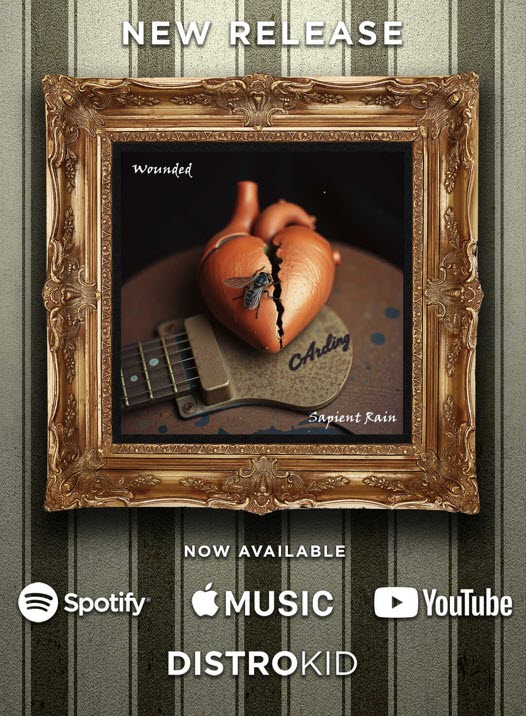
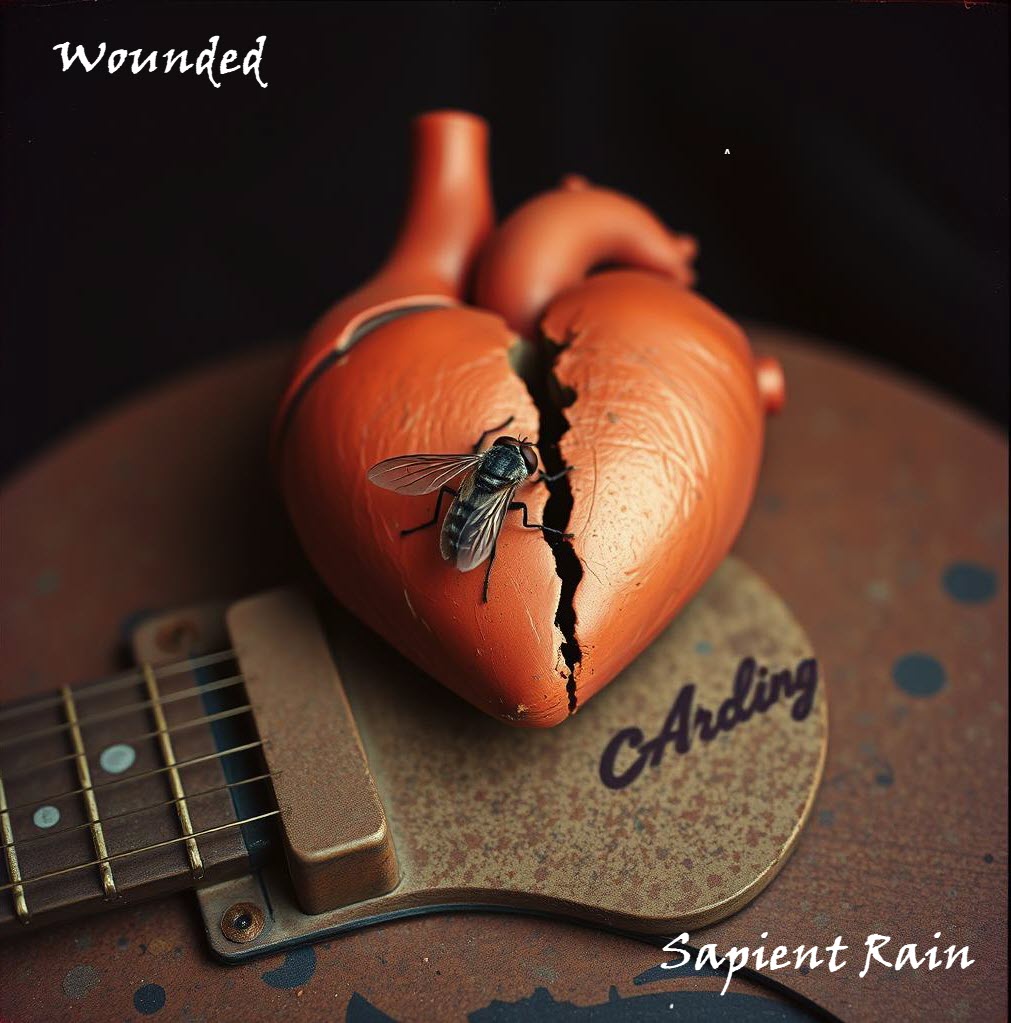
“Wounded”, a creative endeavor between me and the AI Music Engine, Suno, and a follow-up to “Wisdom’s Water”, is available on iHeart, Apple Music, and Spotify.
“Wounded” presents an eclectic collection of songs spanning musical genres, from rockabilly and grunge-inflected bangers to melodic country western ballads.
The work appears under the artist profile “Sapient Rain.”
The lyrics are from poems I’ve written that focus on individuals wounded by love, depression, and the whims of demented, power-hungry authoritarians.
I had a lot of fun crafting the lyrics and working with Suno to select the musical score for my poetry.
My Paper, My Words is a collection of essays, stories, and poems that reflect the challenges of a middle-class husband and father trying to navigate a rapidly changing political, religious, and technological landscape of post-911 America.
The dangers in Pittsburg the dangers in Norway wherever we live its outside our doorway The science is speaking The numbers aren’t lying The danger is global With temperatures rising
Musk in a rocket Bezos-a-blasting they reach for the stars and life everlasting a climate disaster our earth is-a-blazing and those who can help are ego star gazing what world do you want to give to your kids a world with some hope or one on the skids?
On 02/26/26, the single “The Danger’s in Pittsburgh” from the album “Wounded” comes out on Spotify, Apple Music, YouTube Music, and iTunes under the artist profile “Sapient Rain.”
Sapient Rain is the artistic collaboration of writer/lyricist Geoffrey Reilly and the AI music engine Suno.
My Paper, My Words is a collection of essays, stories, and poems that reflect the challenges of a middle-class husband and father trying to navigate a rapidly changing political, religious, and technological landscape of post-911 America.
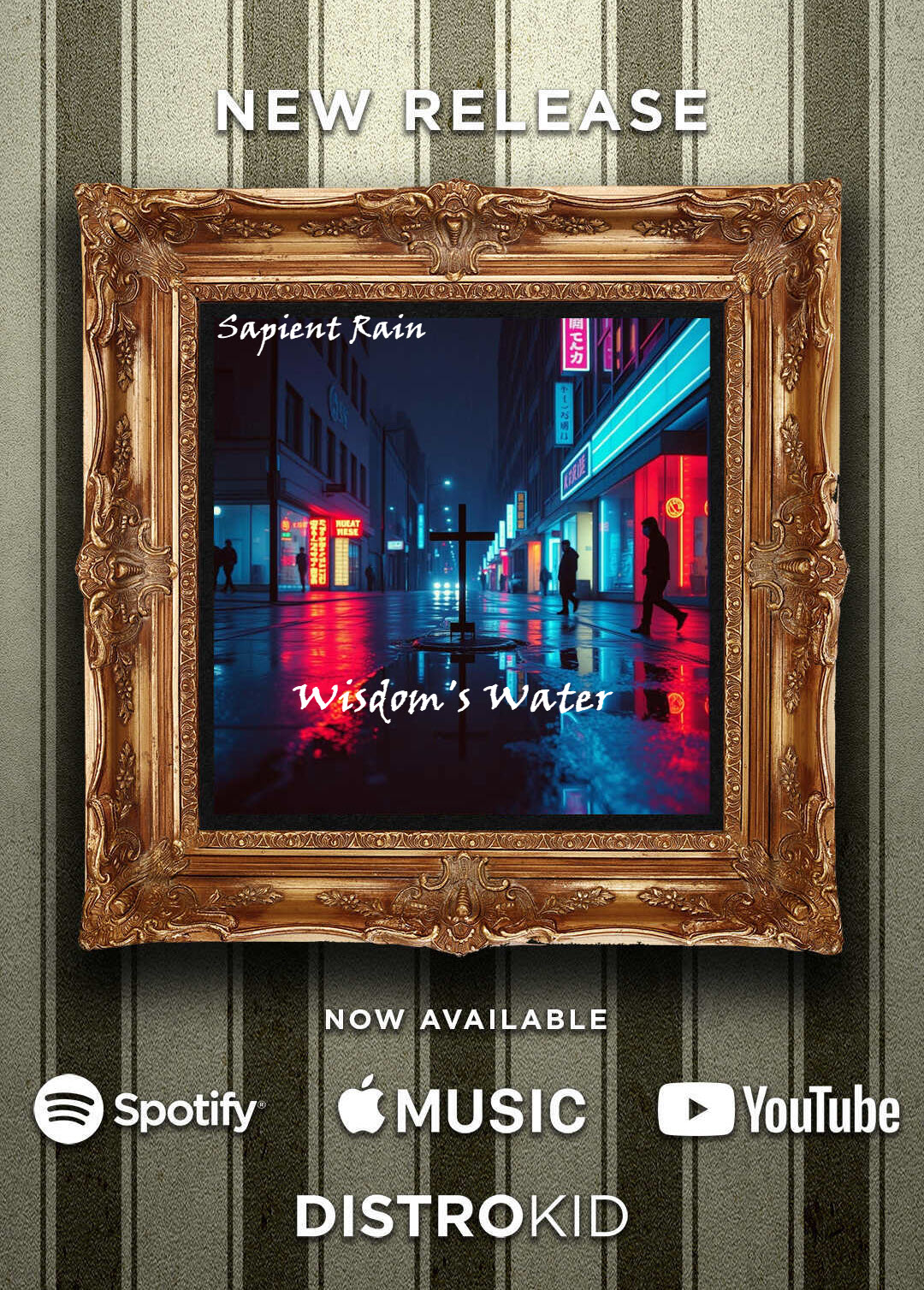
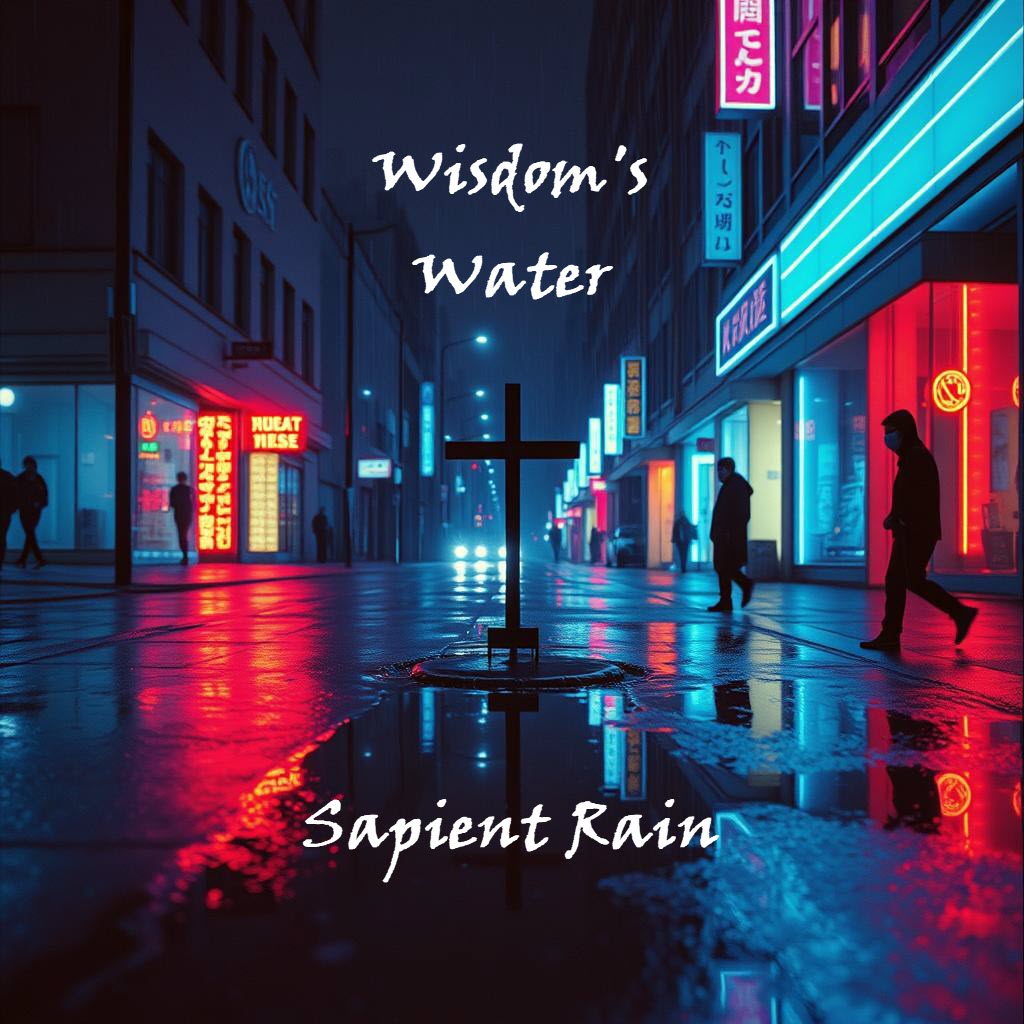
Wisdom’s Water, a creative endeavor between me and the AI Music Engine, Suno, is now available on Apple Music, YouTube Music, and Spotify.
The work appears under the artist profile “Sapient Rain.”
The lyrics on Wisdom’s Water come from poems I’ve written and published over the last few years, and center around themes of religion, violence in America, civic responsibility, and the fragility of democratic ideals.
The music is generated by Suno and adds a second consciousness to the collaboration, shifting from atmospheric tension to rhythmic urgency, mirroring the political and social turbulence the album explores.
I had a lot of fun crafting the lyrics and working with Suno to select the musical score for my poetry.
I’m inspired by all the artists and citizens who are speaking out and protesting in defense of our democracy. I believe this album will resonate with anyone concerned about the troubling direction in which our country is heading under Donald Trump’s fascist regime.
Not all of the songs on Wisdom’s Water are protest songs, but many are. I hope you download, stream, and share them with friends and family. And I hope you enjoy listening to them!
And finally, look for my second collaboration with Suno, titled Wounded, which will be available on streaming services on February 26th, 2026.
My Paper, My Words is a collection of essays, stories, and poems that reflect the challenges of a middle-class husband and father trying to navigate a rapidly changing political, religious, and technological landscape of post-911 America.
Sapient Rain is a human-AI partnership between lyricist Geoffrey Reilly and the AI music platform Suno.
“Wounded,” the follow-up to Sapient Rain’s debut release, “Wisdom’s Water,” presents an eclectic collection of songs spanning musical genres, from rockabilly and grunge-inflected bangers to melodic country western ballads.
Reilly’s lyrics focus on individuals wounded by love, depression, and the whims of demented, power-hungry authoritarians. Suno’s AI-generated music (thoughtfully procured by Reilly) amplifies and transforms the lyric imagery into immersive soundscapes that feel firmly rooted in the times we are living.
My Paper, My Words is a collection of essays, stories, and poems that reflect the challenges of a middle-class husband and father trying to navigate a rapidly changing political, religious, and technological landscape of post-911 America.
Writing today to gently remind you that Wisdom’s Water, my poetic / lyrical collaboration with the AI Music platform Suno, drops on Spotify on February 12th, 20026.
I had a blast crafting the lyrics and working in Suno to select the most suitable musical vehicle for my words and feelings. I’m inspired by all of the artists and citizens speaking out and protesting in defense of our democracy, which we are in legitimate danger of losing.
Not all of the songs are protest songs, but many are. I hope you download, stream, and share them with friends and family. And I hope you enjoy listening to them!
I created an artist account on Instagram and have been posting snippets of tracks from Wisdom’s Water. Feel free to follow the artist profile at https://www.instagram.com/sapientrain/
Here is a little taste of Wisdom’s Water from Sapient Rain:
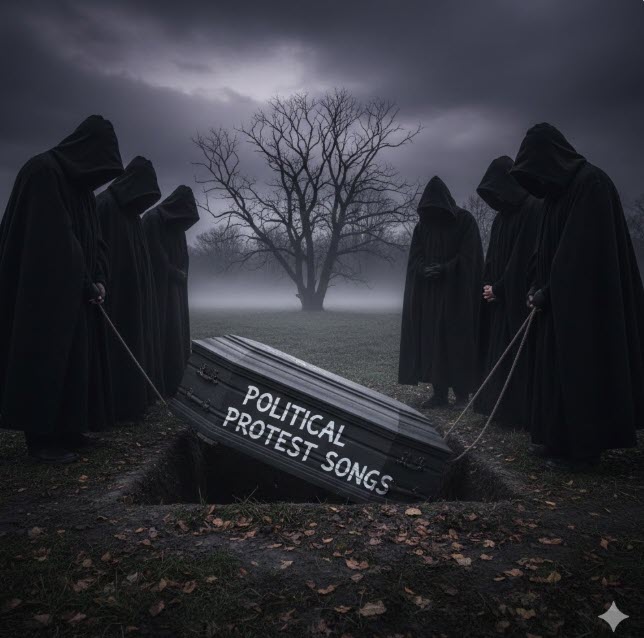
In these turbulent times, why don’t we have protest songs like we used to?
What cultural or sociological changes have made the protest song less popular?
Why Protest Songs Once Thrived
During the 1960s-70s, the economics and centralized nature of the music industry, combined with a shared identity amongst America’s youth (cemented by America’s role in the Vietnam War), provided fertile ground for protest songs to gain popularity.
In the America of the 1960s-70s, young, college-educated, middle-class Americans (a significant demographic) aligned with the counterculture, civil rights, and anti-war movements. This alignment allowed protest songs to find a home in the collective conscience of a generation of young Americans.
The conditions that led to the popularity of protest songs in the 1960s-70s included:
Mass movements: Civil rights and anti-war protests created collective spaces where songs unified crowds.
Limited media outlets: Radio and television amplified protest songs as rallying cries, giving them cultural dominance.
Shared identity: Songs like Bob Dylan’s “Blowin’ in the Wind” or Marvin Gaye’s “What’s Going On” became shorthand for generational values.
Why Protest Songs Declined
Protest songs haven’t disappeared, but their cultural role has shifted due to the following conditions:
Fragmented music culture: Streaming platforms and niche genres mean fewer “universal” hits that everyone hears.
Commercial pressures: Record labels often avoid overtly political content to maximize global market appeal.
Social media activism: Twitter, TikTok, and Instagram now serve as protest tools, reducing reliance on music as the primary vehicle for dissent.
Individualized expression: Protest today often emphasizes personal identity and micro-activism rather than collective anthems.
Cultural fatigue: In turbulent times, audiences may feel overwhelmed, turning to escapism rather than politicized art.
Today, activism often happens through digital platforms, fragmented music genres, and individualized expression rather than mass sing-alongs. Changes have made protest songs less central to political movements.
So, while video killed the radio star in the 1980s, changes in the music industry, commercialization, and the rise of social media may have killed the political protest song today — and that’s a fucking shame, because if there was ever a time for unifying the power of music against political corruption and maleficence, it’s today.
Here are some political protest songs’ that I’ve been working on (my lyrics, Suno’s music). Feel free to share or comment on them!
Donald Trump won’t be around forever (thank God) – but his impact will linger like a fart in a closet. Trump provides a blueprint for other candidates who might possess similar autocratic tendencies. This song is a “heads-up” about the barbarians who will gather at the gates of our democracy once Trump is dead and gone.
These lyrics are from a poem I wrote after the Charlie Kirk assassination. It’s about how dangerously divided America is and the potential for spiraling political violence that seems increasingly likely in the second Trump term.
I wrote the poem “Get a Load of Elon” after seeing the sickening footage of that smiling dirtbag laughing it up and swinging a chainsaw around like some fake-ass efficiency hero. Fuck that guy and everything he represents. I think Suno captured the tone I was looking for on this one.
Donald Trump is my fat, ugly muse. There, I said it. Shame on everyone who voted for this criminal, and fuck all the cowards in Congress who are failing to stand up to this two-bit thug. And that’s all I have to say about this song.
I came up with these lyrics based on a poem I wrote in 2017 called “Resist”, which was about pushing back against Donald Trump and his policies, which I saw as an existential threat to America’s democracy. I added several new verses for the song and reworked the verse that would become the chorus. I can see the Dixie Chicks or Dolly Parton belting this out. I’m not a big fan of country or rockabilly music, but I think that musical style works well with the words here.
Suno and I, channeling our best Pat Benatar impression. I wrote the poem “Oligarchic Kings” recently and published it on my blog. I changed it quite a bit for the song version.
When I wrote this poem originally, I wrote it to the cadence of Supercalifragilisticexpialidocious from “Mary Poppins” and included it in my book “Imagine There’s No Donald” (available on Amazon😉 ). I asked Suno to create a power-pop song from the poem. It’s the only poem I used as is (not changing any of the words). It’s a campy/poppy version of a Disney classic.
My Paper, My Words is a collection of essays, stories, and poems that reflect the challenges of a middle-class husband and father trying to navigate a rapidly changing political, religious, and technological landscape of post-911 America.
I’ve just published “Imagine There’s No Donald” on Amazon.com.
Imagine There’s No Donald is a lyrical collection that channels the melodic cadence of (mostly) Beatles songs to deliver searing poetic indictments of Donald Trump, the MAGA movement, and their corrosive impact on American democracy.
Each poem echoes the structure and emotional resonance of iconic musical tracks—think “Rocky Racoon” reimagined as the tale of Donald Trump’s destructive path to the presidency, or Terry Jacks’ “Seasons in the Sun” transformed into a lament on Republican cowardice and lost democratic norms.
Through this fusion of pop nostalgia and political critique, the collection:
🎶 Harnesses Familiar Rhythms: The song structures serve as scaffolding for verses that are both accessible and subversive, drawing readers in with rhythm before confronting them with truth.
🔥 Excoriates Authoritarianism: Trump and MAGA are portrayed not just as political figures but as symbols of a broader erosion of truth, decency, and constitutional integrity.
🕊️ Defends Democratic Ideals: The poems mourn the fragility of American institutions while fiercely advocating for civic engagement, accountability, and moral clarity.
🎤 Amplifies Dissent: With a voice that is at once satirical and sincere, the book invites readers to sing along in protest, turning melody into a megaphone for resistance.
Whether riffing on “She Came in Through the Bathroom Window” to expose the sycophantic rot of the Trump administration or twisting “When I Saw Her Standing There!” into an elegy against oligarchs and authoritarianism, this book is a poetic rebellion—an artistic act of defiance that refuses to be silent in the face of democratic decay.
Most free thinkers, poets, and essayists are but a thorn in the side of the authoritarian regime that is running roughshod over America’s democracy. Writing and speaking truth to power sometimes feels like screaming into the void. But with critical mass and momentum, art can influence public sentiment and mobilize opposition to repressive policies and tactics, making it a powerful adversary to regimes that rely on propaganda and control.
Verbal resistance alone won’t revive our democracy. If we’re going to right the ship in America, we’re going to have to do more than sing and complain. We’re going to have to take to the streets and, as the honorable Georgia Congressman John Lewis famously said, “get in good trouble, necessary trouble” by the millions.
Get your copy of Imagine There’s No Donaldon Amazon. Please feel free to share the link with others on your social media or simply by giving the book to a loved one as a gift.
My Paper, My Words is a collection of essays, stories, and poems that reflect the challenges of a middle-class husband and father trying to navigate a rapidly changing political, religious, and technological landscape of post-9/11 America.

 bendingtheneedle