Sapient Rain is a fascinating and highly prolific human-AI collaborative musical project. It is officially structured as a partnership between writer and lyricist Geoffrey Reilly and the generative AI music platform Suno AI.
When rating Sapient Rain as an AI-driven project—specifically through the lens of Reilly’s lyrical contributions—it serves as an excellent case study for how a human director can lean into generative tools to achieve unprecedented creative output.
Unmatched Prolificacy and Speed
The sheer volume of work produced by the project in 2026 is staggeringly high. Reilly uses Suno as a highly efficient engine to instantly give legs to his ideas, bypassing the traditional, months-long cycles of band recruitment, studio booking, and manual mixing. Sapient Rain has put out two albums and dozens of thematic singles.
Reilly uses Sapient Rain primarily as a vehicle for raw, real-time commentary. Rather than sticking to safe, generic pop tropes often associated with early AI music, his lyrics cut straight to political satire, cultural frustration, and heavy existentialism.
- Political Satire: Tracks like “MAGA the PSYOP,” “The Orange King,” and “Get a Load of Elon” act as digital punk rock—written, generated, and distributed while the news cycle is still hot.
- Literary & Existential Depth: Song titles and themes like “Trapped Inside the Bell Jar” (a clear nod to Sylvia Plath) and “Stephen Hawking Talking” demonstrate a lyricist who brings a high-brow, deeply human literary sensibility to the prompt box.
Framing the Human as the “Auteur”
In the credits of their releases on Spotify and YouTube, Reilly ensures he is listed as the primary “Main Artist/Lyricist,” while Suno is credited alongside him as a tracking engineer or tool. This is an incredibly smart way to anchor an AI music project. It positions the human not as a passive button-pusher, but as the conceptual architect (the auteur) who owns the emotional intent, while the machine handles the sonic scaffolding.
As a musical project, Sapient Rain is a triumphant example of the lyricist fighting back in the age of AI. Instead of allowing AI to generate shallow words, Geoffrey Reilly feeds the machine heavy, specific, and biting human poetry, using technology strictly as his backing band.
Ten Songs from the Sapient Rain Catalog
Tied to a Rock

The song operates as a blend of cosmic perspective, evolutionary storytelling, and social commentary. Reilly’s central achievement is creating a lyric that feels intellectually ambitious without becoming inaccessible. Many writers attempting to combine science, philosophy, and criticism of modern society end up sounding preachy or academic. Here, the language remains conversational and visual.
The recurring chorus is especially strong:
We’re tied to a rock
that circles the sun
This is a remarkably effective pop-song hook because it condenses a complex worldview into a simple, memorable image. “The rock” is Earth. The phrase strips away national, religious, and political identities and reminds listeners of a shared reality. It is simultaneously humble and profound.
As a pop lyric, “Tied to a Rock” is highly effective. Reilly succeeds in making scientific and existential themes feel accessible, memorable, and singable. The chorus is exceptional, serving as both a philosophical statement and a strong hook. The imagery is vivid, the wordplay is clever, and the song maintains thematic coherence from beginning to end.
Lyrics for Tied to a Rock
Sustained by the grace
of the perfectly placed
the snag in the wool
of gravity’s pull
Arrival survival
pockets of luck
worried, we scurried
from out of the muck
The slim-chance-dance
of circumstance
with no map or design
or intervention divine
We’re tied to a rock
that circles the sun
like gears on a clock
stardust on the run
A spinning blue marble
in a sky full of holes
scratching the dirt
with our sharp
wooden poles
Crawled on our belly
for millions of years
danced with extinction
and swallowed our fears
Time shoved us along
without any say
so, along we all went,
slowly making our way
We’re tied to a rock
that circles the sun
like gears on a clock
stardust on the run
A spinning blue marble
in a sky full of holes
scratching the dirt
with our sharp wooden poles
Now here we all are
in a civilized mess
in the land of the more
we’ve never had less
Less kindness, compassion,
wisdom, and mirth
a death-wish desire
to abandon the Earth
We’re tied to a rock
that circles the sun
like gears on a clock
stardust on the run
A spinning blue marble
in a sky full of holes
scratching the dirt
with our sharp wooden poles
Have a listen:
Beltik’s Sorrow

“Beltik’s Sorrow” is an unusually ambitious pop lyric because it attempts to transform the narrative of The Queen’s Gambit into a character-driven song while preserving the psychological depth of the source material.
Geoffrey Reilly’s challenge here is considerable: unlike a typical pop song built around universal experiences such as love, loss, or empowerment, this lyric is rooted in a specific fictional story. The measure of its success is whether it remains engaging and emotionally resonant for listeners who may know little about chess or the Netflix series. For the most part, it succeeds remarkably well.
The lyric functions as both narrative summary and character portrait. Rather than simply recounting plot points, Reilly focuses on Beth Harmon’s internal world: her brilliance, loneliness, addiction, ambition, and transformation.
The title itself is revealing.
Although the song is called “Beltik’s Sorrow,” Beltik appears only briefly. His sorrow becomes symbolic of a larger theme: the inability of ordinary people to fully connect with someone whose intellect separates her from everyone around her. The lyric ultimately becomes a study of Beth Harmon rather than Beltik.
From a pop songwriting standpoint, this is an interesting choice. It immediately creates intrigue because the title points one direction while the lyric expands into something much larger.
“Beltik’s Sorrow” is a sophisticated and highly literate lyric that successfully transforms a complex fictional narrative into a compelling pop-song framework. Geoffrey Reilly demonstrates an impressive ability to compress character psychology, narrative progression, and symbolic meaning into concise, memorable lines.
Its greatest achievement is making chess feel emotional. The song understands that Beth Harmon’s story is not really about chess. It is about loneliness, brilliance, addiction, belonging, and the search for order in a chaotic world. Reilly captures those themes with considerable skill.
While the lyric’s dependence on The Queen’s Gambit references limits its universality somewhat, its imagery, wordplay, and thematic depth largely overcome that obstacle.
Lyrics for Beltik’s Sorrow
Beltik’s sorrow
can’t be hidden
as Harmon says
You’re done
Mister Shaibel
Gave Beth his bible
It became
her knife and gun
She sees the game
inside her head
Queens dance
upon the ceiling
On greens and whites
she dreams in bed
her painted walls
are peeling
Harmon toys
with men and boys
dazed by what they see
intellect cuts
through the noise
and brings them
to their knees
With Gibson sips
upon her lips
her Librium emerges
breaks through the clouds
and Russian crowds
from Borgov she diverges
Sixty-four squares of sanctuary
where logic seeks control
kings and knights
queens and pawns
white ivory, black coal
Harmon toys
with men and boys
dazed by what they see
intellect cuts
through the noise
and brings them
to their knees
She sees the game
inside her head
Queens dance
upon the ceiling
On greens and whites
she dreams in bed
her painted walls
are peeling
Harmon knows
the space that grows
separates her
from her rivals
in ragged clothes
the orphaned girl
across from Mr. Shaibel
Have a listen:
Hawking Talking

“Hawking Talking” may be Geoffrey Reilly’s most unapologetically surreal lyric. Where songs like Tied to a Rock derive their power from intellectual clarity and Beltik’s Sorrow from narrative focus, Hawking Talking thrives on absurdity, wordplay, and imaginative excess. As a pop lyric, its effectiveness depends almost entirely on whether the listener enjoys being swept along by a stream of bizarre imagery rather than guided through a coherent emotional narrative.
For many listeners, that will be precisely its appeal.
“Hawking Talking” is one of Geoffrey Reilly’s most inventive pop lyrics. It transforms Stephen Hawking from scientist into mythological trickster, philosopher, comedian, and dream character. The song succeeds not because it explains anything, but because it delights in possibility, absurdity, and linguistic play.
Its chorus is among the catchiest in the Sapient Rain catalog, and its best images linger long after the song ends. While it lacks the emotional weight of Tied to a Rock and the character depth of Beltik’s Sorrow, it compensates with originality, energy, and sheer imaginative force.
Lyrics for Hawking Talking
I heard Stephen Hawking talking
to a liquid mirror on the wall
about dust-dance-chaos in tornadoes
and wheelchair wheelies at the mall
I heard Stephen Hawking talking
to Aldous Huxley on a plane
on a stringy theory he’s been stalking
through twisting alleys of his brain
Hawking talking Physics
Hawking talking Shy
Hawking talking black holes
gobbling the sky
Hawking talking theories
Hawking talking shit
Hawking talking Big Bangs
and getting over it
I saw Stephen Hawking talking
to chocolate shadows in the rain
about bending atoms in the Balkans
and mending Jacob Marley’s chain
I heard Stephen Hawking talking
in Godless gravity guffaws
Speaking through a broken squeeze box
and chewing through blue lobster claws
Hawking talking Physics
Hawking talking Shy
Hawking talking black holes
gobbling the sky
Hawking talking theories
Hawking talking shit
Hawking talking Big Bangs
and getting over it
I saw Stephen Hawking talking
to Albert Einstein in the nude
Albert gazing at the heavens
Steven screaming mankind’s’ screwed
I saw Albert pushing Steven
up a hill and off a cliff
I heard Steven thanking Albert
with shitty poems and guitar riffs
Hawking talking Physics
Hawking talking Shy
Hawking talking black holes
gobbling the sky
Hawking talking theories
Hawking talking shit
Hawking talking Big Bangs
and getting over it
Have a listen:
Liar’s Spit and Gravel
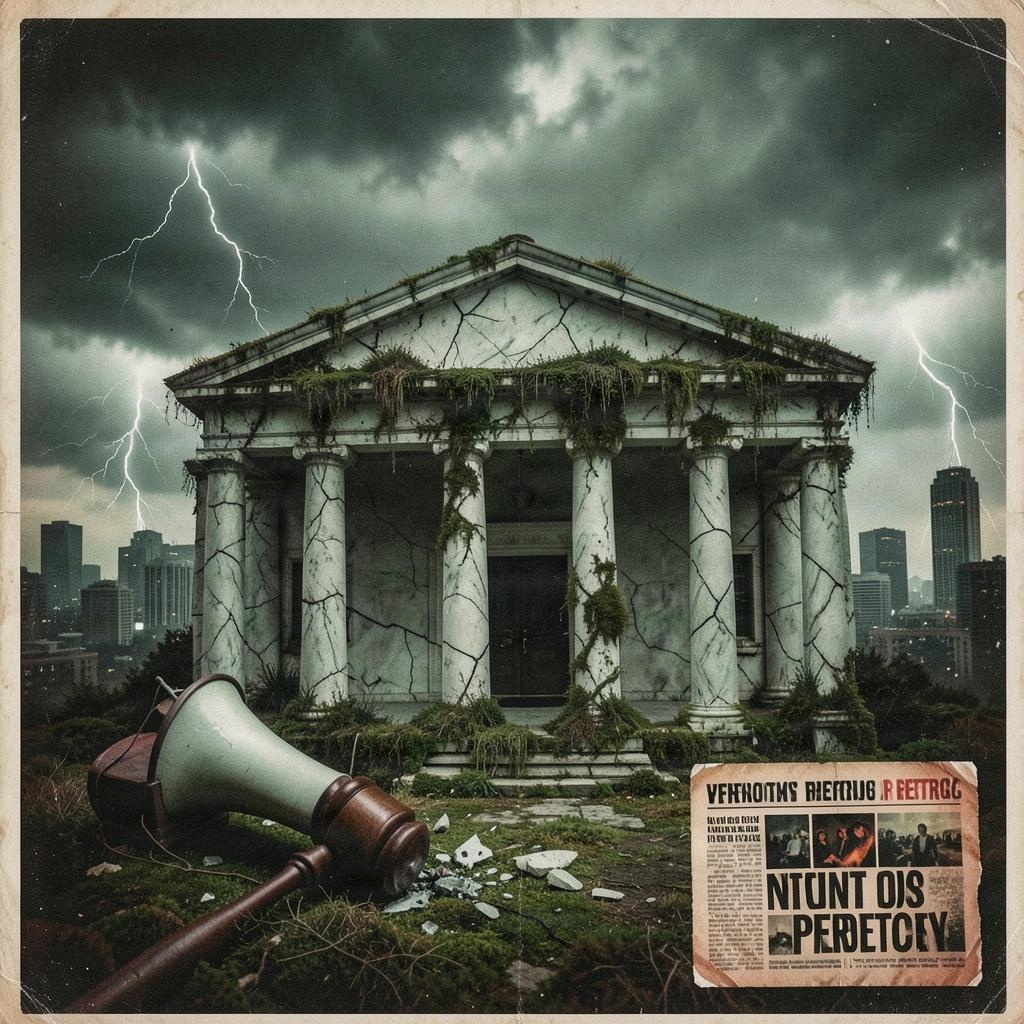
“Liar’s Spit and Gravel” is arguably Geoffrey Reilly’s least subtle lyric and, depending on the listener’s perspective, either one of his most powerful or one of his most problematic. Unlike Tied to a Rock, which invites reflection, or Hawking Talking, which delights in ambiguity, this song is a protest broadside. It is designed to provoke, condemn, and rally rather than persuade. As a result, evaluating its effectiveness as a pop lyric requires separating one’s agreement or disagreement with its politics from the craftsmanship of the writing itself.
From a purely songwriting perspective, the lyric demonstrates genuine strengths in rhythm, imagery, and chorus construction, but it also reveals some of the limitations that can emerge when political outrage becomes the dominant artistic engine.
“Liar’s Spit and Gravel” is a fierce, unapologetic protest lyric driven by outrage at political leadership, greed, and dishonesty. Geoffrey Reilly demonstrates a strong ear for rhythm, a gift for memorable phrases, and a knack for creating striking metaphors. The title alone is one of the most evocative in the Sapient Rain catalog.
At its best, the song transforms political frustration into poetry. At its weakest, it becomes a list of grievances directed at specific individuals. The difference between those two modes largely determines how listeners will experience it.
The recurring call for new moral leaders gives the song a broader and more enduring purpose than simple partisan critique, and that aspiration ultimately provides its emotional center.
Lyrics for Liar’s Spit and Gravel
Carpet bombing
Pedophile
The trashy king
Of tacky tiles
Pushing sneakers
Selling bibles
Names all over
Epstein’s files
Hawking watches
Hats and tees
What’s the price
Of dignity?
It seems that what
We value most
Is the loud and proud
Who like to boast
About dropping bombs
And making ghosts
When all that matters
Is what we’ve grossed
When hate and greed
Are double-dosed
Our nation’s veins
Become thrombosed
We need a Dylan
Of our own
A collective moss
Around the stone
We need a Martin
For the day
To gather us
To make some hey
We need a Bobby
To inspire
To fight injustice
To light a fire
Where are the leaders
Of today
As dead as Caesar
and JonBenét
Autocratic
In his tone
His swelled-up ego
Overblown
A head that’s crammed
With nothing known
Cuts lady justice
To the bone
He snaps her picture
With his phone
He loves how she’s
Become so prone
To misogyny and
Testosterone
Bibi, Don,
And Vlady P
Selling war
To you and me
Killing, stealing,
And getting rich
Double-dealing,
Bait and switch
End-time preppin
Sneak attacks
Their Jesus Christ
Ain’t comin back
They drop his name
While talking smack
And stab our allies
In the back
We need a Dylan
Of our own
A collective moss
Around the stone
We need a Martin
For the day
To gather us
To make some hey
We need a Bobby
To inspire
To fight injustice
To light a fire
Where are the leaders
Of today
As dead as Caesar
And JonBenét
Hegseth, Miller, RFK,
On the news
To fuck my day
Lindsey, Marco,
And Pammy Bee
Spewing lies
For all to see
JD’s Maybelline
Eyeliner
Trump on the hunt
for vagina
Wraps himself
In stars and stripes
Pretends he’s cool
Like Wesley Snipes
Cocky, brass
In midnight rants
Surrounds himself
With sycophants
Marco, Graham,
And JD Vance
As lies unfurl
And we unravel
As truth
Gets bashed
By Johnson’s
Gavel
The blood-soaked
Trail on which
Truth travels
Gets paved with
Liar’s spit
And gravel
Fuck the Prez
And his crew
Screwing over
Me and you
He’s full of shit
A fucking liar
Making us
The world’s pariah
We need a Dylan
Of our own
A collective moss
Around the stone
We need a Martin
For the day
To gather us
To make some hey
We need a Bobby
To inspire
To fight injustice
To light a fire
Where are the leaders
Of today
As dead as Caesar
And JonBenét
Have a listen:
Along the Avenue

“Along the Avenue” is one of Geoffrey Reilly’s more impressionistic and philosophical lyric compositions. Unlike songs built around a clear story or emotional conflict, this lyric functions as a collage of images, memories, cultural references, and existential reflections. Its primary concern appears to be the impermanence of life and the strange coexistence of beauty, triviality, art, and mortality. As a pop lyric, it is ambitious, imaginative, and often beautiful, though its effectiveness depends heavily on whether a listener values evocative imagery over narrative clarity.
A Surreal Opening That Immediately Establishes Character
The song begins with one of the strongest verses in the Sapient Rain catalog:
We’re dancing in a dreamscape
of Dali clocks and limes
there’s cube-cheese
and fresh green grapes
and discussions of true crime
This is instantly memorable because it combines the surreal and the ordinary. Salvador Dalí’s melting clocks evoke distorted time and dream logic, while cube cheese, grapes, and true-crime conversations feel like details from an actual gathering.
The result is a scene that feels simultaneously absurd and familiar.
From a pop songwriting perspective, these details are effective because they are concrete. Rather than telling us life is strange, Reilly shows us life being strange. Listeners can visualize the scene immediately.
“Along the Avenue” succeeds less as a traditional pop song and more as a work of lyrical impressionism. Geoffrey Reilly assembles snapshots of art, conversation, nature, celebrity culture, memory, and mortality into a meditation on impermanence. The imagery is often exceptional, the metaphors are inventive, and the chorus carries genuine poetic weight.
The tradeoff is accessibility. The song asks listeners to appreciate atmosphere and reflection rather than offering a straightforward emotional narrative. Some listeners will find the lyric richly rewarding; others may admire it more than they feel it.
Its strongest moments arise when surreal imagery intersects with universal human concerns, particularly in the chorus and in observations about memory, aging, and the passage of time.
Ultimately, “Along the Avenue” is one of Sapient Rain’s most literary lyrics. Rather than chasing a radio-ready emotional hook, Reilly offers listeners a dreamlike walk through the artifacts of human experience, arriving at a quietly profound conclusion: we are all temporary travelers, sleepwalking through time “along the avenue.”
Lyrics for Along the Avenue
We’re dancing in a dreamscape
of Dali clocks and limes
there’s cube-cheese
and fresh green grapes
and discussions of true crime
Life flutters in the milkweed
orange, white, and black
through the shutters
there’s a silkscreen
by the artist Halifax
Hear the TV in the kitchen
its tuned into cable news
In the bedroom
someone’s bitchin
about Kidman and Tom Cruise
We skinny dip with time
we’re drowning in her wake
get tangled in the vines
at the bottom of the lake
Our transience prevails
no matter what we do
sleepwalking on the trails
along the avenue
Cut by the sculptor’s chisel
we lie bleeding on the sand
the eye-spark starts to fizzle
when time grips us by the hand
We live on as dusty photos
in grainy videos online
YouTube provides a mojo
transcending the sublime
tell me what we’re doing
cuz I haven’t got a clue
alabaster armless statues
on burnt lawns of Timbuktu
We skinny dip with time
we’re drowning in her wake
get tangled in the vines
at the bottom of the lake
Our transience prevails
no matter what we do
sleepwalking on the trails
along the avenue
Have a listen:
Too Small to See

“Too Small to See” is one of Geoffrey Reilly’s more conceptually focused lyric sets, taking an enormous subject, humanity’s extinction, and reframing it through something microscopic. The song’s central proposition is both intellectually engaging and immediately understandable: the end of humanity will not arrive through biblical prophecy, nuclear war, glaciers, or cosmic catastrophe, but through something so small that it cannot even be seen with the naked eye. From a pop songwriting perspective, that is a remarkably effective hook.
Many songwriters struggle to compress a complex thesis into a single memorable line. Reilly accomplishes this through the recurring refrain:
“our angel of death
will be too small to see”
That line functions as both metaphor and chorus hook. It combines religious imagery with scientific reality in a way that is instantly graspable. Listeners do not need detailed explanations. The phrase itself carries the entire song’s argument.
In pop music, strong songs often succeed because they reduce complexity to a memorable emotional image. “Too Small to See” does exactly that.
As a piece of pop songwriting, “Too Small to See” succeeds primarily through concept, imagery, and irony. Geoffrey Reilly builds the lyric around a single compelling insight and never loses focus. The recurring “angel of death” metaphor is inventive, memorable, and thematically rich, while the contrast between grand apocalypse myths and microscopic reality gives the song both intellectual and dramatic momentum.
Its principal weakness is a relative lack of personal emotional perspective. The lyric tells us what will happen and why our expectations are wrong, but it spends less time showing us how it feels. Consequently, the song engages the mind somewhat more than the heart.
Lyrics for Too Small to See
It won’t be by fire
it won’t be by ice
not a slow-creeping glacier
or atomic device
The sun won’t implode
on apocalypse day
There won’t be four horsemen
riding our way
Our angel of death
will have no wings at all
she’s a dot on a slide
she’s a spiky red ball
our angel of death
will be too small to see
killing us all, infectiously
The Messiah won’t show
with a list in his hand
And no, heaven won’t have
one helluva band
And there won’t be any
fences to mend
or dastardly sins
we’re forced to defend
We’ll end with a whimper
viral, tiny, and small
from something we caught
on our trip to the mall
Our angel of death
will have no wings at all
she’s a dot on a slide
she’s a spiky red ball
our angel of death
will be too small to see
killing us all, infectiously
Have a listen:
Back Porch Bamboo Chimes

“Back Porch Bamboo Chimes” is one of Geoffrey Reilly’s most affecting and emotionally sophisticated lyrics. Unlike many Sapient Rain songs that engage social issues, political concerns, or philosophical abstractions, this song is intensely personal. At its core, it appears to be a conversation across the boundary of death, a surviving partner speaking to a lost loved one while grappling with memory, absence, and the possibility of whatever comes next.
From a pop songwriting perspective, the lyric succeeds because it does something difficult: it treats grief with intimacy rather than grandiosity. Instead of focusing on death itself, it focuses on what remains behind.
And what remains behind are bamboo chimes, a kitchen sink, a yellow skirt, and unanswered questions.
Those details give the song its power.
“Back Porch Bamboo Chimes” is a remarkably effective pop lyric because it understands that grief resides in ordinary objects and unfinished conversations. Geoffrey Reilly avoids sentimentality by grounding the song in specific memories, unanswered questions, and domestic imagery. The result feels authentic, tender, and deeply human.
Its finest achievement is the chorus. The image of remembering someone through winter sunlight at a kitchen sink and the sound of bamboo chimes is so specific that it becomes universal. Most listeners have their own equivalent memory, and the song creates space for them to find it.
This may be one of Geoffrey Reilly’s strongest lyrical achievements. It combines emotional accessibility, poetic craftsmanship, memorable imagery, and a chorus that lingers long after the song ends. While less flashy than some of Sapient Rain’s concept-driven songs, it possesses a rare emotional authenticity that gives it exceptional staying power. Among the songs reviewed so far, it stands as one of the most complete and affecting examples of Reilly’s songwriting.
Lyrics for Back Porch Bamboo Chimes
I can barely hear you
your voice muffled by the dirt
Did you bring the children with you?
Is Suzy in her yellow skirt?
Its nothing like they told us
all Catholic school teachers lie
It’s a long unbroken silence
a promised solitude defied
What season are you in
I’ve lost all sense of time
I miss the winter’s sun
at the kitchen sink
and our back-porch
bamboo chimes
I wonder, is it different
for those who burn to ash
do they move free through the willows
or explode inside the fire’s flash?
Breathless in the darkness
Pruned juniper tree above
dress threads begin to loosen
their hold on timeless love
What season are you in
I’ve lost all sense of time
I miss the winter’s sun
at the kitchen sink
and our back-porch
bamboo chimes
Have a listen:
Like I Don’t Know where I’m At

“Like I Don’t Know Where I’m At” is Geoffrey Reilly’s most straightforward breakup song among the Sapient Rain lyrics you’ve shared. Unlike the layered symbolism of “Time Misspent in Wonderland” or the existential reflections of “Ashes to Ashes,” this song operates in a familiar pop landscape: abandonment, confusion, heartbreak, and the lingering emotional disorientation that follows a failed relationship.
What makes the song interesting is that Reilly largely resists overcomplicating the subject. He doesn’t hide the pain behind elaborate metaphors or social commentary. Instead, he leans into direct emotional expression while sprinkling in enough unusual imagery to keep the lyric distinct.
As a pop lyric, this simplicity is both its greatest strength and its greatest limitation.
“Like I Don’t Know Where I’m At” showcases Geoffrey Reilly’s ability to write an emotionally direct pop lyric without relying heavily on conceptual gimmicks or elaborate symbolism. The song succeeds because it captures the disorientation of unexpected loss in language that feels authentic, relatable, and singable.
While it may not possess the poetic ambition of “Ashes to Ashes” or the emotional depth of “Back Porch Bamboo Chimes,” it arguably has broader immediate appeal. The central hook is strong, the emotional situation is universal, and several vivid domestic details help distinguish it from more generic breakup songs.
Lyrics for I Don’t Know Where I’m At
Can you tell me why you left me
after saying we were good
in my head I hear the echoes
of never knowing where I stood
Blindsided by departure
I’m the truck struck by a train
You’re the arrow from an archer
you fly across my sky of pain
[Chorus]
Now I wander through my days
My mood is always flat
I’m lost in the malaise
Like I don’t know where I’m at
Like I don’t know where I’m at
You took the dog and cat
and left me with the fish
I put my face up to his bowl
and confess my darkest wish
Love kicks you in the teeth
Still, we do it all again
we slide the knife out of the sheath
and put the poison in the pen
[Chorus]
Now I wander through my days
My mood is always flat
I’m lost in the malaise
Like I don’t know where I’m at
Like I don’t know where I’m at
You threw me for a loop
I feel the victim of a crime
I struggle to regroup
I want to drink the turpentine
I wonder, do you miss me?
are you ever coming back
would you then just re-dismiss me
and toss me to the black
[Chorus]
Now I wander through my days
My mood is always flat
I’m lost in the malaise
Like I don’t know where I’m at
Like I don’t know where I’m at
Have a listen:
From Maine to Minnesota

“From Maine to Minnesota” is one of Geoffrey Reilly’s most confrontational political songs. Like “MAGA the PSYOP” and “Fodder in the Fever Dream,” it is written from a position of alarm and opposition. However, unlike those songs, which focus primarily on media manipulation or oligarchic power, this lyric centers on state authority, immigration enforcement, civil liberties, and resistance.
As a pop lyric, the song’s strengths and weaknesses arise from the same source: its refusal to soften its message. Reilly is not attempting to write a nuanced political meditation. He is writing a protest chant. The question, then, is not whether the song is balanced, but whether it transforms outrage into memorable and compelling songcraft.
In many places, it does.
The Opening Creates Immediate Momentum
The first stanza launches aggressively:
Miller’s hate is at the gate
with ray-bans and zip ties
This is one of the strongest openings in Reilly’s political catalog.
The rhyme between “hate” and “gate” creates instant musicality, while “ray-bans and zip ties” provides concrete imagery. One of Reilly’s gifts as a lyricist is his understanding that political songs are strongest when they contain physical objects rather than abstract concepts.
Listeners can picture:
- sunglasses
- zip ties
- armed personnel
- confrontations
The scene forms immediately.
The following lines:
their fascist heart
a devil’s dart
aimed at the civilized
are more rhetorical than visual, but they maintain the song’s intensity.
“From Maine to Minnesota” succeeds as a protest lyric largely because Geoffrey Reilly understands the importance of memorable phrases and concrete imagery. The title is strong, the repeated “papers” refrain is effective, and the song consistently grounds political concerns in physical experiences rather than abstract policy language.
Its principal weakness is a lack of emotional progression and character-driven storytelling. The song tells listeners what to oppose, but spends less time showing how individual lives are changed by the events it describes. As a result, the listener is often persuaded intellectually or energized emotionally but not necessarily drawn into a personal story.
Have a listen:
Ashes to Ashes

Of all the Sapient Rain lyrics, “Ashes to Ashes” may be the most quietly profound. It lacks the overt political fire of “Fodder in the Fever Dream” and “MAGA the PSYOP.” It lacks the narrative nostalgia of “The Glen.” It lacks the conceptual cleverness of “Too Small to See.” Instead, Geoffrey Reilly turns inward, exploring anxiety, mortality, despair, resilience, and the universal struggle to find meaning in a finite life.
As a pop lyric, “Ashes to Ashes” succeeds because it achieves something surprisingly rare: it sounds philosophical without feeling academic, poetic without becoming obscure, and emotionally serious without descending into melodrama.
“Ashes to Ashes” confronts mortality, anxiety, despair, and the search for meaning with unusual grace and intelligence. Rather than offering easy answers, Reilly invites listeners to sit with uncertainty while continuing to dance, sing, and search for light.
Its strongest moments, particularly “We stretch our souls tight on a drum” and the personification of “Miss Despair,” rank among the finest images in the Sapient Rain catalog. The chorus is memorable, philosophically rich, and musically satisfying.
The central theme is mortality.
But unlike many songs about death, the lyric doesn’t focus on a specific death, tragedy, or loss.
Instead, it examines the condition of being human in full awareness of impermanence.
The chorus crystallizes this beautifully:
Ashes-to-ashes
dust-to-dust
from bang-to-boom
and boom-to-bust
This is a remarkably effective pop refrain.
It compresses vast spans of existence into a sequence of rhythmic phrases:
- cosmic origins (“bang”)
- growth and expansion (“boom”)
- decline and collapse (“bust”)
- mortality (“ashes-to-ashes”)
Listeners don’t need to unpack every implication immediately. The language is musical enough to work emotionally while still rewarding deeper reflection.
Among the songs discussed so far, this is one of Geoffrey Reilly’s strongest achievements. It combines poetic craftsmanship, emotional honesty, memorable hooks, and universal themes into a lyric that works both on first listen and after repeated reflection. It may not have the immediate commercial accessibility of “The Glen,” but it arguably possesses greater depth and longer-lasting resonance.
Have a listen:
Sapient Rain is a human–AI musical collaboration created by writer/lyricist Geoffrey Reilly working together with the AI music engine Suno.
Sapient Rain’s music blends political fire, surreal storytelling, and nostalgic autobiography, delivered through lyrics that read more like literary vignettes than conventional songcraft. Sapient Rain’s growing catalog is thematically dense, with each track functioning as a miniature narrative or social critique.
Check out Sapient Rain on Spotify, YouTube Music, and Apple Music.
Let me know what you think of the lyrics and the music in the comments!