My Paper, My Words is a collection of essays, stories, and poems that reflect the challenges of a middle-class husband and father trying to navigate a rapidly changing political, religious, and technological landscape of post-911 America.
Most of us don’t get to choose the last thing we hear before dying. The grim reaper doesn’t give a shit about playlists or our affinity for the sound of waves crashing or birds singing.
The man in the blue blazer’s final breath came at 12:46 PM to the shitty sounds of stylized Jazz, and a Bluetooth-wearing mortgage lender yelling, “It’s 2008 all over again!”
With his elbows on the table and bowed head, he looked like any other Barnes and Noble Cafe customer – bewitched by books and coffee. Sure, his posture might have seemed “a little off” to the passersby, but not enough to alert the reference librarian or the pimply-faced adolescent behind the Cafe’s counter.
People don’t care about one another the way they used to. Most of us drift through our day in cell phone-induced trances, grossly unobservant of the world 3 feet beyond the nose on our faces. And so, the man in the blue blazer sat dead and unbothered for nearly eight hours (and one shift change) until a nudge from the Cafe’s manager caused him to fall and strike his head with a sickening biological splat, like a dropped bowling ball wrapped in salami.
Bill and Susie are wiping down the espresso machine when their pale, shell-shocked manager shuffles towards them.
“What’s up, boss? Are you OK?”
The question startles the manager from his stupor. He looks at Bill and says flatly, “He’s dead.”
“Who’s dead?” Bill and Susie chime in unison, causing Susie to laugh and blurt out, “Jinx on you!” while pointing and smiling at Bill demurely, “You owe me a coke, dude!” – Susie’s been crushing on Bill for months and can’t figure out why he hasn’t picked up on her willingness.
Their manager raises his arm slowly and points towards the Cafe’s seating area. Bill and Susie look wide-eyed at one another and dash from behind the counter. Susie sees the man lying on his back, turns immediately on her heel, and heads towards the front of the store, yelling, “Call 911, call 911!”
“Jesus Christ, boss, what happened?”
The manager’s voice is unsure and thready, “I told him we were closing, and that he needed to complete any purchases. When he didn’t respond, I touched him on the shoulder, and he fell.” His voice rattles with panic, “He must have been dead already; I mean, he never even tried to break his fall.”
The manager falls quiet before whispering, “His lips are so blue.” Bill looks at the lifeless body in front of them, turns toward his boss, and acknowledges softly, “So fucking blue.”
“You know, he looks familiar, boss. Not as a customer, but from out there,” Bill nods over his shoulder towards the storefront windows and the world beyond. He brushes by his manager and kneels next to the body. “He’s dead for sure,” and then shockingly reaches into the man’s blazer.
The manager directs a rage-filled whisper at Bill, “What the fuck are you doing? Are you crazy? The police are on their way!”
“I know – I just want to check his driver’s license. I know this guy, boss.”
“Who gives a fuck if you know him? Leave him alone! Wait for the police, for Christ’s sake.”
The manager’s head is on a swivel, his darting eyes surveying the store for straggling customers and police. The last thing he needs is for his manager to hear about a Barnes and Noble employee mugging a dead man.
Bill opens the wallet. A folded piece of paper falls out. Without thinking, he puts it in his pocket and rummages for the dead man’s driver’s license.
Susie comes running from the front of the store, out of breath, “Betty called 911. Bill, what are you doing?”
Bill holds up the license and smiles, “Ted Diamond. 22 Fairview Lane,” before slipping it back into the card slot and sliding the wallet into the breast pocket of the blazer.
A police cruiser glides quietly into the nearly empty parking lot, splashing the storefront in blue and red lights. Car doors slam, and a few seconds later, the reference librarian directs two officers toward the Cafe.
As the officer approaches, Bill looks at Susie and shoves his hands into his pockets nervously, only to discover the piece of paper that fell from the wallet. He looks up and realizes there’s no time to put it back. His fingers draw the paper into his sweaty palm, and he squeezes tightly, digging his fingernails into it.
“I’m Officer Jacobson, and this is Officer Tyler.” Can someone tell me what happened? Bill’s boss offers an outstretched hand to the officer, “Hi, I’m Jack Bellinger, the manager. I found the gentleman about 15 minutes ago. He was sitting at a table, and I nudged him when he didn’t respond to me — then he fell off his chair. I’m pretty sure he’s dead.”
There’s a commotion at the front of the store as the EMTs come rushing in. They begin chest compressions and CPR immediately, checking intermittently for breathing and a pulse. It’s not long before futility settles heavily on their shoulders.
The Cafe manager is off to the side, nodding and speaking with the officers in hushed tones. The EMTs wheel the man in the blue blazer slowly out the front of the store with no sense of urgency. His story ends officially in the parking lot of Barnes and Noble.
Bill pulls the folded and crumpled paper from his pocket.
“What’s that?” Susie whispers.
“A note. It fell out of the dead guy’s wallet when I was looking for his license – I didn’t have time to put it back.” A look of guilt and shame fell over Bill’s face.
“What’s in it?”
“I don’t know. I haven’t read it.”
Susie puts her arm around Bill’s waist and slow-walks him to the Cafe’s kitchen. Bill brushes aside poppy seeds and crumbs from the counter, unfolds the paper, and smooths it out with both hands.
Dear Mary,
I know what you’re doing and who you’re doing it with.
A barista?
How pathetically proletarian.
It’s over. We’re done. You’re DONE!
Ted
Susie steps back slowly from the counter and stares at the back of Bill’s head, his damp, thick curls resting on his shoulders. She watches him slowly take a cigarette lighter from his pocket. In a dream-like sequence, he walks to the sink, holds the note by the corner, and lights it on fire. Then he pulls a sandwich bag of little white pills from his other pocket, empties the bag into the sink, and washes them down the drain.
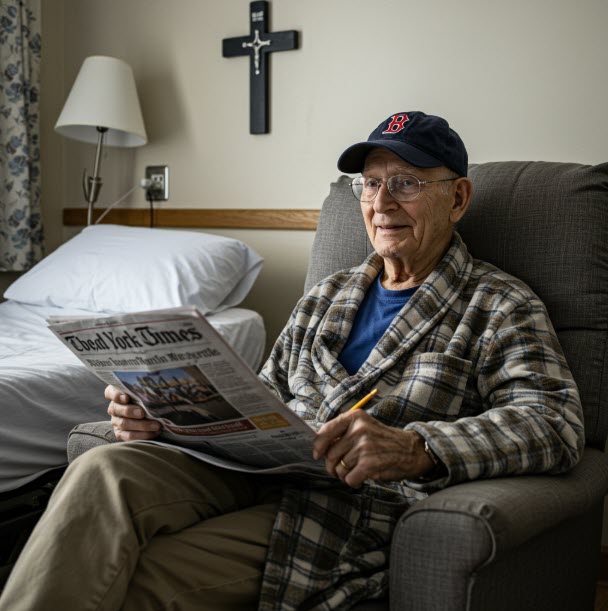
I make my way through a dimly lit hall of walkers, wheelchairs, and medical carts to find him where I always find him – in a threadbare recliner, lightly coated with dried skin cells and broken hair follicles – hunched over the New York Times crossword in his flannel robe, pee-stained underwear, and perfectly fitted Red Sox cap – his lips moving silently to the clues:
“1 Across – Act of saving or being saved – 1 down – Environmentally friendly material.”
Dad never used to move his lips – they were always tightly creased, well-mannered, and coolly detached from the finely humming machine in his head as he attacked the puzzle on all fronts.
To Dad, the Times crossword was a trusted friend, a worthy opponent, and an intellectual fencing partner who, for years, prepared him mentally for the start of his day. It felt grossly unfair that Dad was aging so inelegantly while his opponent remained unscathed by time.
I stand invisible at the entrance of his room, just staring, not wanting to disrupt his endeavor.
When he finally looks up, he shoots me a broad smile and tips his cap in my direction before returning to the puzzle.
I enter the room, clear my throat, and get to the point of my visit.
“Dad, do you have a will?”
Without lifting his eyes or halting the motion of his pencil, he responds, “You can have it all. Just burn me down to a fine ash, then bury me in the desert. There – that’s my will. Cross it off your list.”
I sigh heavily.
With his head still bowed, he holds up his mechanical pencil and points it sharply in my direction before continuing.
“But not too deep. A few inches below the topsoil will do just fine. I want the rain to be able to get to me — muddy me up a bit.”
He lifts his head. A thin dusting of skin cells and hair follicles fall – it’s wintertime in Flannel Ville. He gives me a wink and a smile before returning to the puzzle.
“What about the family plot where Mom is?”
“What about it?”
He goes on, “In the words of the best Beatle by far, Let. It. Be. When she was alive, your mother nagged me about hogging the bed and disturbing her sleep. Trust me, she’d be fine with my desert plan.”
He returns to the puzzle, mumbling under his breath.
“6 across – Breaking down organic matter” – 2 Down – To accept without protest”
“Is any of this written down, Dad?”
He slams the folded Times on his lap, and an unwelcome whiff of urine fills my nostrils.
“Why do I need to write it down? I just told you with actual words from my mouth – Put me in the goddamn desert, a few inches deep – Easy-Peasy. You want to bring nurse Jackie in as a witness?”
There’s no Nurse Jackie, but Dad loved that show so much that he referred to all his nurses as Nurse Jackie—even the males.
“Sorry, Dad.”
He softens immediately and smiles.
“It’s OK. No worries from the weary.”
“The Times is kicking my ass today.” He tosses the newspaper onto his bed – a school of dad-DNA swims in a stream of sunlight above the bedding.
“How are things at home? How are Emma and the boys?”
“They’re good – I’ve been wanting to get the boys in for a visit – -they’ve been busy with basketball and homework.”
“Don’t worry about visits. Honestly, I don’t want them to see me like this.”
A silence settles in the room. I can hear the paint peeling and a clock ticking.
“Can you do me a favor?”
“Sure, Dad, whatever you need.”
He points to the wall behind his bed.
“Get rid of that goddamn cross. It’s from the poor soul who was here before me.”
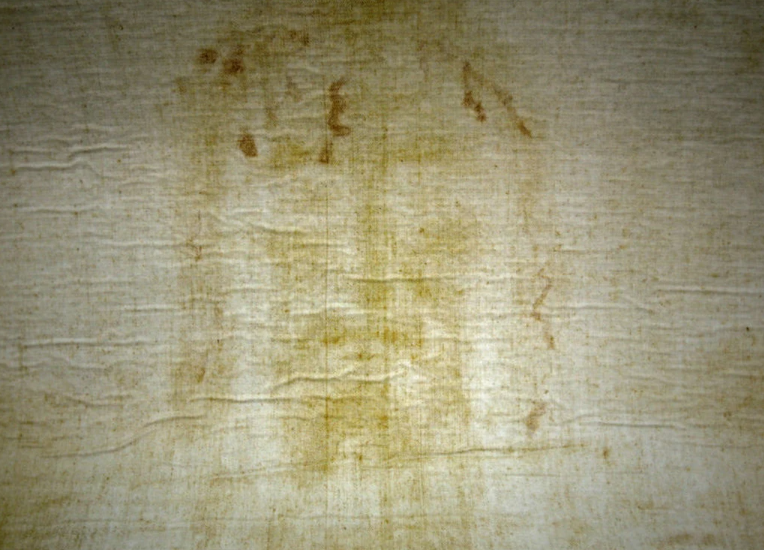
I lift the lacquered black Christless cross from its nail. The unfaded paint beneath it leaves a crucifix shroud of Turin.
In a deadpan voice, Dad stares at the wall and quotes Luke 24:6-7, “He is not there; he has risen,” and smiles sarcastically.
“Thanks, son.”
I stand Pope-like in the middle of his room, holding the crucifix, “What should I do with this?”
“Burn and bury it in the desert – he chuckles and starts to cough – a mosh pit of Dad-dust bounces enthusiastically on his shuddering shoulders. I can almost hear Cobain screaming.
Suddenly, there’s a discharge of electricity around Dad’s recliner. I look up to an intense blueish-white light pushing through the crevices on his forehead—a halo of electrified dandruff swirls above his head. A look of relief falls upon him. He winks and says warmly, “I’m just saving you the effort. Goodbye, son.”
There’s a loud pop—like a fluorescent light bulb dropped from a great height—as Dad bursts into flames like a human Hindenburg. Thin flakes of ash float in the air. Their fiery orange edges burn bright for a few seconds before self-extinguishing into dissipating wisps of smoke and settling all around me.
I drop the crucifix in stunned silence.
A nurse (followed by an elderly gentleman with a Dustbuster) enters the room. The nurse tilts her head towards her left shoulder and speaks into a small black microphone, “Mr. Smith in 103 has transitioned.” She nods sharply to the gentleman, who retrieves the crucifix and vacuums up every remnant of my father. He even vacuums Dad from my shoulders and shoes. When he finishes, the nurse checks her watch and makes a notation on her clipboard.
She hands me a piece of paper. “Your father left us these coordinates. We’re sorry for your loss. Please collect your father’s remains at the nurse’s station.” She and the orderly exit the room along the same path they entered.
I unfold the paper. Scrawled in my dad’s handwriting are the coordinates 40°40′N 117°40′W.
After a few minutes, I head to the Nurse’s Station. Dad’s been packaged neatly in a small cardboard box with the Crestwood Nursing Home logo. Someone thoughtfully taped the crucifix onto it. I pull it off and toss it in the trash on my way out the door.
I place Dad in the glove compartment and drive west to the desert.
My Paper, My Words is a collection of essays, stories, and poems that reflect the challenges of a middle-class husband and father trying to navigate a rapidly changing political, religious, and technological landscape of post-9/11 America.
“I’ve washed this towel twice and still can’t remove the puke stain.”
His wife Mary stands at the top of the stairs, gently shaking the unfurled towel at her husband, who sits with his back to her, hunched over his “work-from-home desk,” even though he’s been out of work for 10 months.
The vet called it megaesophagus, a condition in which the esophagus is unable to move food into the stomach efficiently, causing their aging dog to vomit frequently. His wife displayed the artistic consequence of their dog’s medical condition for her husband to see.
Planting his bare feet on the protective matt under his office chair, he spins towards his wife, her pretty, puzzled face resting atop the puke-stained towel.
He studies the stain. “Let’s change Pepsi’s name to Pollock and sell her work online.” Then, in the next breath, he squints and quips, “Hold on a second… what the hell . . . I think I see Jesus’s face in that puke stain!”
“Ha-ha, very funny”, still, she turns the towel 180 degrees, tilts her head slightly, and studies the stain.
“Our lord savior, perpetually pictured in Pepsi’s puke! — or Pollock’s puke if we decide to move ahead with the name change,” her alliterative husband continues with a self-satisfying grin.
“This could be the financial windfall we’ve been waiting for!”
“It’s a laundry version of the miracle at Lourdes… the Tide Pod that Spied God!” He slips effortlessly into one of his riffs, wagging his finger enthusiastically above his head.
“I’ll call the Vatican and local paper; you work on logistics for backyard tours.”
She chuckles, turns on her heel, and heads down the stairs.
He’s unfazed by her absence.
Once he starts ranting, it’s got to run its course, “like diarrhea,” she would often say.
“We’ll need to erect a clothesline for the bath towel shroud of Jesus!”
“Maybe by the vegetable garden in the back, in front of the doubting toms and holy basil,” he shouts while spinning back to his work desk.
Halfway down the staircase, she responds sarcastically over her shoulder, “I’ll get on that right way,” tossing the rolled-up towel into the clothes hamper at the bottom of the stairs.
“Can you and the young lady step out of the car, please?”
The voice behind the mirrored shades was professional and pleasant, but the driver was reluctant to comply. The look of panic in his daughter’s eyes only hardened his hesitancy.
“I’m sorry, officer. Was I speeding?” the driver asks calmly, offering the officer his license and registration.
“Sir, I received a tip about your passenger’s medical condition. I need you and the young lady to exit the car NOW.”
“Daddy, please, don’t go,” the daughter implores her father, gripping her seatbelt tightly with both hands. Her knuckles are white, and her body visibly trembles.
“It’s OK, honey – just stay put.”
“Listen, officer. This girl is my daughter. She’s 13 years old. I’m her parent and legal guardian, and she is NOT getting out of this car.”
The officer takes a step back, draws his weapon, and points it at the father.
There’s a jarring change in tone as the officer’s jagged words erupt coarsely from his gravel-lined throat:
“Sir, this is your last warning—step out of the car NOW.”
“Jesus fucking Christ – what’s wrong with you?” the flinching father screams towards the officer, angrily throwing his license and registration out of the car window.
Worried and panicked, he turns to his daughter, who cannot speak – “Honey, you stay buckled – I’m going to talk with the officer.”
The father exits the car slowly – putting his hands above his head to show the officer he’s unarmed. The officer instructs him to turn and face the vehicle – before doing so, the father glances at the badge on the officer’s uniform – noticing the etching of four white crosses above and below the shield – the officer holsters his weapon, grabs the father by the back of the collar, and slams him onto the hood of the car before violently slapping handcuffs on him.
The father sees the horrified look on his daughter’s face; she wretches and vomits.
He is helpless.
“She was raped,” he growls at the officer who stands him up against the side of the car – “Six weeks ago, my baby girl was raped.”
“Not by the child in her womb,” the officer sneers callously.
“She’s a soul vessel now. Transporting her across state lines for reproductive care (the officer uses air quotes) is a crime.”
“You’re under arrest.”
Like a black and poisoned weed, the phrase “soul vessel” takes root in the father’s head. He had heard rumors about a network of like-minded Christian police officers across the United States working to enforce “God’s law,” especially as it pertained to unplanned pregnancies.
When he and his daughter worked out their visit to planned parenthood, they consciously mapped a backroads route, steering clear of major highways. “It’ll be safer this way,” he remembers assuring his daughter, whose biggest concern six weeks ago was getting the right cleats for soccer.
The officer places the defeated father in the back of the police cruiser and walks back to the car where the girl sits, still clutching her seatbelt. He opens the passenger door, reaches over her, and unbuckles the seatbelt, coldly instructing her to “exit the vehicle.”
The girl, expressionless, complies. When she gets out, he pushes her towards the back of the car, turns her harshly towards the trunk, and instructs her to place her hands on the vehicle.
The officer glances back at the father, wanting him to witness what comes next.
He takes out his Billy Club and tells the girl to spread her legs; while looking back towards her father, he gently taps the insides of her thighs, moving the club up towards her vagina. He leans into her, and she can feel the warmth of his breath on her neck. Through the stale scent of chewing tobacco and cheap cologne – he whispers, “We’ve got to keep that bun baking, little girl – that’s all that matters now.” – she turns her head in disgust.
She sees her father’s shadowy figure behind the cruiser’s tinted glass and imagines the steel edge of his restraints cutting into his wrists as he explodes in rage at the assault taking place before him. She looks past her father and notices the cruiser’s engine is still running. The tailpipe exhaust relentlessly pushes down on a patch of withering daisies—they bend and twist, but there’s no escape.
As the officer leans away to put the cuffs on the girl, she falls to the ground. He steps aside and smirks with disdain, staring momentarily at her before extending his hand. She looks up at him and sees her broken and crumpled self in the reflection of his sunglasses. She offers up her hand, her middle finger extended. The officer grabs her wrist and pulls her to her feet.
As she rises, she notices the gun in his holster, unsecured—she grabs it and is surprised at how easily it comes out. She takes one step back, points the gun at the officer, and (without hesitation) pulls the trigger.
The bullet shatters his sunglasses and tears through his left eye. Blood, shards of bone, and brain matter explode from the back of the officer’s head, spraying the soft beige dirt on the side of the road in red and pink.
The officer’s knees buckle, and he falls in a heap. The girl’s arm goes limp, and the gun falls loosely from her hand.
She walks purposefully and in silence towards the police cruiser. She passes by her father, who sits stunned, mouth agape, in the back seat—she never even glances at him. At the rear of the car, she squats down, gently pulls the daisies out of the ground, and holds them to her chest. She stands up, walks down an embankment on the side of the road to a running brook, places the flowers in the water, and watches them float away.
She retrieves the handcuff keys from the dead officer and walks to the cruiser to free her father. He hugs her immediately, but she’s unable to hug him back. Her arms hang heavy and motionless from her shoulders like slats of wood.
After a minute, she looks at him and says, “Take me away from here – there’s nothing here for me anymore. – there’s nothing.”
That was the note (a sticky note, actually), pushed hard and pressed purposefully on the upper-left corner of the corkboard in his home office, now splattered with brain matter and blood – like a Jackson Pollock knockoff.
He woke that Tuesday to his routine—lying awake for several minutes before sitting up, scratching his dog Daisy behind the ear, and gesturing for her to get off the bed—but Daisy didn’t budge; she just thumps the mattress with her tail and yawns comfortably. She stares at him and, with her eyes, says, “Tell me again why we’re getting out of this wonderfully warm bed.”
He swings his legs over the side of the bed and stands, “Come on, girl, we’re burning daylight.”
They descend the narrow staircase slowly—her spine stiff with arthritis, his knees achy from age. “Aren’t we a pathetic pair?” he says. Daisy keeps her head down, focusing carefully on each step, but she wags her tail gently at the sound of his voice as if to say, “Yes, we are.” They reach the sunlit kitchen together. “Mission accomplished,” he says (only half-jokingly) and pets her softly.
She looks up at him warmly, tail wagging, eyes smiling.
It’s been four years since his wife passed, leaving him and Daisy to fend for themselves. He puts on a pot of coffee, opens the sliding glass door, and says, “Do your business,” as Daisy steps gingerly onto the patio and into the backyard.
He glances at the manila envelope labeled Medical Imaging on the kitchen table; the clinically grim words: inoperable, terminal, three-to-six months, lurk in his thoughts like shadowy, hooded interlopers with ropes and daggers.
He pours himself a cup of coffee and steps onto the patio as Daisy patrols the yard’s perimeter. When he goes to sit, a searing pain from his belly to his back doubles him over, “fucking Christ,” he says through gritted teeth, imagining the tumors in his stomach rubbing against one another like malignant tangerines in a sack.
With trembling hands, he sets his coffee cup down and takes a deep, steadying breath until the pain subsides. He retrieves a pack of Marlboros from his flannel shirt pocket, lights up, and takes a long, satisfying drag while looking out over his backyard.
It’s always quiet at this time of day. Still, if you listen intently, you can hear the distant drone of early morning commuters—the wet rattle and hum of trucks and cars over potholes and puddles—while more closely, the thinly audible vibrations of birds and insects, their wings still wet with morning dew, dart through the yard before disappearing into the sun-kissed pines and maples that bordered his property.
In between drags, he sips and savors his dark roast, listening to the familiar, incongruent mashup of nature and civilization as Daisy slowly returns to him.
He’ll miss his mornings on the back patio with Daisy, but not enough to stick around for the metastasizing shit-show gathering in his gut. He knew immediately after his last doctor’s appointment that he wasn’t sticking around for that.
His children were grown and out of the house. He advised and counseled them directly and honestly about how to get on. In this regard, he felt accomplished. His parenting in the rearview made him feel he could exit this world with a clear conscience. “Mission accomplished,” he says under his breath, causing Daisy to look up at him curiously.
The afternoon comes quickly.
Daisy watches him sweep the kitchen floor. He pauses to look at her, struck by how time has touched his companion, from the floating cataract in her eye to the rounded and tanned teeth in her mouth.
He leans on his broom and speaks softly in Daisy’s direction, “From pearly whites to tiger’s eye, they tell the tale of you and I.” She thumps the floor with her tail.
He discards the small pile of crumbs and dog fur into the kitchen trashcan and gathers Daisy’s leash from the hall closet, “Are you ready, girl?” She perks up immediately. He slips a frayed collar decorated with dog bones and frisbees over her head. He clips the leash to it as Daisy wiggles with anticipation.
They walk out the front door together.
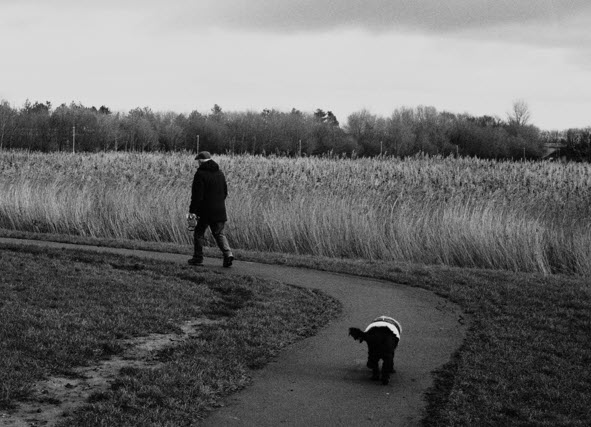
Even in her arthritic state, Daisy relishes their daily walk – nose to the ground, intently sniffing clover, dirt, thistle, and weed. An amalgam of scents blossoms into a bouquet of memories. Daisy responds with a spritelier gait, bringing a slow smile to her master’s face.
They end up where they always do – by the open farms and fields near their house. He unleashes Daisy and gives her free reign, but she never strays too far from his side. When they return home, he slips Daisy an extra half dose of pain medication to make her sleepy and tells her to lie down. She trots to her bed beneath the bay window in the living room, curls up contently, and closes her eyes.
He watches her until she falls asleep; at this point, he rises from his recliner, walks over to her quietly, gets on his hands and knees, kisses her on the head, and begins sobbing. The sound of his grief catches him off guard, and he immediately tries to suppress it, triggering his shoulders to tremble and quake. Daisy takes a deep breath but, to his relief, never opens her eyes. She’s everything to him.
He struggles to his feet and to compose himself before texting his sons to come to the house at 5:30 PM – ending the message with “It’s important.” Then, he tapes a brass key to a piece of paper torn from a legal pad, labels it Safety Deposit Box 347, and places it on the living room chair next to Daisy’s bed.
A few weeks back, he penned his wishes for Daisy in a letter addressed to his sons and placed it on top of the legal documents, trinkets, and keepsakes in that box. In the letter, he explains the reasoning behind his decision. He asks his sons to take good care of Daisy, keep with her routine as best they can, and, most importantly, walk her daily in the farms and fields by the house.
After reading his own words that day, he felt assured and comforted. He locked the box, put the key in his pocket, and walked out. As he passed the security officer guarding the vault, he winked and whispered, “Mission accomplished.”
With Daisy fast asleep, he walks into his office, sits in his chair, presses the sticky note onto the corkboard, retrieves a revolver from the desk drawer, puts the barrel to his temple, and pulls the trigger – never hesitating – not even for a second.
His actions played out gracefully, like a choreographed dance that he’d practiced in his head for months.
Daisy wakes momentarily to a sharp and unfamiliar popping sound. She raises her head and sniffs inquisitively at the burnt powder scent wafting above her. She looks around the living room and then towards the den and office. The door is closed. She whines for a bit before dozing off to the familiar sounds of home – the low hum of the refrigerator, the ticking clock in the living room, and the occasional knocks and pings from the furnace.
She opens her eyes a few hours later to two young men crying and cross-legged on the floor in front of her bed. She thumps her tail slowly, still under the effects of the medication.
They lean over in tandem, hug her, and tell her everything will be OK.
When Bill sees Natalie parking across the street, he opens his car door to the cold backhanded slap of winter. “Fucking freezing“ he mumbles to himself. He steps onto the asphalt of the parking lot, pulls a pack of Marlboros from his coat pocket, and smacks it against his palm like he’s in a Tarantino flick.
Through the smoke, he studies the gathering mourners in long black coats and winter scarves, their low conversations demonstrated only by bursts of breath that quickly dissipate in the crisp January air.
He looks up at the sky. “Solid turnout, Matty … respectable for sure.”
Strategically hovering on the outskirts of the steadily growing crowd, Bill plots his entrance to coincide with Natalie’s. It’s been three years since he left her un-kissed on her parent’s doorstep, clutching that night’s carnival winnings, a plush multi-colored parrot, sobbing uncontrollably.
Several months later, Bill understood the horrible mistake he had made. He tried to win Natalie back for the next year and a half, but she refused to let him back into her life.
Matt’s death shook Bill to his core, and yet, almost immediately, his thoughts turned to Natalie. Ashamed, he wondered what it would be like to see her at the wake. Matt would have found his chagrin darkly amusing, the type of reaction that would have led to an entire afternoon of delving into the complexities of the human condition and intricacies of love, death, opportunity, and loss.
Bill imagined how that scenario would have unfolded. He would have said, that’s what love does to a person and Matt would have nodded, lit cigarette in hand, a wry smile on his face, and replied with one of his Mattyisms:
Love is a fork in the garbage disposal.
Bill takes one last drag, tosses the half-smoked Marlboro to the ground, and grinds it out with the toe of his shoe. He heads slowly towards the line forming at the funeral home entrance while watching Natalie cross the street in his peripheral vision.
Nat steps onto the sidewalk gracefully, and Bill falls into step alongside.
“Hey,“ he says, slowing in hopes of an embrace.
“Hey,“ Natalie says, her voice cool.
“Hey,” he says again, dumbly mesmerized by the combination of her bright beauty and profound sadness.
Natalie catches Bill in mid-stare. “Are you okay?”
Bill sputters. “Huh? Oh. Sorry. Yeah, I’m okay. You?“
“Actually, I’m the opposite of okay,” she says quietly.
“That’s true, you’re a knockout,”Bill says and almost immediately regrets his attempt to lighten the mood.
“Excuse me?” Now she stops, rounding on him.
Bill holds up his hands defensively.“The opposite of OK – KO – Knock Out.”
“Seriously? You’re hitting on me right now? Here?”Natalie shakes her head, but there’s a hint of amusement beneath her veneer of sadness.
They fall into the line of mourners, shuffling along a few steps at a time.
“How are your folks?” Bill asks sheepishly, hoping to at least get back to an informal conversation.
“They’re fine; I’ll tell them you asked.” Her sarcasm shatters Bill’s hope like a bullet through candied glass.
By the time Bill and Natalie step into the funeral home, an awkward silence has set up camp. For the next 30 minutes, it’s mostly just quiet nods to other attendees until they find themselves next in line to pay their respects.
As the couple in front of Bill finishes their prayers, Bill quietly panics. Should he accompany Nat to the coffin or hang back and respect her privacy? The couple stands, and the man and woman each briefly place a hand on Matt’s casket before proceeding to the receiving line.
Natalie looks at Bill, but he’s unsure what it means. He offers his hand, which she takes gently, and they approach Matt’s casket together.
They can feel the stares from around the room. Their break-up three years ago was big news to their small community, so this public reconciliation (if that’s what it is) generated some buzz.
Though Bill had imagined Matt’s wake as an opportunity to reconnect with Nat, he hadn’t envisioned what would happen afterwards. It would all depend on how Natalie responded, and up to this point, it had been primarily awkward silence. He didn’t know how to get a beat on what she was feeling.
As soon as they kneel, Bill bows his head and whispers, “Listen, I can’t begin to tell you how sorry I am. I don’t know what the fuck I was thinking about that night.”
“Suzy,” Natalie mutters flatly, head also bowed.
“What?”Full of confusion, he risks a sidelong glance.
“You said you didn’t know what you were thinking about. Fucking Suzy is what you were thinking about – literally. I figured it out when you started dating her the week after you dumped me.”
Bill swallows, another Mattyism springing into his mind like a jack in the box: The truth has a way of shooting you down and shutting you up.
Matt would have enjoyed this exchange for several reasons: He would have loved that instead of praying at his casket (Matt was a devout atheist) they were trying to work out their shit. And he would have reveled in knowing his wake provided Bill and Nat a venue for reconciliation (if that’s what this is). As he’d been fond of saying, Wakes are for the living.
“You’re right, Nat, and I’m sorry I ambushed you today. I’m lost without you. I’m just stumbling through this.”
After a few more quiet seconds, they both turn to look at a framed picture on the table behind Matt’s casket. Taken at a high school graduation party, Matt is center in the picture. But just over Matt’s right shoulder: Bill and Natalie. They’re holding hands, Nat is smiling at Bill, and they all look at ease and happy.
“That was us,” Nat says, pointing to the picture. Tears fall down Bill’s cheeks as he registers everything he’s lost.
Matt was right; wakes are for the living.
Bill and Natalie stand up together. Bill’s hand brushes the back Natalie’s hand, and she pulls away reflexively, looking at him deeply and shaking her head.
They move through the receiving line of hugs, tears, and warm laughter before going their separate ways.
Maggie discovered her husband at the bottom of the basement stairs – his body contorted, eyes wide open and empty of light.
She remembered hearing a tumble and thud in the middle of the night, waking momentarily before dismissing the sound as a fleeting element of a fading dream.
So, Maggie went back to sleep.
She was so startled by her early morning discovery she almost fell down the stairs herself. Now she stood frozen in the doorframe, unsure what to do.
She nervously fumbled around the pockets of her bathrobe for her phone while staring down at the strangely twisted body of the man she had spent 30 (mostly good) years with.
The gravity of her loss rose from the soles of her feet, and she felt rubber-legged and lightheaded – she wretched suddenly and grabbed the railing to steady herself.
After a few deep breaths, she swiped the security code into her cell, opened the phone app, and stared absently at the number pad.
“Fuck” she whispered to herself.
Who to call?
If there had been any signs of life, this wouldn’t be a question. But the 911 emergency had passed — her husband was dead.
She dialed her son – but with no idea what she would say when he picked up, she panicked and hung up the phone on the third ring.
“FUUUUCK!” she screamed, her voice so loud she reflexively looked down at her husband to see if the sheer amplification had snapped him out of death. It hadn’t. However, her scream woke her dog, Molly, who she heard hopping off the bed upstairs.
Her phone rings.
It’s her son.
The confluence of Molly making her way down the stairs, her dead husband in the basement, and her son on the end of her ringing phone cause Maggie to burst out crying.
“Come on, Maggie, pull yourself together,” she says tersely before answering the phone.
“Mom, is everything OK?”
“No, it’s not.”
“I’m sorry I hung up on you!” now sobbing uncontrollably.
“Mom, what’s wrong!!??”
“Your father fell down the stairs. I think he’s dead.”
She knew he was dead.
She wasn’t sure why she said, “I think he’s dead” – maybe she was trying to protect her son from what she was feeling – alone and adrift.
Was a fifteen-minute drive with false hope better than one with the hard truth?
There was a prolonged silence, followed by “I’m on my way.”
She still hasn’t found the courage to go to him. She’s still at the top of the stairs, and he’s on the cold basement floor.
Dotingly, Molly sits at her feet, wagging her tail softly, looking up at her and seemingly wondering, “Why are we standing in the doorway?”
She pats Molly gently and says sadly, “Daddy’s gone.”
Her moment with Molly evaporates in the sudden crunch of car tires on a gravel driveway – a car door slams, followed by an urgent knock on the front door.
She glances again at her husband before heading to the living room with Molly in tow.
“He’s never going to leave her,” she whispers into the mirror before peeking from the bathroom to the bed, the rise and fall of tangled bedsheets, and the messy truth of her life.
Three years of skulking around hotels and motels in towns miles from where she and her dirty little secret lived their other life.
The sex was great. There was no denying that. But three years in, Maggie wonders, “Would it be so great without all the secrecy – without the element of danger”?
“Probably not,” she says to herself.
“Fuck it – I’m done.”
She packs her overnight bag, gets in her car, and drives.
She never spoke to her married lover, landlord, best friend, or roommate. She drove west for three days – before settling in Jacksboro, New Mexico.
A fresh start.
A few months later, she landed a job as a technical writer at zDeck, a fast-growing company specializing in patio design and architecture.
John graduated in 1987 with a Bachelor’s degree from New Mexico State.
He floundered in the sciences for a few years before settling on an English major – primarily because he enjoyed the classes. From American Short Stories to British Romanticism, he connected with the content – it prodded him to think and broadened his perspective on life and human nature.
Maybe all those stories and poems (and the characters that inhabited them) were a welcome distraction from his life.
“A degree in the humanities isn’t skills-based,” he recollects the words from his bemoaning father.
“It doesn’t give you the tools you need to make money!”
“You’re right, Dad, it doesn’t,” John remembers cavalierly responding to his father’s concern.
“But it’ll help me understand the human condition and navigate life’s absurdities- and I think that’s what I need right now.”
John rarely thought ahead. Not because he didn’t see the value, but because he never acquired that skill – he never observed his parent’s “planning” when he was growing up, the consequence of a disengaged alcoholic father and a mother struggling to keep herself and her family afloat.
In John’s childhood, there was no long view. Growing up was day-to-day.
After graduating, John fell into technical writing, “like a blind man into a quicksand pit,” he warned his son years later when counseling him on the importance of “having a plan.”
In the late 80s and early 90s, technical writing wasn’t specialized (or all that technical)– if you could write, you were a candidate – and John could write.
He was bright, creative, quick-witted, and had an innate way with words.
Everyone who came to know John liked him – almost immediately, it seemed.
Maggie remembers when she met John at zDeck in 1989.
It was John’s second day on the job. Maggie sat at the breakroom table, daydreaming over a cup of coffee and playing with a sugar packet, when he walked in – lunch bag in hand – a nervous smile on a handsome face.
“Hey,” she nodded at him.
He responded kindly with a “Good morning,” opened the refrigerator, and deposited his lunch.
“I’m Maggie, by the way.”
“Hi Maggie-by-the-way, I’m John.”
She smiled, bit her lower lip playfully, and thought, “Hmm, this could be fun.”
Maggie, casting the sugar packet aside, “So, how do you like zDeck so far?”
John, happy to engage:
“So far so good. I’m still learning the ropes. They have me in training this week and next.”
Maggie, smiling: “Ahh… Inkslinger training . . . I remember it well.”
John, somewhat surprised:
“You’re a writer? Tell me – and be honest – what am I in for?”
Maggie, without missing a beat:
“Humiliation, mostly.”
“Ha!” John responded with delight at both Maggie’s response and the natural rhythm of their conversation.
Maggie pushes up from her chair and starts towards the breakroom door. She feels his gaze on her back, looks over her shoulder, and says, “Good luck with training; I’ll see you around.”
“See you around, Maggie-by-the-Way.”
In 3 years, they were married.
Thirty years later, John still referred to his wife endearingly as Maggie-By-the-Way.
Maggie opens the door. Her son stands and stares for a second.
“Where is he?”
Maggie turns towards the open door leading to the basement.
Her son brushes past her and walks tentatively towards the lit doorway – slowing his pace considerably as he gets closer.
When he reaches the doorway, he leans in, bends, turns his shoulders slightly, and peers down the stairs.
Molly remains at Maggie’s feet, quizzically looking across the room at the son and then back up at Maggie, wondering what was happening.
“Did you call 911?” the son asks solemnly – never looking back towards his mother, eyes red and fixed on his dead father.
“No, I haven’t.”
The son takes the cell phone from his coat pocket and taps the screen.
“911, what’s your emergency?”
“My father fell down the stairs – I think he’s dead.”
“Is he breathing?”
“No.
It looks like he broke his neck” – the son begins to cry.
“He’s dead. Can you please send someone.”
John feels the pervasive drop in temperature. It envelops him and pries him from his sleep.
The pilot light’s out again, he thinks to himself.
He sits up and looks over at Maggie – dead to the world. John muses to himself, “She could sleep through a hurricane (and an ice age, apparently),” and smiles in her direction.
He slowly swings his legs over the side of the bed, puts his feet on the cold hardwood floor, and stands.
Molly is tucked cozily in the crook of Maggie’s legs. Sleepy-eyed and content, she raises her head slightly, looks at him and wags her tail quietly.
“I got this girl; you go back to sleep,” John says to her as he heads downstairs.
The light above the stove dimly lights the kitchen. John opens the junk drawer and pushes aside pens and pencils, loose batteries, and an opened pack of note cards before finally finding the matches. He suddenly feels lightheaded and grabs onto the kitchen counter.
“Christ,” he says to himself.
He’s been having these spells for a few weeks now but puts off calling his doctor.
The dizziness passes; John stuffs the matches in his pajama pocket, walks to the door that leads to the basement, opens it, and takes a step.
John’s second dizzy spell inhabits his last vestige of conscious thought. It’s followed by the sensation of twisting and falling, momentary weightlessness, and a sharp crack of pain when the base of his neck meets the unforgiving edge of the fifth step on the basement stairs.
A bright burst of white light and a buzzing electric sound is followed immediately by complete blackness.
And just like that, John, sixty-two years old and newly retired, was gone.
The paramedics – a young man and a woman – arrive 5 minutes after the 911 call.
Maggie meets them at the front door.
“Hello, mam. Did you call 911?”
“My son called – but it’s my husband – he’s fallen – he’s at the bottom of the basement stairs.”
Maggie becomes lightheaded at the words, “he’s at the bottom of the basement stairs,” – and the paramedic reaches out to prevent her from falling.
Years later, Maggie would look back and wonder how eight words strung together could illicit such a strong physiological response.
“OK, mam, come sit with me.”
The woman paramedic slow-walks Maggie to the sofa while the other heads across the living room to the basement stairs, stopping suddenly at the doorway (like there’s an invisible forcefield) before proceeding to the basement.
About 30 seconds later, he’s on his phone – his words float up to the living room:
“Yeah, it’s Bill – we need the coroner at 77 Merton – yeah, looks like a fall – yes – male, about sixty, I think – Yes, his wife and son. Got it – OK – Thanks.”
Maggie and her son are still on the sofa when the paramedic comes up from the basement – they look at him, and he meets their eyes – he’s tight-lipped and pale. Maggie almost feels sorry for him – she wants to tell him, “It’s OK, you don’t need to say the words – we know he’s dead,” but she lets him speak.
“I’m sorry, mam, your husband is deceased. The coroner is being notified. He should be here shortly.” – this time, Maggie does not become lightheaded at the words – she feels her spine stiffen, and a sustained pulse of energy courses through her – emanating from the center of her chest to her limbs.
Maggie turns to her son, who suddenly seems wrecked and catatonic – like he’s been hit by the “everything-all-at-once” train. She slides towards her son, puts her arm around him, and pulls him close – he melts into her – he feels both heavy and empty on her chest.
The coroner arrives at 7:00 AM. By now, neighbors are waking to the flashing lights of the rescue squad and several official-looking vehicles parked haphazardly in front of 77 Merton Road.
Maggie gazes out her living room window towards her best friend Gail Green’s house.
Gail stands on her front porch, swaying while holding her coffee mug with both hands, worry draped on her face. Maggie wants to text her, but she’s unsure if that would be a breach of protocol.
After several minutes, Gail turns slowly and heads back into her house.
The coroner has been with John for nearly 20 minutes, and Maggie starts to feel anxious – then the male paramedic, who has been with the coroner, comes up the stairs.
“Mam, the coroner wants to know if you want a few minutes with your husband before we take him to County General.”
Maggie isn’t sure how to respond. She looks to her son for advice, and he nods approvingly.
“Can my son come with me?”
Maggie and her son walk down to the basement – John’s body is no longer on the floor. Instead, he’s tucked into a thick plastic body bag on a gurney, with only his chest and head exposed.
Maggie leans over and kisses John. His forehead feels like a cold stone on her lips. Maggie’s son stands behind her – head bowed – tears streaming down his cheeks.
Maggie turns to the coroner and asks if she can have the wedding band from her husband’s finger before they take him away.
“Of course. Can you give me a minute alone with your husband?”
Maggie and her son walk to the other side of the basement where John kept his workshop.
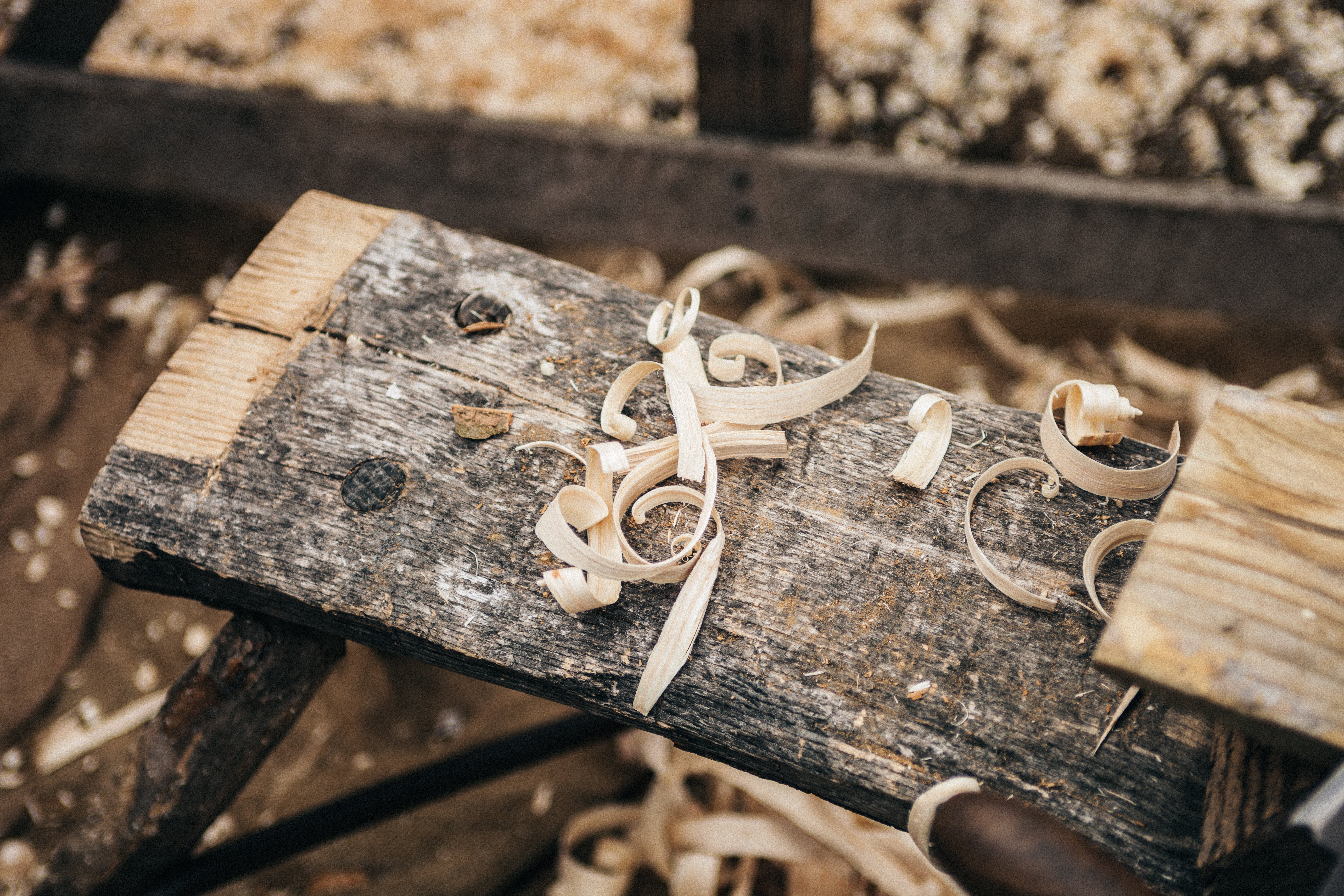
There’s an unfinished project – a repair to the rocking chair that John gave Maggie before the birth of their son – the entire workshop is infused with the comforting smell of wood shavings and varnish, which feels inherently nostalgic in John’s absence.
Maggie takes her index finger and traces the floral engraving on the rocking chair’s headpiece – the day’s events wash over her as she slips between a daydream and a trance engulfed in sepia-toned memories of her and John, young and vibrant, asleep in their bed, arguing across the kitchen table, crying while holding one another and laughing hysterically, at what she’s not sure. The memories play like a tattered and jittery home movie in her head.
With Maggie and her son distracted, the coroner reaches into the body bag and carefully extracts John’s arm, resting it respectfully across his chest. He proceeds to remove the wedding band. It takes some effort, as rigor has set in. With the ring off, the coroner gently twists John’s wrist so that his palm is facing upward – his arm still resting on his chest. He places the wedding band on John’s palm so that it looks like John is presenting it as an offering.
“Mam, you can come back now.”
Maggie and her son stand over John silently.
Maggie looks at the coroner with deep appreciation for his kindness – he nods and steps away from the gurney, disappearing ghostlike from the grieving wife and son.
Maggie gently takes the band from her husband’s hand, holds it close to her face, and reads the inscription.
Enjoying every day with Maggie-By-The-Way – 1992
She closes her hand tightly around the ring and smiles.




 bendingtheneedle