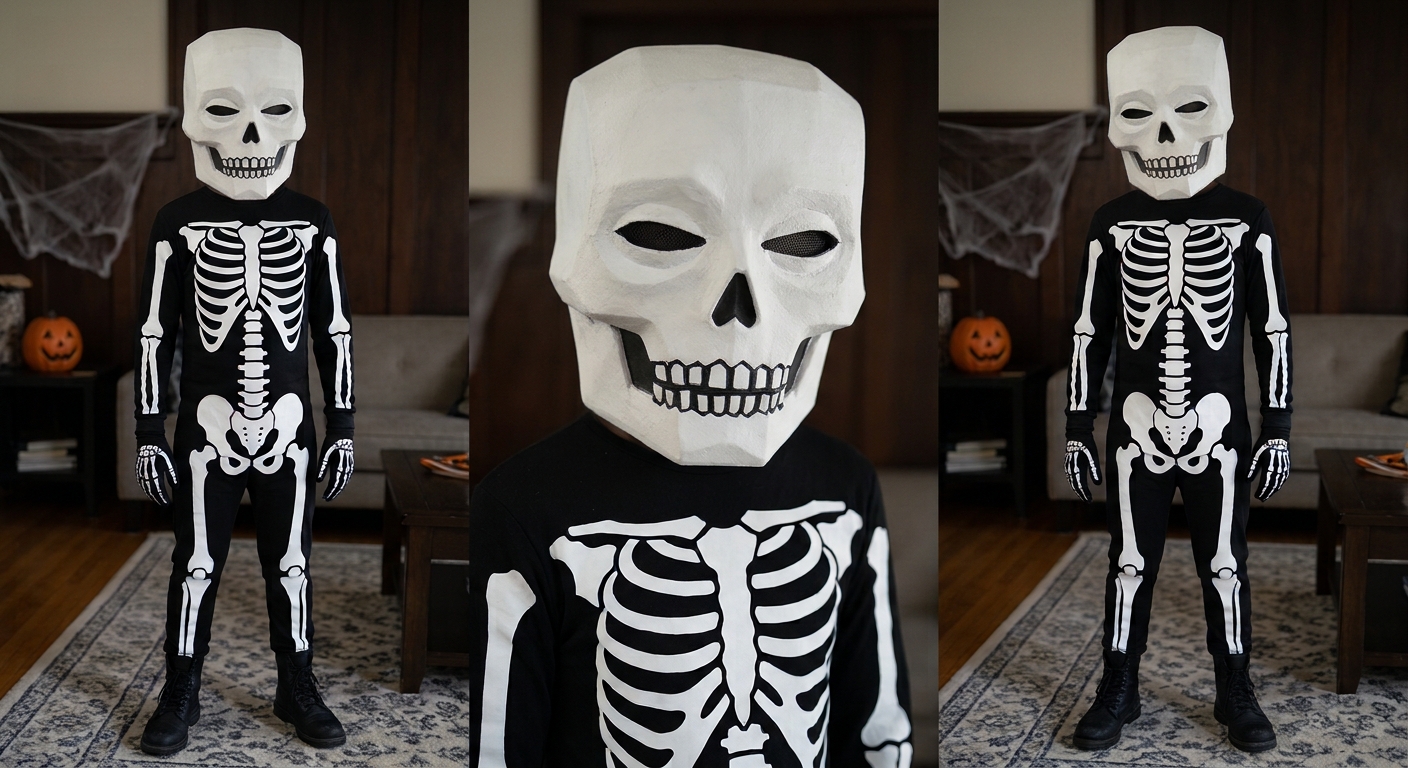
What am I looking at”? The bewildered president of sales stares at a costume display mounted on an easel.
“Well, sir, it’s a skeleton.”
The president’s relaxed fingers form a fist. “I’m not a moron – I see it’s a skeleton – I know what white bones on black nylon represent – but there’s something a little off, and I can’t quite put my finger on it.”
“It’s a Down syndrome skeleton, sir,” the sales rep responds with a misplaced confidence that momentarily stuns the room to silence.
“A what?”
“A Down syndrome skeleton, sir.”
The rep continues, “We had our design team flatten the face, adjust the eye shape, the whole thing. We wanted customers to know immediately that it’s a Down syndrome skeleton.”
“Please stop saying the words ‘Down syndrome skeleton,'” the president says, stiffening his back. He looks at his secretary, whose eyes remain glued to her legal pad, then scans the room for hidden cameras before slowly redirecting his gaze to the sales rep.
“Are you fucking with me, son?”
“No, sir, I’m not.”
In between a sneer and a laugh, the president asks, “What in God’s name makes you think this is sellable? Seriously, who convinced you to pitch this?”
“My son, actually,” the sales rep replies, reaching into the breast pocket of his blazer.
He takes a few steps towards the president’s desk and hands him a photo.
The president gazes at the picture, then looks back at the man, then back at the picture, like he’s verifying a passport.
“Listen, I’m sorry for your situation and all, but this is not a good idea.”
“Why not?” For the first time since commanding the room, the salesman sounds indecisive.
“Because the shitstorm created by your little skeleton costume would put me out of business – that’s why.”
“Listen, I’ve occupied this chair for over two decades.” The president pats both armrests firmly. “I’ve learned a few things, and I’m telling you right now, ain’t nobody gonna buy what you’re trying to sell.”
“Parents of kids with Down syndrome might.”
There’s a slight pause before the president says matter-of-factly, “Sorry, I just don’t see a market for your skeleton.”
The salesman smiles warmly, “Respectfully, sir, I doubt you’ve ever considered such a market.”
Before allowing the president to respond, the salesman continues, “There are over six million people in the United States with an intellectual disability. There are thousands of schools, support organizations, and families.”
“I don’t have any reason to dispute your numbers, but the fact of the matter is, some people will accuse us of exploiting disabilities, and we can’t risk the fallout from that.”
“Or, the salesman raises his finger, “They’ll praise you for finally acknowledging they exist.”
“I know this is a tough sell, but hear me out.” The salesman relaxes his posture.
“Last Halloween my son wanted to be a skeleton. He looked at the costume package and asked me why none of the faces looked like his.”
The president allows him space to continue.
“My son knows he’s different. I can see it in his interaction with others, and he can feel that difference in his bones (the salesman and the president chuckle at the phrasing).”
The sales rep continues, “This simple idea humanizes him and others like him.”
The secretary reaches for a tissue and wipes a tear from her eye.
“Oh, for Christ’s sake, Margaret!”
“Here’s what I’m gonna do,” the president turns from his secretary to the sales rep, “I’ll talk to our marketing team and have them put together some concept testing. If they see a market, I’ll get back to you. OK?”
The president stands, gives the photo back to the salesman, and extends his hand.
“Fair enough.” He takes the photo, shakes the president’s hand, and walks out.
On the street, the salesman crumples the photo and drops it into the first trash can he passes. He’s got eleven more just like it in his briefcase.
He smiles, takes out his phone, dials, and waits.
“Yeah, it’s me. He bought it. He’s gonna push concept testing. One down, eleven manufacturers to go!”
“Meet me at Barney’s for Drinks?”
Barney’s afternoon crowd hums, fueled by ambition and booze.
The salesman turns to his colleague, “We need to strike while the DEI iron’s hot, because once the country’s new president takes office, retards are back to being retards – that mutha-fucker is stone cold.”
His colleague winces at the language; the salesman finishes his scotch with a gulp and sets the glass down on the bar, loud enough for the bartender to know he wants another.
The colleague chimes in, “I don’t know, Bill; I’m starting to get a bad feeling about your skeleton.”
“What the fuck are you talking about, Hal?”
“This is a win-win. We’re doing the right thing societally (that’s still a thing, right?) – we’re padding our bank accounts, AND we’re helping downsies feel better about themselves. So, actually, it’s a win-win-win – 3 Ws! – When’s the last time you had 3 Ws on any fucking thing, Hal? Never, that’s when! Have another on me,” he motions to the bartender.
Bill was known company-wide for burying people verbally to get them to agree or simply wave the white flag – it didn’t matter which.
Having a conscience and drinks with Bill was always exhausting. But Hal was close enough professionally and personally to push back. He emerges from Bill’s verbal assault: “But why the fake Down Syndrome son story? Why not pitch the skeleton costume without the pictures?”
Bill stares at Hal like a village elder about to dispense pearls of wisdom. “The pictures are the hook, Hal. Without a hook, we’re just hungry fishermen.” He gets up and heads out of the bar, leaving Hal staring at his bourbon.
Bill studies his whiteboard calendar while kneading a stress ball labeled “Squeeze me Bitch”. Three months had passed since concept testing his Skeleton costume, which exceeded all expectations. Three manufacturers had signed licensing agreements. Two more were negotiating.
Bill checks his watch, spins towards his office door, and springs out of his seat. He walks down the hall to the conference room, several minutes ahead of his meeting with another major retailer. Through the glass wall, he watches a focus group wind down.
The moderator thanked everyone for participating.
Smiling parents gathered their notepads and personal items. Children ran toward the snack table.
One boy lingered. He couldn’t have been more than ten.
He was holding one of the prototype costume packages.
Bill had sat in on several of these focus groups, and he just wanted to get into the room and prep for his meeting. He barely noticed the boy until he heard the moderator ask, “So what did you think?”
The boy looked down at the package and shrugged.
Then he smiled.
“He looks like me. Just a little.”
The room went quiet.
“I never knew a skeleton that could look like me.”
The moderator smiled warmly and quietly scribbled on his clipboard.
Bill couldn’t stop staring.
Some data points hit harder than others.
Inclusion wasn’t something this boy woke up thinking about, and he certainly wasn’t tuned into any “movement” or “cause.” He didn’t care about representation, DEI politics, or market opportunities for multinational retailers.
In that moment, he was happy because, for the first time in his life, something in the world mirrored him.
A simple thing.
A silly thing.
A skeleton.
With a hand on his shoulder, the boy’s misty-eyed mom guides him toward the exit. She looks over her shoulder and mouths “thank you” to the moderator.
As they pass, the boy waves at Bill through the glass.
Bill lifts his hand instinctively, still holding the “Squeeze Me Bitch” ball, which he drops immediately as he smiles back at the boy.
Then they were gone.
Bill enters the conference room quietly, feeling a little untethered. The room suddenly feels more vital than before.
For his entire professional life, Bill swam in the transactional waters of sales and marketing, where “moral” causes were rarely the prime objective, but more often than not, a matter of happenstance. His money-first philosophy made him rich.
Alone in that fishbowl of a conference room, Bill found himself thinking about the months spent calculating the value of his Down Syndrome skeleton, without ever considering its worth.
The distinction agitated him.
He thought about the crumpled photographs.
The fake son.
The fabricated story.
All those expressions of false sincerity rehearsed late in the evenings in front of his bathroom mirror.
Bill struggles to reconcile the countless hours spent building the machinery around a meticulously calculated lie with a boy’s genuine, achingly real smile.
He catches his barely visible reflection in the glass wall and almost doesn’t recognize himself.
As his company’s top salesman, he starts to wonder if everything that goes into selling something successfully hasn’t somehow blinded him to what truly matters.
His phone buzzes.
A text from Hal.
Three more manufacturers interested! Drinks at Barney’s tonight?
Bill looks at the message.
Then at the empty hallway.
Then back at the phone.
After a long moment, he types:
Not tonight, I got a thing.
He sets his phone face down and sits in silence until he hears the muffled voices of his meeting approaching the conference room.
The clients amble in, and for the first time in his career, Bill is at a loss for words.
If you haven’t had a chance yet, please check out my book, My Paper, My Words: Rantings from a Progressive Boomer and Peeved Parent, from Amazon. And if you feel moved to write a review of the book, on Amazon, or anywhere else, I’d be honored.
My Paper, My Words is a collection of essays, stories, and poems that reflect the challenges of a middle-class husband and father trying to navigate a rapidly changing political, religious, and technological landscape of post-911 America.
Also, check out my AI music project, Sapient Rain, a human–AI musical collaboration. Sapient Rain’s music blends political fire, surreal storytelling, and nostalgic autobiography, delivered through lyrics that read more like literary vignettes than conventional songcraft.
You can listen to Sapient Rain songs on Spotify, YouTube Music, and Apple Music.
You can also listen to Sapient Rain songs for free on Suno.


