We cannot be afraid to speak at what is being done Trump’s a bully and freak who wants to shock and stun With fascists in our government, this isn’t a dry run And so, we have a song to sing, a song that must be sung
GO!
Neo-fascist-oligarchic-expialidocious Elon-Bezos-Zuckerberg are really quite atrocious We need to fight them in the streets and call them on their grossness Neo-fascist-oligarchic-expialidocious
On 02/26/26, the single “Neo-fascist-oligarchic-expialidocious” from the album “Wounded” comes out on Spotify, Apple Music, YouTube Music, and iTunes under the artist profile “Sapient Rain.”
Sapient Rain is the artistic collaboration of writer/lyricist Geoffrey Reilly and the AI music engine Suno.
My Paper, My Words is a collection of essays, stories, and poems that reflect the challenges of a middle-class husband and father trying to navigate a rapidly changing political, religious, and technological landscape of post-911 America.
News is now tribal with no true reporting FOX is the bible a church for consorting Where lies lead to lust for the ignorant masses gaping and raping in their Eva Braun glasses
Troubadour tribesmen of white patriarchy pied-piping pitchmen for the new oligarchy Putin has puppets Elon and Don a triad of hatred running a con
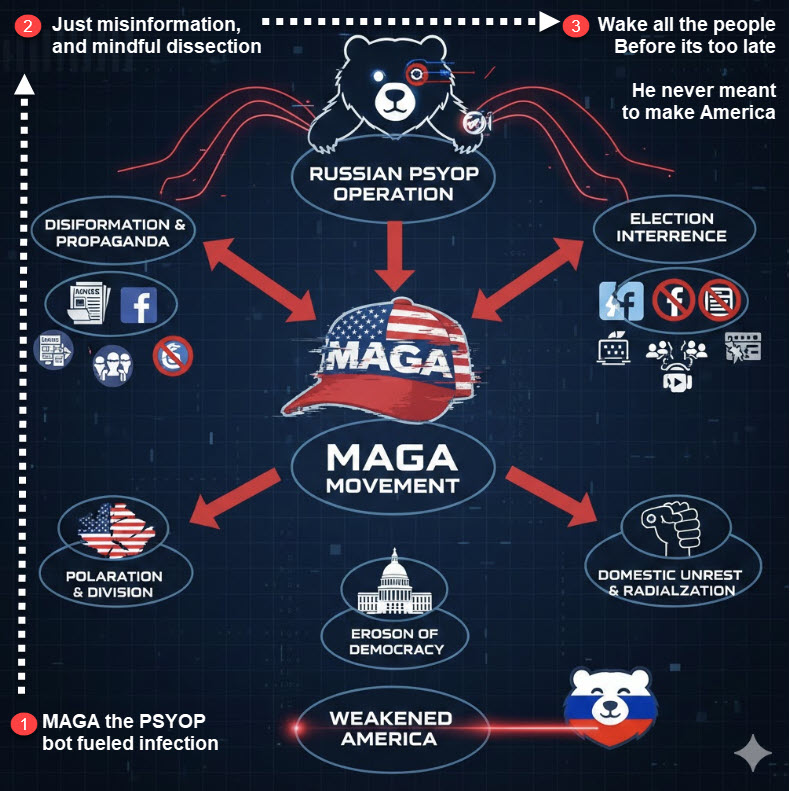
MAGA the psyop bot fueled infection, just misinformation, and mindful dissection Wake all the people Before its too late He never meant to make America Great
On 02/26/26, the single “MAGA The PYSOP” from the album “Wounded” comes out on Spotify, Apple Music, YouTube Music, and iTunes under the artist profile “Sapient Rain.”
Sapient Rain is the artistic collaboration of writer/lyricist Geoffrey Reilly and the AI music engine Suno.
My Paper, My Words is a collection of essays, stories, and poems that reflect the challenges of a middle-class husband and father trying to navigate a rapidly changing political, religious, and technological landscape of post-911 America.
Sapient Rain is a human-AI partnership between lyricist Geoffrey Reilly and the AI music platform Suno.
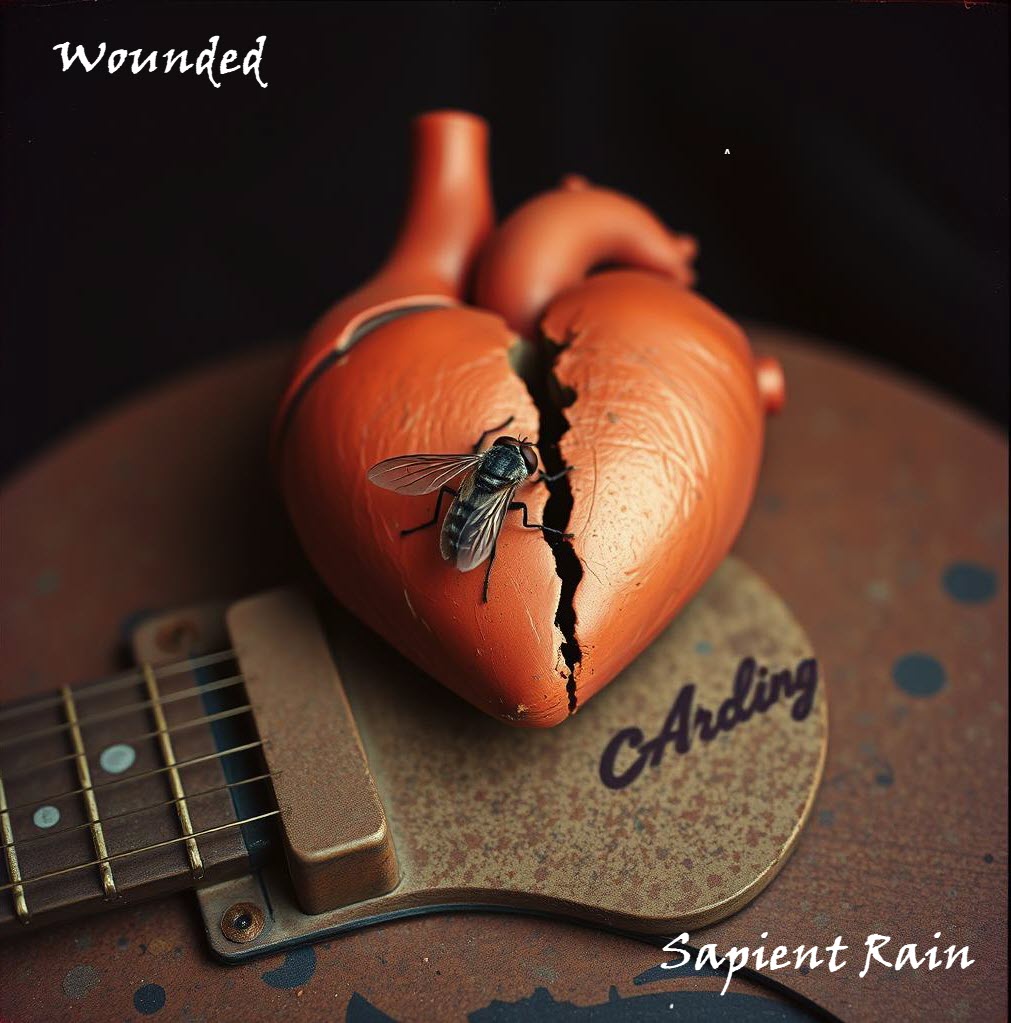
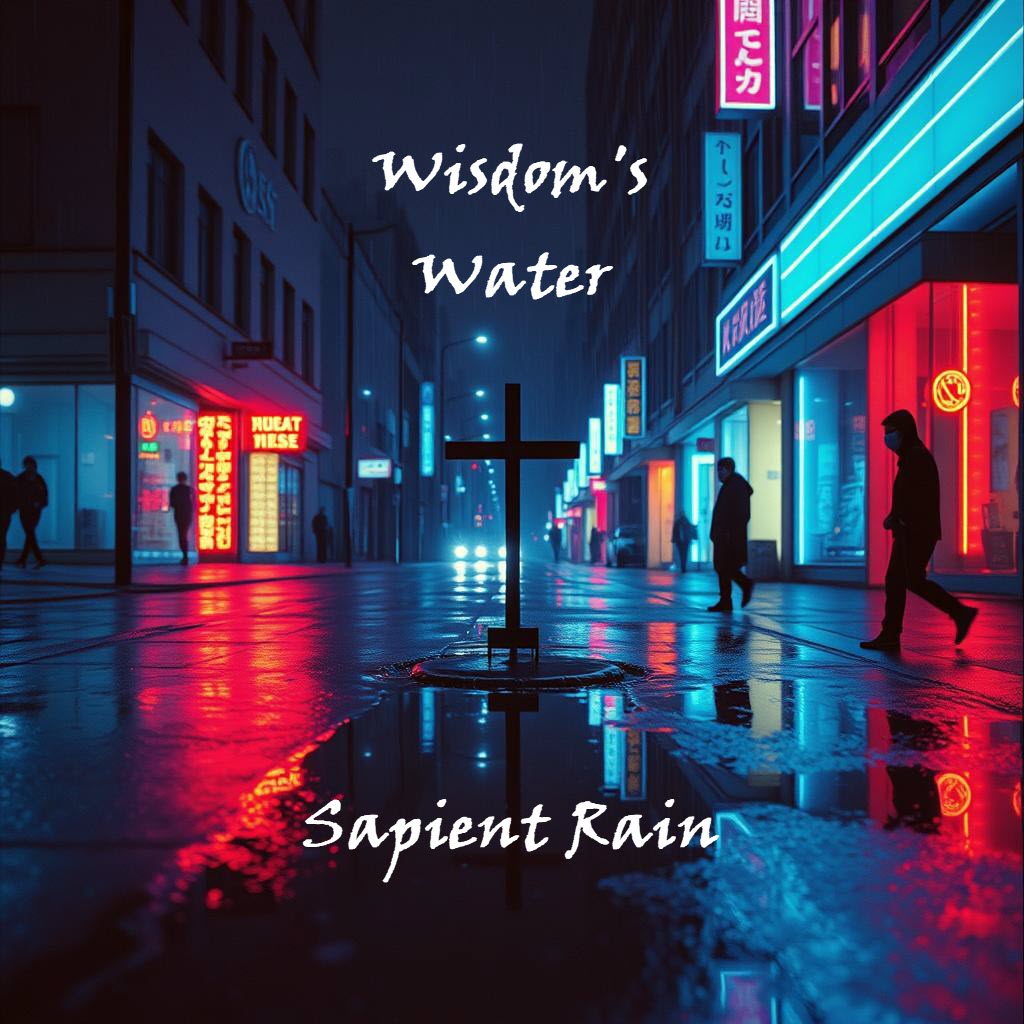
“Wounded,” the follow-up to Sapient Rain’s debut release, “Wisdom’s Water,” presents an eclectic collection of songs spanning musical genres, from rockabilly and grunge-inflected bangers to melodic country western ballads.
Reilly’s lyrics focus on individuals wounded by love, depression, and the whims of demented, power-hungry authoritarians. Suno’s AI-generated music (thoughtfully procured by Reilly) amplifies and transforms the lyric imagery into immersive soundscapes that feel firmly rooted in the times we are living.
My Paper, My Words is a collection of essays, stories, and poems that reflect the challenges of a middle-class husband and father trying to navigate a rapidly changing political, religious, and technological landscape of post-911 America.
Did any “Christians” at the Prayer breakfast call out the President of the United States for his shameful statements and treatment of immigrants in America?
In between pancakes and coffee, did anyone speak to the hypocrisy of Donald Trump attending the event, considering his well-documented dishonesty, vindictiveness, and unrepentant sexual immorality, or was there just a hushed acceptance of this “flawed man”?
Did any of the “Christians” in attendance voice their concerns about the Trump administration’s cutting of USAID, which will lead to millions of deaths by 2030?
Did those in attendance lend support and prayer for marginalized people, and justice for young girls trafficked and abused by the rich and powerful, as documented in the Epstein files?
Seems like a prayer breakfast would be the perfect place for talking about all these things.
From what I’ve read, rather than promoting unity, spiritual reflection, and reconciliation, the Orange Ayatollah of Ice Brigades and Sexcapades turned the once venerated event into a boastful campaign rally brimming with self-promotion and partisan political attacks. Like every other institution he encounters, the president torched norms and obliterated traditions, while religious bigots in attendance bowed down to their true king.
One thing about Trump you can’t deny: there’s very little subterfuge when it comes to his bigotry, vindictiveness, and hate. And his unvarnished take on anyone who defies or challenges him has laid bare the true morality of his religious base, who have revealed themselves as people who care more about power and control than grace and humility, who want to subjugate and dominate, and who would sooner punch you in the face than turn the other cheek.
The National Prayer Breakfast is a National Farce. What used to be a bipartisan and unifying event has become a partisan pigpile, obscuring the event’s original, inclusive, ecumenical nature.
Examples:
President Trump used the breakfast to criticize political opponents, claiming they “oppose God and religious freedom.”
He also used the platform to attack political enemies along religious lines, turning the event into a partisan stage rather than a shared spiritual gathering.
Trump mocked Democratic lawmakers and questioned why “people of faith would ever vote for a Democrat,” despite the event’s bipartisan leadership.
Trump’s rhetoric excludes Christians who refuse to align themselves with the undeniably Christian Nationalist identity of the MAGA movement. Through words and actions, the President continues to make a mockery of Christianity, and that mockery gets amplified by conservative Christian leaders who to turn a blind eye to Trump’s amoral behavior.
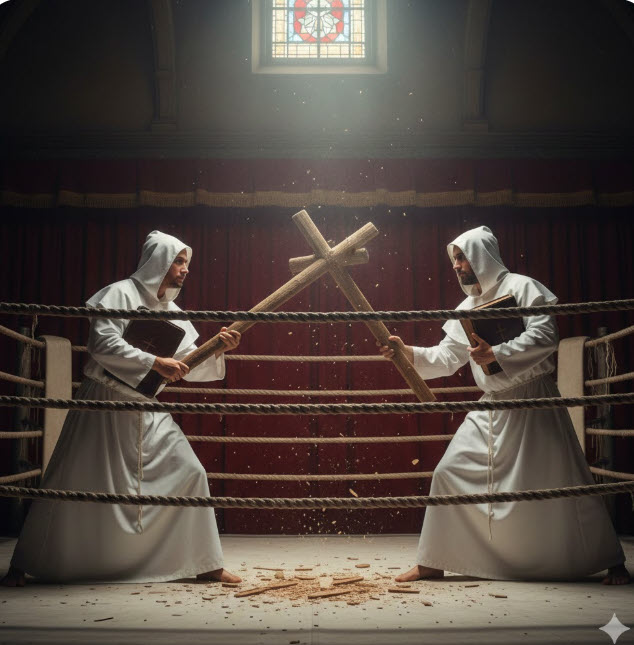
The quote “When fascism comes to America, it will be wrapped in the flag and carrying a cross” describes perfectly what occurred at this year’s National Prayer Breakfast and what’s happening in America today. The president’s remarks are indicative of the dangerous merger of nationalist demagoguery and religion.
How long before Christianity in America undergoes a full-blown sectarian split?
As America struggles to maintain Jefferson’s wall of separation between church and state, Atheists, Agnostics, and religiously unaffiliated need to unite behind the version of Christianity that promotes kindness, empathy, and love.
My Paper, My Words is a collection of essays, stories, and poems that reflect the challenges of a middle-class husband and father trying to navigate a rapidly changing political, religious, and technological landscape of post-911 America.
Writing today to gently remind you that Wisdom’s Water, my poetic / lyrical collaboration with the AI Music platform Suno, drops on Spotify on February 12th, 20026.
I had a blast crafting the lyrics and working in Suno to select the most suitable musical vehicle for my words and feelings. I’m inspired by all of the artists and citizens speaking out and protesting in defense of our democracy, which we are in legitimate danger of losing.
Not all of the songs are protest songs, but many are. I hope you download, stream, and share them with friends and family. And I hope you enjoy listening to them!
I created an artist account on Instagram and have been posting snippets of tracks from Wisdom’s Water. Feel free to follow the artist profile at https://www.instagram.com/sapientrain/
Here is a little taste of Wisdom’s Water from Sapient Rain:
My Paper, My Words is a collection of essays, stories, and poems that reflect the challenges of a middle-class husband and father trying to navigate a rapidly changing political, religious, and technological landscape of post-911 America.
You can judge a nation’s greatness by how it treats the marginalized in its communities and by whether it encourages kindness, tolerance, education, and scientific expertise. When America excels at these things, we are indeed a great nation. Under Trump, we are objectively regressing in every one of these areas, and today, many American citizens are afraid of their government, which is a tell-tale sign that we are drifting towards authoritarianism.
Truth, integrity, and character have not simply been relegated to the backseat of our democracy – it’s worse than that – they’ve been thrown out of the car altogether, and now that vehicle travels recklessly as a putrid vessel of Presidential self-interest and self-preservation.
When an unrestrained and morally decrepit leader of a powerful nation flaunts the rule of law, the rest of us, the citizens of that nation, get splattered and stained by the consequences of his messy and lawless decisions.
We are muddied and sullied by association, and our ability to disassociate ourselves from his sick, twisted, and purely transactional worldview is hampered by the chokehold he and his supporters have put on the systems of checks and balances designed by our founders to prevent such a person from rising to power.
My Paper, My Words is a collection of essays, stories, and poems that reflect the challenges of a middle-class husband and father trying to navigate a rapidly changing political, religious, and technological landscape of post-911 America.
Fascism and Oligarchy are familiar bedfellows that share several structural similarities, including the concentration of power, the suppression of dissent, the prioritization of ruling-class interests, and the erosion of democratic norms.
The repressive effect of fascism and oligarchy on citizens includes loss of political voice, economic inequality, reduced civil liberties, and social polarization. Horrifyingly, we’re seeing the effects of fascism and oligarchy in America today.
I understand the cynicism Americans feel around politics — and it is totally justified. But, to effectively fight the spread of fascism and oligarchy, we MUST participate in democratic processes, even when they feel imperfect. So, educate yourselves (and others), build cross-community solidarity, push for structural reforms, and stay connected and refuse isolation.
My Paper, My Words is a collection of essays, stories, and poems that reflect the challenges of a middle-class husband and father trying to navigate a rapidly changing political, religious, and technological landscape of post-911 America.
In these turbulent times, why don’t we have protest songs like we used to?
What cultural or sociological changes have made the protest song less popular?
Why Protest Songs Once Thrived
During the 1960s-70s, the economics and centralized nature of the music industry, combined with a shared identity amongst America’s youth (cemented by America’s role in the Vietnam War), provided fertile ground for protest songs to gain popularity.
In the America of the 1960s-70s, young, college-educated, middle-class Americans (a significant demographic) aligned with the counterculture, civil rights, and anti-war movements. This alignment allowed protest songs to find a home in the collective conscience of a generation of young Americans.
The conditions that led to the popularity of protest songs in the 1960s-70s included:
Mass movements: Civil rights and anti-war protests created collective spaces where songs unified crowds.
Limited media outlets: Radio and television amplified protest songs as rallying cries, giving them cultural dominance.
Shared identity: Songs like Bob Dylan’s “Blowin’ in the Wind” or Marvin Gaye’s “What’s Going On” became shorthand for generational values.
Why Protest Songs Declined
Protest songs haven’t disappeared, but their cultural role has shifted due to the following conditions:
Fragmented music culture: Streaming platforms and niche genres mean fewer “universal” hits that everyone hears.
Commercial pressures: Record labels often avoid overtly political content to maximize global market appeal.
Social media activism: Twitter, TikTok, and Instagram now serve as protest tools, reducing reliance on music as the primary vehicle for dissent.
Individualized expression: Protest today often emphasizes personal identity and micro-activism rather than collective anthems.
Cultural fatigue: In turbulent times, audiences may feel overwhelmed, turning to escapism rather than politicized art.
Today, activism often happens through digital platforms, fragmented music genres, and individualized expression rather than mass sing-alongs. Changes have made protest songs less central to political movements.
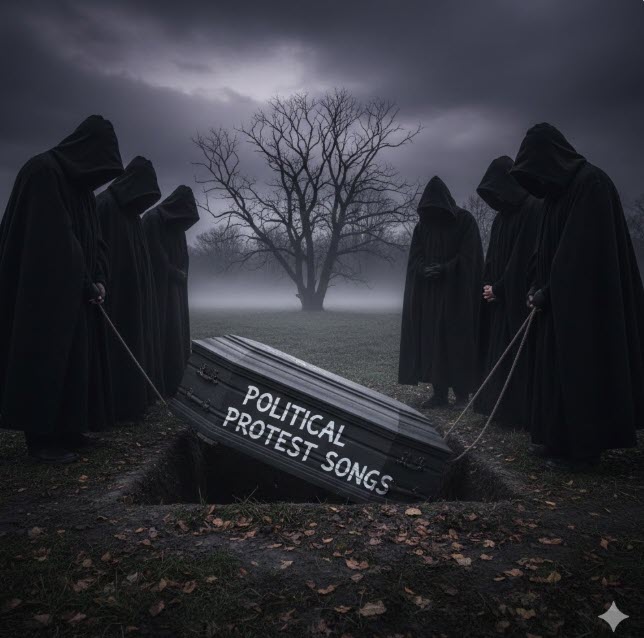
So, while video killed the radio star in the 1980s, changes in the music industry, commercialization, and the rise of social media may have killed the political protest song today — and that’s a fucking shame, because if there was ever a time for unifying the power of music against political corruption and maleficence, it’s today.
Here are some political protest songs’ that I’ve been working on (my lyrics, Suno’s music). Feel free to share or comment on them!
Donald Trump won’t be around forever (thank God) – but his impact will linger like a fart in a closet. Trump provides a blueprint for other candidates who might possess similar autocratic tendencies. This song is a “heads-up” about the barbarians who will gather at the gates of our democracy once Trump is dead and gone.
These lyrics are from a poem I wrote after the Charlie Kirk assassination. It’s about how dangerously divided America is and the potential for spiraling political violence that seems increasingly likely in the second Trump term.
I wrote the poem “Get a Load of Elon” after seeing the sickening footage of that smiling dirtbag laughing it up and swinging a chainsaw around like some fake-ass efficiency hero. Fuck that guy and everything he represents. I think Suno captured the tone I was looking for on this one.
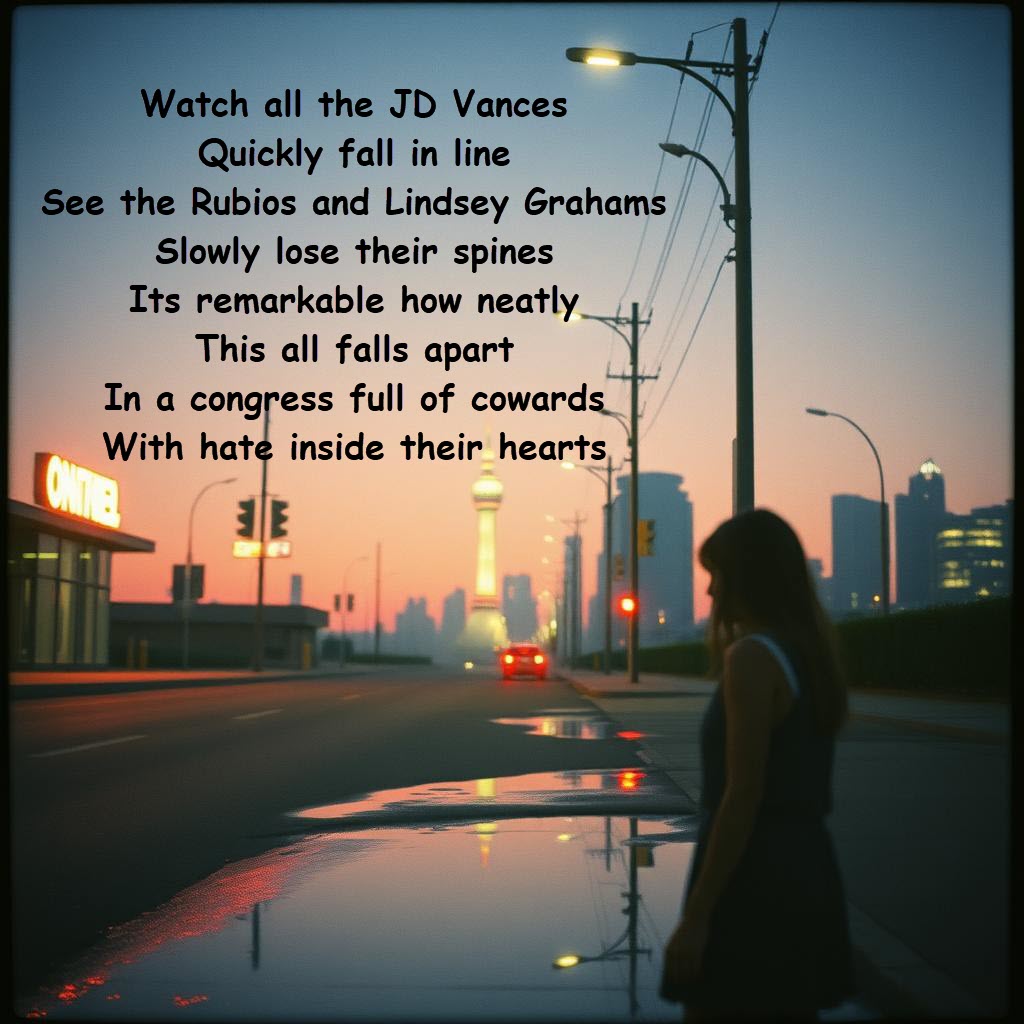
Donald Trump is my fat, ugly muse. There, I said it. Shame on everyone who voted for this criminal, and fuck all the cowards in Congress who are failing to stand up to this two-bit thug. And that’s all I have to say about this song.
I came up with these lyrics based on a poem I wrote in 2017 called “Resist”, which was about pushing back against Donald Trump and his policies, which I saw as an existential threat to America’s democracy. I added several new verses for the song and reworked the verse that would become the chorus. I can see the Dixie Chicks or Dolly Parton belting this out. I’m not a big fan of country or rockabilly music, but I think that musical style works well with the words here.
Suno and I, channeling our best Pat Benatar impression. I wrote the poem “Oligarchic Kings” recently and published it on my blog. I changed it quite a bit for the song version.
When I wrote this poem originally, I wrote it to the cadence of Supercalifragilisticexpialidocious from “Mary Poppins” and included it in my book “Imagine There’s No Donald” (available on Amazon😉 ). I asked Suno to create a power-pop song from the poem. It’s the only poem I used as is (not changing any of the words). It’s a campy/poppy version of a Disney classic.
My Paper, My Words is a collection of essays, stories, and poems that reflect the challenges of a middle-class husband and father trying to navigate a rapidly changing political, religious, and technological landscape of post-911 America.